Château de Conches-en-Ouche: A Medieval Fortified Castle in France


Site at a Glance
- Rating
- 4.4
- Popularity
- Low
- Country
- France
- Primary era
- Medieval
- Eras represented
- Medieval
- Civilizations
- Norman
- Site type
- Military
- Remains
- Castle
On this page8 sections
History
Château de Conches-en-Ouche is a former fortified castle in France, built by the Tosny family beginning around 1034. The Tosny lords were a medieval Norman aristocratic family who inherited the fief, whose name had earlier appeared in medieval forms derived from the Latin Castellio. The castle later became a contested stronghold in the struggles between the French, Navarrese, and English powers.
Foundation and royal expansion
Construction began under Roger I of Tosny. In 1199, Philip II of France, also known as Philip Augustus, captured the castle. Three years later, he granted it to his cousin Robert of Courtenay, a French nobleman. The fortress was subsequently enlarged, including the addition of towers flanking the outer enclosure.
Conches-en-Ouche later became a fief of Robert of Artois, a French prince and nobleman. Its position and fortifications continued to give it a military role during the political and dynastic conflicts of the Middle Ages.
War between France, Navarre, and England
During the Hundred Years’ War, the prolonged series of conflicts between the English and French crowns, Henry of Lancaster’s military campaign attacked the town in 1356, and the castle was burned. Under the Treaty of Mantes in 1354, John II of France had granted the town and fortress to Charles II of Navarre, together with the county of Beaumont-le-Roger, the viscounty of Pont-Audemer, and the Clos du Cotentin, a historic district of the Cotentin Peninsula.
Charles, known as Charles the Bad, entrusted Conches to Jean de Grailly, the captal of Buch, a Gascon noble title. Jean de Grailly placed it in the care of his uncle Archambaud. Bertrand du Guesclin, a leading French commander, besieged Conches in 1371 because Jean de Grailly had gone over to the English. An agreement signed on 4 February 1371 resulted in the evacuation of the town by the Navarrese. Because Conches surrendered before Charles V of France later seized the Navarrese king’s possessions, it escaped the destruction inflicted on other fortresses belonging to Charles II.
Henry V of England seized the castle in 1420. French forces retook Conches in 1440, but the English recovered it the following year. Robert de Floques, the bailiff of Évreux and a senior royal official in the district, finally expelled the English in 1449.
Later decline and preservation
Members of the Catholic League, a militant Catholic political and religious movement active during the Wars of Religion, took refuge in the castle in 1591. The fortress was dismantled in the sixteenth century because it remained a potential stronghold for enemies of the monarchy.
The ruins belong to the municipality. The donjon ruins have been protected as a monument historique since 12 July 1886, while the park of the old castle, including its entrance gate, has been a classified site since 1940. Volunteers from the association Chantiers Histoire et Architecture Médiévales restored the ruins between 2007 and 2016, including the ramparts and donjon.
Remains
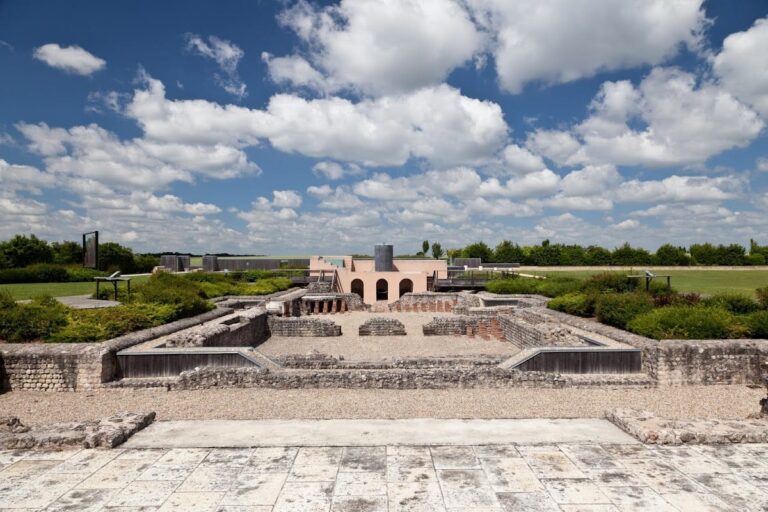
The surviving ruins stand in Conches-en-Ouche above the Rouloir valley and the town. The eleventh-century donjon occupies a raised earth mound at the centre of what was once the lower bailey, the enclosed area around the principal fortified tower. The castle’s walls were 2.60 metres thick, and the donjon had at least three storeys.
Fortified core and surrounding defences
The cylindrical donjon
The cylindrical donjon is enclosed by a close protective shell wall, or chemise. At each corner of this enclosure, very closely spaced, almost adjoining semicircular towers strengthened the defence. Roger VI of Tosny, another member of the Tosny family, built this arrangement around 1175. Its configuration anticipated the later defensive design associated with Château-Gaillard, a major medieval fortress in Normandy. The donjon and ramparts survive in ruined form and underwent restoration between 2007 and 2016.
The lower bailey and entrance
The lower bailey contained a parish enclosure with a church and probably a settlement. It was later converted into a public garden. The garden’s entrance is the surviving element of that transformation, enclosed among half-timbered houses. The donjon stands 150 metres southeast of the Church of Sainte-Foy, retaining its position within the former castle setting.