Castell de Jorba: A Medieval Romanesque Fortification in Spain


Site at a Glance
- Rating
- 4
- Popularity
- Very Low
- Country
- Spain
- Primary era
- Medieval
- External website
- Open
- Eras represented
- Medieval
- Civilizations
- Crown of Aragon
- Site type
- Military
- Remains
- Castle
On this page5 sections
History
Castell de Jorba is a medieval Romanesque fortification in Spain, overlooking Jorba from Guardia Hill in the Noya district of Barcelona. Its surviving and documented defensive elements probably date from the twelfth or thirteenth century, while the earliest known reference to the castle dates to 978. The fortress became the center of the Barony of Jorba, a territorial lordship governed by a baron or equivalent noble lord, and remained associated with the Jorba lineage.
The Jorba lineage and the Viscounty of Cardona
Guerau de Jorba was the first recorded lord of the castle. He served as an adviser to Ramon Berenguer IV, Count of Barcelona, and Alfonso I of Aragon and Pamplona. The barony appears in records from the twelfth century, and toward the end of that century the marriage of Gueraua de Jorba and Guillem de Cardona brought it into the Viscounty of Cardona, a territorial lordship governed by a viscount.
In the fourteenth century, control passed to the Castellolí family. In 1444, Manuel de Rajadell, the castellan of Òdena, purchased the castle. A castellan was an official responsible for administering and defending a castle, often on behalf of its lord.
War and changing ownership
During the Catalan Civil War of 1462 to 1472, a conflict between the Generalitat, Catalonia’s governing political institution, and forces supporting the monarchy, Castell de Jorba sided with the Generalitat. Royalist forces captured it in 1475.
The barony changed hands through marriages and inheritances in the following centuries. In the seventeenth century, it passed from the Rajadell family to the Ponts family through the marriage of Jerónima de Rajadell and Miquel de Ponts. It later belonged to the Salvá family, Marquises of Vilanant; the Pont-López de Mendoza family, Counts of Robres; the Abarca de Bolea family, Counts of Aranda; the Híjar family, Counts of Guimerà; and finally the industrial families Muntadas and Campeny.
Destruction and conservation
During the First Carlist War, a Spanish civil conflict fought from 1833 to 1840 between Carlist supporters and forces defending the established liberal constitutional order, the castle was being used as a barracks by liberal forces. An attack destroyed the fortress and its chapel. The Muntadas family purchased the ruins in 1890.
Castell de Jorba became a protected cultural monument in 1988. In January 2012, Jorba mayor Josep Maria Palau informed the government delegate that the ruins required consolidation, as erosion threatened to destroy the remaining fabric.
Remains
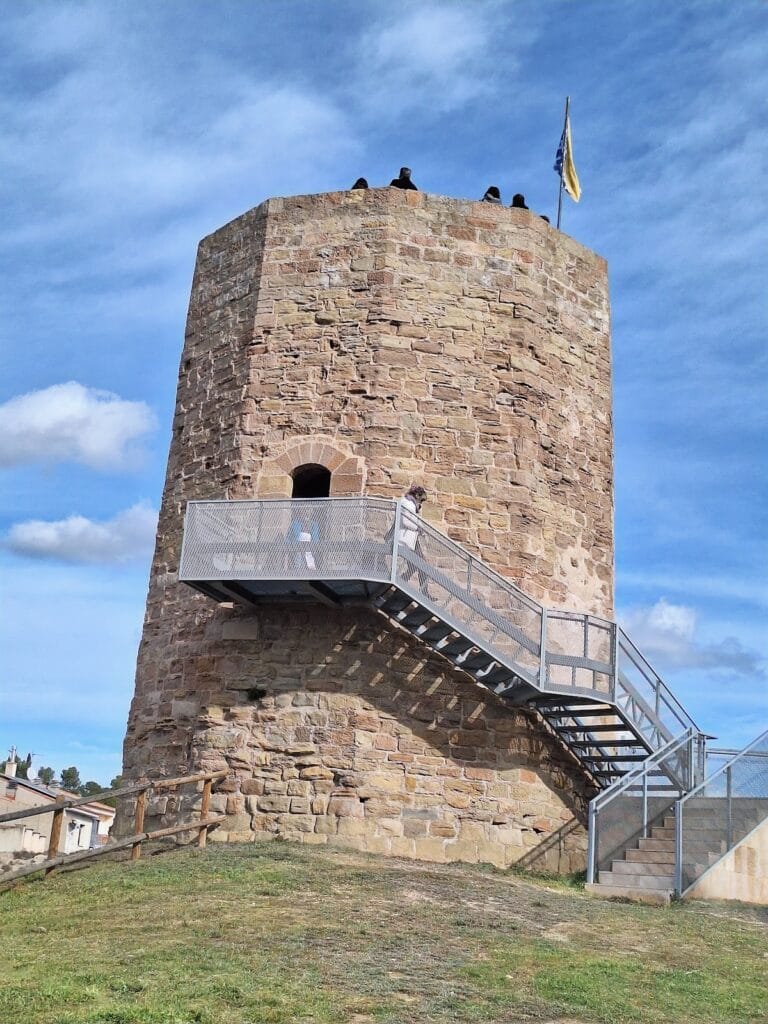
The ruined fortification occupies Guardia Hill at an elevation of 549 metres above the village of Jorba. Built in the medieval Romanesque style, which is characterized by substantial masonry, rounded arches, and heavy forms, the complex survives in poor condition. Its remaining layout is represented by a circular-plan tower, fragments of the perimeter walls, and other defensive remains, probably belonging to the twelfth or thirteenth century. These elements preserve part of the castle’s fortified enclosure and indicate the substantial masonry construction of the medieval stronghold.
Nearby sites