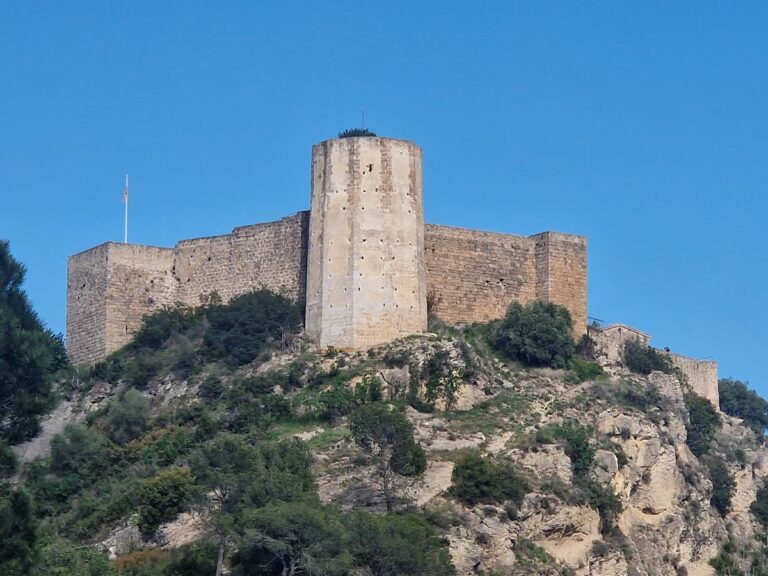
Montbui Castle: A Tenth-Century Frontier Fortress in Spain


Site at a Glance
- Rating
- 4.6
- Popularity
- Low
- Country
- Spain
- Primary era
- Medieval
- External website
- Open
- Eras represented
- Medieval
- Civilizations
- Unclassified
- Site type
- Military
- Remains
- Castle
On this page7 sections
History
Montbui Castle, also known as Castle of La Tossa, is a tenth-century fortress in Santa Margarida de Montbui, Spain. Built during the medieval organization of the frontier, it occupied a summit controlling the natural passage between the Miralles and Ancosa ranges and formed part of a network of castles protecting routes across the region.
Frontier settlement and episcopal rule
The castle was documented as an organized fortress by 936, when Ocelló, Saió, and Tous served as subordinate fortifications. The surrounding Noya sector belonged to the frontier zone of the Osona-Manresa county. Its settlement followed an aprisio, a medieval system in which land was occupied, cultivated, and defended under a ruler’s authority, attributed to Wifredo the Hairy, count of Barcelona. The earliest indications of this process are associated with the rule of Count Sunyer between 911 and 947.
In 970, Count Borrell II transferred Montbui Castle to Ató, bishop of Vich. Records from 972 and 993 state that Bishop Fruià established a new castle and church on the summit. A severe drought caused settlers to leave, and the church remained unfinished. In 1023, Bishop-Abbot Oliba granted the fortress as a fief to the levite Guillem d’Oló, also called Guillem de Mediona. A levite was a medieval clerical title generally associated with a deacon or another member of the lower clergy.
Guillem permanently resettled the territory and restored the castle. He either completed the existing church or constructed another one, and the building was serving parish purposes when Bishop Oliba consecrated it in 1035. Guillem died fighting the Saracens in 1034. The fortress continued under the superior lordship of the bishopric of Vich, meaning that ultimate ecclesiastical authority remained with the bishop even when another lord held the castle as a fief.
From castellans to the Barony of Montbui
The Montbui family had served as castellans, the officials responsible for administering and defending the castle, since 1139. Later bishops granted the castle to the viscounts of Cardona without removing the Montbui castellans. Disputes among the bishops of Vich, the Cardona family, and the Montbui family led Bishop Berenguer de Guardia to sell the castle’s direct lordship to James II of Aragon, known as the Just. The agreement required the territory to remain permanently attached to the Crown.
In 1322, James II nevertheless sold the direct lordship to the Cardona family, together with Ocelló, Òdena, and Espelt. These territories became the core of the Barony of Òdena around the royal town of Igualada. In 1399, the somatén of Igualada, a local armed levy used for defense, policing, or military action, attacked Montbui territory because people accused of crimes in Igualada had taken refuge there. The Count of Cardona responded by prohibiting his vassals from trading in Igualada.
During the later fifteenth century, the Cardona family sold the territory to the Montbui family, who became barons of Montbui. By the middle of the sixteenth century, the barony had passed to Lanuza of the Plasencia comital house. Lanuza’s successors retained the site until hereditary seigneurial lordships, domains governed by hereditary lords rather than directly by the Crown, were abolished in the nineteenth century.
Religious change and modern conservation
In 1614, the village church became a parish, while Santa Maria served as a subordinate church. In 1828, Santa Maria was converted into a sanctuary. Wars during the nineteenth and twentieth centuries damaged the castle and its associated church. The Patronato de la Tossa was established in 1954 and, with collaboration from the Barcelona Provincial Council, rehabilitated the sanctuary and castle, arranged a room for exhibitions and public events, and created a small museum.
Montbui Castle was declared a monument on 8 November 1988 and is recorded as a protected cultural property.
Remains
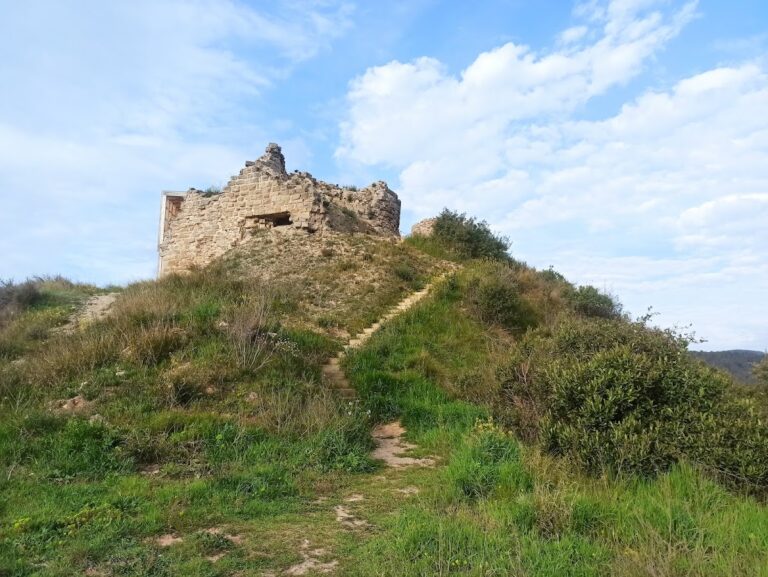
Montbui Castle stands on the summit of Tossa de Montbui, a few metres from Santa Maria de la Tossa. The surviving fortress has a rectangular plan with rounded corners. Its walls are about two metres thick and were built mainly from small, roughly dressed stones set in lime mortar. The summit overlooks the Òdena basin and the surrounding mountains, while its position explains the castle’s role in controlling the passage between the Miralles and Ancosa ranges.
Walls and masonry
Several courses of the walls use opus spicatum, masonry laid in alternating diagonal lines to create a herringbone pattern. More regular courses in the upper sections belong to an enlargement carried out in the eleventh century. The visible fabric therefore preserves evidence of both the tenth-century fortress and its subsequent expansion.
Interior and entrances
Restorations have altered the interior, which is arranged around a ground floor divided into a vestibule and a room covered by a semicircular vault with a central opening. The level immediately above is enclosed by walls, with holes that probably held the beams of wooden ceilings. The original entrance was raised to first-floor level and operated like a window. Access is now through a doorway opened at the same height, beside a smaller doorway. Both entrances are on the eastern side, and windows across the facades end in semicircular arches.