Castell de Tous: A Fortified Residential Manor in Spain


Site at a Glance
- Rating
- 4.3
- Popularity
- Low
- Country
- Spain
- Primary era
- Medieval
- Eras represented
- Medieval
- Civilizations
- Crown of Aragon
- Site type
- Domestic
- Remains
- Castle
On this page8 sections
History
Castell de Tous, formally Castell de Sant Martí de Tous, is a fortified residential manor in Spain, first recorded in 960 during the repopulation of the Anoia valley. Tradition attributes the conquest of Tous in 880 to Guifré el Pelós, a ninth-century count associated with the formation of the Catalan counties. In 960, Borrell II, Count of Barcelona and Osona, granted the castle to the See of Vic, the bishopric that exercised superior lordship over Tous for much of the medieval period.
Ecclesiastical lordship and medieval disputes
Borrell II had received the territory through the aprisió of his parents, a frontier process in which land was occupied, cultivated, and claimed as part of repopulation. The castle formed part of the territory of Castell de Montbui, and Pope Benedict VII confirmed its transfer to the See of Vic in 978.
During the eleventh century, the bishopric retained superior authority over Tous. Between 1017 and 1046, Bishop Oliba granted the fortresses of Tous, Montbui, and Ocelló to Guillem d’Oló, also known as Guillem de Mediona. Tous was then entrusted to Bernat de Tous, a castellan, the official who held and administered a castle for its superior lord.
The boundaries of the castle’s territory became the subject of repeated disputes. A judgment in 1018 defined the extent of Tous and the neighboring territory of La Roqueta, held by Hug de Cervelló, uncle of Bernat Sendred de Gurb-Queralt. Another ruling, issued in 1027, favored Bishop Oliba. In 1032, Guillem d’Oló made his testament before leaving to fight the Saracens and entrusted Tous to Ramon, son of Bernat de Tous. Ramon’s son and successor, Pere Ramon de Tous, held direct lordship over the district between 1079 and 1095.
The Tous family and royal transfer
In the early twelfth century, Pere de Tous, son of Pere Ramon de Tous, swore allegiance to Ramon Gaufred, Bishop of Vic from 1109 to 1146. A Ramon de Tous held the castellan’s office in 1172 and reached an agreement over the castle’s fief with Ramon de Xetmar, Bishop of Vic, in 1188. The Tous family continued as castellans throughout the thirteenth century, repeatedly paying homage to the bishopric.
This arrangement changed in 1318, when the bishop ceded Tous, together with Cucalla, Montbui, and Ocelló, to James II, king of the Crown of Aragon. The Tous family nevertheless retained control of the castle. In 1347, Bernat de Tous purchased full jurisdiction for 12,000 sous. His successors pawned the castle to Prince Joan I in 1386, but the family’s supremacy ended in 1423, when the property was sold to Ponç de Perellós.
From noble estate to private ownership
Ownership passed to the Saplana family in 1441. In 1505, Isabel Saplana donated the castle to the Hieronymite monastery of Sant Jeroni de la Murtra in Badalona. The Hieronymites, a Catholic monastic order associated with the religious life of Saint Jerome, held complete civil, military, and economic jurisdiction over the estate until the confiscations of 1835.
Those confiscations formed part of Spain’s nineteenth-century disentailment process, through which substantial ecclesiastical properties were seized and sold. The castle and its possessions, including 249 jornals of farmland and two flour mills, were publicly auctioned and passed through several private owners. The Rojas family of Igualada became the final owners named in the property’s history when they bought it in 1918.
A nineteenth-century description attributed to Madoz states that the castle possessed a tower dating from the period of Muslim rule and that Carlist forces burned and partly destroyed it in 1838. The Carlists supported the traditionalist branch of the Spanish Bourbon succession, and their conflicts produced repeated civil wars and military actions during the nineteenth century. Castell de Tous is now protected as a Cultural Asset of National Interest and listed as a historic monument in the Catalan and Spanish heritage registers under references 1502-MH, RI-51-0005656, and IPA 1698.
Remains
Hilltop fortress and surviving fabric
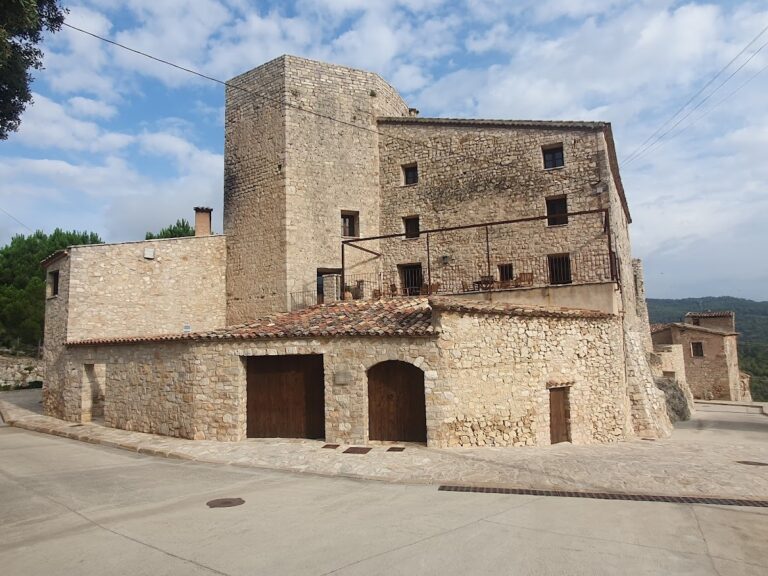
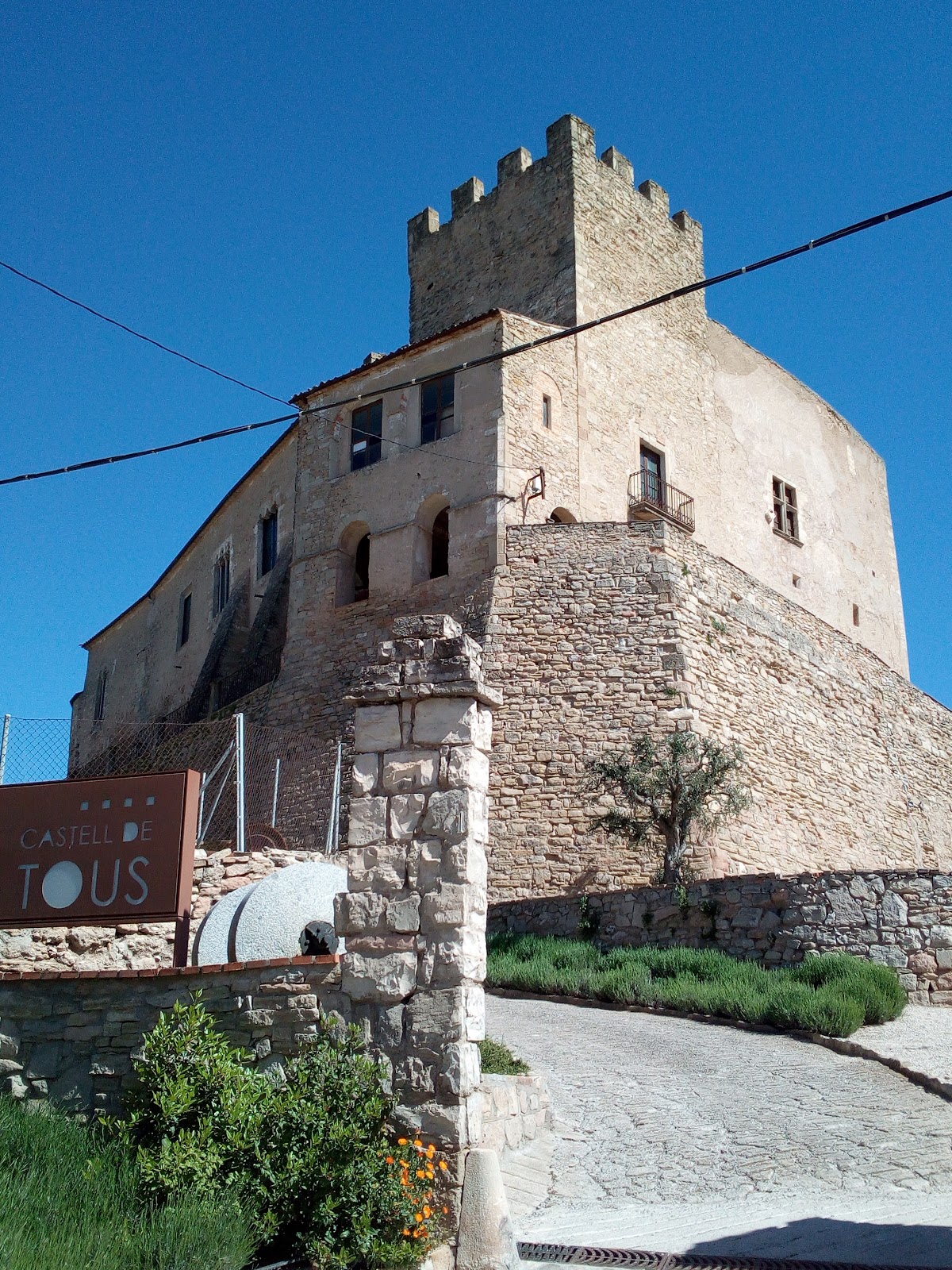
The castle is a large fortified residential manor on a hilltop above the left side of the Tous stream, at a listed elevation of approximately 455 to 490 metres. It is built principally of stone and mortar, and its existing structure is mainly Gothic, with numerous later changes and an extensive modern restoration. The reconstruction involved limited archaeological consideration, but the foundations appear to follow those of the original castle. The surviving fabric still conveys its former fortress character.
Tower and masonry
A crenellated tower remains visible as part of the restored building. Its proposed connection with the period of Muslim rule comes from the nineteenth-century description attributed to Madoz and is not certain. Areas of opus spicatum, masonry laid in a herringbone pattern, survive in the ground-floor walls and probably belong to the original building. These sections preserve evidence of an earlier phase beneath the later Gothic form.
Windows and interior structure
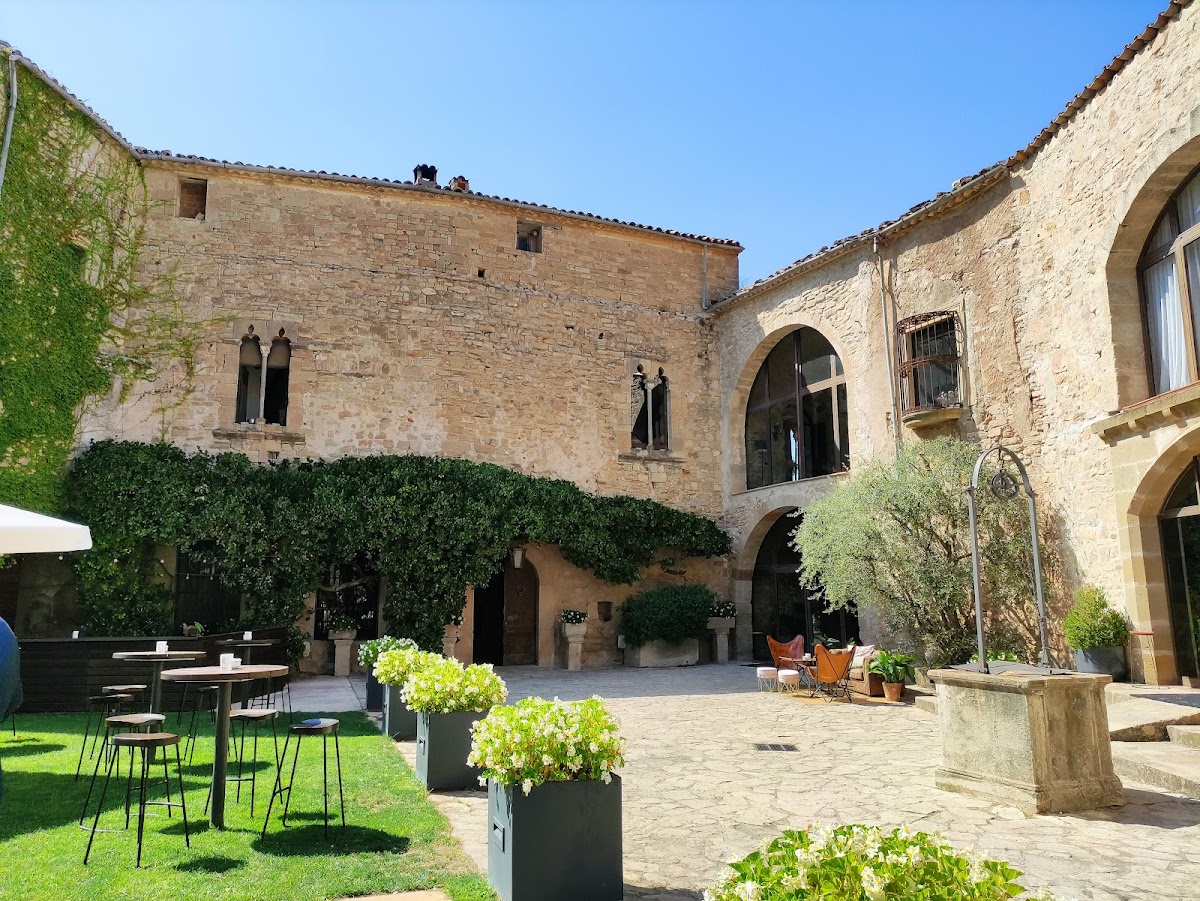
The windows include tall, narrow mullioned openings, with slender stone columns supporting semicircular arches. Some openings have trilobed arches and festejadors, built-in window seats. Diaphragm arches, transverse arches that divide or support the bays of a room, survive in several rooms. Together with the masonry and tower, these elements show how the present residential building retains features derived from its fortified medieval structure.