Castell de Sant Gervàs: A Medieval Frontier Castle in Catalonia


Site at a Glance
- Rating
- 4.3
- Popularity
- Very Low
- Country
- Spain
- Primary era
- Medieval
- External website
- Open
- Eras represented
- Medieval
- Civilizations
- Unclassified
- Site type
- Military
- Remains
- Castle
On this page8 sections
History
Castell de Sant Gervàs is a medieval castle in Spain at Sant Miquel de la Vall, now within Gavet de la Conca in Pallars Jussà. Its creation dates to the tenth century, while the archaeological castle belongs to the eleventh century, when a settlement grew around it. The castle and village occupied a strategic position for controlling routes into and out of the comarca, in a frontier landscape where the Montsec de Rúbies range separated the Christian territories from Muslim lands around Lleida until the middle of the eleventh century.
Frontier settlement and changing power
The settlement developed during the eleventh and twelfth centuries within the former territory of Aransís. Its strategic importance declined after Arnau Mir de Tost, a prominent eleventh-century Catalan nobleman involved in the Christian conquest and consolidation of territories around the Àger valley, reconquered the Àger valley and pushed the frontier southward. Later feudal conflicts shifted the main danger away from Sant Miquel, although a watchtower continued to stand on the ridge crest.
Castell de Sant Gervàs and its village traditionally belonged to the priory of Meià, a religious institution that controlled them before the fourteenth century. From the beginning of that century, the Llordà family and the counts of Pallars disputed regional supremacy with the priory. Their grievances continued until 1319, when Bord de Pallars purchased the castle and village from the priory for 6,000 Jaquesan sous, medieval monetary units associated with the Crown of Aragon. At that time, only five families and the parish priest lived there.
Decline and abandonment
Plague-related depopulation contributed to the settlement’s decline. In 1399, troops commanded by the Count of Foix and the Viscount of Castellbò violently attacked the Barcedana valley, damaging both the settlement and the church of Santa Maria. This destruction probably helped bring about the village’s final abandonment, and no fifteenth-century materials have been found at the site.
Archaeological excavations took place between 1978 and 1980 under teams directed by the Department of Medieval History of the University of Barcelona. The site is listed in the Archaeological and Palaeontological Heritage Inventory of Catalonia and is protected as a Cultural Asset of National Interest and historic monument under reference RI-51-0006333. This designation dates from 8 November 1988.
Remains
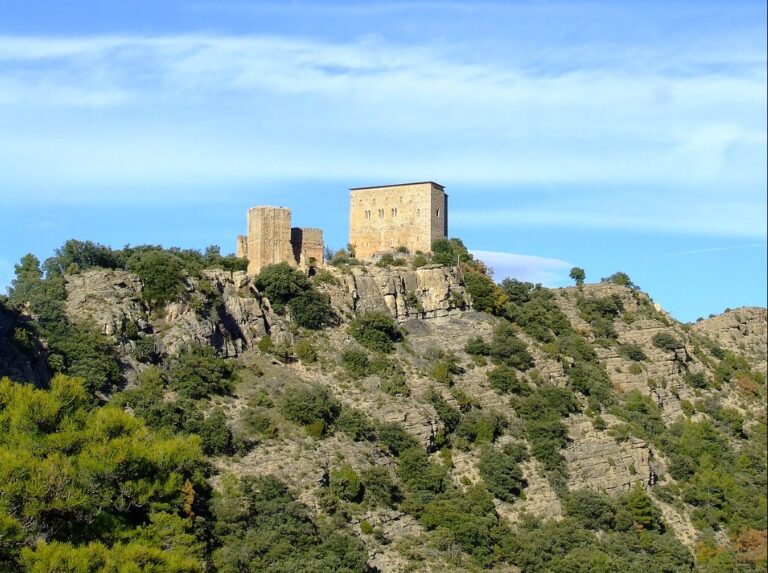
The archaeological site occupies a platform at an altitude of 998 metres near the Noguera Pallaresa and its tributary, the Barcedana, north of the Montsec de Rúbies massif. The castle stands at the eastern end of the platform, while the abandoned village extends across the central and western areas. Together, the remains preserve the relationship between a fortified enclosure and the settlement it protected.
Fortified enclosure and settlement
Castle walls and towers
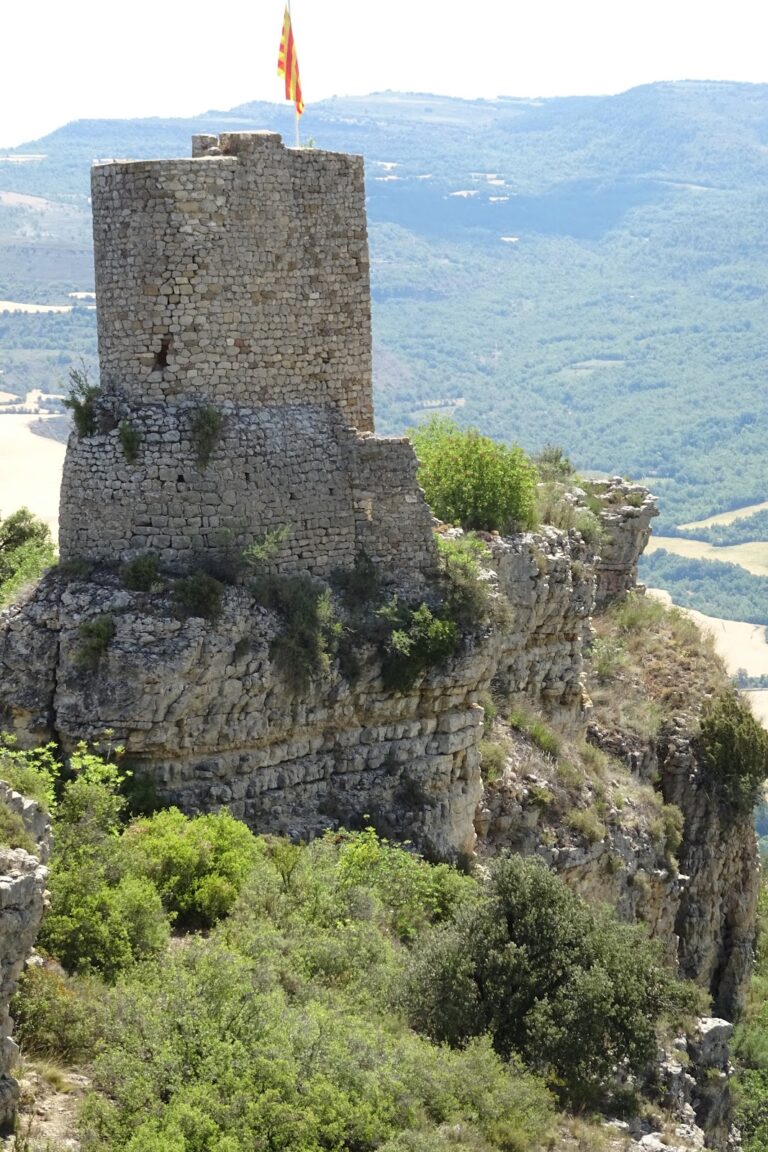
The castle covers 1,269 square metres and has a plan compared with that of Castell de Mur. Sections of its walls survive at different heights, built from carefully squared stones arranged in regular courses. The eastern wall contains a central main tower, or keep, the principal fortified tower of a medieval castle, together with three projecting towers. Well-worked stone bonded with lime-and-sand mortar formed the castle’s construction.
Village layout and houses
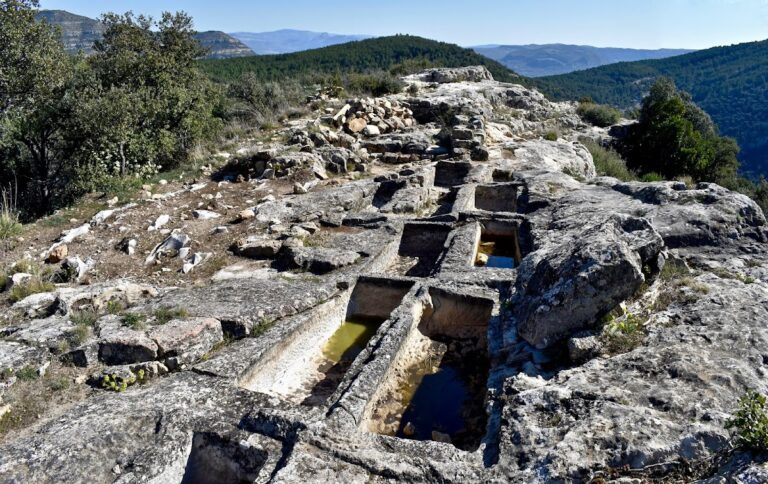
A defensive wall enclosed the village, which covered approximately 8,158.57 square metres and measured about 130 metres from end to end and 70 metres across. The surviving remains consist mainly of house foundations and the lowest wall courses, but excavation has revealed part of the settlement’s arrangement, including a square, streets, and several rectangular houses. These dwellings generally contained two or three chambers, and the settlement probably held about twenty houses or households. One identified dwelling is known as the rectoral house.
Santa Maria del Castelló Sobirà
At the extremity of the site are the remains of the Romanesque church of Santa Maria del Castelló Sobirà. The church was damaged during the 1399 attack on the Barcedana valley, the same assault that affected the settlement. Its surviving remains form part of the archaeological complex alongside the castle and village.