Kasuga-taisha: Shinto Shrine of the Fujiwara Family


Site at a Glance
- Rating
- 4.5
- Popularity
- High
- Country
- Japan
- Primary era
- Early Modern
- External website
- Open
- Eras represented
- Early Modern
- Civilizations
- Tokugawa
- Site type
- Religious
- Remains
- Sanctuary
On this page22 sections
History
Kasuga-taisha is a Shinto shrine in Nara, Japan, founded in 768 as the tutelary shrine of the Fujiwara family and as a protector of Heijo-kyo, the Nara capital, and its people. Fujiwara no Nagate is traditionally credited with establishing the shrine by enshrining Takemikazuchi from Kashima, Futsunushi from Katori, and Ame-no-Koyane and Himegami, who had previously been worshipped at Hiraoka Shrine, in four sanctuaries at the foot of Mount Mikasa.
Origins and Fujiwara patronage
Another tradition places the shrine’s beginnings in 710, when Fujiwara no Fuhito transferred the Fujiwara clan deity Takemikazuchi from Kashima to Mount Mikasa. Excavations within the precincts have also raised the possibility that rituals took place there before the formal foundation of 768. Takemikazuchi was traditionally believed to have arrived from Kashima riding a white deer and to have settled on Mount Mikasa to protect Nara. Deer consequently became sacred messengers of the shrine’s kami, or sacred beings, and an enduring symbol of Kasuga-taisha.
The shrine prospered alongside the Fujiwara family. Court-sponsored rites were being held by the early Heian period, which lasted from 794 to 1185, and the Kasuga Festival became one of the Three Imperial Festivals, alongside the festivals of Kamo Shrine and Iwashimizu Hachimangu. Takemikazuchi and Futsunushi received the highest divine rank in 850, followed by Ame-no-Koyane in 940.
The tenth-century Engishiki Jinmyocho, a register of officially recognized Shinto shrines, listed the four Kasuga deities of Soegami District in Yamato Province. Kasuga-taisha was classified as a major shrine entitled to receive offerings for monthly and harvest rites. During the Kasuga Festival, an imperial envoy from the Fujiwara family entered through the Wisteria Torii, a gate also mentioned in a poem by Emperor Go-Daigo.
Kasuga and Kofuku-ji
Kasuga-taisha developed a close religious and institutional relationship with Kofuku-ji, the Buddhist temple associated with the Fujiwara family. In 813, Kofuku-ji’s Southern Octagonal Hall was linked with Fukukenjaku Kannon, regarded as the Buddhist counterpart of Takemikazuchi. Buddhist sutra recitation before the shrine began in 947, initially performed by monks from both Kofuku-ji and Todaiji, the major Buddhist temples of Nara.
By the late Heian period, Kasuga-taisha and Kofuku-ji were treated as a unified religious and political institution known as Kasuga-Kofuku-ji. From the late eleventh century, Kofuku-ji monks petitioned the court in processions carrying a sacred tree believed to embody the shrine’s divine presence. The monks could conduct rites before the shrine but could not enter the inner precinct containing the main sanctuary.
Medieval honji suijaku, a theory that understood kami and Buddhist divinities as corresponding manifestations, shaped worship at Kasuga. Takemikazuchi was identified with Fukukenjaku Kannon, Futsunushi with Yakushi Nyorai, Ame-no-Koyane with Jizo Bosatsu, and Himegami with Juichimen Kannon. Under the influence of the teachings of Jokei, Takemikazuchi’s Buddhist counterpart was later reinterpreted as Shaka Nyorai. Together, the shrine’s kami formed Kasuga Daimyojin, a composite divine presence used for worship.
Two five-story pagodas surrounded by cloisters were erected in connection with Kofuku-ji. Fujiwara no Tadazane sponsored the West Pagoda in 1116, while Emperor Toba sponsored the East Pagoda in 1140. The East Pagoda was rebuilt in 1217, and the West Pagoda was rebuilt around 1247 to 1249.
Warfare and medieval expansion
In 1181, Taira no Shigehira attacked Nara during a conflict that devastated Kofuku-ji and Todaiji. Kasuga-taisha’s two pagodas burned, as did the associated Isagawa Shrine, while the shrine’s principal area narrowly escaped destruction. Both pagodas burned again in 1411 and were not rebuilt thereafter.
Kasuga worship spread beyond the aristocracy to warriors and townspeople. Their offerings of lanterns made the shrine a major center for lantern donations. During the Kamakura period, which lasted from 1185 to 1333, and the Muromachi period, Kofuku-ji administered Yamato Province in place of a formally appointed military governor. It controlled local warrior groups and extensive estates, while Kasuga-taisha shared in the income connected with this religious and political system.
Revenues declined sharply during the Sengoku period as regional warlords appropriated the estates. By 1580, the shrine had only 1,400 koku of assessed revenue, a measure of the productive capacity of land. After Toyotomi Hideyoshi unified Japan, Kasuga-taisha received 3,206 koku of land in 1595 in several settlements of Soegami District, including 1,554 koku belonging to shrine families. In 1617, the Tokugawa government recognized combined revenue of 21,119 koku for Kofuku-ji and Kasuga-taisha.
The Tokugawa government permanently endowed 300 koku in 1662 for Kofuku-ji’s Takigi Noh and 200 koku for Kasuga’s On-matsuri Noh. These endowments supported performance traditions connected with the two institutions. Festivals at Kasuga also preserved court-derived music and dance, kagura, Yamato-mai, processions, sacred-horse rites, and ceremonies intended to avert misfortune or illness and encourage renewal.
Separation of Shinto and Buddhism
The 1868 policy separating Shinto and Buddhism ended the institutional unity of Kasuga-taisha and Kofuku-ji. Buddhist buildings within the shrine were renamed, reused, or demolished, and Buddhist statues and ritual implements were removed. Kofuku-ji lost most of its precinct to Nara Park but was permitted to survive. Several smaller shrine institutions connected with former Kofuku-ji buildings were transferred or reorganized during this period.
In 1871, the shrine was renamed Kasuga Jinja and designated a Kanpei-taisha, a shrine in the former state-supported system of officially ranked Shinto shrines. That ranking system was abolished in 1946. The name Kasuga-taisha was adopted to distinguish the shrine from the many other Kasuga shrines, and in 1948 it became a Beppyo shrine, one specially listed by the Association of Shinto Shrines.
Kasuga-taisha and the adjacent Kasugayama Primeval Forest were inscribed in 1998 as components of the UNESCO World Heritage property Historic Monuments of Ancient Nara. The shrine is also the head shrine of approximately 3,000 Kasuga shrines throughout Japan. Its continuing religious life includes more than 2,200 ritual observances each day. Buddhist sutra recitation before the kami also continues ceremonially during the annual New Year visit of the Kofuku-ji abbot.
Renewal and continuing worship
The shrine maintains the Shikinen Zotai tradition, a periodic rebuilding or repair carried out according to established specifications. The principal sanctuaries are renewed without changing their locations, while sacred treasures are renewed approximately every twenty years. This practice expresses the Shinto idea of tokowaka, in which renewal preserves sacred vitality and dignity. The sixtieth cycle took place from 2015 to 2016.
Wakamiya Shrine was established in 1135 for Ame-no-Oshikumone, regarded as the divine descendant of Ame-no-Koyane and Himegami. Its worship developed around avenging deities and the dead, and it became the setting of the Kasuga Wakamiya Festival. Other major observances include the Kasuga Festival on 13 March, Setsubun Mantoro on 3 February, Chugen Mantoro on 14 and 15 August, and the Kasuga Wakamiya Festival from 15 to 18 December.
Remains
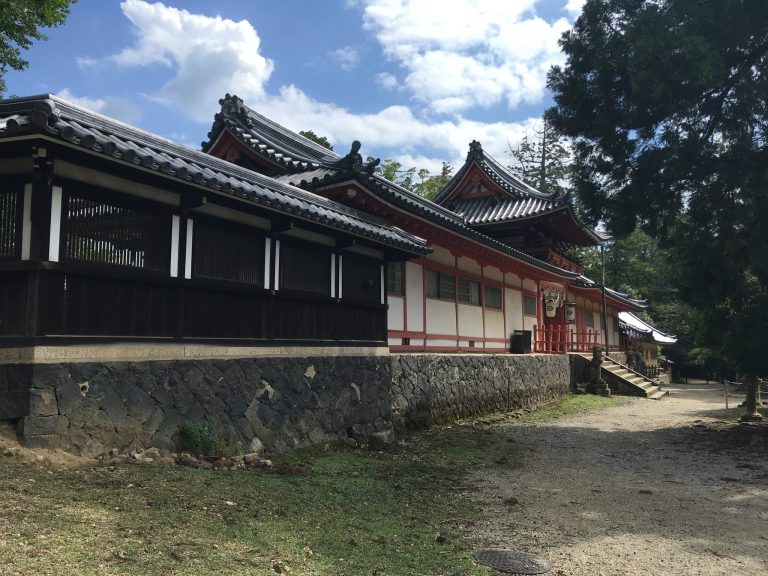
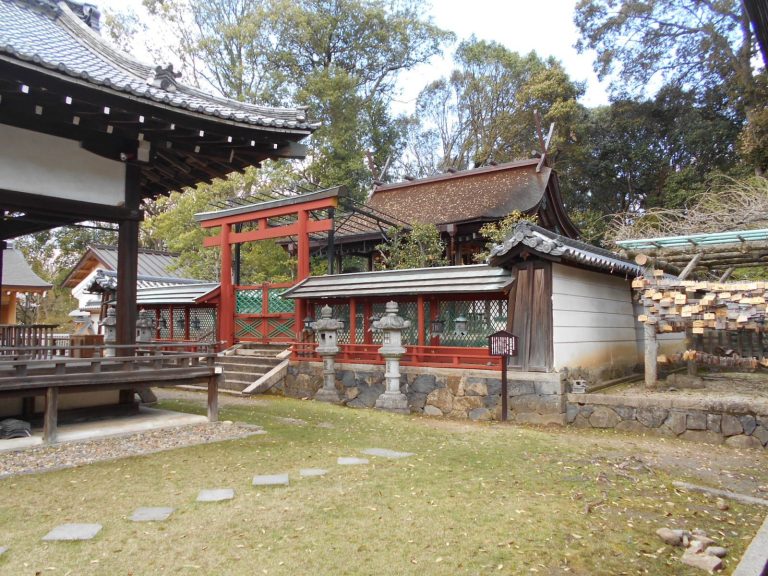
Kasuga-taisha occupies a wooded sacred landscape at the foot and on the slopes of Mount Mikasa. The approach passes through a park where sika deer roam freely under a traditional prohibition against harming them. The complex is enclosed by four cloisters and includes the main sanctuary, a treasure house, halls, and large gates. Its buildings are repeatedly renewed, but their locations, forms, and construction techniques preserve older traditions. The shrine’s principal architectural language is Kasuga-zukuri, a style named after its main sanctuary.
Main sanctuary and precinct
Four principal sanctuaries
The main sanctuary consists of four separate halls, each assigned to one of the principal kami. The first houses Takemikazuchi, the second Futsunushi, the third Ame-no-Koyane, and the fourth Himegami. Each hall follows the Kasuga-zukuri style, with a rectangular form, a steeply sloping gabled roof, decorative katsuogi, or roof logs, and a forked chigi, a roof finial. The present buildings do not survive unchanged from the eighth century, but the repeated renewal of the sanctuaries preserves their established locations and forms.
Gates, cloisters, and lanterns
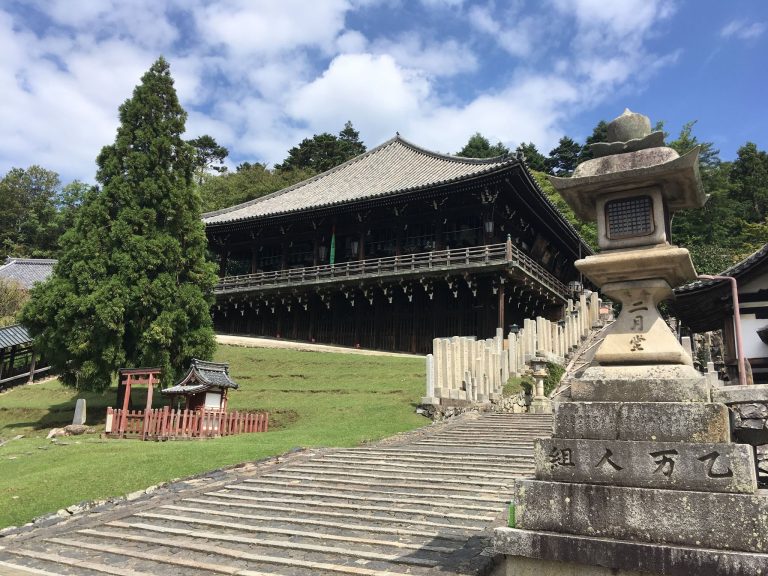
The complex’s large gates and cloisters organize the principal sacred area. Its principal torii, a gate marking the entrance to sacred space, is regarded as one of the oldest torii in Japan and influenced later torii design. More than 3,000 lanterns are associated with the shrine, including approximately 2,000 stone lanterns and 1,000 hanging lanterns. They line the approach, occupy parts of the cloisters, and are housed in Fujinami-no-ya Hall. During Setsubun Mantoro and Chugen Mantoro, the lanterns are lit together.
Wisteria and sacred deer
Kasuga-taisha is known for bronze lanterns and wisteria. The old wisteria called Sunazuri-no-Fuji is said to be more than 700 years old. At full bloom, its flowering branches extend a meter or more toward the ground. The sika deer associated with the shrine’s kami and surrounding mountains appear in Nanboku-cho-period paintings and other artistic works, preserving the connection between the shrine’s sacred landscape and its religious traditions.
Treasures and surviving objects
Treasure house collections
The treasure house contains hundreds of national treasures and many other cultural properties, most dating from the Heian period. Objects associated with the shrine include Heian-period arrows fitted with crystal whistles, bronze mirrors from the Heian and Nanboku-cho periods, and decorated taiko drums used in Kamakura-period gagaku, the music of the imperial court.
Recovered swords and lanterns
Twelve swords found in 1939 in the ceiling space of a treasure storehouse began to be successively polished in 2016. The work showed that several were of national-treasure or important-cultural-property quality. They included a sword made by Enju Kuniyoshi, two unsigned late-Heian or early-Kamakura swords regarded as Old Bizen works and possibly connected with an offering by Hojo Tokimura, and a black-lacquered, yamagane-forged sword identified as a late-Heian Old Hoki work and possibly one of the earliest curved Japanese swords by Yasutsuna.
The Kasuga-taisha Treasure House and the Kasuga National Treasure Hall preserve and display selected shrine treasures. A Kamakura-period blue-glass hanging lantern, formerly part of the main sanctuary’s furnishings, has a fire chamber covered with linked glass beads.
Wakamiya and auxiliary shrines
Wakamiya Shrine
Wakamiya Shrine includes a main sanctuary rebuilt in 1863 and a worship hall rebuilt in the same year. Its kagura hall, rebuilt in 1605, is divided into a northern three-bay section, a central bay, and a southern six-bay section. An ablution building rebuilt in 1632 and 1633 is now used as an office and contains Meoto Daikoku Shrine.
Associated sanctuaries
Meoto Daikoku Shrine is described as the only shrine in Japan dedicated to Okuninushi and his consort together. Motomiya Shrine stands on the summit of Mount Mikasa, at the place where Takemikazuchi is traditionally said to have first been enshrined. Enomoto Shrine is associated with the local land deity, while Mizutani Shrine retains a rock altar beneath its sanctuary and was formerly associated with the Buddhist-era deity Gozu Tenno.
Kii Shrine, formerly called Konomi Shrine and also known as the Inner Sanctuary, has a main sanctuary and worship hall dedicated to Itsutakeru, Oyatsuhime, and Tsumatsuhime. Other auxiliary shrines within the precincts honor wind deities, agricultural and rice deities, mountain and metal deities, the three Sumiyoshi deities, and other kami. Munakata Shrine, formerly the Benzaiten Shrine, is traditionally associated with the transfer of the deity of Tenkawa Benzaiten by Kukai. A purification shrine stands beside the Second Torii.
Transferred Kofuku-ji institutions
Several auxiliary shrines preserve links with former Kofuku-ji institutions. Sogu Shrine was first built beside Kofuku-ji’s Five-Story Pagoda in 726 and moved to its present location in 1875, where Kofuku-ji’s former retreat building had stood. The guardian shrine associated with the Southern Octagonal Hall was likewise founded beside that hall and moved in 1875. Other shrines originated in the former Kofuku-ji subtemple of Shion-in, while a shrine once connected with Kofuku-ji’s Three-Story Pagoda is also believed to have been transferred to Kasuga.
Outlying sacred landscape
Mount Kasuga shrines
Several outlying auxiliary shrines stand on Mount Kasuga. Narai Shrine is beside Dragon King Pond, a water source said not to dry even during drought. Other mountain shrines are associated with Kasuga’s four principal deities, Wakamiya, Mizutani, Sarutahiko, and purification. A shrine beside Sarusawa Pond is dedicated to a court lady deity, and an Inari shrine was moved in 1948 to the side of the lodging hall at Mochiidonocho.
Shion-in remains
Part of the former Shion-in complex survives beside the present Kasugano International Forum site. Foundation stones from its former thirteen-story pagoda remain in the southern part of the forum garden. The shrine associated with the pagoda’s guardian deity is now within Kasuga-taisha, linking the surviving physical remains with the shrine’s former Kofuku-ji connections.
Forest and botanical garden
Kasugayama Primeval Forest covers approximately 250 hectares around Mount Kasuga, whose summit reaches 498 meters. It contains 175 tree species, 60 bird species, and 1,180 insect species. Hunting and logging have been prohibited there since 841, preserving the forest beside the shrine’s buildings in a form described as nearly unchanged since the Nara period.
The adjacent Man’yo Botanical Garden, established in 1932, contains more than 300 varieties of plants mentioned in the Man’yoshu, an ancient Japanese poetry anthology. Each plant is identified with a sign giving the poem in which it appears.