Mikumano Shrine: A Shinto Shrine and Festival Heritage Site in Japan


Site at a Glance
- Rating
- 4.3
- Popularity
- Low
- Country
- Japan
- Primary era
- Early Modern
- External website
- Open
- Eras represented
- Early Modern
- Civilizations
- Tokugawa
- Site type
- Religious
- Remains
- Sanctuary
On this page12 sections
History
Mikumano Shrine is a Shinto shrine in Kakegawa, Japan, founded in 701 during the reign of Emperor Monmu. Its principal sanctuary, rebuilt in 1854 in the nagare-zukuri flowing-roof style, belongs to a long religious tradition connected with the Kumano shrines. The shrine historically held the rank of prefectural shrine, an administrative classification rather than a theological status.
Foundation and Kumano Worship
The shrine’s foundation tradition links its creation with Empress Fujiwara no Miyako. She vowed to establish three shrines in eastern Japan if she safely gave birth to a prince. After the birth, Mikumano Shrine was founded as an expression of gratitude for divine protection. The story places the shrine’s beginnings within the reign of Emperor Monmu, who ruled from 697 to 707.
Worship at the site was transferred from Kumano Hongu Taisha, one of the three major pilgrimage shrines of the Kumano region on the Kii Peninsula. The imperial court granted the Kasahara Estate as shrine territory. Together with Takamatsu Shrine in Omaezaki and Ogasa Shrine in Kakegawa, both founded at the same time, Mikumano Shrine became known as one of the Three Kumano Shrines of Enshu, the historical name for western Shizuoka.
The shrine attracted local devotion as Kumano religious practices spread through the surrounding area. In 1335, the military leader Nitta Yoshisada visited to pray for victory and dedicated a bell associated with the military leader Kusunoki Masashige. This episode connects the shrine with the political and military conflicts of the fourteenth-century Kenmu Restoration period.
The Shrine and Yokosuka
Local ties became especially strong after Tokugawa Ieyasu built Yokosuka Castle in 1578. The successive lords of the castle and their retainers revered Mikumano Shrine, which also became a major focus of worship for the castle town and nearby villages. Its religious role therefore extended beyond the precincts into the wider community shaped by the castle.
A festival was being held by about the 1690s, with parishioners’ dancing as its central feature. Around 1720, Nishio Tadanaka, lord of Yokosuka Domain, introduced float processions and related customs after seeing the Kanda and Sanno festivals while carrying out official duties in Edo. His retainers learned festival music there and brought it back to Yokosuka, where it developed into the Three-Shrine Festival Music tradition.
Modern Recognition and Religious Continuity
The annual Enshu Yokosuka Mikumano Shrine Grand Festival combines a mikoshi, or portable shrine, procession with the movement of two-wheeled floats known as neri. Its older rites include the Ground-Settling Dance and rice-field play. Another ceremony, the Child-Embracing Rite, carries a child effigy called Onenneko-sama in the procession as worshippers pray for conception and safe childbirth.
The Three-Shrine Festival Music received designation as Shizuoka Prefecture’s first intangible folk cultural property in 1955. The Ground-Settling Dance and rice-field play were given prefectural designation in 1989. In 2019, the neri procession was selected as an intangible folk cultural property for which measures should be taken to document it.
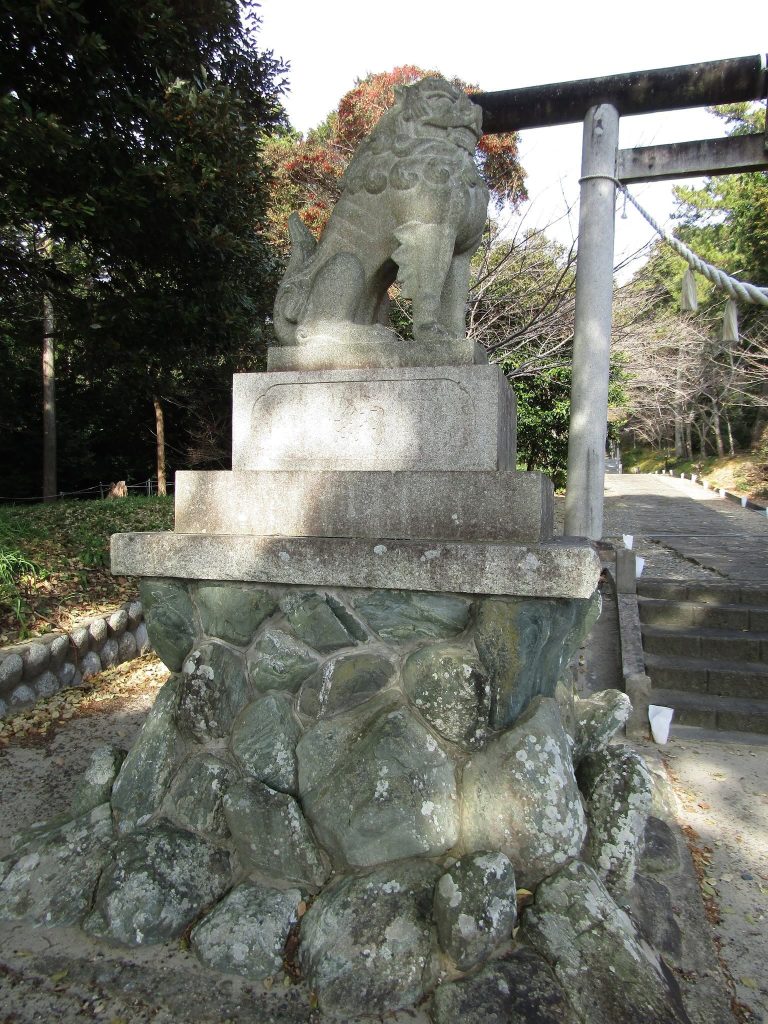
The shrine’s main sanctuary and 44 votive plaques have prefectural designations, while its komainu guardian figures are designated by Kakegawa municipality. The neri procession also has national documentation status, and the Three-Shrine Festival Music remains prefecturally designated. The principal enshrined kami, or sacred beings, are Ketsumimiko-no-kami, Izanami-no-kami, and Kotosakano-o-no-kami. The precincts also contain Suwa Shrine, Tenjin Shrine, and Okuno Shrine, associated respectively with Takeminakata-no-kami and Okuninushi-no-kami, Tenman Tenjin, and Okuno Saemon Koreyoshi.
Remains
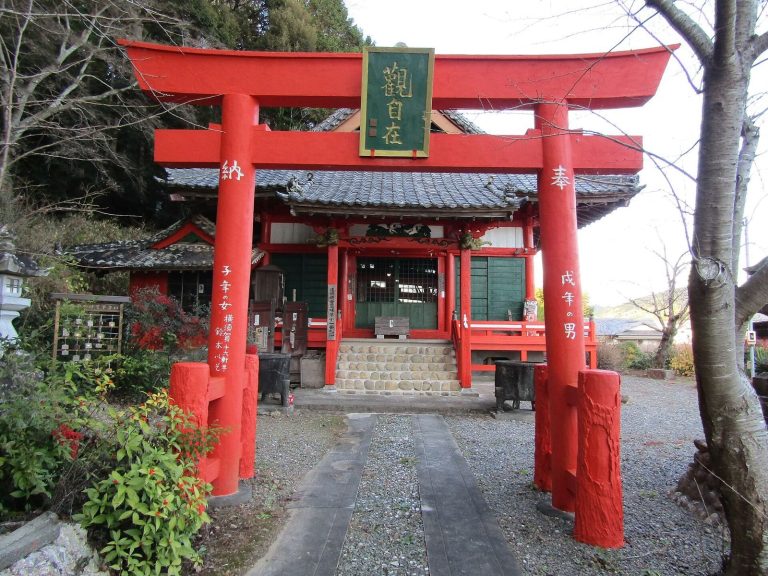
Mikumano Shrine’s precincts contain a torii, a worship hall, the main sanctuary, subsidiary shrines, guardian figures, votive plaques, and other shrine installations. These elements combine the built setting of the shrine with objects and structures connected to its religious practice and festival traditions.
Main Shrine Buildings
Main Sanctuary
The main sanctuary was built in 1854 by a craftsman of the Tachikawa school. It follows the nagare-zukuri form, in which the main roof extends forward to create a sheltered porch over the entrance. The building carries varied carvings associated with Tachikawa-school architecture and is valued for retaining the appearance of unpainted natural wood.
Precinct Buildings and Installations
The sanctuary stands within a precinct that includes a torii and worship hall, along with subsidiary shrines and associated installations. Suwa Shrine, Tenjin Shrine, and Okuno Shrine are also located within the grounds. Their enshrined figures are Takeminakata-no-kami and Okuninushi-no-kami, Tenman Tenjin, and Okuno Saemon Koreyoshi respectively.
Votive and Guardian Objects
Votive Plaques
The shrine’s 44 votive plaques are associated with several contributors. Thirty-five depict the Thirty-Six Immortal Poets and were dedicated by Honda Toshinaga. Seven were dedicated by the Nishio family, while another painted plaque and one painted by Okubo Ikkyu complete the group.
Guardian Figures and Mask
Paired komainu, traditional guardian figures placed in shrine precincts, are located within the grounds. The shrine also has an associated tengu mask, linking its surviving religious objects with the broader visual and ritual culture of the site.
Festival Features
The two-wheeled neri floats are drawn along the festival route during the grand festival, accompanied by performances of the Three-Shrine Festival Music. Together with the mikoshi procession, the floats form the principal moving elements of a tradition whose rites also include the Ground-Settling Dance, rice-field play, and the Child-Embracing Rite.