Myōō-in Temple: A Shingon Buddhist Temple in Fukuyama, Japan


Site at a Glance
- Rating
- 4.4
- Popularity
- Low
- Country
- Japan
- Primary era
- Medieval
- External website
- Open
- Eras represented
- Medieval, Early Modern
- Civilizations
- Ashikaga shogunate, Kamakura shogunate, Tokugawa
- Site type
- Religious
- Remains
- Monastery
On this page19 sections
History
Myōō-in Temple is a Buddhist temple in Fukuyama, Japan, at the foot of Atago Mountain beside the Ashida River. Temple tradition attributes its foundation to the monk Kūkai in 807, when he enshrined an image of Eleven-Faced Kannon on the mountainside. The temple belongs today to the Daikakuji branch of Shingon, an esoteric Buddhist school whose practice includes mantra, mandala, and fire rituals. Its principal object of worship is Eleven-Faced Kannon, and its medieval buildings place it within the religious history of the Bingo region.
Early Buddhist establishment
The temple was originally a Ritsu institution, a Buddhist tradition centered on monastic discipline, called Saikōzan Richiin Jōfuku-ji. The early history remains difficult to reconstruct. A 1621 ridge plaque in the main hall gives 807 as the foundation date, while the first recorded attribution of the foundation to Kūkai, also known as Kōbō Daishi, appears on a ridge plaque from 1690. The early Heian-period Eleven-Faced Kannon and postholes found beneath the present main hall support the existence of a religious establishment by the ninth century.
From the Heian period, approximately 794 to 1185, until around the beginning of the Edo period, a settlement beside the Ashida River flourished as a temple-front town. Its remains are known as the Kusado Senken Town Site and have been excavated archaeologically. The settlement formed part of the wider historical setting in which Jōfuku-ji developed as a religious and local institutional center.
Medieval rebuilding and regional prominence
During the late Kamakura period, the main hall was rebuilt in 1321 through the initiative of a principal donor and a monk. In 1348, the monk who had promoted that rebuilding raised funds for a five-story pagoda. The temple gate and a former Amida Hall, which survived until approximately the beginning of the Edo period, are also thought to belong to this building phase.
Jōfuku-ji appears in records from 1391 and 1471. During the Nanboku-chō period and the middle Muromachi period, it is thought to have been one of the major temples of the Bingo region. The Muromachi period lasted from 1336 to 1573, while the later Edo period began in 1603. The surviving medieval buildings preserve the results of the temple’s expansion during this earlier phase.
Reorganization in the early Edo period
The temple gate was rebuilt in 1614, and the Enma Hall, also called the Ten Kings Hall, was rebuilt during the Keichō era. In 1620, landslides caused by heavy rain damaged the temple buildings, after which Mizuno Katsunari restored them. Between 1627 and 1647, the bell tower, Goma Hall, priests’ quarters, study hall, the hall of En no Gyōja, Benten Shrine, Tenjin Shrine, Ryūō Shrine, Atago Shrine, and Inari Shrine were rebuilt or newly constructed.
The present institutional form emerged after Mizuno Katsusada became lord of Fukuyama in 1655. Between April 1655 and September 1656, the Myōō-in formerly located in Honjō Village was merged with Jōfuku-ji. The combined temple adopted the name Myōō-in. The former Myōō-in stood at Aokibata in Honjō Village, approximately two kilometers northeast of the present temple. After its lands had been confiscated by Fukushima Masanori, it declined, although Mizuno Katsunari is traditionally said to have favored its abbot, Yūshō.
Yūshō served as ritual officiant for the ground purification performed during construction of Fukuyama Castle. The former Myōō-in later moved to Naraya-chō in the castle town and became a prayer temple of the Mizuno family. These relocations and the merger may have been connected with the reorganization of the castle town.
Patronage and modern changes
After the merger, Myōō-in held a prominent regional position and had 48 subordinate temples. The Mizuno family donated 36 koku, a historical measure of rice-based land income, around the Genroku era and strongly supported the temple. After the Mizuno line ended in 1698, the successive Matsudaira and Abe rulers of Fukuyama continued their patronage. The Abe family made Myōō-in a family prayer temple, and the five-story pagoda underwent major repairs in 1742.
The Meiji-era government’s policy of separating Buddhism and Shinto removed the Tenjin, Atago, and Inari shrines from the temple. By 1879, the compound had been greatly reduced and consisted essentially of the buildings that remain today. Myōō-in’s thirtieth abbot was Mitsuo, a senior Buddhist cleric who also served as the 389th abbot of Kongōbu-ji on Mount Kōya and headed the Mount Kōya Buddhist administration.
The five-story pagoda was designated a National Treasure, Japan’s highest statutory cultural-property category, in 1953. Its first dismantling and repair since construction took place from 1959 to 1962. The main hall was dismantled and repaired from 1962 to 1964, when excavation beneath it revealed about 60 postholes and other remains extending toward the pagoda. These remains belonged to structures older than the present main hall. The main hall received National Treasure designation in 1964. Myōō-in is also affiliated with the Chūgoku Thirty-Three Kannon pilgrimage and the Sanyō Flower Temples pilgrimage.
Remains
Myōō-in’s surviving compound occupies the lower slope of Atago Mountain beside the Ashida River. The main hall and five-story pagoda form its principal medieval architectural group, while later halls, residences, shrines, and religious features extend around them. The buildings combine predominantly Japanese architectural forms with other Buddhist traditions, including the Daibutsu and Zen styles, which influenced monumental and monastic design.
Medieval Buddhist buildings
Main hall
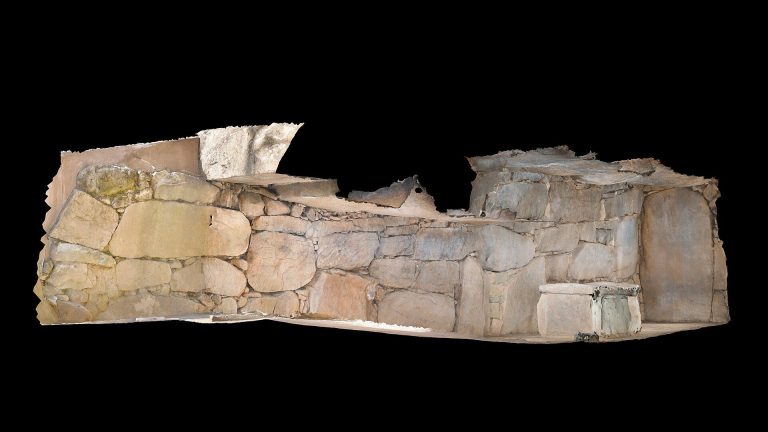
Constructed in 1321, the main hall is predominantly Japanese in style but incorporates features associated with the Daibutsu and Zen styles. This combination was unusual for its period. The building contains one Buddhist altar cabinet and three ridge plaques. Excavation beneath the hall revealed approximately 60 postholes and related remains belonging to earlier structures, extending in the direction of the five-story pagoda. The hall also enshrines the temple’s wooden standing image of Eleven-Faced Kannon, which dates from the early Heian period and is traditionally attributed to the monk Saichō. The image was designated an Important Cultural Property in 1899 and is not visible to the general public.
Five-story pagoda
The five-story pagoda was built in 1348 and represents the Japanese style associated with the period of the divided imperial courts. It is considered the fifth-oldest surviving pagoda among Japan’s National Treasure pagodas. On its ground floor, a sculptural group identified as Dainichi Nyorai is centered on a figure that is actually Miroku, flanked by Fudō Myōō and Aizen Myōō. Columns associated with the Four Heavenly Kings surround the group, while representations of the eight founders of Shingon are also present. Major repairs were carried out in 1742, followed by dismantling and repair between 1959 and 1962.
Gate and early Edo buildings
Temple gate
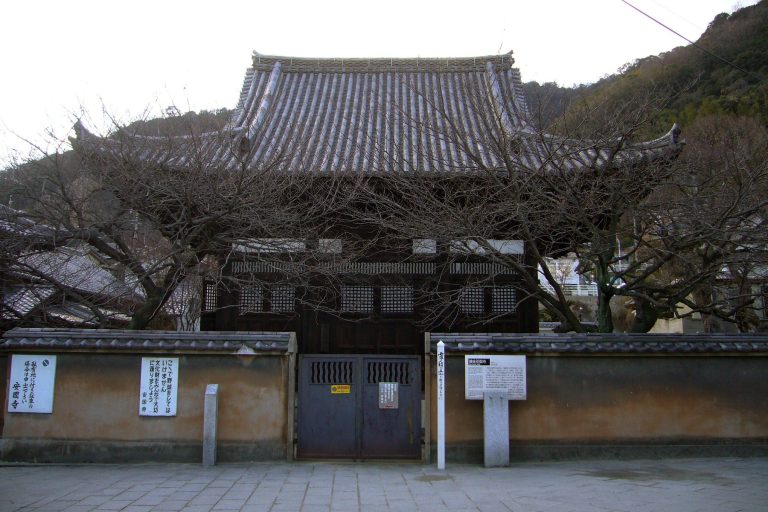
The temple gate is thought to have been rebuilt in 1614. It belongs to the early Edo-period rebuilding of the compound and is designated an important cultural property by Hiroshima Prefecture.
Study hall and priests’ quarters
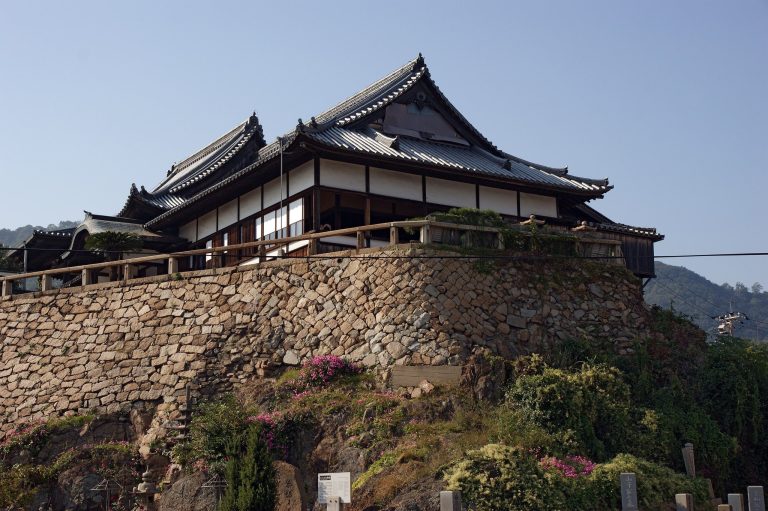
The study hall and priests’ quarters are traditionally said to have been rebuilt together in 1621. Both buildings are designated important cultural properties by Hiroshima Prefecture. They form part of the group of early Edo-period structures that survived the later reduction of the temple compound.
Goma Hall
The Goma Hall stands slightly above and behind the study hall and priests’ quarters. A Goma Hall is used for Buddhist fire ceremonies. The building contains a wooden standing image of Fudō Myōō, which is designated a Fukuyama municipal cultural property, as well as paintings on the reverse side of the screen behind the principal image. The hall is not open to the public.
Bell tower
The bell tower was built in 1647. Its bell was donated in 1657 by Mizuno Katsusada, the third lord of Fukuyama. A seven-tiered granite stone pagoda stands in the forecourt of the Goma Hall. It is 3.20 meters high and is designated an important cultural property by Fukuyama.
Religious features and associated shrines
Enma Hall and smaller halls
The Enma Hall, also called the Ten Kings Hall, was rebuilt in 1990 and enshrines Enma, the Buddhist judge of the dead, together with the Ten Kings associated with postmortem judgment. A statue of Daikoku stands at the foot of the slope between the main hall and the five-story pagoda. The longhouse now serves as a rest room for worshippers, but it functioned as a temple school until the end of the Edo period. To its left, the Jizō Hall contains six statues of Jizō, a bodhisattva associated especially with travelers, children, and the dead.
Benten pond
At the southern edge of the compound, a pond dedicated to Benten is lined with statues of the Seven Lucky Gods. This feature belongs to the later religious landscape of the temple and remains within the reduced compound formed by the end of the nineteenth century.
Atago Shrine and approach
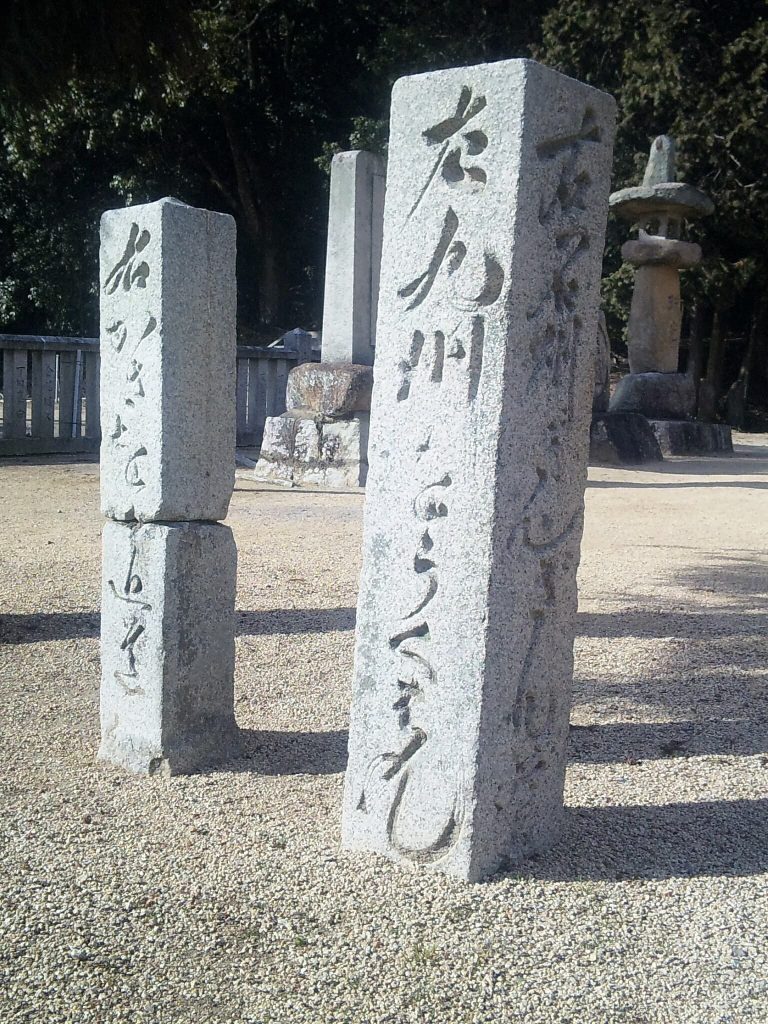
The main sanctuary of Kusado Atago Shrine stands on the summit of the mountain behind Myōō-in. A torii marking the entrance to its approach stands beside the five-story pagoda. A ridge plaque from 1628 records the shrine’s construction. It was originally built as Myōō-in’s tutelary shrine, but the Meiji-era separation of Buddhism and Shinto made it affiliated with the neighboring Kusado Inari Shrine. An Atago Daigongen shrine established on the mountainside during that separation remains affiliated with Myōō-in.
Gravestones and the Kusado Senken Town Site
A group of gravestones excavated from the Kusado Senken Town Site is arranged beside the approach to Atago Shrine. The town site lies on an island in the Ashida River in front of the temple. The gravestone group is designated an important cultural property by Fukuyama and connects the surviving temple precinct with the archaeological remains of the settlement that flourished beside the river.