Busecker Schloss: A Neo-Gothic Castle and Municipal Seat in Germany


Site at a Glance
- Rating
- 4.2
- Popularity
- Very Low
- Country
- Germany
- Primary era
- Modern
- Eras represented
- Early Modern, Modern
- Civilizations
- German, Holy Roman Empire
- Site type
- Domestic
- Remains
- Castle
On this page6 sections
History
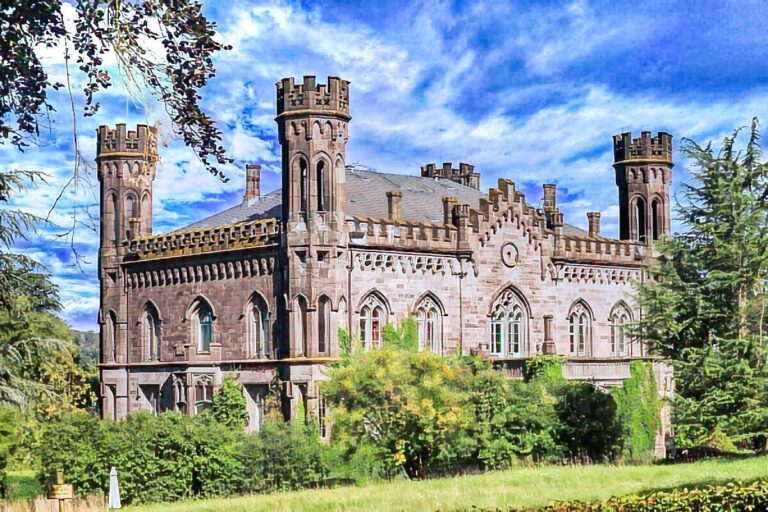
Busecker Schloss, also called Schloss Großen-Buseck, is a castle in Buseck, Germany, whose present form is a nineteenth-century neo-Gothic modernization of a building erected in 1580. It stands on the site of a medieval water castle that had been held as a Hessian fief from the fifteenth century.
Medieval lordship and the water castle
The medieval castle was a seat of the von Trohe family in Großen-Buseck. The von Trohe and von Buseck families formed a Ganerbschaft, a joint lordship in which several families shared rights over the same territory or property. Their lordship included the Buseck localities except Trohe and was known as the lordship of the Buseck Valley. This territory was probably an imperial fief, meaning land held from the emperor under a feudal relationship, granted by Emperor Frederick II in the thirteenth century.
The water castle was probably first mentioned in a document in 1458. In 1580, the Schutzbar genannt Milchling family had a new castle building erected on the square site occupied by the earlier fortress.
Ownership and nineteenth-century transformation
Financial difficulties led the owners to surrender the castle to their creditors in 1784. At the end of 1785, the municipality of Großen-Buseck auctioned the castle and surrounding estate for 35,000 gulden but did not obtain possession. The government of Hesse-Darmstadt refused to approve the sale because the property remained a fief. For the same sum, the bankruptcy estate passed in 1786 to Elisabetha Dorothea, Baroness von Zwierlein, née von Wahl, the widow of Privy Councillor Johann Jacob Baron von Zwierlein. Landgrave Ludwig IX of Hesse-Darmstadt, a high-ranking territorial ruler in the Holy Roman Empire, then granted her the property as a fief.
A great-granddaughter of Elisabetha Dorothea married Baron Friedrich von Nordeck zur Rabenau in 1829. In 1860, Baroness Ernestine von Nordeck zur Rabenau, née von Zwierlein, renovated and modernized the castle in its present neo-Gothic style. Neo-Gothic architecture was a nineteenth-century revival of medieval Gothic forms, often using pointed arches, vertical emphasis, and historicizing decoration. She also sought to convert the Großen-Buseck fief into freehold property without payment.
Municipal preservation and use
The municipality acquired the castle, park, and estate in 1976. Following the municipal reform that created the municipality of Buseck on 1 January 1977, a decision was made in 1978 to preserve the castle and park. Extensive restoration allowed the municipal administration to move into the building in 1981. Busecker Schloss remains the seat of Buseck municipal administration and a center of municipal life.
Remains
Busecker Schloss stands at an elevation of 200 metres above NHN, north of the centre of Großen-Buseck, within its own park. The medieval and early-modern castle occupied a square plan, and the present building retains that site while presenting the nineteenth-century neo-Gothic appearance created in 1860.
Castle fabric and water defenses
Only the earlier castle’s cellars survive as identifiable fabric within the present building. They are formed by barrel vaults and preserve a physical element of the earlier structure beneath the later modernization. Around the castle, the former moats were drained but remain recognizable. The present gateway was probably also the entrance to the medieval water castle, linking the surviving access point with the earlier square defensive complex.