Nordeck Castle: A Hill Fortress and Dynastic Seat in Germany


Site at a Glance
- Rating
- 4.3
- Popularity
- Very Low
- Country
- Germany
- Primary era
- Medieval
- Eras represented
- Medieval, Early Modern
- Civilizations
- Holy Roman Empire
- Site type
- Military
- Remains
- Castle
On this page7 sections
History
Nordeck Castle is a hill castle in Germany, located in Nordeck, now a district of Allendorf an der Lumda in Hesse. The settlement of Nordeck was mentioned in 1093, and the castle is thought to have been established by the eleventh century. Its chapel’s dimensions follow the Roman foot, an ancient unit of length used as a building standard. The castle first served as the ancestral seat of the Nordeck zur Rabenau family.
Early History and Hessian Rule
The castle’s exact construction date cannot be established from surviving building documents. Its position made it an important barrier on the road from Mainz to Amöneburg. From the thirteenth century, Nordeck Castle belonged to the Landgraves of Hesse, territorial rulers whose rank was generally comparable to that of a duke. Adolf von Nordeck is the first documented lord of the castle, appearing in records in 1222.
In 1328, Hermann the Elder, the youngest son of Landgrave Otto I, received Nordeck Castle after his elder brother Heinrich II became Landgrave of Hesse. This grant was a dynastic appanage, a territorial or economic provision for a junior member of a ruling family. The castle subsequently changed owners frequently.
Later Ownership and Institutional Use
The Nordeck zur Rabenau family reacquired the complex in 1906. It later passed by inheritance, together with Friedelhausen Castle, the Appenborn estate, and the Upper Castle of Rabenau, to the Counts of Schwerin, who remain its owners. Since 1925, Nordeck Castle has housed a rural boarding school. Since 2015, Lebenshilfe Gießen has operated a residential home there.
Remains
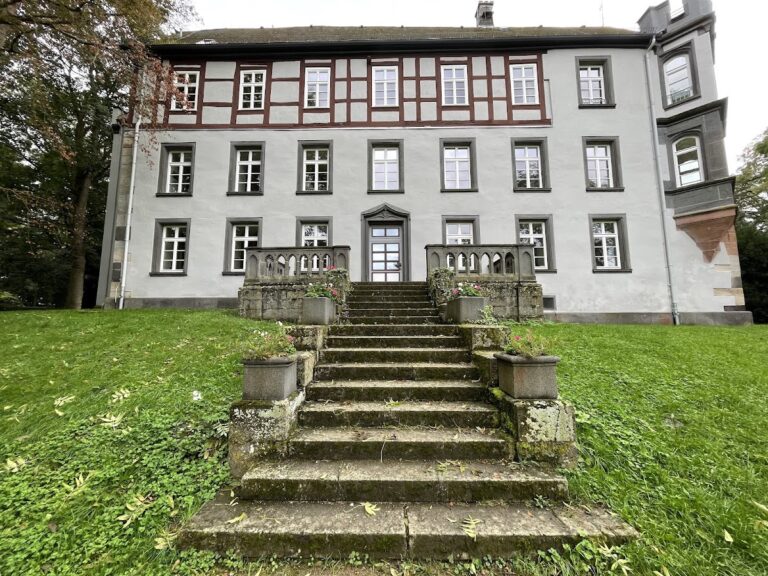
Nordeck Castle is a small, well-preserved hill castle set on a slope at approximately 305 metres above sea level. Its original complex was built from basalt and Lungstein, and substantial parts of the medieval and early modern structure survive. The buildings enclose three sides of a narrow courtyard, while the defensive works occupy the castle’s more exposed side.
Defensive Works
A neck ditch and shield wall protect the defensive side of the castle. A round keep, dating from the twelfth or thirteenth century, forms part of this fortified arrangement. Together, these elements define the castle’s defensive character and reflect its role in controlling the route between Mainz and Amöneburg.
Courtyard Buildings
Buildings added between the fourteenth and seventeenth centuries surround three sides of the narrow castle courtyard. An old well remains within the courtyard and belongs to the surviving arrangement of the complex.
Castle Chapel
The castle includes a chapel built from basalt and Lungstein. Its dimensions are based on the Roman foot, a measurement standard that helps place its origins by the eleventh century. The chapel forms part of the original castle complex and remains among the substantial preserved elements of Nordeck Castle.