Château de Varey: A Medieval Fortified Castle in France


Site at a Glance
- Rating
- 4.5
- Popularity
- Very Low
- Country
- France
- Primary era
- Medieval
- Eras represented
- Medieval
- Civilizations
- Holy Roman Empire
- Site type
- Military
- Remains
- Castle
On this page6 sections
History
Château de Varey is a medieval fortified castle in Saint-Jean-le-Vieux, France, built in the twelfth century as the seigneurial residence and seat of the lordship of Varey. The castle stood in Bugey, a historic territory now largely within the Ain department, and later became involved in the rival political interests of Geneva, Dauphiné, Savoy, and France.
The lordship of Varey
In 1150, the lordship belonged to Guerric, lord of Coligny and Revermont, under the authority of the lords of Thoire. In 1188, Humbert of Thoire acknowledged the feudal authority of Henry VI, King of the Romans. This title belonged to the elected German king before, or independently of, imperial coronation.
Around 1240, Varey passed from the lords of Coligny to the counts of Geneva through the marriage of Marie de Coligny, daughter of Hugues de Coligny, to Rudolf, Count of Geneva. In his will, Amadeus II, Count of Geneva, designated his son William as his successor. He assigned his other sons, Amadeus and Hugues, the castles of Varey, Mornex, Rumilly-sous-Cornillon, and Cornillon, along with the vidominate of Bornes, market rights at La Roche, and lands and rents in Vaud. A vidominate was a territorial jurisdiction administered by a vidomne, an official exercising delegated judicial or administrative authority. The brothers could alienate these rights only to the count’s heirs.
In 1309, Amadeus II of Geneva granted Varey to his daughter Jeanne as a marriage provision when she married Guichard, Lord of Beaujeu and Dombes. The lordship was later withdrawn from her and given to her uncle Hugues of Geneva, Lord of Anthon.
The Battle of Varey and the Dauphiné
By the fourteenth century, Varey was regarded as one of the largest and strongest strongholds in Bugey. On 7 August 1325, Edward, Count of Savoy, attempted to capture it during the Battle of Varey. His army was defeated and almost annihilated by Guigues VIII, Dauphin of Viennois, who came to the castle’s aid. A Dauphin of Viennois was the hereditary ruler or heir of Dauphiné, a principality later incorporated into the French realm.
In recognition of this assistance, Hugues of Geneva became Guigues VIII’s liege man, meaning a feudal vassal bound by a particularly direct oath of loyalty. Hugues paid homage for Varey on 16 February 1334 to Humbert II of Viennois, Guigues VIII’s successor. Because of the castle’s importance to the dauphin, it was subsequently purchased from Hugues of Geneva.
In 1349, Philip VI, King of France, acquired Varey with the rest of Dauphiné. Under an exchange contract dated 5 January 1355, King John II and his son Charles, the new Dauphin of Viennois, ceded the castle and its mandement to Amadeus V, Count of Savoy. A mandement was a feudal administrative district attached to a lordship or castle.
Challant and later noble ownership
On 3 May 1410, Amadeus VII, Count of Savoy, granted Varey as a fief to Boniface de Challant, Lord of Montbretton and Marshal of Savoy. Boniface later bequeathed it to his younger son, Amé de Challant, establishing the Varey branch of the Challant family.
After Étienne-Philibert de Challant, Lord of Varey and Saix, died without issue, part of the lordship was awarded to German merchant creditors by the Parliament of Chambéry on 28 March 1556. This body was the sovereign judicial and legislative court of the Duchy of Savoy. Duke Emmanuel-Philibert of Savoy paid the creditors in 1560 and transferred the land first to his squire Claude de Divonne, then to Prosper of Geneva, Lord of Lullin, on 27 October 1563. On 15 October 1571, he granted it as a fief to Claude de l’Aubépin, the nephew of Étienne-Philibert de Challant.
Renée de l’Aubépin brought the lordship into the family of François d’Ugnie, Lord of La Chaux, through their marriage. Their daughter Nicole d’Ugnie married Philibert de Beaurepaire on 24 January 1620, transferring Varey to the Beaurepaire family. That family took over the fief in 1644, 1656, 1665, 1675, and 1723.
On 30 March 1753, Jacques, Marquis of Beaurepaire, sold the fief and castle for 206,000 livres to Jean Dervieu of Goiffieu, Lord of Villars. The property remained with his descendants and was still held by the Dervieu family in 1873.
Revolutionary damage and modern status
In 1793, the castle was badly damaged on the orders of Antoine-Louis Albitte, a French revolutionary representative and administrator. The architect Fléchel restored it in the middle of the nineteenth century. The façades and roofs received protection under the French Monument historique system by decree of 21 March 1983. This designation is a legal form of heritage protection for a monument or specified parts of it.
In the twenty-first century, an association owns the property and uses it as a medico-social establishment. In 2023, the prefecture of Ain proposed its temporary use as accommodation for migrants.
Remains
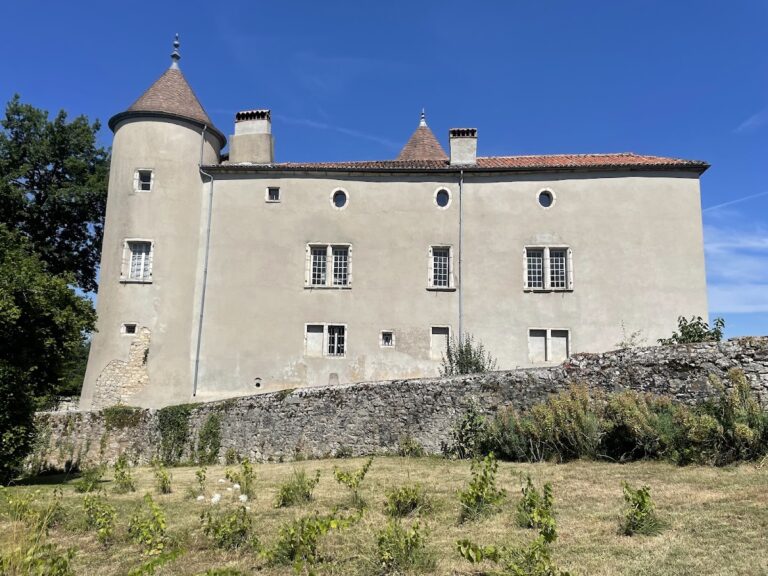
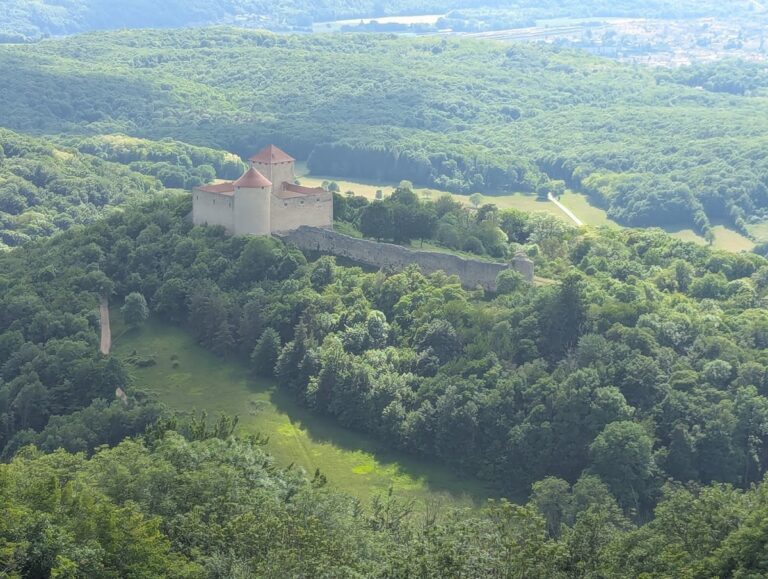
Château de Varey stands in the commune of Saint-Jean-le-Vieux, approximately one kilometre south-southeast of the village centre. The surviving complex takes the form of a large polygonal enclosure with circular elements projecting from its sides. This arrangement reflects the castle’s character as a fortified seigneurial residence and stronghold.
The protected physical fabric consists of the façades and roofs. The complex was restored in the nineteenth century after the severe damage inflicted in 1793, leaving those elements as the principal surviving and protected features of the castle.
Nearby sites