Burgruine Rehberg: A Medieval Spur Castle in Austria
Site at a Glance
- Rating
- 4.5
- Popularity
- Very Low
- Country
- Austria
- Primary era
- Medieval
- Eras represented
- Medieval, Early Modern
- Civilizations
- Holy Roman Empire
- Site type
- Military
- Remains
- Castle
On this page7 sections
History
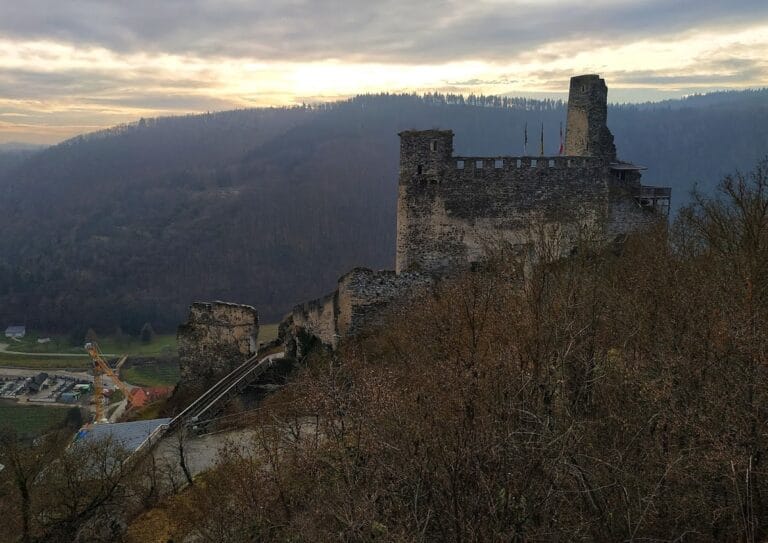
Burgruine Rehberg is a ruined medieval spur castle in Austria, above the village of Rehberg in the municipality of Krems an der Donau. Its construction dates to the eleventh century, and it was also known historically as Rechperg. The site later passed through the hands of the Babenbergs, Habsburg rulers, noble families, and private owners before becoming a residential palace and then a ruin.
Medieval lordship
In 1141, Otto of Lengenbach and his brothers Hertuvicus of Rehperch and Heidenricus of Purchstalle were associated with the area. After Otto IV, the last of the Lengenbachers, died, the lordship passed to the Babenbergs in 1235. The Babenbergs were the medieval dynasty that ruled the Duchy of Austria before the Habsburg succession.
The castle church was mentioned in 1316 as the “chapelle ze Rechperch.” During the first half of the fourteenth century, Rehberg formed part of the endowment of Agnes of Hungary, the daughter of Albert I of Habsburg and widow of Andrew III of Hungary. After Andrew’s death, she received Weitenegg, Rehberg, and Persenbeug, and she is thought to have lived at Rehberg at times.
Agnes died in 1364. Rudolf IV of Habsburg then planned to assign Rehberg to the endowment of the chapter of St. Stephen’s Cathedral in Vienna. The plan was not carried out because Rehberg was regarded at that time as an imperial fief, meaning land held from the emperor within the feudal system of the Holy Roman Empire.
Castellans, pledges, and territorial administration
Rehberg was subsequently administered by castellans, officials responsible for managing a castle, and was later pledged to different holders. The noble Grabner family held it from 1410 to 1451. Its holders included Jakob Grabner the Younger, Johann Grabner, and Georg Grabner of Joslowitz. With the consent of the territorial ruler, Georg Grabner transferred the castle to the brothers Valentin and Ulrich of Eyczing and to Georg Mühlwanger, who retained it until 1479.
Emperor Frederick III eventually commissioned the city of Krems to redeem the castle for him in exchange for various privileges. Rehberg was then administered by officials of the territorial ruler. In 1501, Emperor Maximilian I sold it to Hans of Sacher of Weissenstein. From 1520 to 1650, it belonged to the Protestant Thonradl family.
Palace conversion and decline
Count Ludwig of Kuefstein later purchased the lordship. Because the castle had been neglected under its previous owners, he converted it into a residential palace. Ownership changed rapidly from 1688 onward. David Ungnad of Weißenwolf was followed by the Counts of Salburg in 1702, Johann Ernst of Glanz in 1713, Johann Georg Emanuel of Hoheneck and his brothers in 1715, Johann Nepomuk Drexler in 1773, Vinzenz of Salzgeber in 1796, a Baroness of Reichel in 1799, and Count Falkenhayn in 1800.
Count Falkenhayn sold the palace to the municipality of Rehberg. Parts of the buildings were demolished from 1822 onward. The Barons of Sina became owners in 1847, followed by the Gutmann family, which held the property from 1884 to 1966. The ruins have since belonged to the Association for the Promotion of the Renewal of Krems. The castle church became a subsidiary church of Imbach in 1783, meaning that it depended institutionally on that larger parish or church. Burgruine Rehberg is listed as a heritage object in Austria.
Remains
Castle ruins on the ridge spur
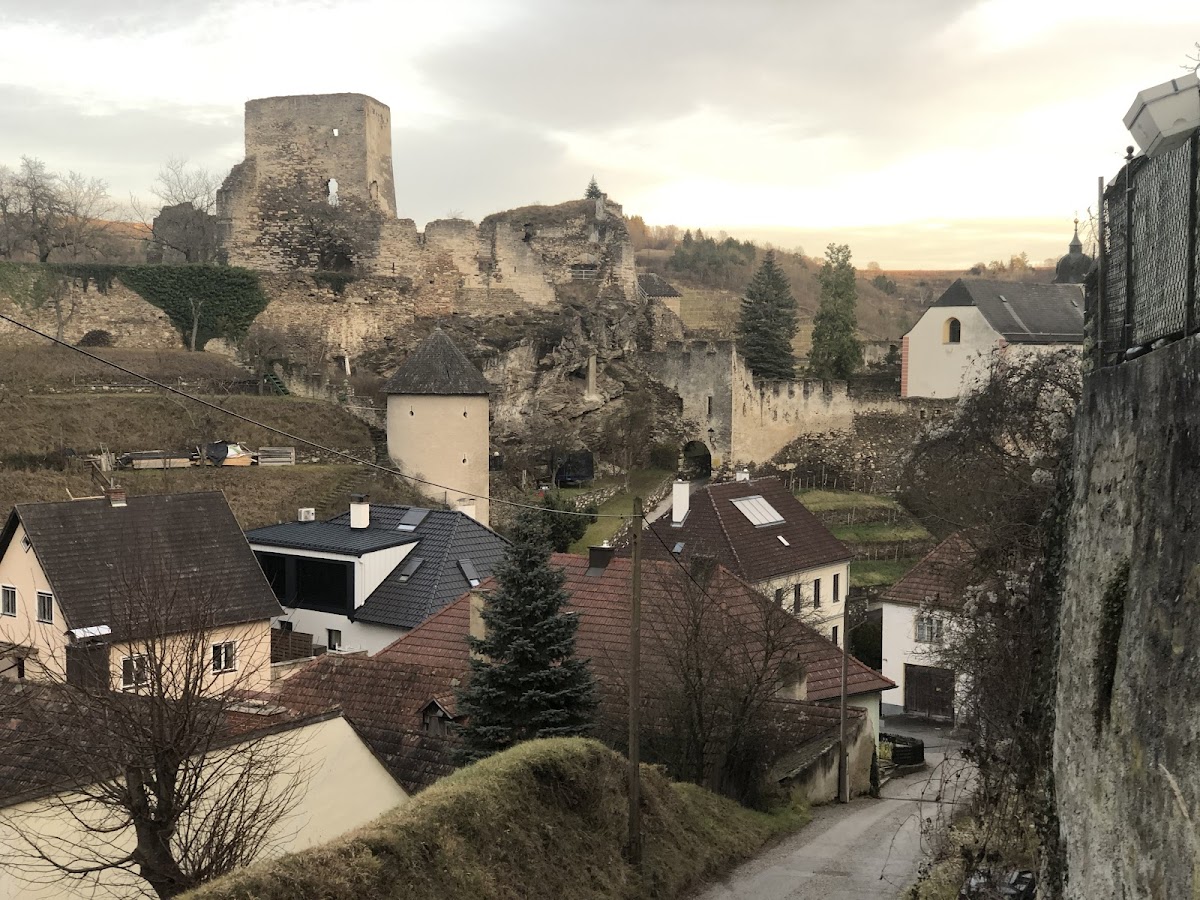
The ruin occupies a spur-like projection of a ridge that runs northwest toward the village. It stands above the Krems River and Rehberg, where the Frauenbach valley meets the Krems valley, in Lower Austria. The rocky spur drops steeply toward the Alt-Rehberg district on every side except where it remains connected to the ridge, giving the site its characteristic defensive position.
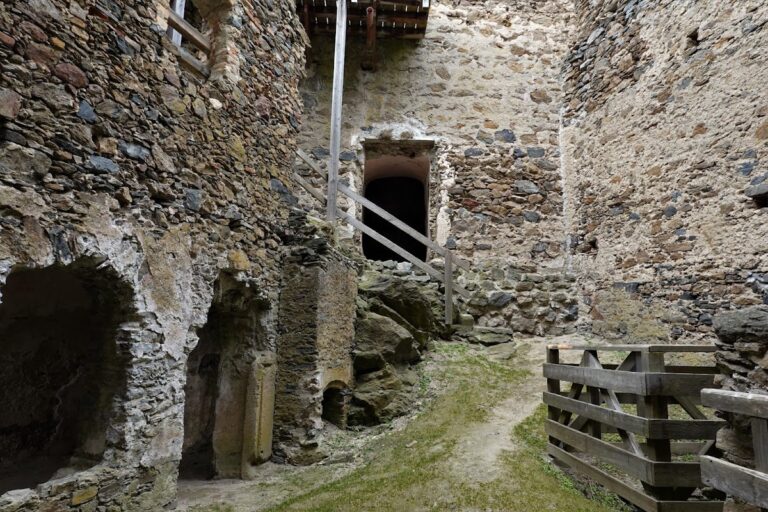
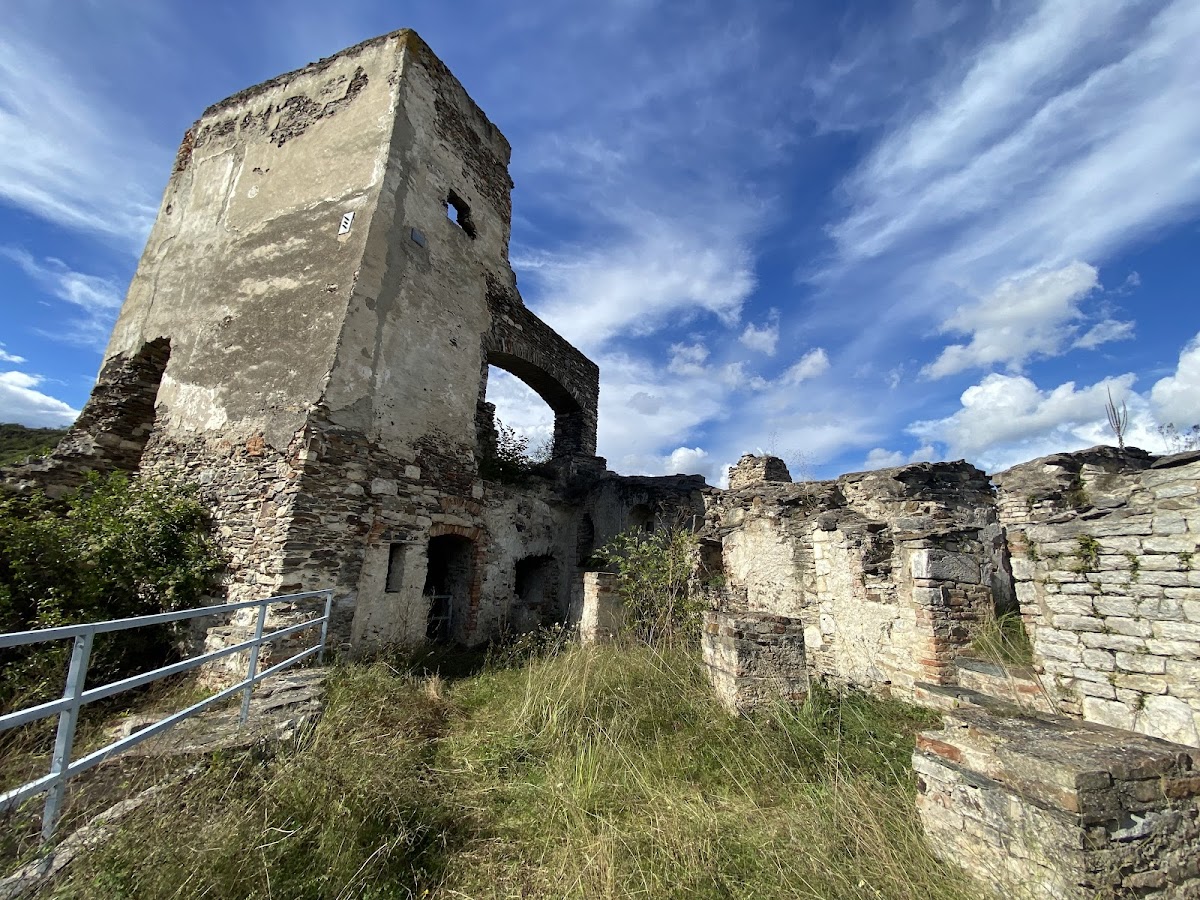
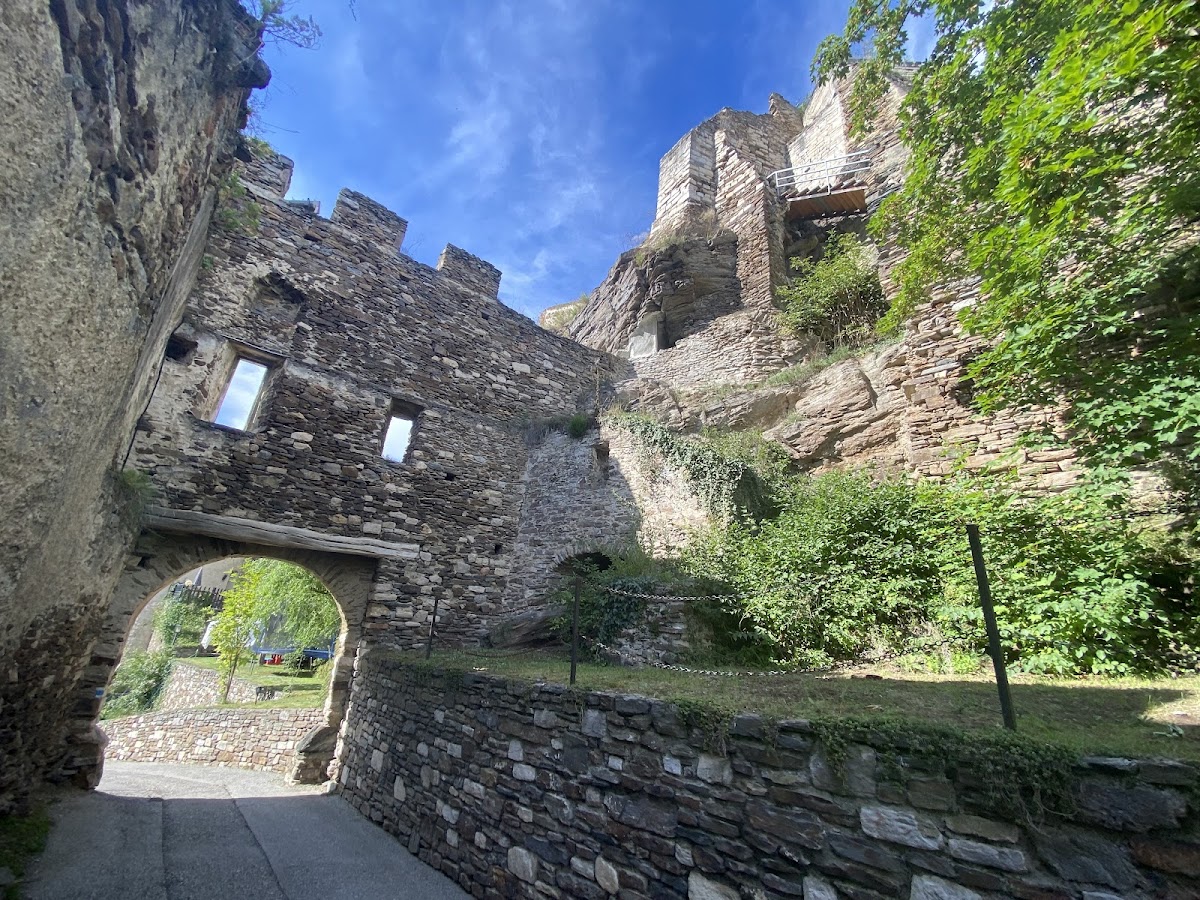
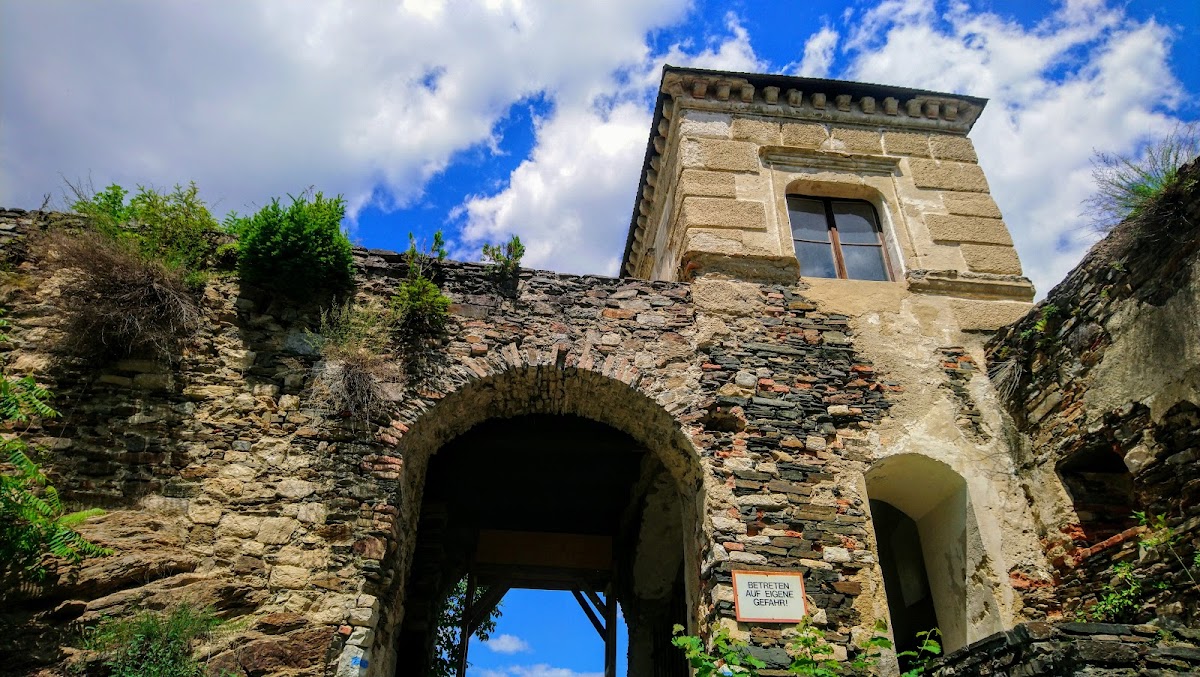
The surviving fabric combines remains of the medieval castle with components from the later conversion into a residential palace. The buildings are in a ruined condition, and demolition from 1822 onward further reduced the complex. The remains therefore preserve elements associated with both the earlier fortified residence and its later residential transformation.
Church on the lower terrace
A subsidiary church dedicated to Saint John stands on the lower southeastern terrace of the spur. Its position forms part of the surviving complex below the castle ruins and reflects the continuing religious association of the site.