Burgruine Klauseck: A Medieval Border Fortress in Austria


Site at a Glance
- Rating
- 4.9
- Popularity
- Very Low
- Country
- Austria
- Primary era
- Medieval
- Eras represented
- Medieval
- Civilizations
- Holy Roman Empire
- Site type
- Military
- Remains
- Castle
On this page11 sections
History
Burgruine Klauseck is the ruin of a medieval border fortification in Austria near Tamsweg, established by Salzburg’s archbishops in the thirteenth century to guard the route toward Styria. The castle formed part of a defensive and administrative system in Seetal, at the easternmost point of the present-day state of Salzburg. Although the origins of the site are uncertain and earlier development is broadly placed between 1000 and 1200, dendrochronological analysis, which dates timber through its annual growth rings, indicates construction around 1300.
The eastern border system
Klausegg belonged to the Klausensystem, a Salzburg policy that blocked strategically narrow valleys with walls, gates, and fortified points. Comparable barriers were established at Ramingstein and the Mandling Pass. At Seetal, the wall closed the valley passage, while the Klausentor regulated movement along the commercial road and enabled the collection of tolls. Salzburg’s archbishops were both senior Catholic churchmen and territorial rulers, so they could organize this defense and administer the surrounding district.
The Klausegg Pflege, a territorial administrative district, carried military responsibilities and maintained a castle garrison. During the first major phase of mining in the Lungau, a Berghut, or mining-guard office, was also established at Klausegg before being transferred to Moosham. Administrators came partly from prominent local noble families, including the Mooshaimers and Thannhausers. Wulfing of the Mooshaimer family held the office in 1354.
Conflict, decline, and preservation
The fortification was repeatedly involved in military confrontations during the Hungarian Wars of the late fifteenth century, and numerous finds are associated with these conflicts. A frequently repeated claim that the castle belonged to the Lords of Pettau and passed with the market of Tamsweg to Salzburg Archbishop Eberhard II in 1246 has not been substantiated.
During the seventeenth century, repeated efforts were made to dissolve the Klausegg district. In 1642, the Salzburg Hofkammer ordered the border tower to be demolished, yet Martin Jocher was still assigned to the castle garrison in 1680. The administrative office ended at the close of the century when it was merged with the principal district at Moosham. The castle and the wider border system then fell into decay. In 1712, an imperial administrative and customs house was built on Styrian territory near the Klausentor.
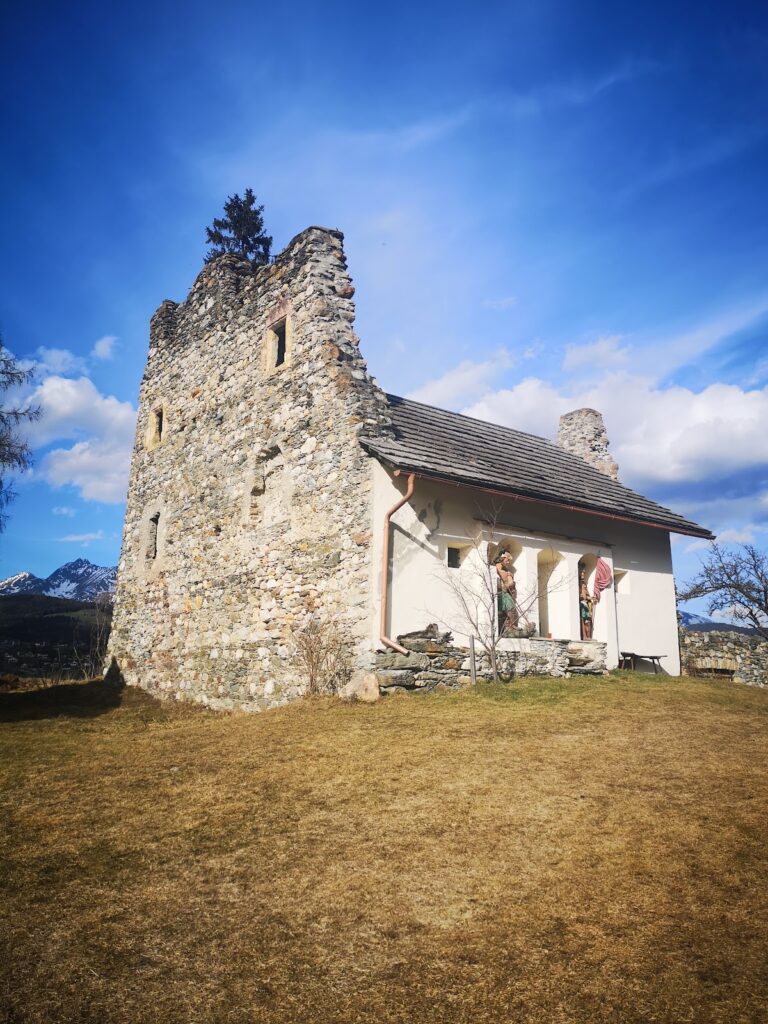
Sections of the former border wall were dismantled, and their stones were reused in other buildings. By 1786, spruce trees and shrubs had overgrown the castle walls. The ruin and surviving parts of the border wall were restored in 1999. Masonry considered worthy of preservation was sealed and protected beneath a roof, stabilizing the remains while retaining their ruined form.
Remains
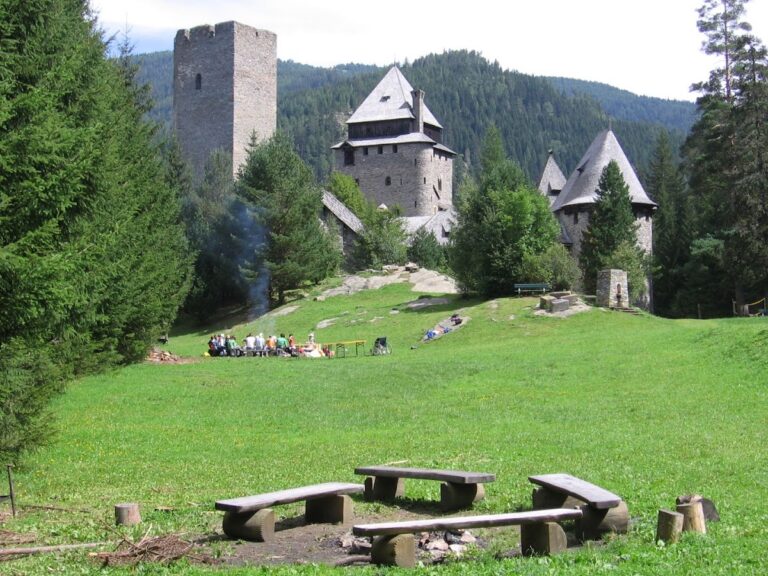
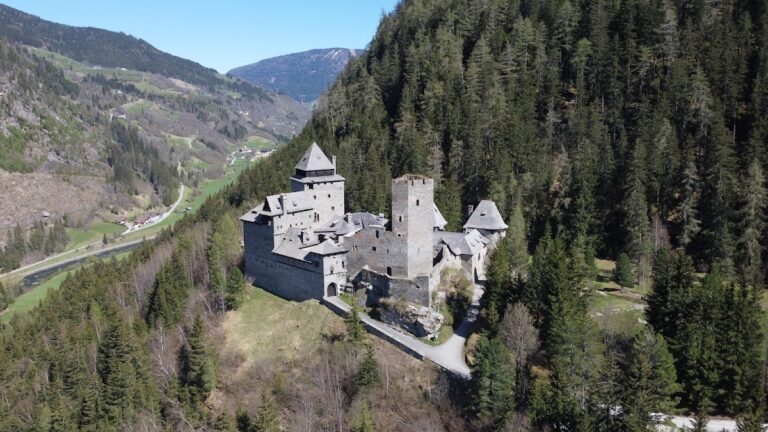
Burgruine Klauseck stands on the steep northern slope of the Gstoder in Seetal, about 70 metres above the valley floor and approximately 1,280 metres above sea level. Seetal extends for roughly 12 kilometres eastward from Tamsweg to the Styrian border and continues to Seebach, where it joins the Rantental. The surviving complex includes the castle ruin, the border wall, the Klausentor, the adjacent Passhaus, and the Klauswirt.
Castle structure
Stone keep-like building
The castle survives as a box-like, three-storey stone building measuring approximately 27 by 12.5 metres and standing about 16 metres high. Its intermediate floors have collapsed, and the interior is divided into three sections. A castle ditch supplied additional protection on several sides. The walls are uniformly about 2.60 metres thick. The ground floor is entered from the mountainside through a later doorway, while the original entrance on the valley side was blocked at a later date.
Interior arrangement
The plan follows the central-passage-house type, in which a longitudinal passage separates rooms on either side. The entrance room is flanked by approximately square chambers measuring about 7 by 7.5 metres, and this three-part arrangement continues on the first upper floor. The second upper floor served as the residential level. Its dividing wall was omitted, creating a room about 15 by 8 metres. Five windows with seat niches faced the valley, while two faced east, making the valley side the building’s principal display facade. A kitchen was built into the southern wall.
Valley barrier and gate complex
Border wall
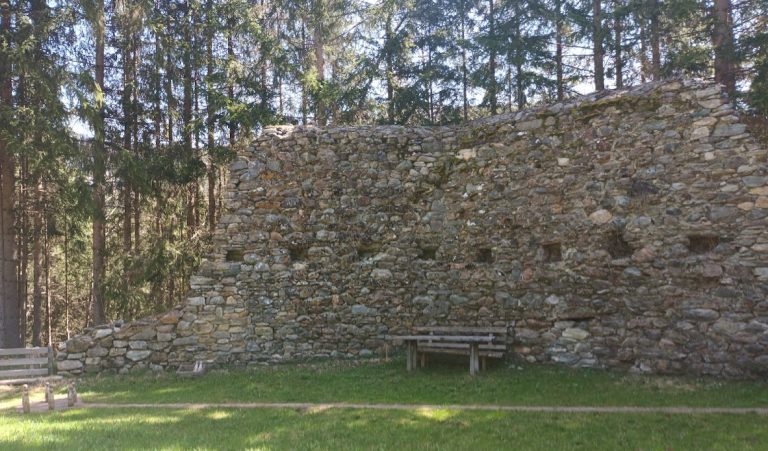
The border wall ran for approximately 400 metres from the northern valley slope, across the defile, and up to the castle on the opposite side. It therefore formed a complete barrier across the valley. Parts of the wall were later dismantled, and their stones were reused in other buildings. Surviving sections were included in the 1999 conservation work, when preservable masonry was sealed and covered by protective roofing.
Klausentor and associated buildings
The Klausentor was the only passage through the barrier along the commercial road. The Passhaus beside it served as a customs and guard house, while the tavern on the Salzburg side offered refreshment to travelers and continues as the Gasthaus zur Klause. The historic building beside the gate was the home of Eduard Macheiner, a Salzburg archbishop who lived from 1907 to 1972.
Legendary escape route
Local legends describe the overgrown fortification as haunted by the souls of violent “Klausegger” robber knights awaiting redemption. About 100 metres west of the ruin, a nearly vertical tunnel is traditionally identified as the exit of an underground escape route. A flickering light seen there on some nights is linked in the legend to a castle watchman who suffered a violent death. The tunnel’s connection with the castle remains a matter of tradition rather than an archaeologically established feature.
Nearby sites