Burgruine Thurnschall: A Medieval Hilltop Castle Ruin in Austria

Site at a Glance
- Rating
- 4.6
- Popularity
- Very Low
- Country
- Austria
- Primary era
- Medieval
- Eras represented
- Medieval
- Civilizations
- Holy Roman Empire
- Site type
- Military
- Remains
- Castle
On this page9 sections
History
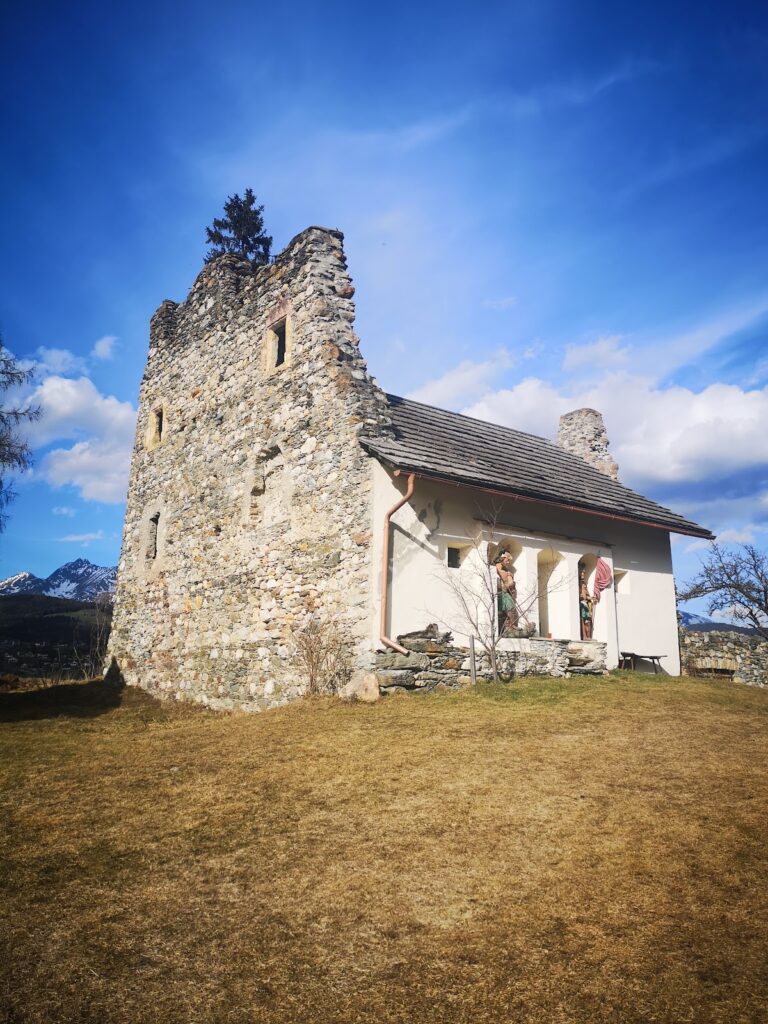
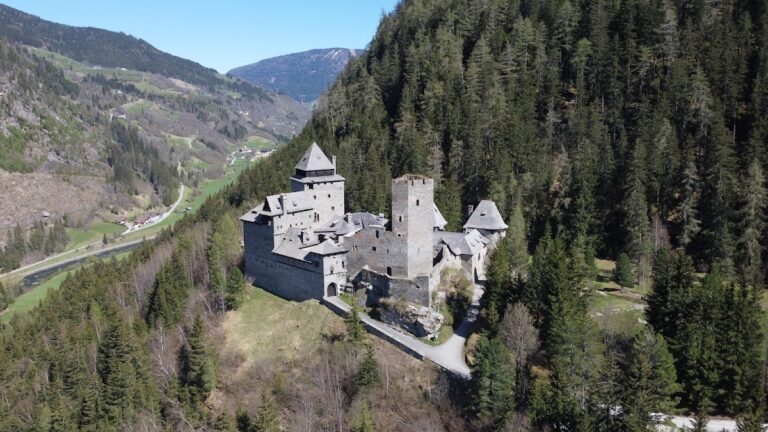
Burgruine Thurnschall is a thirteenth-century hilltop castle ruin in Austria, situated at Zoitzach in the municipality of Lessach, Salzburg. Built on a rocky rise above the Lessach Valley, it formed part of the medieval fortifications of the area and later lost its defensive purpose after Lessach came under the authority of the Archbishopric of Salzburg.
Early references and medieval ownership
The history of the site is connected with the early development of Lessach. The first recorded reference to Lessach dates to 1074, when Admont Abbey, a Benedictine monastery in Austria, received tithes from the Lessach Valley after its foundation. A castle called Castrum Lessach appears in records at the beginning of the thirteenth century, when it belonged to Count Wilhelm of Heunburg.
In 1239, Wilhelm of Heunburg donated Thurnschall, with the approval of his territorial lord, Duke Bernhard of Carinthia, to Count Hermann of Ortenburg. Three years later, Hermann sold the area around Lessach and Thurnschall to Eberhard II, Archbishop of Salzburg. The transfer placed the castle within the territory of the Archbishopric of Salzburg, an ecclesiastical principality whose possessions and authority included the Lessach area.
Castle officials and decline
Several commanders were identified by their connection with Lessach as part of their official positions. Pilgrim and Ortlieb are named in 1239, Waltherus in 1266, Otto of Lessach in 1272, and Wolfgang of Lessach around 1400. Animal bones found at the castle indicate habitation approximately between 1200 and 1250.
Once the Salzburg authorities acquired the Lessach area, Thurnschall no longer served as a defensive position against attacks from the direction of Schladming. The castle was probably then allowed to decay, leaving the structure as a ruin rather than maintaining it as an active stronghold.
Investigation and preservation
Initial efforts to secure the ruin began in 1914 but were halted by the First World War. Work on the lower wall sections resumed in 1975 and prevented them from collapsing. Archaeological investigation in 2002 exposed surviving stone walls that reached up to 4 metres in thickness. The ruin is currently owned by the Austrian Federal Forests.
Thurnschall also survives in local tradition through the legend of the Thurnschall woman. She is said to guard the former knight’s treasure in the castle cellar and to be released only when the treasure gains a new owner. In the legend, she continues to watch over the chests with a black dog.
Remains
Fortifications on the rocky hill
Thurnschall occupies a rocky hill in woodland on the western side of the Lessach Valley, above a steep drop towards the Lessach Stream. The surviving fortifications follow the elevated ground. On the western side, approximately 8 metres of a polygonal tower remain, while sections of the enclosing defensive wall extend from it at acute angles.
Wall above the Lessach Stream
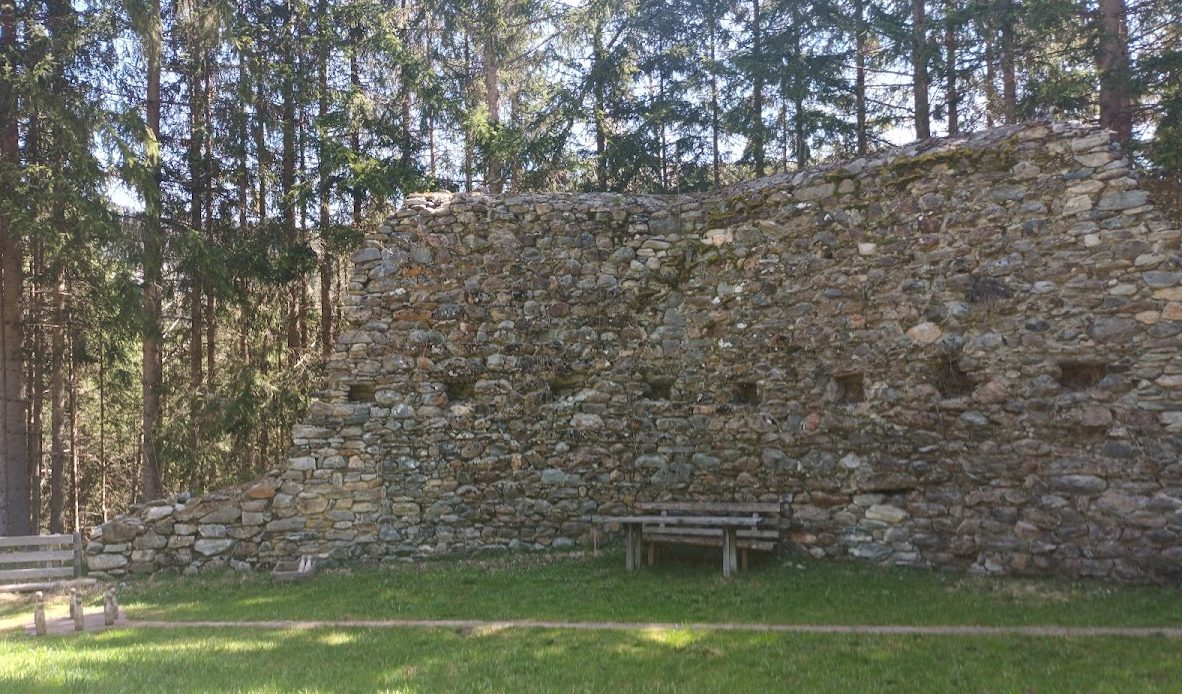
A wall approximately 18 metres long and 7 metres high stands above the steep drop towards the stream. It is built from rough masonry laid in courses. A row of post holes about 3 metres above ground level marks the former support for an intermediate floor, providing evidence of an earlier internal level within the structure.
Interior area and archaeological finds
Within the surviving wall remains is a circular area that forms part of the castle’s interior layout. On its western side, a large section of masonry until recently contained a wide opening leading to an underground chamber. The arrangement has helped preserve the connection between the castle’s enclosing walls and its subterranean spaces. A plan of the castle appears in the work of Friedrich-Wilhelm Krahe.
Weapons and equipment
A knife blade and a support fork for heavy firearms were found in the area of the ruin in 1997. The fork belonged to a type used from the mid-sixteenth century to steady heavy muskets, early firearms that required support while being aimed, and to improve shooting accuracy.
Nearby sites