Ramingstein Schloss Wintergrün: A Former Mining Administration Centre in Austria


Site at a Glance
- Rating
- 4.9
- Popularity
- Very Low
- Country
- Austria
- Primary era
- Medieval
- External website
- Open
- Eras represented
- Medieval, Early Modern
- Civilizations
- Holy Roman Empire
- Site type
- Domestic
- Remains
- Castle
On this page10 sections
History
Ramingstein Schloss Wintergrün is a historic castle in Ramingstein, Austria, first mentioned in 1188 and retaining a Gothic core with Rococo features. Together with Finstergrün Castle, it formed part of a defensive line along the Mur against Styria and later became the administrative centre of the local mining jurisdiction.
Medieval origins and mining administration
In 1188, Otto von Machland transferred his Lungau possessions, including the site of Wintergrün, to the Salzburg Cathedral Chapter. This body of clergy attached to Salzburg Cathedral held extensive landed property in the region and remained the manorial lord of Ramingstein.
The castle acquired a more defined administrative role in 1459, when Archbishop Sigismund von Volkersdorf made the mining area a special mining jurisdiction. Its mining judge could decide most disputes within the district, while cases carrying the death penalty remained under the authority of the district judge at Moosham. Schloss Wintergrün became the administrative centre of this jurisdiction, linking its defensive role with the organisation of mining affairs.
The Moosham and Weitmoser families
The castle became the residence of the Mooshamer family, whose members used the designation “von Mosshaimb zu Ramingstein.” Seyfried von Moosham, the son of Wilhelm von Moosham, and his wife, Helena, Baroness von Teuffenbach, established a chapel dedicated to Saint Helena and the Finding of the Cross. They endowed two weekly Masses and another Mass for the Feast of the Finding of the Cross on 3 May, with the priests accommodated in the castle.
Marriage and inheritance later brought the estate to the Weitmoser family. When Hans Weitmoser died without descendants in 1603, the lordship was divided among the daughters of his brother Christoph Weitmoser. Regina, who was married to Hans Friedrich Fuchs von Fuxberg, received the old Ramingstein Castle. Her husband transferred the Mass endowment to the church of Saint Margareten, which passed it to Nonnberg Abbey in 1664.
Seventeenth- and eighteenth-century changes
Ownership changed repeatedly during the seventeenth century. In 1647 the property went to Wilhelm Carl, Ursula, and Eva Jocher. Andree Salzleitner acquired it in 1658, followed in 1661 by his son Franz and other co-heirs. In 1662, Balthasar Plockh von Arnholz auf Niederaich, the administrator of Mauterndorf, became the owner. He bought the estate to keep the well-built and furnished Saint Helena Chapel together with the property and to prevent it from falling into disrepair. In 1667, he sold the estate to the Ramingstein mining enterprise.
Officials considered using the small castle in 1684 to house a vicar and a sacristan, since its large rooms could support the necessary ecclesiastical functions. The plan was abandoned because the building stood too far from the parish church of Saint Achaz. A court bailiff, an official responsible for court orders and related administrative duties, received temporary accommodation there in 1750 until a separate house could be built.
The building underwent extensive repairs in 1759. On 16 September that year, Archbishop Sigmund von Schrattenbach rededicated the chapel to Saint Helena. He donated relics associated with Saints Urban, Benedict, Crescentius, Deodatus, John Chrysostom, and Daria, granted a forty-year indulgence, and restored the Masses that had not been celebrated since 1699 at the miners’ request. The chapel became an archiepiscopal court chapel, meaning that it was formally attached to the archbishop’s household. Its portable altar was transferred to the mining administrator in Gastein the following year for safekeeping.
Mining decline, fire, and ownership
Mining operations ceased in 1778, and a detailed inventory of the Saint Helena Chapel followed in 1781. Mining resumed in 1806. The imperial-royal mining treasury sold the property to Prince Schwarzenberg in 1825, and in 1827 the Salzburg Saline Directorate transferred the entire complex to the Schwarzenberg chief mining administration at Murau. The property has remained with the Schwarzenberg family since 1827. This prominent Central European aristocratic house held estates and administrative interests in the Salzburg region.
Once the castle was no longer required for mining administration, the Schwarzenberg commissioner gave the chapel keys to Mathias Klettner, the imperial-royal district forester. The Salzburg archiepiscopal consistory objected, creating a legal dispute that continued until the Ramingstein fire. On 26 July 1841, a devastating forest fire ravaged Ramingstein and damaged the castle, although the chapel altar survived.
The south wing was demolished in 1892, and the chapel tower was dismantled. The remaining principal part was the north wing, known as the Verweserhaus, a building associated with a mining superintendent or chief administrator. Recorded Schwarzenberg owners include Josef Schwarzenberg, Johann Adolf in 1840, Adolf Josef in 1900, Johann in 1920, Dr. Adolf in 1940, Dr. Heinrich in 1951, and Dr. Karl Johannes in 1967.
Modern use and protection
Between 1970 and 1973, the building was repaired and renovated. It now accommodates the Schwarzenberg forestry administration and apartments for employees. Its earlier function as the administrative centre of Ramingstein and Lungau mining operations is no longer visibly apparent. Schloss Wintergrün is protected as an architectural monument in Austria under registration number 24389.
Remains
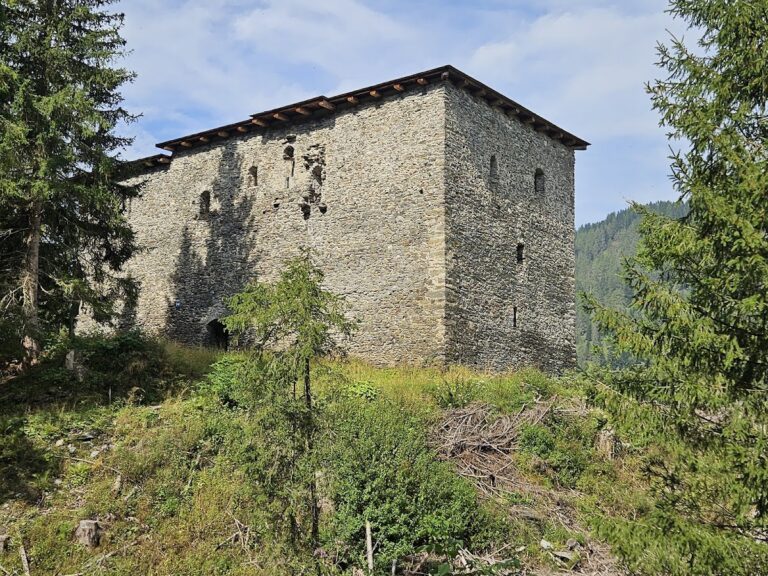
The surviving complex consists principally of a three-storey north wing with a hipped roof. Its Gothic core was reshaped with Rococo features, producing the building known as the Verweserhaus after the demolition of the south wing in 1892. The surviving structure preserves the main architectural mass of the formerly larger castle complex.
North wing and facade
The main facade is articulated by blind pilasters and windows framed by projecting lisene surrounds. A lisene is a narrow, slightly projecting vertical strip resembling a shallow pilaster. The ground floor has rusticated treatment, while the entrance portal is enclosed within a curved frame. These details give the surviving wing its Rococo character while the building’s core remains Gothic in origin.
Saint Helena Chapel
The Saint Helena Chapel formed part of the castle complex and was associated with the Mooshamer family’s religious foundation. It was rededicated in 1759 and later became an archiepiscopal court chapel. The chapel tower was dismantled in 1892, while its altar survived the forest fire that damaged Ramingstein and the castle in 1841.
Demolished south wing
The south wing was removed in 1892. After this intervention, the north wing remained the only surviving principal part of the formerly larger complex, leaving the present building as a reduced form of the historic castle.
Nearby sites