Grafenstein Castle Ruins: A Medieval Hilltop Castle in Austria
Site at a Glance
- Rating
- 5
- Popularity
- Very Low
- Country
- Austria
- Primary era
- Medieval
- Eras represented
- Medieval
- Civilizations
- Holy Roman Empire
- Site type
- Military
- Remains
- Castle
On this page8 sections
History
Grafenstein Castle Ruins are the remains of a Romanesque medieval hilltop castle in Austria, built around 1100 to 1150 on a rocky elevation south of Grafenstein. First mentioned in 1158 as castrum gravenstaine, the castle became the ancestral seat of the Grafensteiner family and an early focus of the settlement’s development.
Foundation and Early Lords
In 1158, Bishop Roman I of Gurk enfeoffed Heinrich V of the Spanheim dynasty, a medieval ruling family associated with Carinthia and neighboring territories, with the estate and farm of Gravindorf. The castle was included in the charter under its Latin name. Since it had no major strategic importance, Heinrich assigned it to his vassals. Heinrich of Truchsen held the castle first, followed by his sons Gottfried and Adalbert, also called Albert, who served as burgraves. A burgrave was an official responsible for administering and defending a castle or fortified settlement.
During the twelfth century, the Grafensteiner family emerged from the Trixen comital family and adopted its name from the castle. Heinrich of Grafenstein took part in a tournament at St. Veit in 1227, where he was defeated by the Austrian poet, knight, and minstrel Ulrich of Liechtenstein. The seal of Rudolf of Grafenstein later became the municipal coat of arms in 1954. It shows a griffin, or wolf, rising from a five-pointed crown.
Decline and Destruction
The settlement connected with the castle grew rapidly into the forum Gravenstein, a medieval market center. As this community expanded, the castle lost its central role. After the Grafenstein comital line died out, the property was pledged during the fourteenth century. It no longer satisfied contemporary defensive needs and had ceased to serve as the settlement’s economic and judicial center.
The castle changed hands several times. Hans Liebenberg acquired it in 1330, and the Kraiger family held it from 1351. The major earthquake of 1348, associated with the collapse of part of the Dobratsch mountain massif in Carinthia, probably brought about the castle’s end. After that event, documents refer to the site as a burgstall, a former or ruined castle site whose buildings were no longer functioning.
Over the next three centuries, the ruin lost all practical importance and deteriorated so extensively that it could no longer serve as an aristocratic residence or military stronghold. On 30 July 1629, Johann Andreas von Rosenberg acquired the lordship of Grafenstein together with the ruin. The forgotten site later became associated in legend with the supposed Schloss Lerchenau and was also known as Burg Altgrafenstein, or the Old Castle.
Excavation and Rediscovery
In the 1920s, the Carinthian castle researcher Franz Xaver Kohla excavated parts of the site and identified sections of a ring wall around the rocky summit. The remains were later reburied and became overgrown, leaving the surviving masonry and ground plan to be read mainly through the physical traces on the rock cone.
Remains
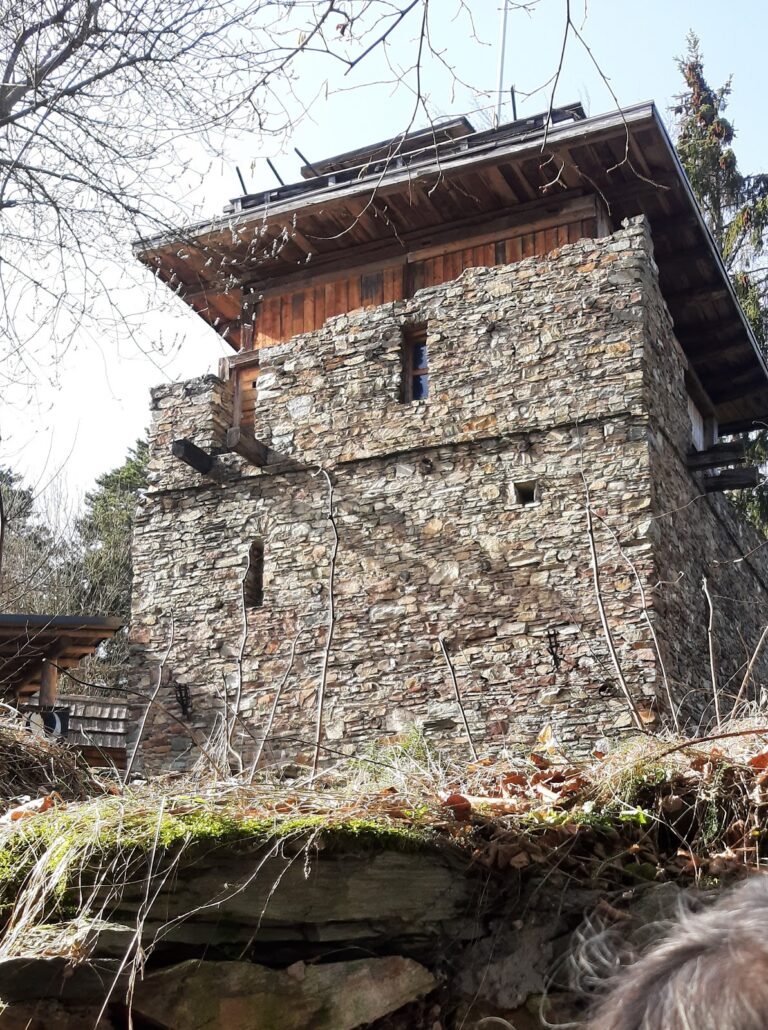
The surviving remains occupy a steep rock cone about 20 metres high on the northern slope of the Skarbin, the easternmost extension of the Sattnitz, south of Grafenstein in the Klagenfurt Basin. The site is accessible naturally from only one side, the north. Its Romanesque ground plan and traces of masonry survive on the elevated formation, while the position of the rock provides a view across the Klagenfurt Basin.
Defences and Rock-Cut Features
Ring Wall
A ring wall once enclosed the rock cone. Excavations in the twentieth century exposed parts of this defensive circuit, but the excavated masonry was later covered again and is now overgrown. Visible traces still help define the castle’s former enclosure and its Romanesque layout.
Caves and Niches
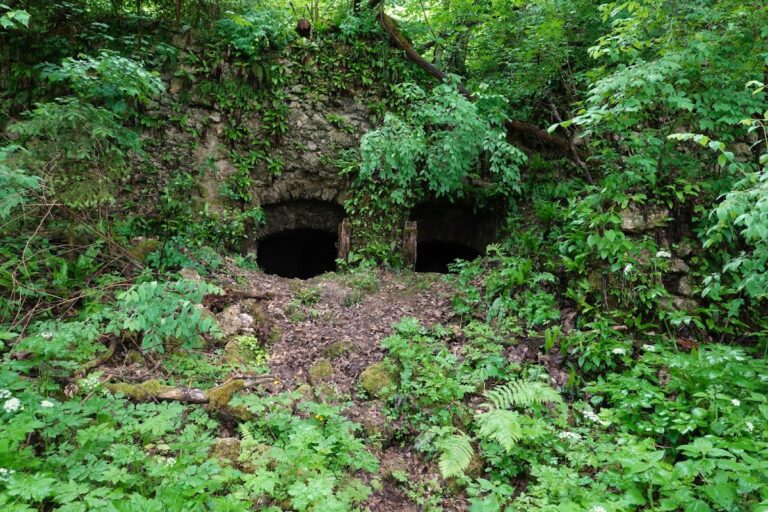
Numerous natural caves and niches occur within the rock. Some appear to have been enlarged by human action, and several contain recognizable masonry remnants. These features form part of the surviving archaeological fabric of the hilltop castle and are closely integrated with the natural rock formation.
Nearby sites