Schloss Gundersdorf: An Eighteenth-Century Manor House in Austria


Site at a Glance
- Rating
- 4.8
- Popularity
- Very Low
- Country
- Austria
- Primary era
- Early Modern
- External website
- Open
- Eras represented
- Early Modern
- Civilizations
- Habsburg
- Site type
- Domestic
- Remains
- Manor House
On this page7 sections
History
Schloss Gundersdorf is an eighteenth-century manor house in Austria, near Klagenfurt am Wörthersee. The present building developed from an earlier agricultural estate around the middle of the eighteenth century, when its owner, Anton von Dreer, expanded the main structure into a residence representing the authority and status of an estate owner. The exterior has remained largely unchanged since that period.
Early agricultural origins
Gundersdorf first appears in a ducal donation document of 1245 under the names Hundreinsdorf or Hundrensdorf. A manor or castle is not documented at the site for many centuries afterward. By the sixteenth century, however, a farm or agricultural estate probably stood there. The property has also been interpreted as having developed from a medieval Edlingerhof, a farmstead associated with free peasants in medieval Carinthia. This proposed earlier estate may have belonged to a nearly enclosed settlement of similar farmsteads.
Creation of the manor
Around the middle of the eighteenth century, Anton von Dreer enlarged the existing main building and transformed it into a manor house, or Herrensitz. The change gave the agricultural property a more formal residence suited to the estate owner while retaining its connection with the surrounding land. A small chapel was built northeast of the house toward the end of the same century.
Changing ownership and later use
Josef Plasch acquired the castle and estate in 1802, and Jakob Ulbing became its owner in 1834. Ownership changed several times toward the end of the nineteenth century, including transfers to Alfred von Offermann and Reinhold von Mohrenschildt. In the early twentieth century, Johann Tauschitz acquired the property, and his family retained it until 1964, when it passed to the Horner family.
The Horners restored the interiors in 1973 and later used the building as a guesthouse. Schloss Gundersdorf remains privately owned and serves agricultural and commercial purposes. The Republic of Austria protects it as a monument under number 12513.
Remains
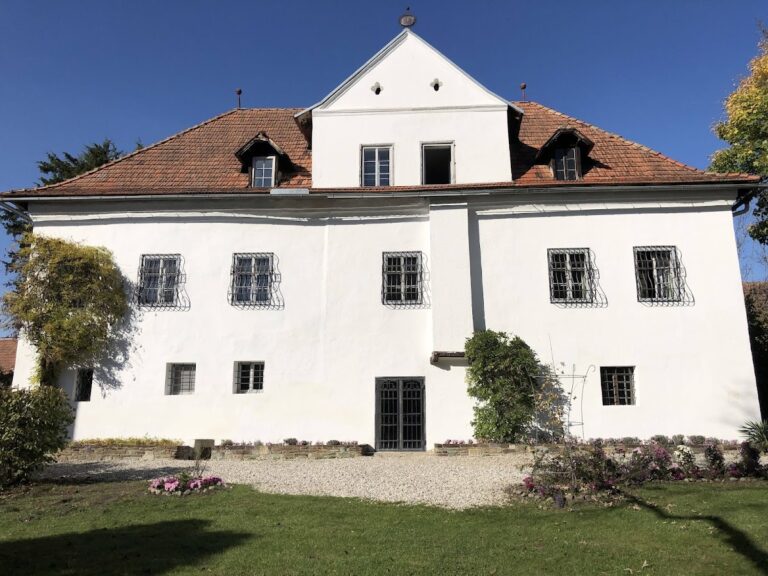
Schloss Gundersdorf stands in a large park at the foot of Sechzigerberg, beside the road between Klagenfurt and Brückl. The representative two-storey building has a horseshoe-shaped plan, with a long central block and two short wings projecting toward the front. These wings enclose a small courtyard. Agricultural buildings beside the house remain in use, preserving the estate’s continuing connection with farming.
Main manor building
The south-facing principal facade is organized around a central triangular pediment containing a clock. Four broad basket-arched arcades remain open at ground level, while six narrower arcades above are closed with glazing. The upper-storey windows have frames and projecting hoods. A further level is indicated by small, low rectangular windows, which show that it formerly served as a grain store. Plastered rustication, a treatment that emphasizes masonry joints or corner blocks, marks the corners of the main building and the outer corners of the wings. The largely undecorated north facade is arranged in eleven window axes, meaning vertical bays organized around windows.
Chapel and estate buildings
The small chapel northeast of the castle was built toward the end of the eighteenth century. It contains a life-size Crucifix. Together with the nearby agricultural buildings and the park setting, the chapel forms part of the surviving physical arrangement of the estate.
Nearby sites