Burg Oberschüpf: A Medieval Spur Castle in Germany
Visitor Information
Google Rating: 4.6
Popularity: Very Low
Official Website: www.mobile-geschichte.de
Country: Germany
Civilization: Medieval European
Site type: Military
Remains: Castle
History
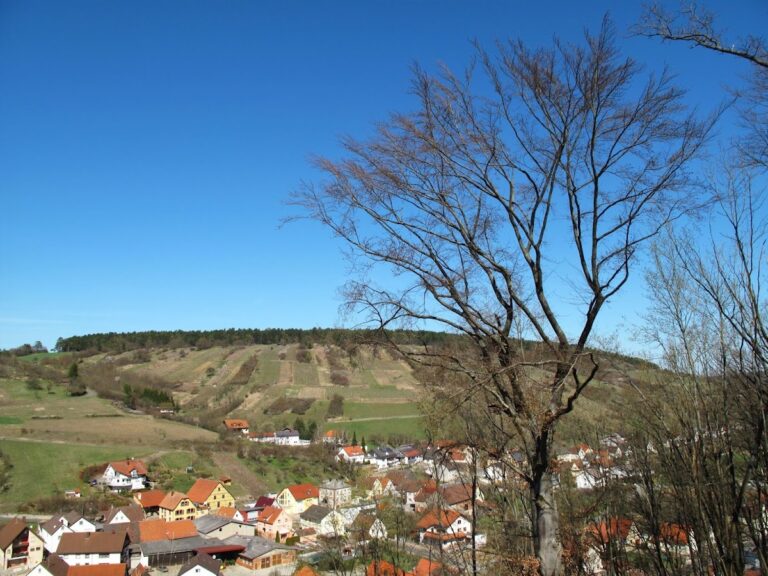
Burg Oberschüpf is located above the village of Oberschüpf within the municipality of Boxberg in present-day Germany. This castle was constructed by medieval builders near the end of the 12th century, belonging to the Holy Roman Empire’s feudal society. It is an example of a spur castle, built on a projecting ridge of land for defensive purposes.
The earliest documentary mention of Burg Oberschüpf dates from the early 13th century, when it was established as the residence of the first Schenk (a medieval court office roughly translated as “cupbearer”) of Schüpf. The Schenk family held the castle and its lands, using it as their stronghold and administrative center. By 1235, the descendants of the original Schenk had pledged the castle to the Counts of Hohenlohe, a notable noble family of the region, indicating a shift in political control.
Ownership changed again in the 14th century when the castle passed from the Hohenlohe family into the hands of the Lords of Rosenberg. This noble house founded a branch of their lineage at Schüpf, maintaining the castle as their seat. Later, the estate transferred to the Lords of Tottenheim, who managed it until their line ended in 1556. During these centuries, the castle was part of the complex feudal power dynamics typical of southwestern Germany.
Significant military action occurred around 1470 when Burg Oberschüpf was almost completely destroyed by allied forces comprising Elector Frederick I of the Palatinate, Prince-Bishop Rudolf of Würzburg, and Archbishop Adolf of Mainz. This coalition’s attack reflects the turbulent political landscape of the late Middle Ages, though the castle does not appear to have been rebuilt afterward. Excavations beginning in 1888, supported by the Grand Duchy of Baden, uncovered numerous artifacts from the castle’s past, including finely crafted Romanesque sculptures now preserved in the Badisches Landesmuseum Karlsruhe and the local Heimatmuseum Boxberg.
Remains
The ruins of Burg Oberschüpf occupy a roughly oval-shaped spur, about 304 meters above sea level, overlooking the village below at around 230 meters in elevation. The castle is strategically positioned where a small stream flows into the Schüpfbach river, with natural features enhancing its defense. It is separated from the adjacent western ridge, called Burgwald, by two deep ditches cut into the solid limestone rock known as Muschelkalk. These ditches served as formidable obstacles to potential attackers.
Access to the site is provided by a pathway running along the upper southern edge of the neck ditch, which cuts off the castle from the mountain ridge. Although the grounds are now heavily overgrown, this path marks the route once used to reach the inner castle area. The terrain surrounding the fortress drops steeply on all sides, emphasizing the site’s natural defensibility.
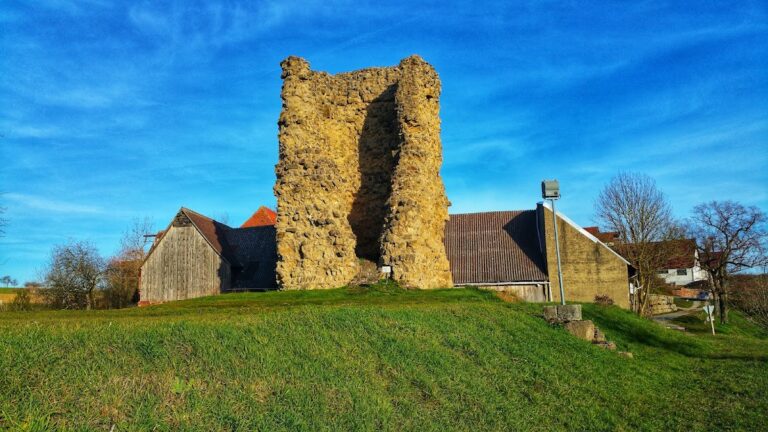
Archaeological work has uncovered the foundations of the castle’s original structures, revealing their layout and size. There are notable remnants of walls covered in vegetation, as well as earthworks that once formed part of the castle’s fortifications. Among these remains are the base walls of a bergfried, the main tower or keep typical of medieval German castles, designed as a last refuge in case of attack. The bergfried’s foundation walls are partially preserved, though no elaborate decorations or inscriptions have been recorded.
Excavations have brought to light architectural sculptures in the Romanesque style, suggesting a level of refinement and artistic craftsmanship in the castle’s original construction. These sculptures are now curated in regional museums, highlighting the site’s historical and cultural value. The earthworks and worn footpaths visible on the site today provide further evidence of the castle’s former presence and layout despite centuries of decay and natural overgrowth.