Merenberg Castle: Medieval Hilltop Castle Ruin in Germany


Site at a Glance
- Rating
- 4.6
- Popularity
- Low
- Country
- Germany
- Primary era
- Medieval
- External website
- Open
- Eras represented
- Medieval
- Civilizations
- Holy Roman Empire
- Site type
- Military
- Remains
- Castle
On this page7 sections
History
Merenberg Castle is a medieval hilltop castle ruin in Germany, first documented in 1129, on the 337-metre Schlossberg above the municipality of Merenberg in central Hesse. A hilltop castle was a fortified residence or stronghold built on elevated ground for defense and visibility. From 1163, the castle lay under the lordship of Gleiberg, while the Merenberg family retained certain judicial and comital rights.
Lordship and noble administration
In 1333, the castle passed through marriage to the Nassau-Weilburg line, a branch of the House of Nassau, and became a summer residence. From the thirteenth or fourteenth century, lower-noble castle guards, known as castle men, occupied the site. Members of the Schütz von Holzhausen family were among them. During the sixteenth and seventeenth centuries, an Amtmann, an official administering a territorial district for a higher lord, held office at the castle.
Destruction and heritage status
Merenberg Castle was destroyed in 1646 during the Thirty Years’ War, a major European conflict fought from 1618 to 1648. Its surviving ruins are recognized as a cultural heritage monument in Hesse.
Remains
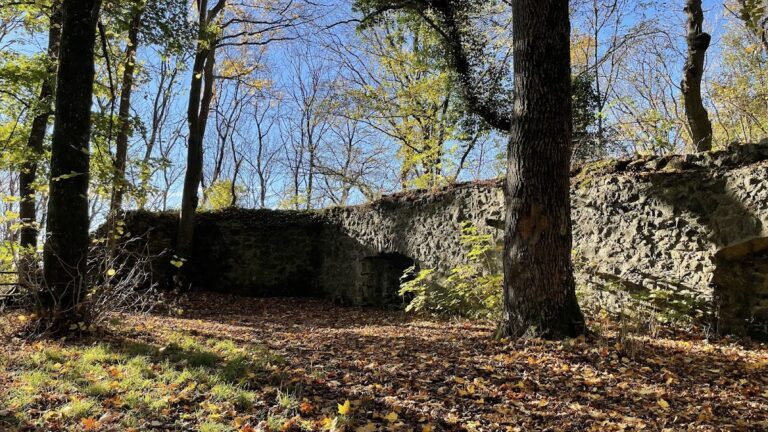
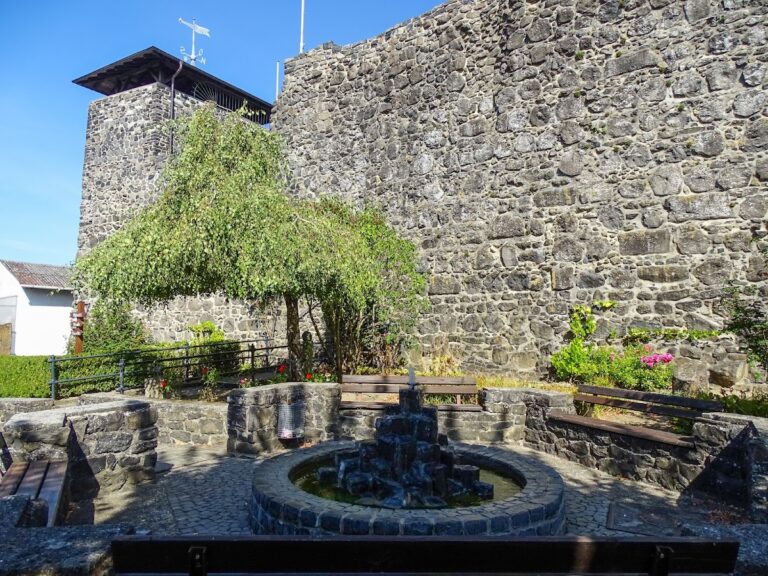
The remains stand on a basalt cone above Merenberg. Parts of the medieval walls, exterior walls, cellars, keep, and palas survive. The keep was the principal tower of a medieval castle, while the palas was its main residential and representative building.
Castle tower and residential buildings
Round keep
The round keep survives as a 22-metre-high tower. It can be climbed, and its preserved height reflects the tower’s dominant role among the remaining castle structures.
Palas and enclosing walls
A corner of the three-storey palas remains alongside parts of the castle walls, exterior walls, and cellars. These fragments preserve elements of both the castle’s residential building and its defensive enclosure.