Burg Hof am Regen: A Medieval Tower Castle in Bavaria


Site at a Glance
- Rating
- 4.3
- Popularity
- Very Low
- Country
- Germany
- Primary era
- Medieval
- External website
- Open
- Eras represented
- Medieval
- Civilizations
- Holy Roman Empire
- Site type
- Military
- Remains
- Castle
On this page11 sections
History
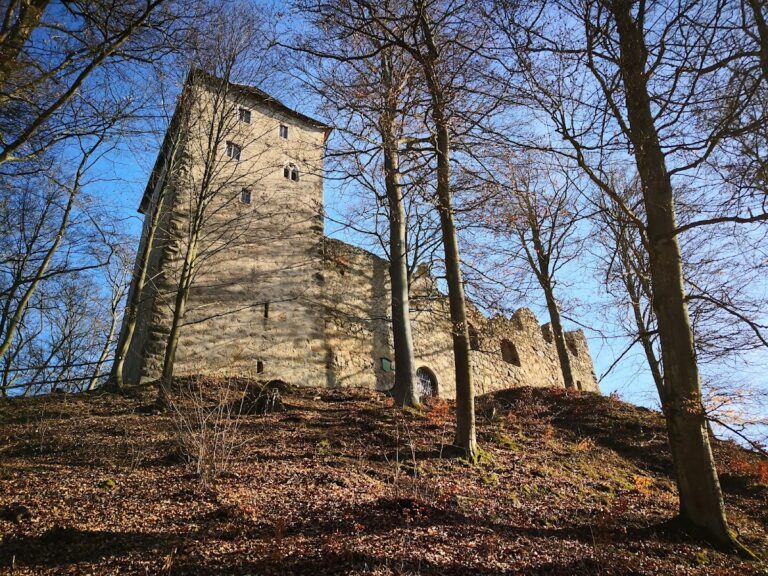
Burg Hof am Regen is a ruined medieval castle in Germany, now within Nittenau in Bavaria, whose origins date to around 1150. Its earliest core was a Romanesque building, reflecting the medieval style of heavy masonry and substantial walls. The castle served as the seat of the Hofer noble family and the centre of a closed Hofmark, a territorial estate whose lord held lower judicial authority over its inhabitants.
The Hofer family
The Hofer family first appears around 1150 as ministerials of the Wittelsbach dynasty. Ministerials were legally unfree service nobles who performed administrative, military, and courtly duties for rulers and other powerful lords. By the middle of the thirteenth century, members of the family had gained important political positions.
A dispute within the family divided it in 1340 into the Hofer of Hof and the Hofer of Lobenstein. In that year, Otto and Dietrich Hofer withdrew to Lobenstein. Both remained vassals of the Palatine rulers. During the fifteenth century, another branch adopted the name Hofer of Sünching, while other family members were established at Sengersberg, Drachenstein, Hirschling, and Triftlfing. Hiltprand of Hof, mentioned in 1481 and entered in the oldest Landsassen register in 1488, is the last recorded member of the family at the castle. A Landsassen register was an official record of landed nobles and estates subject to a territorial ruler.
Later ownership and protection
In the eighteenth century, the castle and the Hofmark passed to the Counts of Thürheim and the Lords of Fischbach. In 1801, both properties came into the possession of Lieutenant General Wilhelm Karl, Count of Eckart. They later passed to his grandson, Count Du Moulin-Eckart.
Burg Hof am Regen is now preserved as a ruin and is registered in Bavaria as a protected architectural monument. Archaeological protection also covers finds and buried remains in the castle area, including earlier structures or predecessors of the surviving buildings and fortifications.
Remains
The ruined complex is arranged with a southern outer bailey and a northern main castle. Its surviving masonry, underground remains, and partly preserved moat reveal a fortified settlement that developed around a substantial central building.
Main castle and chapel
Romanesque tower chapel
The main castle consists chiefly of a twelfth-century Romanesque rural church. Two secular upper storeys were added later above the former church, providing residential and utilitarian space and transforming the building into a tower castle. The church is now a restored chapel. Its apse, the usually semicircular terminal space behind the altar, contains frescoes dating from the second half of the fifteenth century. These wall paintings were made on wet plaster.
Defensive masonry
Walls measuring up to 2.50 metres thick and several loopholes demonstrate the defensive character of the complex. A loophole is a narrow opening that allowed weapons to be used from behind the protection of a wall. The fortifications survive together with buried sections of earlier buildings and defensive works.
Outer bailey and associated buildings
Southern outer bailey
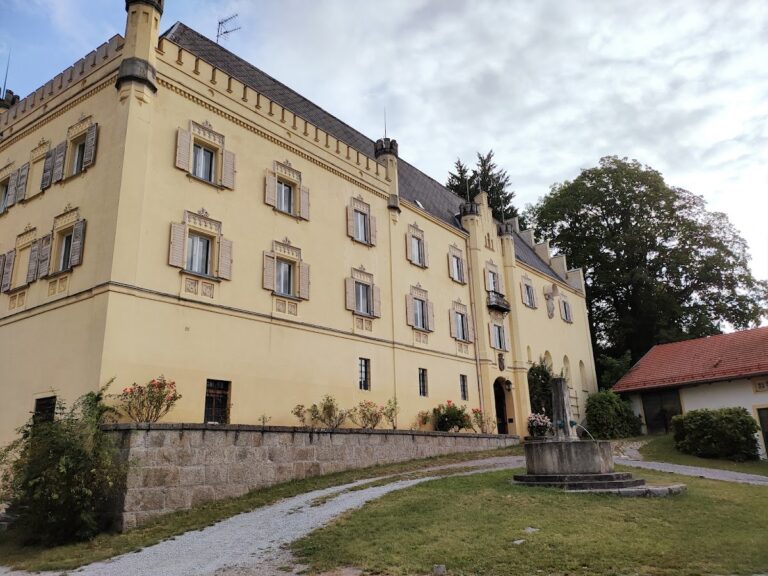
The southern outer bailey forms the second principal part of the complex. The documented castle buildings and associated structures extend across Hof am Regen 22 and numbers 38 to 56. They include residential buildings, a brewery, and separately identified castle structures at numbers 38, 40, 42, 46, 48, 52, and 56.
Archaeological remains
Buried structures and moat
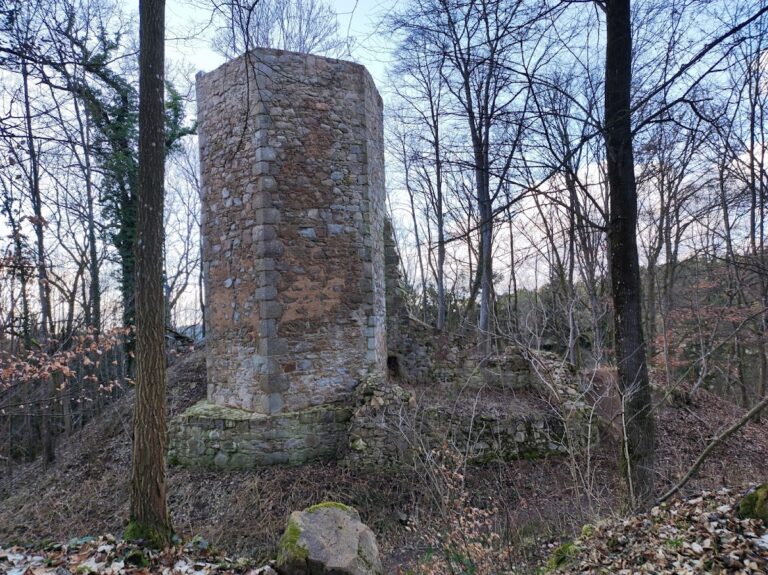
Below and around the standing ruins are underground parts of earlier buildings and castle fortifications. The castle moat survives partly as a terrain monument, preserving a physical element of the former defensive layout alongside the ruined buildings.
Nearby sites