Castle of Anguix: A Medieval Rock Fortress in Spain


Site at a Glance
- Rating
- 3.6
- Popularity
- Very Low
- Country
- Spain
- Primary era
- Medieval
- External website
- Open
- Eras represented
- Medieval
- Civilizations
- Crown of Castile, Spanish
- Site type
- Military
- Remains
- Castle
On this page7 sections
History
Castle of Anguix is a medieval rock fortress in Spain, above the Bolarque Reservoir within the municipality of Sayatón, Guadalajara. Martín Ordóñez commissioned the present castle around 1160 on the site of an earlier stronghold, continuing its role in the defense of the Tagus frontier during the twelfth century.
Frontier fortress and the Order of Calatrava
A fortress at Anguix was already mentioned in chronicles from the reign of Abd al-Rahman III, the tenth-century emir and later caliph of Córdoba whose reign encompassed political and military developments in al-Andalus. In 1136, Alfonso VIII of Castile ceded Anguix to Martín Ordóñez for the defense of the Tagus frontier. The castle’s frontier role is associated with the period from about 1160 to 1170.
After Martín Ordóñez died, his widow, Sancha Martínez, donated the castle to the Order of Calatrava. This military religious order had been founded in medieval Castile to defend Christian territories and frontier settlements. The transfer placed Anguix within an institution closely connected with the military organization of the region.
Royal and noble ownership
In 1328, Alfonso XI of Castile gave Anguix to his royal huntsman, Alfón Martínez. Alfón Martínez’s son later married into the Carrillo family of Huete, which inherited the castle. In 1464, Enrique IV of Castile bought back the castle and village before selling them in 1484 to Íñigo López de Mendoza y Quiñones, the second Count of Tendilla and first Marquis of Mondéjar.
The castle suffered extensive damage during the War of the Castilian Succession, a fifteenth-century conflict over the Castilian throne between supporters of Juana of Trastámara and Isabel of Trastámara. The Count of Tendilla then began its reconstruction. Anguix subsequently remained in the possession of the Marquises of Mondéjar for several centuries.
War, decline, and modern status
During the War of the Spanish Succession, an early eighteenth-century European conflict over the Spanish monarchy, Austrian troops damaged and occupied the castle in 1710. Troops of Philip V, the first Bourbon king of Spain, later recaptured it.
In 1847, the castle was acquired by a resident of Brihuega. Repeated sales of the village and castle followed, ending in 2005 when the property was sold to a company that fenced the estate and intended to develop it as a luxury hunting operation. Castle of Anguix is privately owned, lies in ruins, and is no longer in use. Spain declared it a Cultural Heritage monument, or Bien de Interés Cultural, in 1992.
Remains
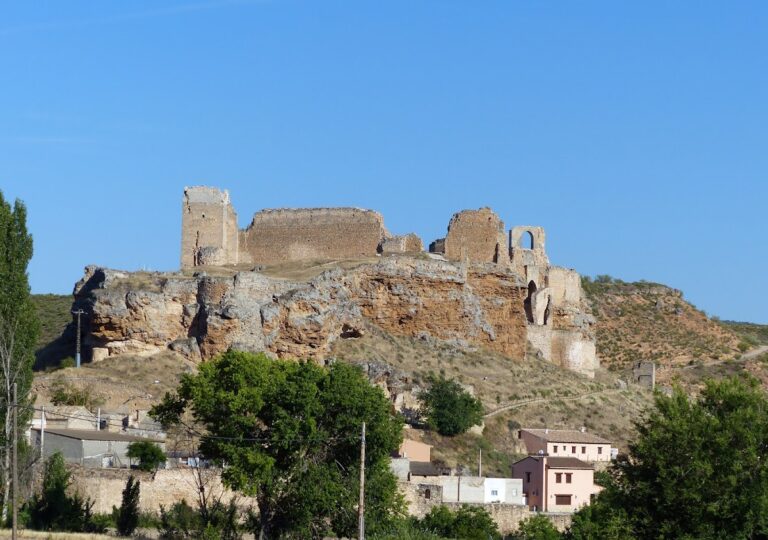
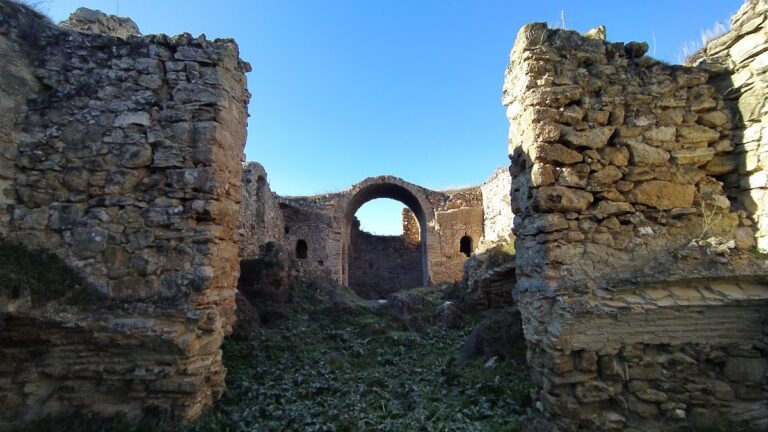
The fortress occupies a rocky crag above the Bolarque Reservoir, where steep terrain forms part of its defensive setting. Its roughly 90-metre perimeter encloses a compact medieval stronghold built in ashlar stone, with walls approximately 1.5 to 2 metres thick. The surviving exterior principally reflects reforms of the fourteenth and fifteenth centuries, when the plan changed from a parallelepiped, a four-sided elongated form, to a pentagon.
Walls and corner defenses
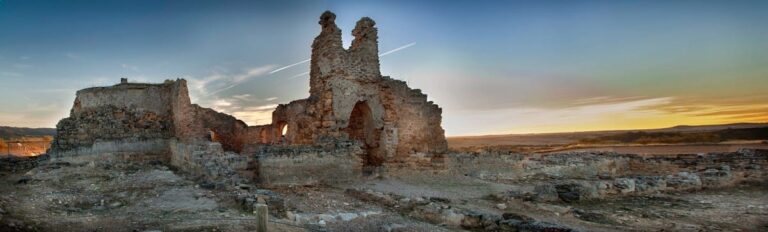
Nearly 10 metres of the former height remain. Cylindrical structures terminate the corners and give the fortress a strong, rounded defensive outline. The eastern side is in advanced deterioration, with the eastern wall almost completely collapsed, while portions of the battlements survive only in fragmentary form. The castle nevertheless retains its principal exterior elements and conveys the constrained layout of a fortress adapted to a narrow rocky site.
Keep and surviving inscription
The limited construction area caused the keep to dominate the complex from the south. A segmental-arch window opens in its southern wall at the level of the main floor. Above the window, traces remain on an upper ashlar block from a long inscription that apparently referred to the name Anguix. The keep also preserves fragmentary portions of its battlements.