Kurama-dera Temple: A Mountain Buddhist Temple in Kyoto


Site at a Glance
- Rating
- 4.6
- Popularity
- Medium
- Country
- Japan
- Primary era
- Modern
- External website
- Open
- Eras represented
- Modern
- Civilizations
- Japanese
- Site type
- Religious
- Remains
- Monastery
On this page22 sections
History
Kurama-dera Temple is a Buddhist temple in Japan on the southern slope of Mount Kurama, north of Kyoto. Its traditional foundation date is 770, when Kantei, a monk of the Ritsu school and a disciple of Jianzhen, is said to have built a hermitage and enshrined Bishamonten. The temple later became associated with Shingon and Tendai Buddhism before becoming the head temple of the independent Kurama Kōkyō religious movement in 1949.
Foundation traditions
The temple’s formal name is Kurama-yama Kurama-dera. Its traditional foundation story says that Kantei dreamed of a white horse carrying a jeweled saddle in 772. He then reached Mount Kurama and discovered an image of Bishamonten after a miraculous encounter with a demon. The historical reliability of this account is uncertain.
A separate tradition places the establishment of the temple in 796. In this version, Fujiwara no Isendo, an official connected with the construction of Tō-ji, followed a dream to a small Bishamonten hall on Mount Kurama. He founded a temple after placing a Thousand-Armed Kannon beside Bishamonten. A related entry in the Later Chronicle of Japan links Isendo’s foundation with a revelation from the deity of nearby Kifune Shrine.
Shingon and Tendai affiliations
During the Kanpyo era, approximately 889–897, the Tō-ji monk Buen entered Kurama-dera and restored its affairs. The temple became a Shingon Buddhist institution, a tradition centered on ritual, mantra, and mandala practice. In the twelfth century, the Tendai monk Jūi entered the temple, and during the Hoen era, approximately 1135–1140, Kurama-dera adopted Tendai Buddhism. It subsequently came under the authority of Shoren-in, a major Tendai temple in Kyoto. Tendai Lotus, esoteric, and Pure Land practices became part of its religious life.
Kurama-dera attracted notable visitors during the late Heian period. Emperor Shirakawa worshipped there in 1091, while the regent Fujiwara no Moromichi visited in 1099. The Pillow Book used the temple’s winding approach, known as the “Ninety-Nine-Bend Pilgrimage Path,” as an example of something that was near yet difficult to reach.
Fires repeatedly damaged the temple, including a major conflagration in 1126, but the complex was restored after these disasters. Its warrior monks were reputed in the Heian period to be fewer than those of Enryaku-ji but more courageous. A late-Heian tradition also holds that Minamoto no Yoshitsune, then known as Ushiwakamaru, trained at Kurama and learned military arts from the mountain tengu, legendary beings associated with supernatural powers.
Subordination, decline, and rebuilding
In 1229, the abbot of Shoren-in also became chief administrator of Kurama-dera, formally making it a subordinate temple of Shoren-in. The temple became subordinate to Nikko Rinno-ji as well in 1730, when the complex contained ten subtemples and nine monks’ residences. A great fire in 1814 began a period of decline. In 1855 Kurama-dera became subordinate solely to Nikko Rinno-ji, and in 1868 it again became a subordinate temple of Shoren-in.
Restoration continued after the Meiji-era suppression and separation of Buddhism from Shinto. In 1945, the main hall and other buildings burned. The present structures consequently belong to the modern period, while many Buddhist statues and other cultural treasures survived. From 1919, Shigaraki Shinjun began restoring the temple after the damage caused by fire and religious reforms.
Kurama Kōkyō and religious traditions
Kurama-dera’s earlier Tendai worship centered on Bishamonten and the Thousand-Armed Kannon. Its present doctrine joins these figures with the Defender Lord as Sonten, a threefold unity. The temple describes Sonten as the cosmic energy sustaining all life: Bishamonten represents light and the Sun, Kannon represents love and the Moon, and the Defender Lord represents power and the Earth.
The temple identifies the Defender Lord with Sanat Kumara, who is said to have descended from Venus to Earth 6.5 million years ago and to remain eternally sixteen years old. The three principal images are concealed and opened only once every sixty years in a Hinoe-Tora year, a designation in the traditional sixty-year calendar. Substitute images are displayed before their sanctums.
Kurama-dera became the head temple of Kurama Kōkyō, an independent religious movement, in 1947. In 1949 it separated from Tendai Buddhism. The temple’s observances include the Spring and Autumn Repayment Ceremonies, the New Year’s First Tiger Festival, the traditional Setsubun exorcism rite, the May Full-Moon Festival, the Bamboo-Cutting Ceremony, the Yoshitsune Festival, and an autumn festival commemorating the proclamation of Kurama Kōkyō.
A bronze vessel inscribed with the date 1450 shows that the May Full-Moon Festival was already practiced by that year; the ceremony was opened to the general public in 1947. The Bamboo-Cutting Ceremony recalls the tradition that Buen subdued a male serpent through religious power. Participants divide into the Omi and Tamba groups and cut green bamboo representing the serpent in a speed contest. Bamboo representing a female serpent, believed to protect Mount Kurama’s water, is planted rather than cut.
Mountain worship and associated shrines
Mount Kurama has long been linked with mountain worship, the ascetic practices of yamabushi, mountain spirits, and tengu. Its highest-ranking tengu is traditionally called Sojobo. The mountain is also associated with Minamoto no Yoshitsune and with the Noh play Kurama Tengu.
In 940, Yuki Shrine was transferred from the imperial palace to the foot of Mount Kurama and became Kurama-dera’s guardian shrine. Its fire festival was once associated with the temple, although Kurama-dera does not organize it today. The temple is the nineteenth stop on the New Saigoku Thirty-Three Kannon Pilgrimage and the 103rd temple on the Pilgrimage of the Temples and Shrines of the Gods and Buddhas.
Remains
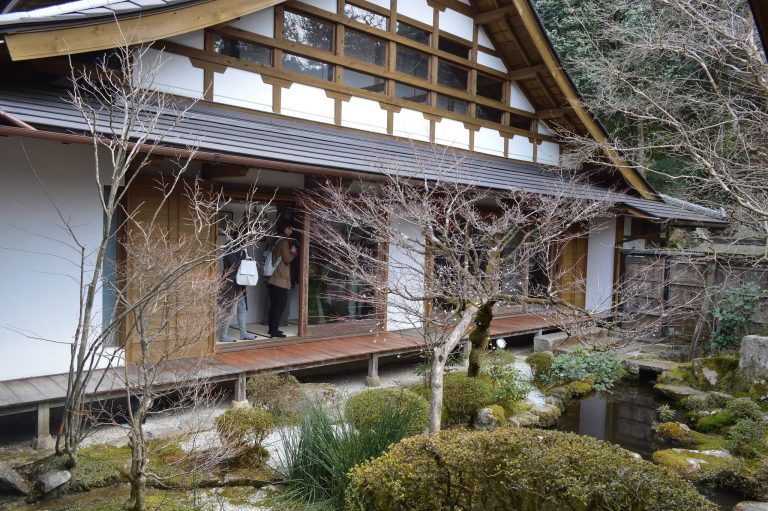
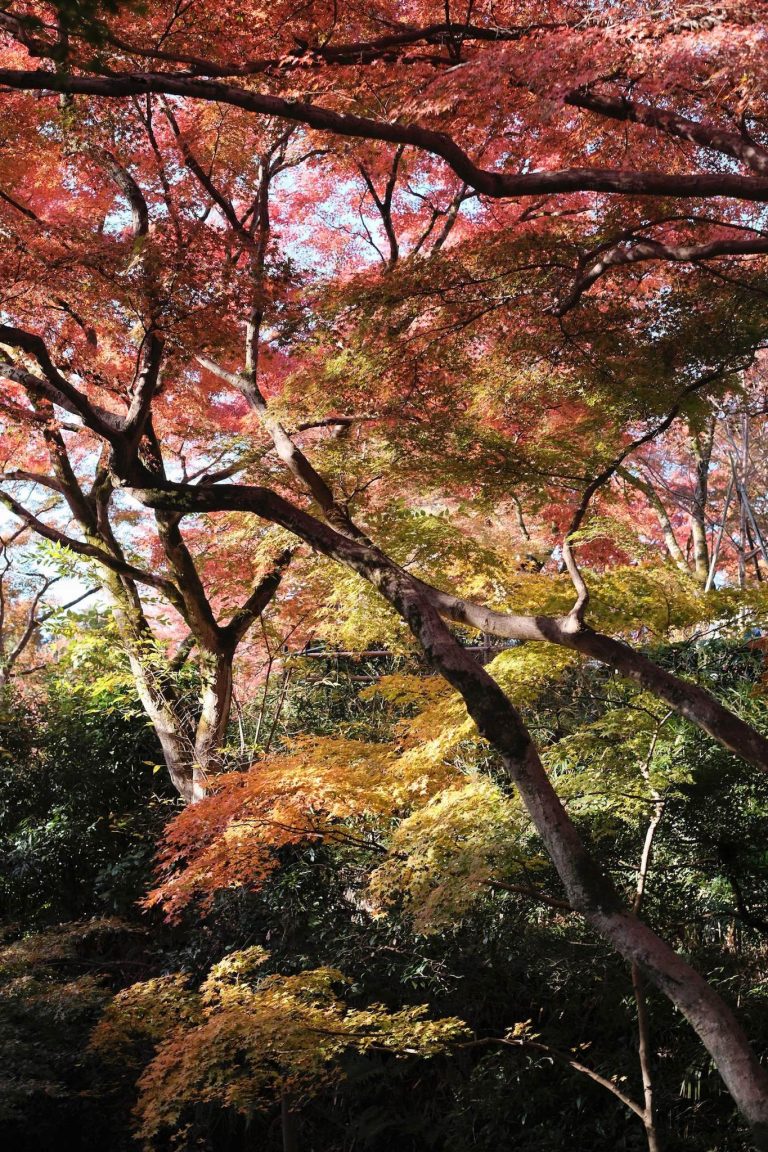
Kurama-dera occupies a wooded, relatively secluded setting on the southern slope of Mount Kurama, a 570-metre mountain north of the Kyoto Basin. The precinct extends through the mountain landscape and is linked by the Kurama-dera Cable, a cable railway operated by the religious corporation. Its route rises from the entrance gate through a steep, winding forest approach to the upper precinct, where the principal hall stands on the highest level.
Entrance and pilgrimage path
Niomon Gate
The entrance is the Niomon, or Two Guardian Kings Gate, a large tower gate. After burning in 1881, it was rebuilt in 1911. Its guardian statues are attributed to Tankei, the eldest son of the sculptor Unkei, and were transferred to Kurama from Tamba during the rebuilding.
Tsuzura-ori Pilgrimage Path
From the Niomon to the Middle Gate, the approach follows the steep, repeatedly winding Tsuzura-ori Pilgrimage Path, also called the “Ninety-Nine-Bend Pilgrimage Path.” The path forms the principal connection between the entrance and the higher levels of the mountain precinct.
Upper precinct
Main Hall
The Main Hall occupies the temple’s highest level and is enclosed by a retaining wall. The present reinforced-concrete building was constructed in 1971. It houses the threefold Sonten arrangement of the Thousand-Armed Kannon, Bishamonten, and the Defender Lord. Because the principal images are concealed, substitute images are displayed before their sanctums.
Shoundai
In front of the Main Hall, a circular elevation called the Shoundai is paved with slabs reused from the cover stones of a sutra mound excavated behind the hall. A sutra mound is an underground deposit intended to preserve Buddhist scriptures or related devotional objects.
Akaigohouzen Guardian Shrine
The Akaigohouzen Guardian Shrine stands to the right of the Main Hall. It enshrines Akaigohouzen, who is credited with healing Buen with water from Mount Kurama after the monk was bitten by a large serpent.
Komyoshinden and Kongojumyo-in
The Komyoshinden stands to the left of the Main Hall. Its pyramidal roof covers a space used for goma fire ceremonies, in which offerings are burned before a sacred fire. Farther left is the abbot’s residence, whose principal building is Kongojumyo-in.
Temporin Hall and Shinden
On the level below the Main Hall are the Temporin Hall and the guest quarters known as the Shinden. The name Temporin refers to the turning of the wheel of the Buddha’s teaching.
Reihoden and surviving collections
Treasure house and museum
West of the upper precinct, across a road, stands the Kurama-yama Reihoden treasure house and museum. Its ground floor is a natural-history museum with rocks, fungi, insects, shells, and plants. The first floor contains temple treasures, while the second floor contains Buddhist sculptures.
Heian and Kamakura-period objects
The Reihoden contains a bronze lantern bearing an inscription from the Shoka era, approximately 1257–1259. The lantern once stood before the Main Hall. The collection also includes a stone treasure pagoda, a sutra container dated 1120, a fragment of a gilt-bronze repoussé bodhisattva image, and other objects from the Heian and Kamakura periods.
Buddhist sculpture
Among the sculptures is a Heian-period wooden group of Bishamonten with Kisshōten and Zennishi-doji. The large Bishamonten holds a trident in his right hand and raises his left hand as though looking into the distance. Known as “Protector of the Realm,” the figure is accompanied in the collection by a Heian-period wooden Bishamonten guardian image and a wooden Kannon image dated 1226.
Defender Lord image
The substitute image of the Defender Lord has wings, a long beard, a prominent nose, and a leaf-shaped halo, giving it the appearance of an aged hermit. A similar image is housed in the temple’s pagoda. This form is connected with the local tradition of the tengu.
Yosano memorial stone
Beside the treasure house stands a memorial stone for the poets Yosano Tekkan and Yosano Akiko. Its front carries the inscription “Tōhaku-tei,” the name of Akiko’s writing pavilion. Her pupils erected the stone in 1929 for her fiftieth birthday, and it was moved to its present location in 1976.