Usa Jingū: Head Shrine of the Hachiman Tradition in Japan


Site at a Glance
- Rating
- 4.5
- Popularity
- Medium
- Country
- Japan
- Primary era
- Early Modern
- External website
- Open
- Eras represented
- Early Modern
- Civilizations
- Tokugawa
- Site type
- Religious
- Remains
- Sanctuary
On this page24 sections
History
Usa Jingū is a Shinto shrine in Usa, Japan, built and developed through the religious traditions of the Usa region from the sixth to the nineteenth century. Also known as Usa Hachimangū or Usa Hachiman, it is regarded as the head shrine of approximately 44,000 Hachiman shrines and has long received Imperial patronage. Hachiman is a Shinto kami associated especially with warfare and the protection of warriors; at Usa, he is identified with Emperor Ōjin, a legendary early Japanese emperor.
Origins and the Three Sanctuaries
The shrine’s foundation is represented by several traditions. One places the appearance of a smith-like figure between Umamine and Hishigata Pond during the reign of Emperor Kinmei, around 571. Ōga no Higi is said to have received a revelation identifying the figure with Emperor Ōjin as Hachiman. Other traditions associate the earliest shrine with the Wadō era, from 708 to 714, while Takai Shrine is said to have been built between 588 and 592.
The earliest religious setting may have involved the Usa clan’s worship of sacred rocks on Mount Omoto. The Karashima clan is associated with the development of worship devoted to Hime-no-Okami, meaning Hime Great Kami. At Usa, this title refers to the three Munakata goddesses, traditionally associated with maritime protection. The Karashima clan later established several shrines around the Karashima area, including Inazumi, Otome, Sakaizumi, and Gose shrines.
The first sanctuary on Mount Kame, now the site of the Upper Shrine, was built in 725. A second sanctuary followed in 729, and a third was added in 823. Together they formed the three-sanctuary arrangement that remains central to Usa’s religious identity. In 740, the imperial general Ōno no Azumabito prayed at Usa before the decisive stage of the Fujiwara no Hirotsugu Rebellion. Three years later, shrine officials carried a divine oracle to the capital and supported construction of the Great Buddha at Tōdai-ji, strengthening the shrine’s ties with the Imperial court.
Imperial Authority and Heian-Era Expansion
In 769, the Usa Hachiman Oracle Incident brought the shrine into a dispute over imperial succession involving the monk Dōkyō. The oracle was consulted in the controversy, and the episode increased Usa’s importance as an imperial religious center, second in prestige to Ise Shrine.
During the Heian period, the shrine was listed in the Engishiki, a government register of institutions and rites. Its three principal shrines were all ranked as major Myōjin-taisha shrines. The three were identified as Hachiman Great Bodhisattva Usa Palace, Hime Shrine, and the Great Empress Shrine. Usa was the ichinomiya, or highest-ranking shrine, of the former Province of Buzen and was historically treated, together with Ise Shrine, as one of the two imperial ancestral shrines.
During this period, the Ōga family divided into warrior and other lineages, and the Usa family assumed the vacant chief-priestly office. Usa, together with Miroku-ji, developed into one of the largest estate-holding institutions in Kyushu. Shrine officials and administrators also acted as warriors, frequently coming into conflict with powerful families in Buzen and Bungo.
War, Estates, and Medieval Patronage
During the Genpei War, a conflict between the Taira and Minamoto forces in the late twelfth century, the chief administrator Usa Kimimichi supported the Taira. Taira Munemori and other members of the Taira family temporarily sought refuge at his residence with Emperor Antoku. Forces associated with Ogata Koreyoshi later burned the shrine. A sacred object was seized during the attack, recovered afterward, and placed under the administration of Iwashimizu Hachimangū by imperial decision.
During the Mongol invasions of the Kamakura period, Usa performed protective rites like other major religious institutions. Usa Kimiyo restored the shrine’s estates and was revered as a restorer of its fortunes. His son, Usa Korenobu, participated in the overthrow of the Kamakura shogunate and later in efforts to support Prince Kaneyoshi.
The hereditary chief administrators were initially drawn from the Ōga family. The office later passed through other hereditary families, including the Oyamada family, before returning to the Usa lineage. Within that lineage, the Miyanari, Itōzu, Iwane, and Ajimu families contested and alternated in holding the office. From the late Kamakura period until the Meiji era, the Miyanari and Itōzu houses became the principal successors.
Shinbutsu-Shūgō and the Spread of Hachiman Worship
Miroku-ji, a Tendai Buddhist temple, was established beside the shrine in 779. The combined institution, known as Usa Hachimangū-ji, continued for more than a millennium. A jingū-ji was a shrine-temple complex in which Buddhist and Shinto institutions operated together. Usa and the Tendai temples of the Kunisaki Peninsula, collectively known as Rokugō Manzan, are regarded as an important birthplace of shinbutsu-shūgō, the historical combination of Buddhist worship and kami worship in Japan.
Usa is also regarded as the birthplace of the mikoshi procession tradition. A mikoshi is a portable shrine used to carry the sacred presence of a kami during a procession. In 749, a mikoshi carried Hachiman’s spirit from Kyushu to Nara to protect construction of the Great Buddha at Tōdai-ji. By the tenth century, carrying mikoshi into local communities during shrine festivals had become established practice.
Branch Hachiman shrines extended Usa’s religious influence. Iwashimizu Hachimangū was established near Kyoto in 859, Hakozaki-gū in Fukuoka in 923, and Tsurugaoka Hachimangū in Kamakura in 1063 by Minamoto no Yoriyoshi. Usa is counted among the three principal Hachiman shrines together with Iwashimizu Hachimangū and either Hakozaki-gū or Tsurugaoka Hachimangū.
From the Sengoku Period to the Edo Period
During the Sengoku period, an era of warfare among competing regional powers, the shrine was caught between the Ōtomo family of Bungo and the Ōuchi family. The Ōuchi, particularly Ōuchi Morimi and Ōuchi Yoshitaka, protected the shrine and sponsored the rebuilding and revival of lost buildings. After Yoshitaka fell in the Daininji Disturbance, the shrine again lost its patron and was burned by Ōtomo Sōrin. Chief Administrator Miyanari Kōtatsu and others fled to Itōzu Hachiman in present-day Kitakyushu.
After Toyotomi Hideyoshi’s conquest of Kyushu, the Mōri and then the Kuroda families entered Buzen. During the Edo period, the area was divided among Nakatsu Domain, a detached territory of Saga Domain, shogunal lands, and the shrine’s surviving estates, which had been donated by the shogunate.
Separation of the Shrine and Temple
The Buddhist component of Usa Hachimangū-ji ended after the 1868 policy separating kami and Buddhas. Miroku-ji’s buildings were demolished, although their foundations remain. The separation removed the Buddhist institution that had operated beside Usa for more than a thousand years and permanently changed the physical and religious character of the precincts.
From 1871 to 1946, Usa was classified as a government-supported Grand Imperial Shrine. It is now on the Association of Shinto Shrines’ special list, while its precincts are designated a national historic site and its three principal sanctuary buildings are National Treasures.
Clergy and Ritual Administration
After the Second World War, the Hōri and Miyanari houses left the clergy, and the Itōzu family continued the shrine’s ritual administration. From around 2004, an acting administrator served in place of the Itōzu chief priest. In 2006, the chief priest of Komo Shrine, whose ancestral line was associated with the Usa administration, became the shrine’s seventy-ninth chief priest.
After his death in 2008, a succession dispute developed between the shrine’s hereditary side and the Association of Shinto Shrines. The Association appointed a special chief priest in 2009, while shrine officers and parish representatives supported the hereditary female deputy chief priest and submitted a notice of withdrawal from the Association. Lawsuits seeking recognition of her position were rejected by the District Court, the Fukuoka High Court in 2011, and the Supreme Court in 2013. She was dismissed from the deputy position by the Association in 2014 and discharged by the shrine. The special chief priest resigned in February 2016 after local representatives petitioned for his removal. A new chief priest appointed later in 2016 faced opposition from the Usa branch of the Ōita Prefecture Association of Shinto Shrines. In 2017, the branch refused cooperation with shrine ceremonies and donation requests and moved its office away from the shrine.
Deities and Annual Rites
The principal deities are Hachiman Great Kami, identified with Emperor Ōjin; Hime-no-Okami, identified with the three Munakata goddesses; and Empress Jingū. Empress Jingū is a legendary Japanese sovereign traditionally associated with imperial ancestry and military conquest. Hime-no-Okami occupies the central position in the main sanctuary even though Hachiman is regarded as the principal deity, and the reason for this arrangement remains unexplained.
The February Plague-Quelling Festival seeks to avert disease and calamity. The March 18 Usa Festival is the shrine’s most important festival and receives offerings from the Imperial household. In July, the Goshinkō Festival carries three mikoshi to a temporary sanctuary, a ritual transfer rather than a permanent relocation. The autumn Chūshū Festival, or Hōjō-e, carries the mikoshi of the First Sanctuary to the Floating Hall at Wama Shrine.
Hōjō-e is a Buddhist-derived life-release rite, typically involving the freeing of captured animals. At Usa, the mikoshi travels approximately eight kilometres to the Yorimo River, where monks from the Rokugō Manzan temples chant sutras. Mollusks are released on the following day, and kagura, ritual music and dance performed for or before kami, commemorates fish killed by fishermen during the preceding year.
Other rites include January New Year and Hachiman birth commemorations, an April ceremony marking Hachiman’s death, a June rice-planting rite and summer purification, an October wind-protection thanksgiving with a sacred performance, and November harvest thanksgiving and ritual purification. The shrine’s stated form of worship is two bows, four claps, and one bow.
Remains
Mountain Setting and Main Precincts
Usa Jingū stands at the foot of Mount Omoto, a 647-metre mountain at the base of the Kunisaki Peninsula. Its precincts extend around Mount Kame, also called Mount Ogura. The Upper Shrine occupies the summit of Mount Kame, while the Lower Shrine lies at the foot of the hill. This arrangement connects the principal sanctuary group with subsidiary shrines, former Buddhist foundations, ponds, bridges, and mountain worship sites.
Upper and Lower Shrines
Upper Shrine Sanctuaries
The Upper Shrine contains three principal sanctuaries corresponding to the First, Second, and Third Sanctuaries. Each uses the Hachiman-zukuri form, a building arrangement of two connected structures placed front and rear. The structures have parallel gabled roofs and entrances on their long sides. Their inner and outer parts form one building internally but appear as two structures externally. The inner sanctuary contains the deity’s night seat, while the outer sanctuary contains the daytime seat.
The present sanctuary buildings are National Treasures dating from the nineteenth century. The Second Sanctuary was built in 1859, the First in 1860, and the Third in 1861. Sumiyoshi Shrine stands inside the Upper Shrine’s gate as a side sanctuary of Empress Jingū and is dedicated to the three Sumiyoshi deities. Kasuga Shrine, dedicated to Ame-no-Koyane, is also located inside the gate. Hokushin Shrine, a side sanctuary of Hime-no-Okami, stands there as well and is an Ōita Prefecture cultural property.
Lower Shrine
The Lower Shrine, also called the Mikashi Palace, has the same principal deities as the Upper Shrine. Its First Sanctuary includes a side sanctuary dedicated to Ōga no Higi. The West Gate dates from approximately the Bunroku years, 1592 to 1596, and displays an Azuchi-Momoyama-period style.
Approach Shrines
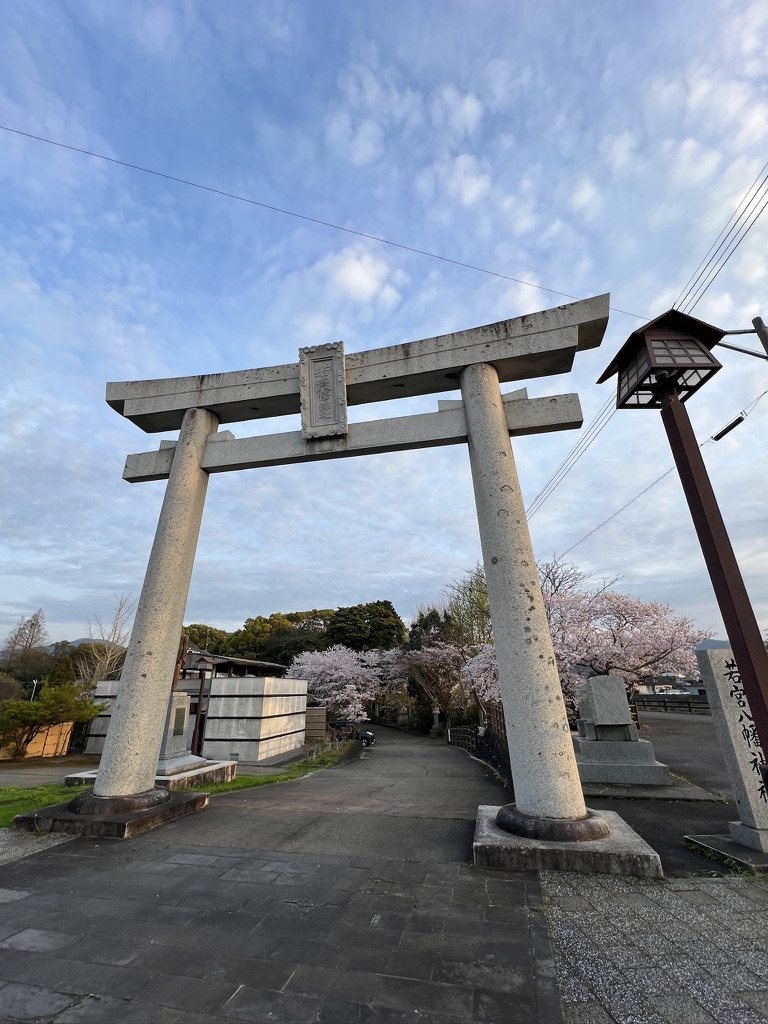
Wakamiya Shrine stands along the approach from the Lower Shrine to the Upper Shrine. It contains five wooden seated images representing the five Wakamiya deities, including Emperor Nintoku; the images are Important Cultural Properties. Kuroo Shrine, dedicated to Takeuchi no Sukune, stands near the main torii. Tōgū Shrine, dedicated to Prince Uji no Wakiiratsuko, is located near the Lower Shrine.
Mountain and Water Shrines
Ōmoto Shrine
Ōmoto Shrine is the inner sanctuary on the summit of Mount Omoto, south of the main precincts. It enshrines three massive rocks as manifestations of Hime-no-Okami, identified with the three Munakata goddesses. Mount Omoto is traditionally regarded as the place where Hime-no-Okami first descended to earth. The shrine also identifies the “Usa Island” mentioned in one passage of the Nihon Shoki with this locality.
Ōo and Usa Ancestral Shrines
Ōo Shrine stands on Mount Ōo east of the precincts. It is associated with the tradition that Hachiman remained there after returning from Nara until moving to the Upper Shrine. Usa Ancestral Shrine is dedicated to Usatsuhiko and Usatsuhime, who are traditionally said to have welcomed Emperor Jimmu during his eastern expedition.
Pond and Subsidiary Shrines
Several smaller shrines mark other parts of the precincts. Kameyama Shrine is dedicated to Ōyamatsumi as the deity of Mount Kame, while Yasaka Shrine near the Lower Shrine is dedicated to Susanoo. Yako Shrine, dedicated to Hachiman’s eight princes, is situated in a camphor tree without a shrine building. Mokushōso Shrine, dedicated to deities regarded as protectors of craftsmen, stands near Hishigata Pond. Mikumari Shrine, dedicated to five water deities, occupies an island in the pond. Tenman Shrine is dedicated to Sugawara no Michizane, and Gokō Shrine, dedicated to Wake no Kiyomaro, stands on the slope of Mount Ōo.
Bridge and Former Temple Area
Kurehashi
Kurehashi is a vermilion-painted, roofed bridge on the western approach. Its original date is unknown, although a bridge existed before or during the Kamakura period. The present bridge was built in 1622 by Hosokawa Tadatoshi, lord of Kokura Domain.
Miroku-ji Foundations
Miroku-ji formerly stood within the precincts as the Buddhist partner of Usa Hachimangū-ji. Its buildings were demolished during the suppression of Buddhism in the Meiji period, leaving foundation stones. The shrine administrative office and a treasure museum now occupy the area north of the former temple.
Objects and Historical Materials
The National Treasure collection includes the three principal sanctuary buildings and a bronze ritual gong known as the Peacock-Patterned Gong. The gong bears an inscription dated 1209, came from Miroku-ji, and is privately owned but managed by Usa Jingū as its legally designated management body.
Important Cultural Properties include a Korean-style bronze bell with a partially preserved inscription referring to 904. It is described as the second-oldest Korean-style bell in Japan. The collection also includes a 93.5-centimetre Japanese sword with double-ridged construction, donated in 1358 by Prince Kaneyoshi while he was serving as commander of the Western Army, in prayer for long military success.
Other protected historical materials include the Illustrated Plan of Buzen Province’s Usa Palace, three scrolls of Plans for the Construction of Usa Jingū, and the Great Mirror of Usa Palace Estates. The last of these is privately owned and managed by Usa Jingū as the designated management body.
Former Railway Connection
The Usa Sangū railway formerly connected Bungotakada with Usa Hachiman Station near the shrine. The line closed in 1965, and the station was demolished and converted into a parking area. Steam locomotive Krauss No. 26, formerly used on the line, remains preserved near the parking area and the main approach. A slope car installed in 2013 provides access toward the Upper Shrine for elderly and wheelchair-using visitors.