Bornsen Megalithic Tombs in Bienenbüttel: Neolithic Burial Monuments
Site at a Glance
- Popularity
- Very Low
- Country
- Germany
- Primary era
- Stone Age
- Eras represented
- Stone Age
- Civilizations
- Unclassified
- Site type
- Burial
- Remains
- Necropolis
On this page12 sections
History
Neolithic burial groups
The Bornsen Megalithic Tombs in Bienenbüttel, Germany, probably comprised six Neolithic graves built by communities of the Funnelbeaker culture around 3500–2800 BC. This northern and central European culture takes its name from the shape of some of its pottery. The graves were arranged in two groups of three.
Early descriptions and later surveys
Johann Karl Wächter described the three northern graves in 1841. He thought the middle grave had been excavated around 1829. In 1846, Georg Otto Carl von Estorff described another group of three to the southwest. Karl Hermann Jacob examined the graves in 1914, and Ernst Sprockhoff and Gerhard Körner surveyed them in 1967–68. J. von Dein, a technician with the Lüneburg regional archaeology service, identified remains of the northern group’s middle grave in 1995.
Authors used different names and numbering systems for the graves. Sprockhoff’s catalogue numbers are 740 for the surviving northern grave, 741 for the western grave in the southern group, and 742 for its eastern grave.
Remains
The graves formed northern and southern clusters, each originally containing three monuments. The northern group lies northwest of Bornsen in Wichmannsdorf Forest, part of the Süsing; the southern group is about 2.2 km to the southwest. Their long barrows, elongated earthen mounds associated with large stones, contained burial chambers. Three graves survive in some form.
Northern group
Grave 740
This east–west long barrow measures about 35 m by 5 m. Its mound still rises about 1 m, and traces of former stone positions are partly visible. The tomb originally had a stone perimeter, with its burial chamber in the eastern part.
Northern grave A
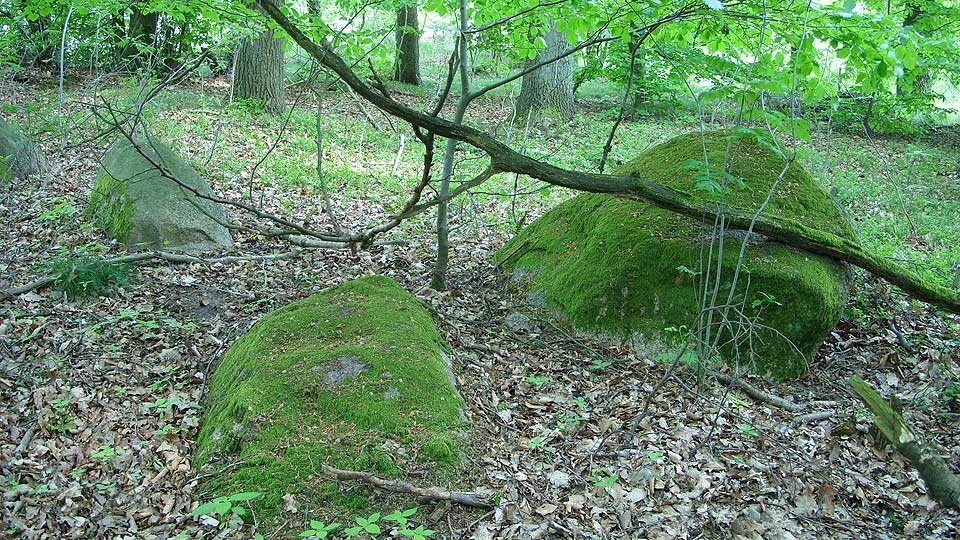
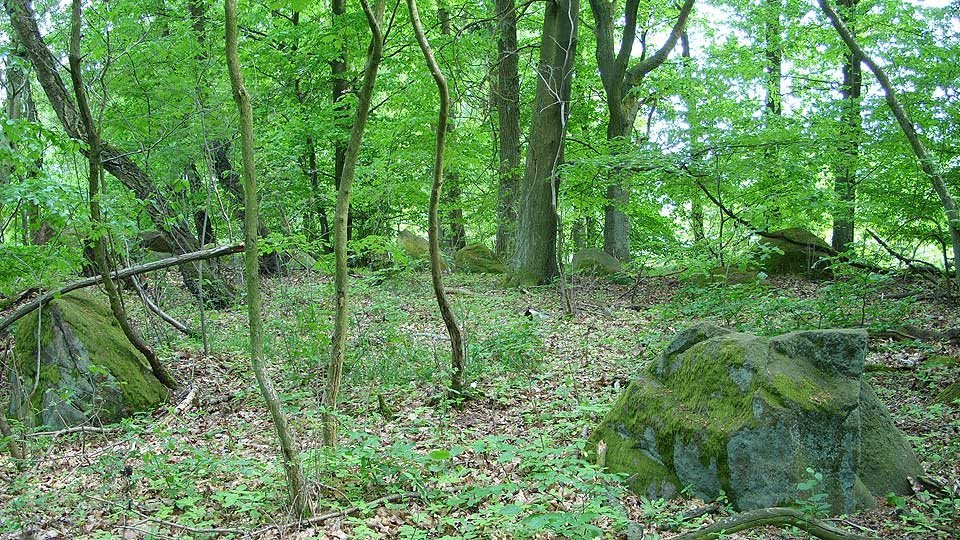
About 150 m east-northeast of grave 740, across a forest track, this long barrow runs northeast–southwest and measures roughly 40 m long and 6–8 m wide. Its mound stands 0.8–1 m high. A guardian stone, a standing stone associated with a megalithic tomb, remains at the western end of the southwest short side. Another perimeter stone survives farther west, while three perimeter stones lie on their sides in the east. Depressions along the mound’s edges mark other former stone positions, and additional stones are buried nearby.
Wächter placed the chamber about 3 m from the southwest end and described it as approximately 3.5 m long, 1.8 m wide, and 1 m high. His description gives five worked granite wall stones along each long side, three at the eastern end, and three or four at the western end, with four slate capstones about 0.2 m thick. The chamber was probably a large dolmen, a type of megalithic burial chamber.
At the chamber’s western side, a small fieldstone burial box about 0.6 m wide and high apparently held a later burial. An urn containing bones, possibly cremated, and sand broke down during recovery, as did a wooden dagger handle. The flint dagger, which had a wooden crossguard, entered Wächter’s private collection. A small heap of stones beside the chamber was also noted, but its purpose is unclear.
Northern grave D
Wächter described a rectangular long barrow about 94 m east of grave A, smaller than that grave’s mound. It may correspond to a large round burial mound listed in the Lower Saxony Monument Atlas.
Southern group
Western grave 741
Beside a field track, this damaged long barrow runs northwest–southeast. Its mound reaches about 1.5 m high near the chamber. Four perimeter stones remain along the northeast side and eight along the southwest side, though not all stand in their original positions.
The chamber lies in the southeast part of the mound, off-centre toward its southeast side and slightly oblique to the mound’s axis. Two large capstones and three upright wall stones remain in place, with two wall stones on the southern long side and one on the northern side. Sprockhoff reconstructed three pairs of wall stones and three capstones. Von Estorff’s drawing instead depicts a chamber extending across more than three-quarters of the mound’s length. The chamber was probably a large dolmen.
Middle southern grave
A map represents this grave as a rectangular long barrow, probably oriented east–west and similar in size to the eastern grave.
Eastern grave 742
This approximately east–west long barrow was about 30 m long. Von Estorff’s 1846 description notes perimeter stones at the eastern end, along the southern side, and along the northern side. The chamber stood at an angle in the western part of the mound and measured about 10 m by 1.6 m. It originally had six pairs of wall stones along its long sides and was probably a large dolmen.