Blatná Chateau: A Historic Water Castle in the Czech Republic


Visitor Information
Google Rating: 4.7
Popularity: Medium
Official Website: www.zamek-blatna.cz
Country: Czechia
Civilization: Early Modern, Medieval European, Modern
Site type: Military
Remains: Castle
History
Blatná Chateau is situated in the town of Blatná in the Czech Republic. It was originally established by medieval Bohemian builders at the close of the 12th century on a rocky elevation surrounded by swampy terrain near the Lomnice River. The castle’s name reflects this setting, deriving from the Czech word “blata,” meaning swamp.
The earliest written mention appears in 1235 with Vyšemír of Blatná, a noble connected to the Bavors of Strakonice family. By that time, the site had already developed into a stone fortress constructed in the Romanesque style. Around 1241, the fortress was encircled by water, creating what is known as a water castle. The Bavors family replaced wooden structures with stone buildings and engineered the wetlands into a defensive water system during the late 13th century. A local legend links the castle to the Knights Templar, alleging that they concealed treasures within the walls; however, historical research does not confirm this, as the nearby Strakonice Castle was linked instead with the Knights Hospitaller in the mid-13th century, who never held ownership of Blatná.
During the 15th century, Jan of Rožmitál and his sons undertook significant rebuilding, transforming the fortress into a Gothic stronghold complete with a fortified gate tower and a chapel. The castle served as a Catholic bastion throughout the Hussite Wars. Jaroslav Lev of Rožmitál, who acquired the castle in 1446, continued renovations between approximately 1475 and 1480, adapting it into an impressive residence showcasing late Gothic design elements such as frescoes in the entrance tower and the adjacent Rožmitál Palace.
Following this, Zdeněk Lev of Rožmitál, who died in 1535, commissioned the Renaissance-style Rejt Palace during the late 15th or early 16th century, with the royal architect Benedikt Rejt credited for its design. Financial difficulties forced Adam Lev to sell the estate in 1555. Ownership changed hands several times before the Rozdražov family acquired it. In the late 16th century, they added the Renaissance Rozdražov Palace near the entrance tower.
The castle endured considerable destruction and looting during the Bohemian Estates uprising and the early years of the Thirty Years’ War (1618–1620). Additionally, a plague outbreak impacted the region. Mid-17th-century restoration efforts were carried out by the Rozdražov family to repair the damages. When the Rozdražov male lineage ended in 1691, the estate passed to Count Jan František Kolowrat-Krakowsky, who sold it four years later to Countess Ernestina Serényi of Hungary. The Serényi family introduced Baroque modifications, notably to the Rozdražov Palace.
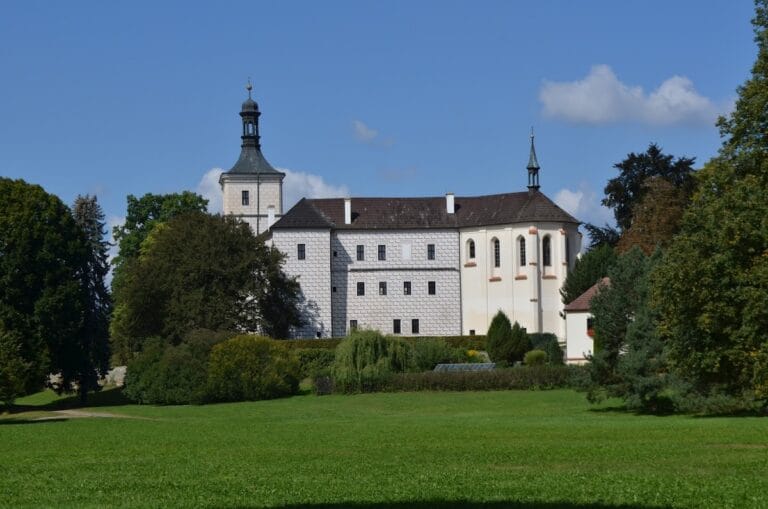
At the close of the 18th century, in 1798, Baron Václav Karel Hildprandt von Ottenhausen purchased the castle. Throughout the 19th century, his descendants transformed the property into an elegant residence with landscaped parks, a stone bridge spanning the moat, and additional outbuildings. Between 1850 and 1856, Robert Hildprandt commissioned a thorough Neo-Gothic renovation led by Munich architect Bernhard Grüber. This restoration gave the castle its present romantic Gothic appearance.
After the communist takeover of Czechoslovakia in 1948, the Hildprandt family’s ownership ended. The last owner, Bedřich Hildprandt, and his family were expelled in 1952 and later emigrated in 1959, maintaining connections with Emperor Haile Selassie I of Ethiopia. Following the Velvet Revolution of 1989, ownership was restored to Cornelia Hildprandt and her daughters in 1992. Today, the family resides in a refurbished Empire-style residence on the castle grounds.
Remains
Blatná Chateau is a rare and well-preserved example of a water castle in the Czech Republic, notable for its integration with the surrounding swamps and moat system. Its overall layout presents a horseshoe shape open to the east, a configuration resulting from the demolition of the western wing, including the original Romanesque chapel, during the early 19th century. The fortress is constructed primarily of stone, reflecting successive architectural styles from Romanesque origins through Gothic, Renaissance, Baroque, and 19th-century Neo-Gothic modifications.
The most prominent feature is the tall, four-story rectangular entrance tower on the eastern side. This tower provides the main entry via a pointed, or Gothic, arched portal accessible by a stone bridge spanning the moat. Adjacent to this tower on the southeast side stands the Neo-Gothic Chapel of the Virgin Mary and Saint Andrew, a 19th-century reconstruction by architect Bernhard Grüber carried out in 1878.
The southern wing of the castle complex comprises the Rožmitál Palace and the Rejt Palace. The Rožmitál Palace, reflecting late Gothic and Renaissance-Neo-Gothic elements, adjoins the Gothic-style Rejt Palace built in the late 15th or early 16th century under the direction of Benedikt Rejt. The northern wing is embodied by the Renaissance Rozdražov Palace, situated near the entrance tower on the northeast side and constructed in the late 16th century.
Enclosing a central courtyard, the chateau grounds connect to an English-style landscaped park and a significant 17th-century game reserve. This expansive reserve was among the largest in Bohemia, originally featuring century-old oak trees and artificial landscape elements, including a man-made cave from 1815. The presence of a herd of fallow deer within the park continues a centuries-old tradition, complemented by peacocks and alpacas that contribute to the site’s natural character.
Inside the castle, visitors can find well-preserved frescoes dating back to the 15th century, specifically located in the entrance tower’s so-called Green Chamber. The castle also contains medieval lavatories, notable for their survival, and furnishings adorned with hunting trophies and crafted from fallow deer antlers, reflecting the estate’s historical relationship with hunting and nature.
The surrounding parklands extend to a protected natural monument that includes the Naděje pond and the banks of the Lomnice River, ensuring the preservation of the chateau’s historic landscape setting alongside its architectural heritage.
Nearby sites