Burg Scharfenstein: A Medieval Spur Castle in Germany

Site at a Glance
- Rating
- 4.6
- Popularity
- Medium
- Country
- Germany
- Primary era
- Early Modern
- External website
- Open
- Eras represented
- Medieval, Early Modern, Modern
- Civilizations
- Holy Roman Empire
- Site type
- Military
- Remains
- Castle
On this page17 sections
History
Burg Scharfenstein is a medieval spur castle in Germany above Beuren in the Eichsfeld region of Thuringia. Probably built around 1200 by the Counts of Gleichen, it occupied a projecting hilltop and developed through repeated destruction, rebuilding, and changes in political control. From the thirteenth century until 1802, it formed part of the territories of Mainz, an ecclesiastical principality ruled by an archbishop and elector.
Foundation and early destruction
The castle was probably established on previously unoccupied ground after the decline of Burg Beuren in the Leine valley. Its builders are generally considered to have been the Counts of Gleichen, medieval noble rulers whose interests included parts of the Eichsfeld. Burg Scharfenstein first appears in written records in 1209, when Dietrich Böhme von Scharfenstein was associated with it. A supposed connection with Godehardus von Scharfenstein, named in 1161, is considered doubtful.
In 1219, Landgrave Ludwig IV of Thuringia captured and destroyed the castle during his feud with Mainz Archbishop Siegfried II of Eppstein. The conflict involved the Thuringian landgraves’ feudal claims over Scharfenstein. By the middle of the thirteenth century, the castle had been rebuilt with a larger surrounding defensive wall, known as an enceinte, and a second keep, the principal fortified tower of a medieval castle.
Transfer to Mainz and the pledge district
Scharfenstein was recorded in 1287 as Castrum Scharphenstein and was leased to Archbishop Heinrich II. In 1294, the heavily indebted Count Heinrich von Gleichenstein sold Scharfenstein, along with Birkenstein and Gleichenstein, to Mainz Archbishop Gerhard II of Eppstein. The sale transferred the old Eichsfeld possessions to Mainz, which retained them until 1802.
From the fourteenth century, the castle served as the center of a Mainz pledge district. A pledge district was territory assigned to a creditor or pledge-holder in return for a financial or other obligation. Scharfenstein’s district included 14 villages, two monasteries, and several mills, and it also exercised judicial authority. A prison operated within the castle, while the location of its execution site remains uncertain.
Members of the von Bodungen and Knorr families held the district from the middle of the fourteenth century, sometimes jointly with other nobles. After Heinrich Knorr died in 1383, his share passed to Hans and Heinrich von Wintzingerode. A grant made in 1412 enabled the Wintzingerode family to acquire further parts of the castle, and the family held much of the castle and district for more than 200 years.
A jointly held noble castle
Because several noble families held residences or shares at Scharfenstein at the same time, the castle became a Ganerbenburg, a castle jointly owned by several noble families with separate shares and residences. Holders and officials included members of the families von Scharfenstein, von Bodungen, Knorr, von Wintzingerode, von Entzenberg, von Worbis, von Bodenstein, von Kindehausen, von Westhausen, von Geisleden, von Wildungen, and von Linsingen. Other recorded figures included Hugo von Marchia, Ludolf von Schlotheim, and Rüdiger von dem Hagen.
Some fifteenth-century castle men acted as robber knights. In 1415, the Mainz Elector and allied forces besieged Scharfenstein. A lightning strike then caused the castle to burn almost completely in 1431. The Wintzingerode family rebuilt it, and major work had produced a new form of the castle by 1448.
Reformation and renewed Mainz control
Heinrich Pfeiffer, a former Cistercian monk who adopted Lutheran teachings, stayed at Scharfenstein from 1521 to 1523 under the protection of Hans von Entzenberg. He preached in the surrounding settlements, at the castle, and beneath the castle linden tree. Pfeiffer later went to Mühlhausen, where he met Thomas Müntzer, a radical reformer and leading figure in the German Peasants’ War.
In May 1525, during the German Peasants’ War, forces led by Pfeiffer and Müntzer attacked and burned Scharfenstein on Pfeiffer’s orders. They also attacked Reifenstein Monastery and other castles and monasteries in the Eichsfeld. Friedrich von Wintzingerode rebuilt the castle seven years later.
The Reformation, the sixteenth-century movement that produced Protestant churches including Lutheranism, spread through the Scharfenstein district under the Lutheran Wintzingerode lords. In 1583, Mainz Elector Daniel Brendel von Homburg ended the Wintzingerode pledge and restored direct Mainz control. The subsequent Catholic Counter-Reformation, a response aimed at restoring Catholic authority, proceeded in the district from the Jesuit College at Heiligenstadt. Scharfenstein then served mainly administrative purposes, while its vaulted cellar was used as a prison.
From Prussian estate to public property
After the Eichsfeld passed to Prussia in 1802, Scharfenstein ceased to be a territorial and administrative seat. From 1814, it functioned as an outwork of the Reifenstein domain. After the Napoleonic period, its lands became a royal Prussian cameral estate. The estate was reduced in 1869 and placed under Prussian forestry administration. A district forester lived at the castle until 1956 and for some time afterward below the Schlossberg.
The deteriorated keep was demolished in 1864, and another major fire followed a lightning strike in 1909. After the Second World War, the castle became public property in the German Democratic Republic. From 1960, it served as a holiday home and recreation center associated with the Solidor combine in Heiligenstadt.
Restoration and new use
After 1990, the Treuhand managed the castle, and the city of Leinefelde-Worbis acquired it in 2002. Restoration began in 2006, followed by extensive work on the core castle from 2008. Parts of the complex were equipped with geothermal heating. The restoration earned the city the Thuringian Monument Protection Prize in 2012.
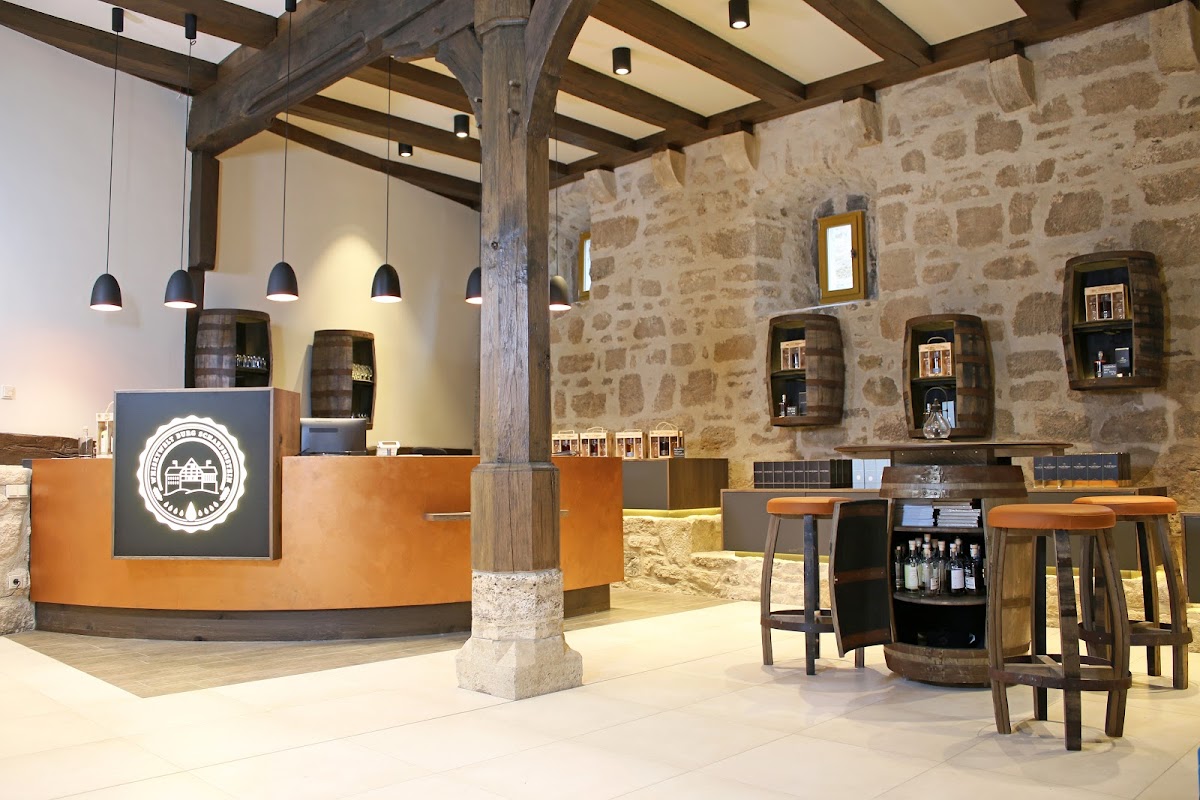
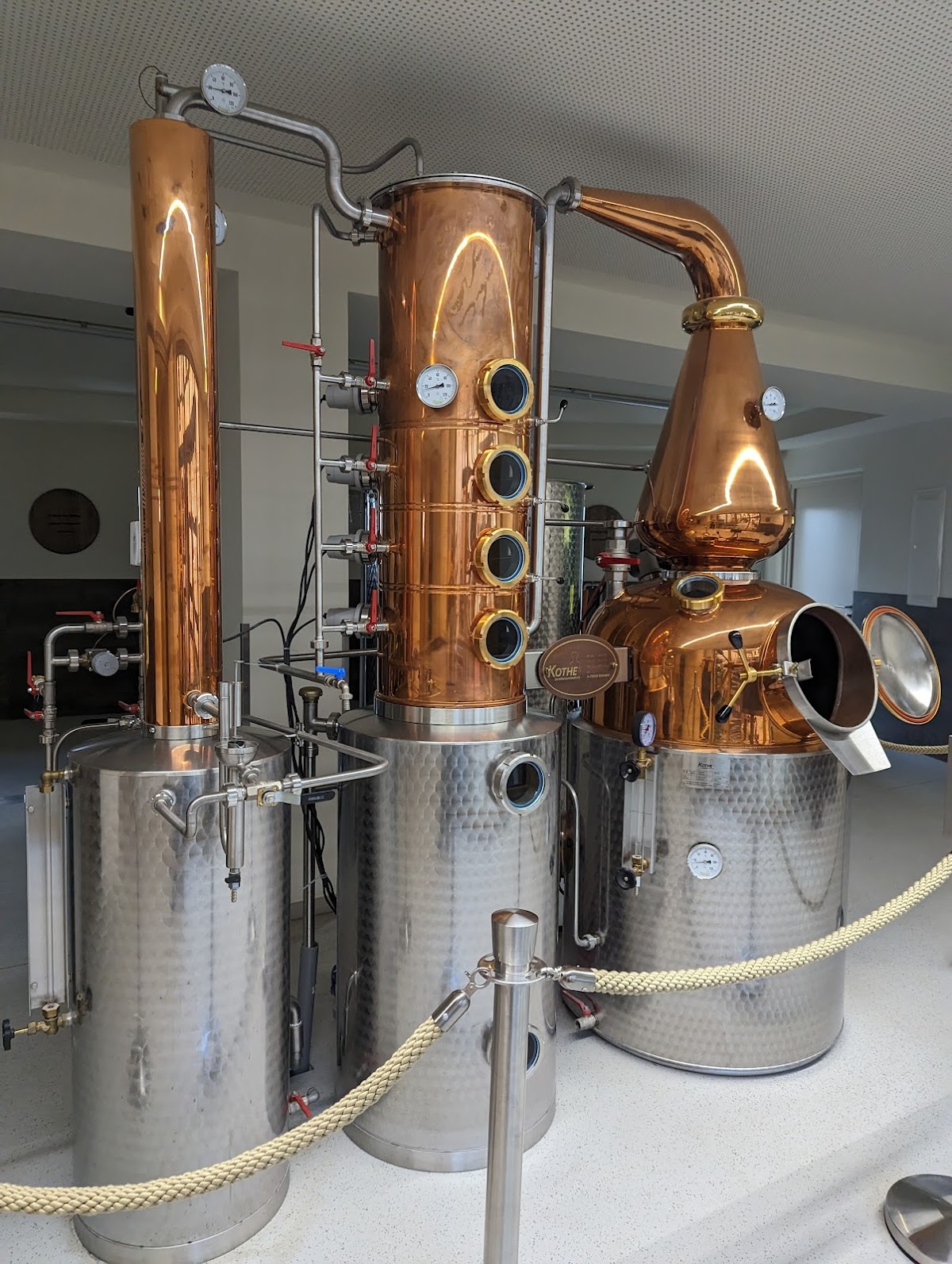
Archaeological and building-historical investigations accompanied the work. In 2014, the lowest two meters of the first keep, dating from around 1200 and dismantled after the 1525 destruction, were discovered and partly exposed in the cellar of the west wing. A new tower was built where a section of the core castle’s outer wall had collapsed in the 1960s, and the tower was completed in 2016. In 2017, the city leased the complex to Whiskywelt Burg Scharfenstein GmbH, owned by the nearby Neunspringe Worbis brewery. Restoration of the core castle was completed by 2020, after which the complex received commercial functions as a whisky experience center, hotel with restaurant, and coffee roastery.
Remains
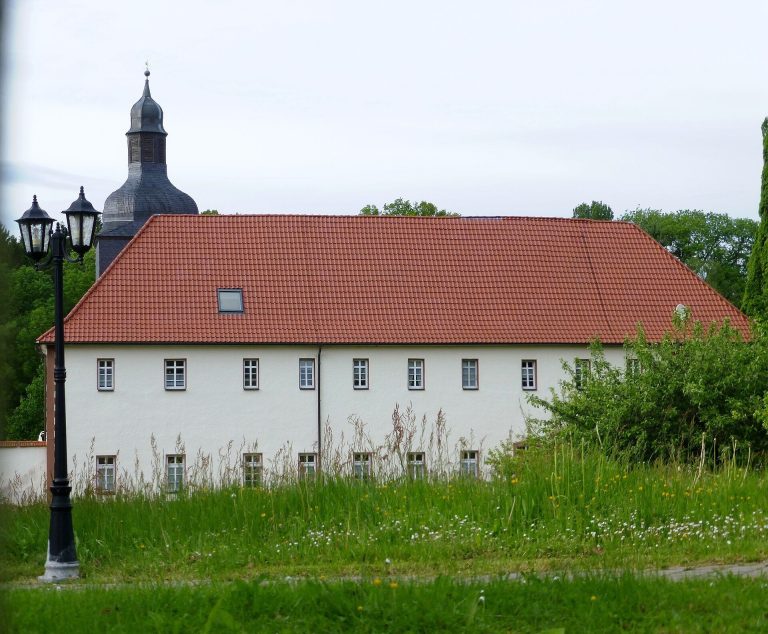
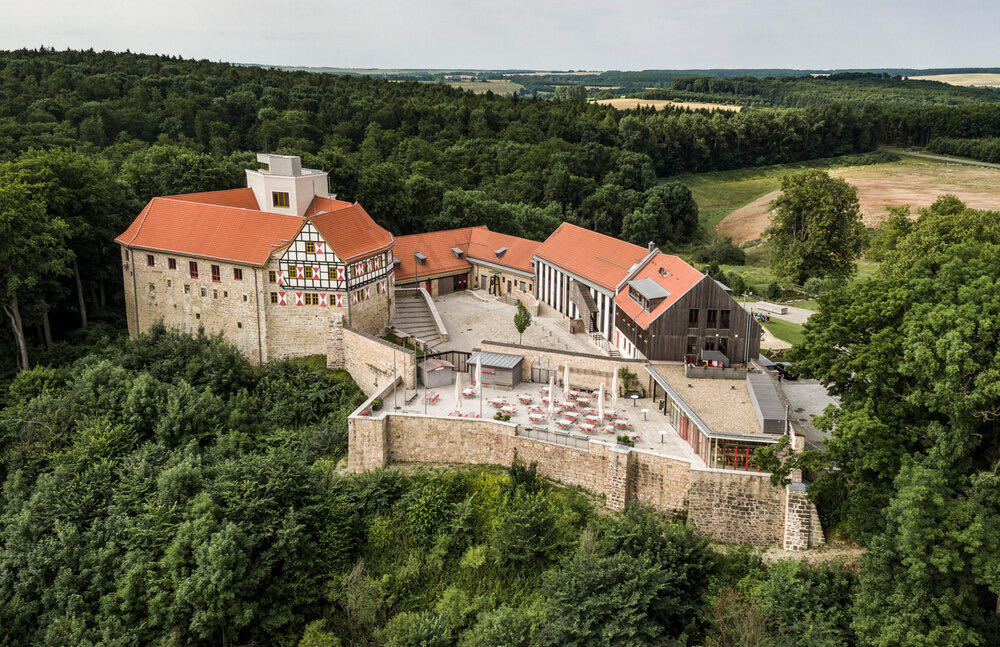
Burg Scharfenstein occupies the Schlossberg, a small eastward-projecting spur at about 480 meters above sea level on the northern escarpment of the Dün. A ravine toward Totenkopf bounds the spur to the east, while a terrain incision toward the Nesselberg defines it to the west. The complex is divided into a core castle and an outer bailey, each organized around its own courtyard. The plateau consists of Wellenkalk limestone, while the castle’s surviving construction includes masonry from several building phases.
Early defensive structures
First keep
The oldest surviving fabric includes the stump of a Romanesque first keep, a robust medieval tower built with heavy masonry and rounded-arch traditions. Its bossed ashlar masonry consists of carefully shaped stones with raised central faces. The lowest two meters of this keep, dating from around 1200, survive partly exposed in the cellar of the west wing. A small adjoining wall section and a sparse remnant of a structure in front of the castle belong to the twelfth or thirteenth century.
Second keep and enceinte
The rebuilt castle of the thirteenth century had a second keep that was smaller than the first. It also possessed an enlarged enceinte, the surrounding defensive wall that enclosed the castle. Later destruction and rebuilding altered the complex, while parts of the core castle erected or rebuilt under Friedrich von Wintzingerode in the sixteenth century remain within the present structure.
Core castle and outer bailey
Core castle
The core castle forms one of the two principal courtyard areas. Its surviving fabric combines the early keep remains with later construction associated with the Wintzingerode rebuilding. The west-wing cellar contains the partly exposed lower section of the first keep, allowing the early defensive structure to be seen within the later complex.
Outer gate
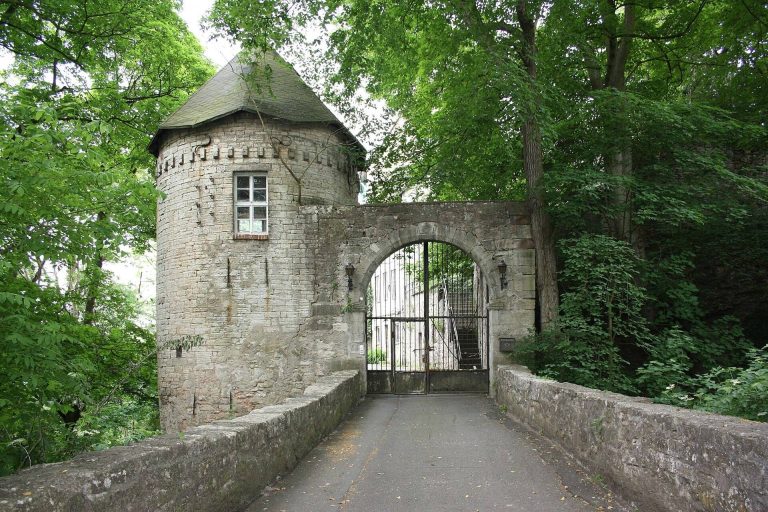
The outer gate bears the Mainz wheel emblems and the date 1587. These details belong to the period when Mainz had restored direct control over Scharfenstein during the Counter-Reformation. They remain part of the gate’s visible architectural evidence for the castle’s late sixteenth-century political phase.
New tower
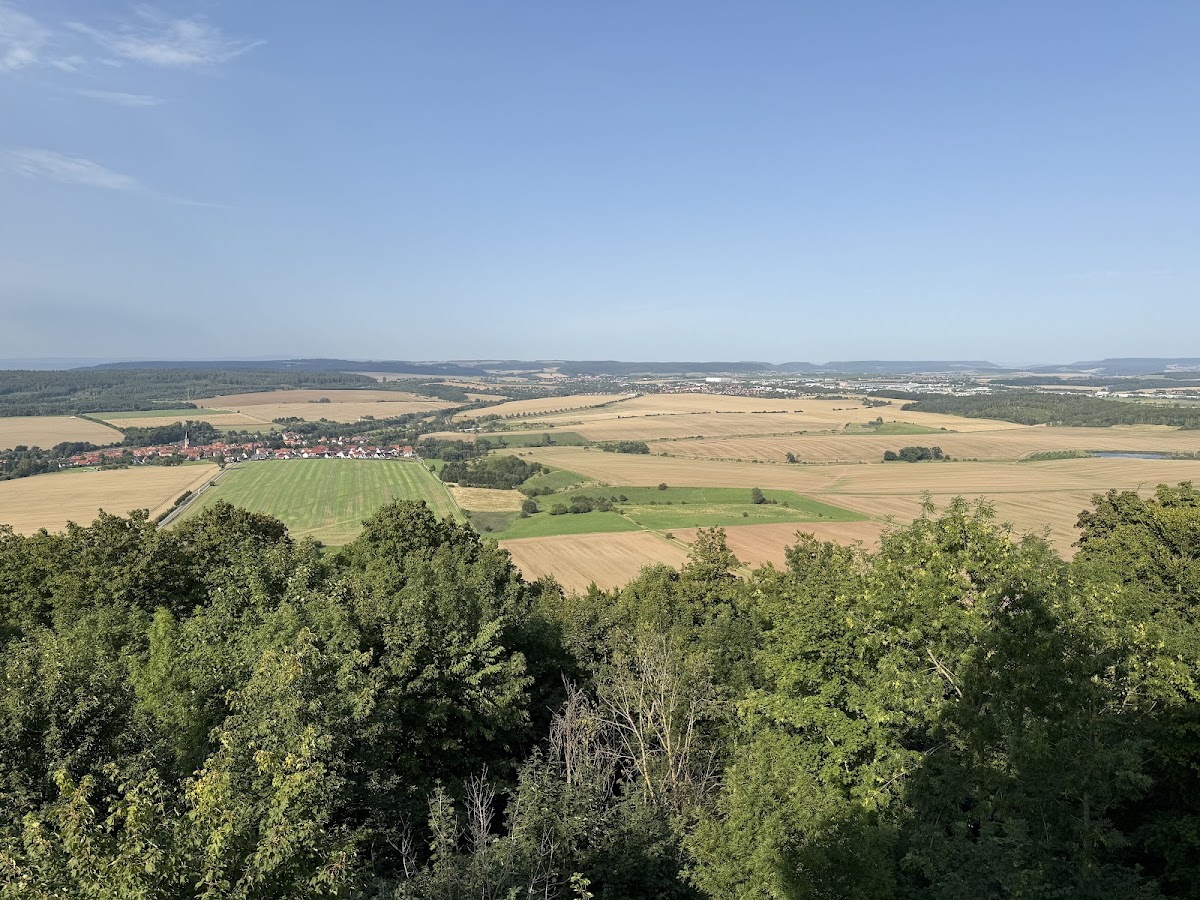
A section of the core castle’s outer wall collapsed during the 1960s. A modern tower-like structure replaced it after 2010 and was completed in 2016. The tower rises 20 meters and includes a viewing platform. The northern view reaches toward the Harz, while the southern outlook extends over the Eichsfeld heights. The associated viewing terrace occupies the northern end of the complex, where the large barn formerly stood, and looks across the upper Leine valley, the Eichsfeld basin, the Ohm Mountains, and the eastern Dün. In clear conditions, the view extends from the Upper Harz and the Brocken toward the Lower Harz beyond the Eichsfeld Gate.
Historic lime trees
Thomas-Müntzer Linden
The Thomas-Müntzer Linden stands in front of the castle gate, north of the outer-bailey entrance. It is a summer lime tree associated by tradition with Heinrich Pfeiffer’s preaching and named in memory of Thomas Müntzer. Its planting is often dated to around 1450, although estimates place its age between 490 and 600 years. The tree is listed among Germany’s notable old trees and is described as the oldest deciduous tree in the Eichsfeld.
The massive trunk divides a few meters above ground into several large limbs that form a dense crown. A 2019 measurement gave its trunk circumference at breast height as 8.05 meters, and its stated height is 25 meters. The tree and two other very large old lime trees directly in front of the castle are protected together as the natural monument “Three Lime Trees in Front of Burg Scharfenstein.”