Biberstein Castle: A Historic Fortress and Administrative Center in Switzerland
Visitor Information
Google Rating: 4.6
Popularity: Low
Official Website: www.schlossbiberstein.ch
Country: Switzerland
Civilization: Early Modern, Medieval European
Site type: Military
Remains: Castle
History
Biberstein Castle is located in the municipality of Biberstein, Switzerland. It was originally built in the late 13th century by the Counts of Habsburg-Laufenburg, a noble family connected to the broader Habsburg dynasty. The castle is first documented in 1280, marking its early importance in the region.
By 1335, ownership of the castle and the adjacent town shifted when the Habsburgs sold them to the Knights Hospitaller, a religious and military order. The Knights established a commandry at Biberstein, which became a center of their territorial rule. Around the turn of the 15th century, the town itself was protected by a ring wall, likely completed by 1399, emphasizing its growing strategic value.
In 1415, during territorial conflicts, the city of Bern expanded its influence by occupying the region including Biberstein. However, the Knights Hospitaller retained de jure control over the castle and the town, maintaining their administrative rights despite Bern’s military presence. This arrangement changed in 1499 during the Swabian War when Bernese forces took direct control of the castle to strengthen their northern frontier.
The Protestant Reformation brought further transformation. After Bern adopted Protestantism in 1527, it actively suppressed monasteries and religious orders in its territories. The following year, Bern installed a vogt—an appointed official—who governed directly from Biberstein Castle. This marked the beginning of Bern’s de facto authority over the site.
In 1535, the Knights Hospitaller were compelled to sell the castle and town to Bern, which formally acquired ownership. Biberstein then became the center of one of Bern’s smallest vogtei, or administrative districts, overseen by a succession of 51 vogts until the political upheavals of the late 18th century.
The castle’s history includes dramatic events such as the fire in 1587, believed to have been started by Elsa Schiblerin, a local woman accused of witchcraft. She was executed following the blaze. The fire led Bern to rebuild the castle, aiming to create a more comfortable residence for the vogt. Decorative coats of arms were added during this period, including the Biberstein arms above the main entrance in 1627 and the Bernese arms painted on the tower in 1643.
A smaller fire occurred in 1784, damaging the roof but causing limited harm overall. This period of relative stability ended in 1798 when French forces invaded, abolishing Bern’s vogtei system. Ownership passed to the newly formed Canton of Aargau in 1803.
Afterward, the castle’s role shifted substantially. It briefly served as a home for Heinrich Zschokke, an influential Swiss historian and reformer, and functioned as a municipal school prior to 1835. Later that year, the property moved into private hands before being renovated in 1889 and repurposed as a children’s home. Since 1987, Biberstein Castle has housed a residential and work facility for adults with mental handicaps, reflecting a continued adaptation of the historic structure to social needs.
Remains
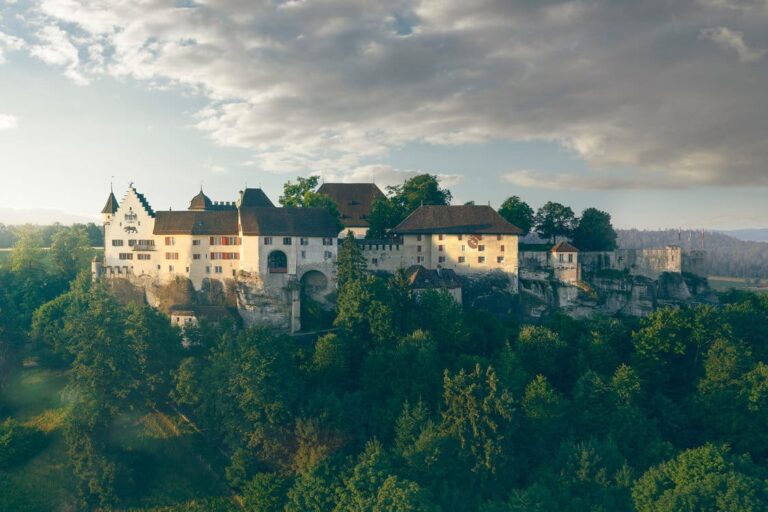
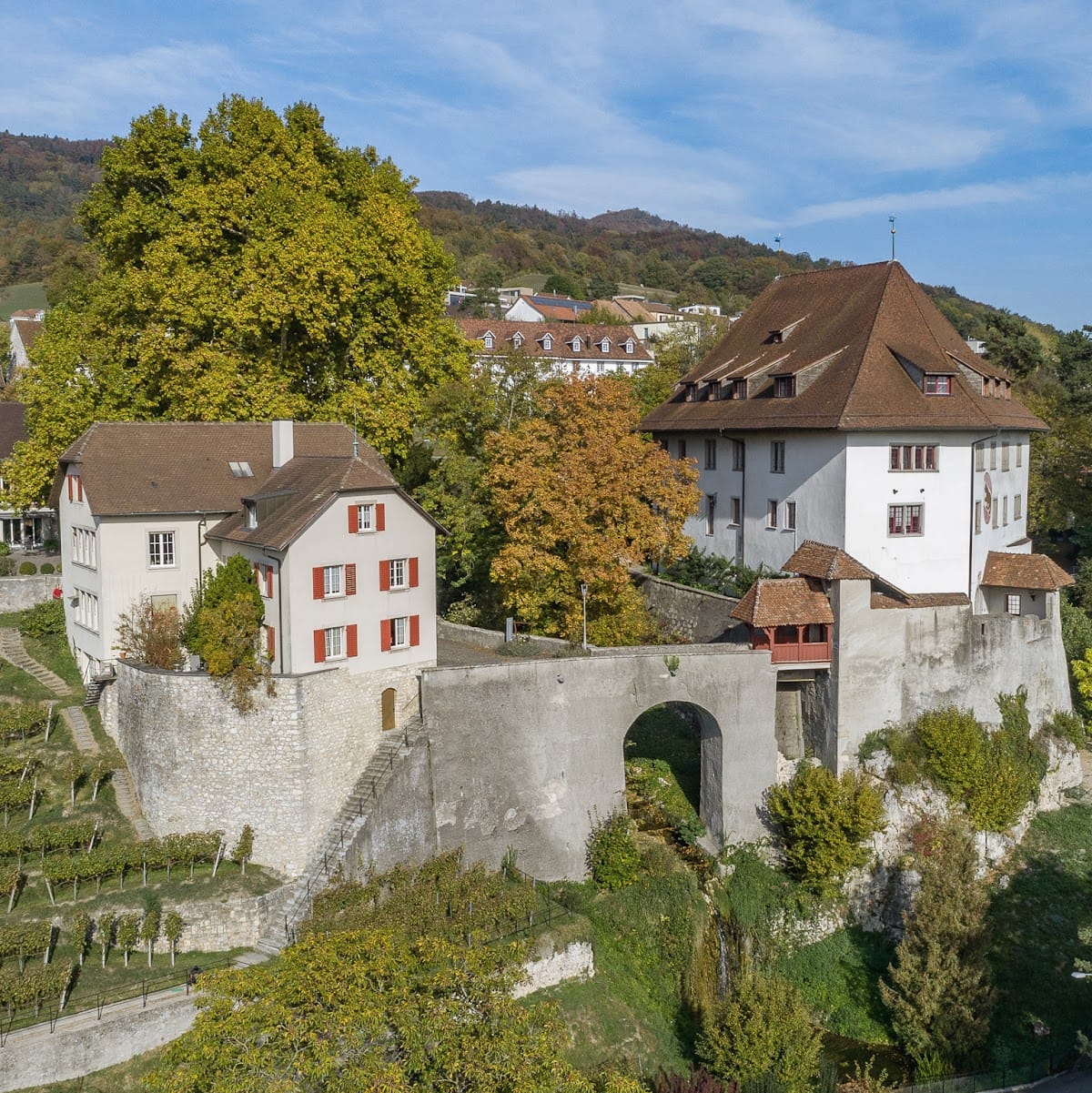
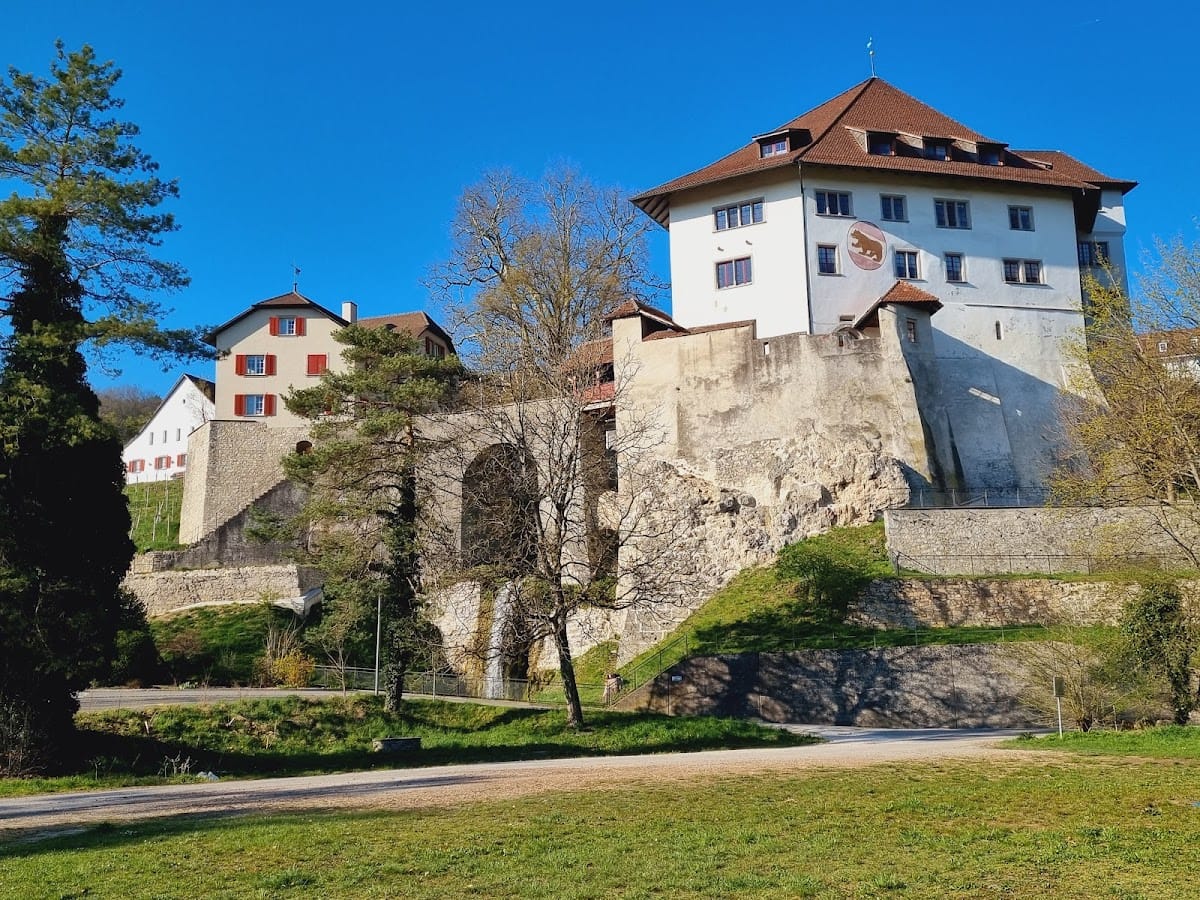
Biberstein Castle occupies a commanding position on a steep tuff rock overlooking the Aare river. The layout includes terraced walls that follow the natural contours of the site, enhancing its defensive capabilities. On the western side, a moat provides an additional barrier, once deterring attackers and slowing advances.
Approach to the castle is across a 10-meter covered wooden bridge, which leads directly to a round-arched entrance gate. This gate opens into an outer defensive courtyard known as the Zwinger, a narrow space designed to trap enemies between walls for easier defense. The Zwinger exemplifies medieval military architecture emphasizing layered protection.
The main castle building features an irregular octagonal outline topped by a multi-hipped roof, reflecting the structure’s evolution over the centuries. Originally, a large medieval bergfried—a tall defensive tower characteristic of castles—stood prominently, but around 1670 it was reduced to only the ground floor and first floor because of stability problems. Parts of the bergfried’s lower walls and foundations remain intact, offering tangible links to its medieval origins.
Surviving medieval elements also include segments of the original outer wall, providing glimpses into the early fortifications that once safeguarded the site. However, most of the visible architecture dates from the 16th-century reconstruction after the 1587 fire and includes later renovations that softened the castle’s military features in favor of more comfortable residential use.
The castle’s exterior walls are coated with plaster applied in a late Gothic style, contributing to its distinct historic ambiance. Inside, the entrance hall is notable for its star vault—a decorative ceiling composed of intersecting ribs forming star-like patterns—demonstrating skilled craftsmanship and stylistic trends from the post-medieval period.
Two painted coats of arms remain significant visual markers. The Biberstein family’s emblem is displayed above the main gate, added during the 1627 rebuilding phase, while the Bernese coat of arms was painted on the tower in 1643, symbolizing Bern’s authority.
Over time, these architectural adaptations reflect the castle’s changing purpose—from a resilient medieval fortress to a more hospitable administrative residence and finally to a facility serving social functions. Despite modern modifications, the castle’s historic core endures, encapsulating centuries of regional history and evolving human use.
Nearby sites