Benediktbeuern Abbey: A Medieval Benedictine Foundation in Germany


Site at a Glance
- Rating
- 4.5
- Popularity
- Medium
- Country
- Germany
- Primary era
- Early Modern
- External website
- Open
- Eras represented
- Medieval, Early Modern, Modern
- Civilizations
- Duchy of Bavaria, Holy Roman Empire
- Site type
- Religious
- Remains
- Monastery
On this page14 sections
History
Benediktbeuern Abbey is an early medieval monastic complex in Benediktbeuern, Germany, founded in the eighth century and shaped by Benedictine religious, educational, and scholarly traditions. Its beginnings are uncertain because no contemporary foundation charter survives. Later tradition places an initial establishment between 725 and 728 under Charles Martel, the Frankish military and political leader traditionally associated with the expansion of Frankish influence into Bavaria, while the Benedictine abbey is generally dated to around 739 or 740.
Early foundation and medieval learning
The early monastery was associated with the Huosi, a Bavarian noble clan, and was dedicated to Saints James and Benedict. Saint Boniface, an Anglo-Saxon missionary bishop involved in the Christianization and church organization of German lands, may have consecrated the first church and installed Lantfrid as abbot, although that attribution remains uncertain. Lantfrid is generally placed in office in the mid-760s and is regarded as the first abbot of the foundation.
Benediktbeuern soon became a center of learning. Its school and scriptorium, the specialized monastery workshop for writing and copying manuscripts, produced codices that survive from the late eighth and early ninth centuries. The monks established one of southern Bavaria’s important scriptoria, linking the abbey’s religious life with the preservation and circulation of texts.
Hungarian forces destroyed the monastery in 955. Wolfold, a priest, restored it in 969, initially as a house of canons. In 1031, under the influence of Conrad II, a medieval Holy Roman Emperor, the institution was rebuilt as a Benedictine monastery. Monks from Tegernsee Abbey repopulated it under Abbot Ellinger, beginning a new phase in its history.
Rebuilding, pilgrimage, and historical writing
Under Abbot Gothelm, the school and scriptorium were re-established. In 1052, Emperor Henry III granted the abbey to Nitker, Bishop of Freising, without Gothelm’s knowledge. The monks responded by compiling a detailed account of the abbey’s history, properties, benefactors, and adversaries. This activity strengthened the institution’s historical memory and preserved information about its changing position in the region.
In 1053, Abbot Gotschalk arranged for the relics of Saint Anastasia, traditionally venerated as a Christian martyr, to be brought to Benediktbeuern. Their arrival made the abbey a pilgrimage center and contributed to its reputation and prosperity. The abbey’s historical writing continued in the early sixteenth century, particularly through the work of Father Antonius Funda around 1530 to 1540.
The monastery’s educational resources expanded over the medieval period. Gardens for medicinal herbs existed by about 1200. By around 1250, the library held approximately 250 manuscripts covering theology, philosophy, the liberal arts, and the natural sciences, the principal fields of higher education then available. Benediktbeuern also hosted the first procession for the Feast of Corpus Christi in Bavaria in 1273.
Fires and the Baroque transformation
The abbey church suffered a fire in 1248 and collapsed in 1288. Further major fires struck in 1377, 1378, and 1490. The central monastic buildings destroyed in the last of these fires were rebuilt by 1493. The surviving cloister and other parts of the complex therefore combine medieval fabric with later Renaissance, Baroque, and early Rococo rebuilding.
After the Thirty Years’ War, the abbey entered a new period of cultural and educational activity. Its grammar school, which emphasized languages, music, mathematics, and botany, had reopened by 1689. A theological college of the Bavarian Benedictine Congregation was established, and a higher-education institution known as the commune studium opened in the north wing in 1698. Benediktbeuern belonged to the Bavarian Congregation of Benedictine monasteries, founded by Pope Innocent XI in 1684, until the abbey was dissolved in 1803.
Scholarship remained central to the institution. In 1700, Karl Meichelbeck, the librarian and archivist, applied source-critical historiography in a pioneering way for southern Germany. He wrote the Historia Frisingensis, the Chronicon Benedictoburanum, and a 1710 account of Saint Anastasia. That work described the so-called miracle of Lake Kochel, through which tradition held that the abbey was saved during the War of the Spanish Succession, a conflict over the Spanish throne and European power, on 28 January 1704.
Secularization and the Fraunhofer glassworks
Bavaria’s secularization dissolved the abbey in 1803. Its monastic court was abolished, and its jurisdiction was divided between the district courts of Tölz and Weilheim. About 700 hectares of agricultural land were sold to more than 150 purchasers, most of them local farmers. The former abbey church became the parish church of Saint Benedict in Benediktbeuern and received the status of a papal minor basilica in 1972. This designation is a special ecclesiastical status granted by the pope to a church because of its religious, historical, or pastoral importance.
Secularization also brought the manuscript of the Carmina Burana, a thirteenth-century collection of songs by wandering scholars, to wider attention in the abbey library. Also called the Codex Buranus, it was transferred with many other manuscripts and printed books to Munich and is now held by the Bavarian State Library. Several former monks later became university professors, including Aegidius Jais in Salzburg, Sebastian Mall in Landshut, and Florian Meilinger in Munich.
Joseph von Utzschneider acquired the former monastic and economic buildings in 1805 and established glassworks there, including an experimental plant for optical glass. Joseph von Fraunhofer worked at the complex from 1808 to 1819. He developed flawless, or “waveless,” flint glass and discovered the Fraunhofer lines, dark absorption lines in the solar spectrum whose study helped establish spectroscopy, the analysis of matter through the light it emits or absorbs.
State uses and the return of religious life
The Bavarian state took over the complex in 1818, except for the Fraunhofer glassworks. The buildings served military and state purposes as a cavalry stud farm or remount depot, barracks, an invalid home, a military convalescent home, a prison, and, after 1921, a state agricultural enterprise. The former abbey brewery closed in 1925.
A religious community returned in 1930 with the arrival of the Salesians of Don Bosco, a Catholic congregation founded for the education and pastoral care of young people, particularly those in disadvantaged circumstances. In 1931, the Salesians founded a theological study institution for members of their order. It developed into the Philosophical-Theological College of Benediktbeuern, which gained state recognition as a non-state institution of higher education in 1981, the right to award doctorates in Catholic theology in 1990, ecclesiastical doctoral rights as a theological faculty in 1992, and habilitation rights in 2000. The college closed after the winter semester of 2013 to 2014, and a religious-education program of the Catholic Foundation University of Munich later used its former rooms.
The complex also became a center for youth and social education. A youth-leader seminar opened in 1967 and became a higher technical school for social pedagogy in 1968. It was integrated into the Catholic Foundation University of Munich in 1971. The Don Bosco Institute for Youth Pastoral Studies followed in 1978, providing continuing education for specialists in child and youth welfare. The Centre for Environment and Culture was established in 1988, and two Don Bosco foundations were created in 2001 to support Salesian work.
During the Second World War, a Wehrmacht school for military paymasters operated in the complex from 1941. After 1945, the Salesians resumed use of the buildings. In 1946 they founded a grammar school for late-vocational priesthood candidates, which continued until its transfer to Buxheim in 1964. A major fire in 1979 destroyed, among other areas, half of the north wing and the building of the higher technical school.
The complex today
Benediktbeuern is now a Salesian institution rather than a Benedictine abbey. Around 35 Salesians lived there in 2022 under a director, the title used to lead this community instead of the monastic office of abbot. Its current educational and cultural roles include work by the Catholic Foundation University of Munich, youth education, the Centre for Environment and Culture, a youth hostel, the former Fraunhofer glassworks museum, and research by the Fraunhofer Society into energy-efficient rehabilitation of historic buildings and heritage conservation.
On 26 August 2023, hail and torrential rain damaged every building in the complex, including the basilica and Anastasia Chapel. Roofs, windows, facades, and sections of the historic timber structure suffered severe damage, while water entered the buildings and some areas were considered at risk of collapse. Most of the complex had become accessible again by October 2025, while the basilica remained under repair.
Remains
The surviving complex consists of two large, structurally separate groups arranged around three quadrangles, together with several freestanding buildings. The eastern group begins with the Maierhof, while the western group forms the principal monastic complex. The buildings preserve evidence of the abbey’s medieval foundations, its rebuilding after fires, the Baroque transformation begun in the seventeenth century, and later industrial and educational uses.
Maierhof and eastern group
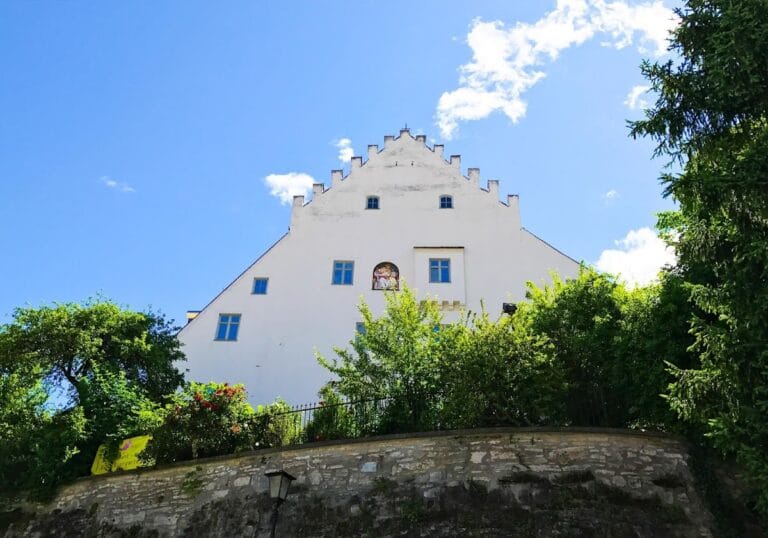
The Maierhof is a four-wing building measuring approximately 113 by 86 metres. It once contained the abbey’s economic buildings and now accommodates the Klosterbräustüberl, the Upper Bavaria Centre for Traditional Costume, and the charitable Centre for Environment and Culture. The latter includes a museum, exhibitions, concert facilities, landscape-care areas, biotopes, and educational paths. South of the Maierhof stand the historic Fraunhofer glassworks and Fraunhofer Museum. The former monastery cemetery borders the Maierhof to the west and reaches the eastern side of the main monastic complex.
Cloister and inner quadrangle
The inner quadrangle is organized around the historic cloister, a covered passage surrounding an open courtyard. It is formed by the Church of Saint Benedict, the attached Anastasia Chapel, and the convent building. Three sides of the Gothic cloister survive. Rebuilt after the fire of 1490 between 1490 and 1493, it received its present Renaissance-style stucco decoration between 1669 and 1679.
The former refectory occupies the southeast corner of the cloister. Its flat wooden ceiling carries richly decorated late-Gothic carving, portions of which were faithfully reconstructed in 1976 and 1977 after damage. On the eastern arm, the nearly square chapter house contains High-Baroque stucco representing the four cardinal virtues, prudence, justice, temperance, and courage. Two ceiling paintings show Saint Benedict of Nursia as founder of the order holding its rule and as a teacher of peoples. They are attributed to Andreas Wolff.
The convent building has corridors on its first and second floors with basket arches positioned directly above the cloister. Hans Georg Asam painted a ceiling fresco cycle in the second-floor corridor between 1682 and 1684, presenting the history of Benediktbeuern. These corridors connect the monastic architecture with the decorative and historical program developed during the abbey’s late seventeenth-century rebuilding.
Church and Anastasia Chapel
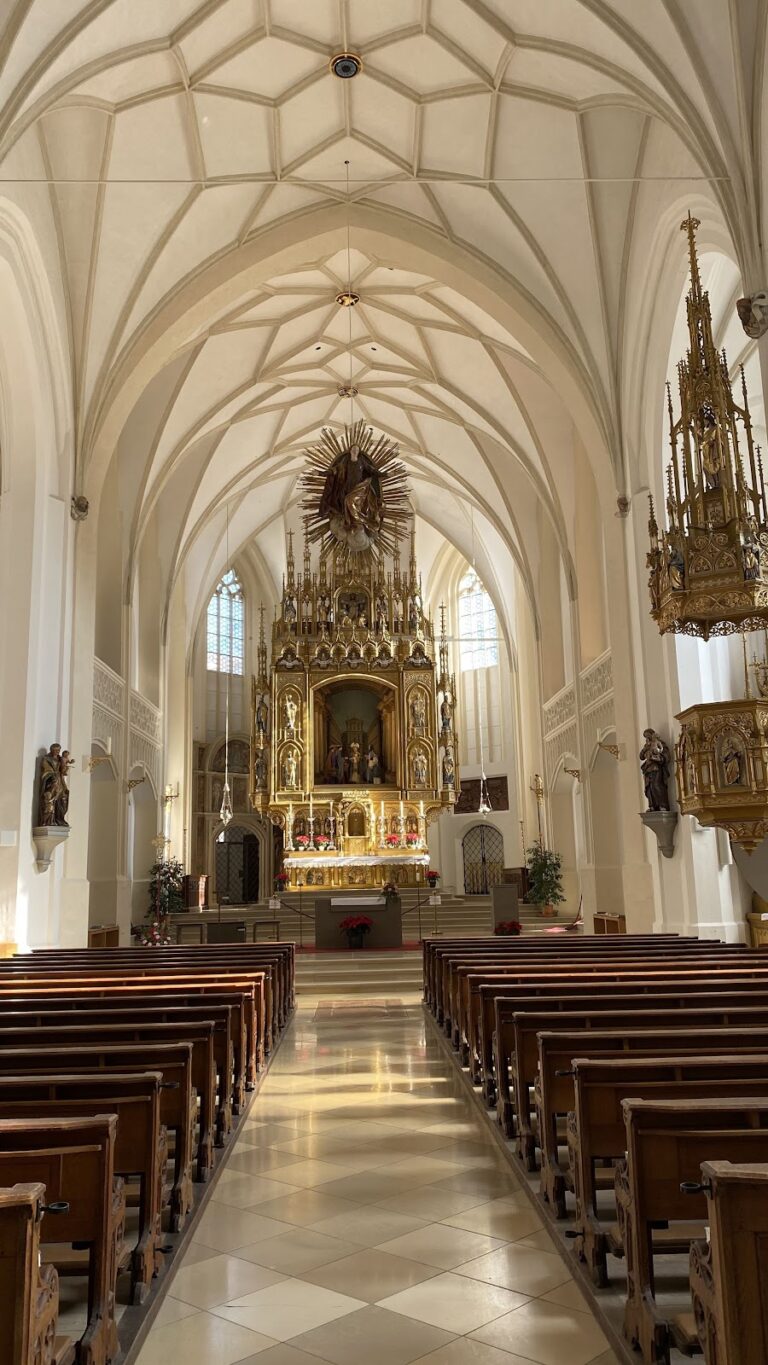
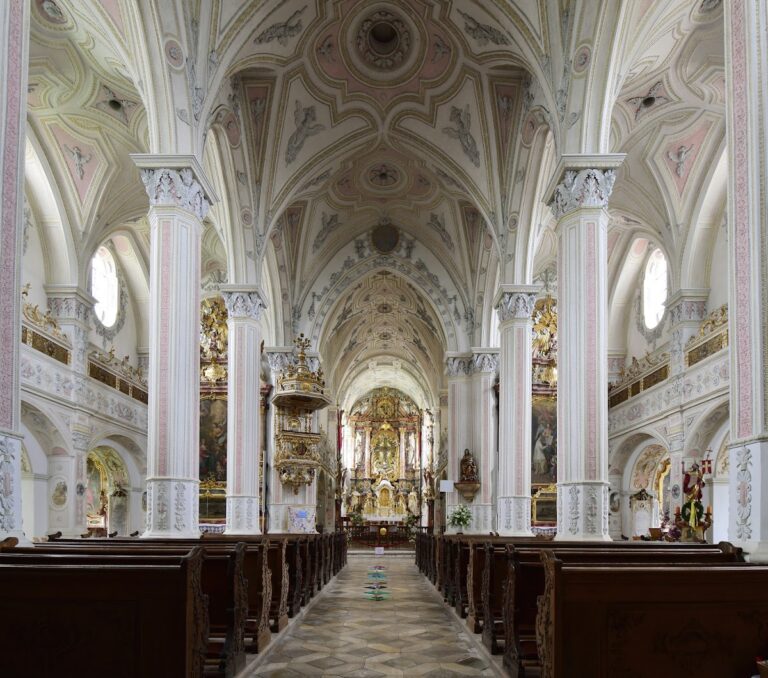
The Church of Saint Benedict is an Italian early-Baroque building rebuilt from 1672 during the Baroque transformation of the complex. It contains a Romanesque ornamental pavement from the twelfth century, found during archaeological excavations. Excavations in the cloister garden in September 1988 uncovered an eighth-century grave made from tuff slabs immediately beside the foundations of the first church, which was under the patronage of Saint James the Elder.
The Anastasia Chapel was added northeast of the church between 1751 and 1753. It is associated with Johann Michael Fischer and is regarded as a major work of Baroque architecture. The chapel and basilica sustained extensive damage in the 2023 storm, particularly to roofs, windows, facades, and surrounding historic fabric.
Arcade wing and ceremonial rooms
The outer quadrangle, known as the arcade wing, has its eastern side formed by the convent building and the church facade. Arcaded rooms surround an inner courtyard measuring approximately 106 by 75 metres, and some of these rooms are used by the Catholic Foundation University of Munich. The former abbey brewery is attached to the north, while the former abbey mill stands to the south. The mill now houses the Salesian Aktionszentrum, an open youth-education facility.
The Old Banqueting Hall in the west wing of the second floor was designed by Caspar Feichtmayr between 1672 and 1675, during the transition from Renaissance to early Baroque design. Its geometric stucco arrangement retains a Renaissance character, while applied foliage and frieze masks anticipate Baroque forms. Twenty-nine oil paintings depict the four elements, the twelve months, the Creation, and the conflict between vices and virtues. They are attributed, partly through signatures, to the workshop of Stephan Kessler and his son Michael Kessler.
The south wing of the arcade complex was built between 1728 and 1732 as the final section of the outer quadrangle. It contains the Princely Rooms, intended for distinguished monastic guests, particularly members of the Wittelsbach electoral family. The eastern corner room has early Rococo stucco by Franz Edmund Doll. The adjoining Salettl contains a principal painting of the Feast at the House of Simon from the Gospel of Luke.
The Princely Staircase has a ceiling painting by Johann Baptist Zimmermann showing Saint Benedict receiving the noble youths Placidus and Maurus as monastery students. Secondary paintings represent Benedictine ideals. In the corridor before the New Banqueting Hall, also called the Electors’ Hall, a fresco depicts Apollo as protector of the Muses.
Zimmermann also designed the stucco and frescoes of the New Banqueting Hall. Its scenes present legendary episodes from the early history of the monastery, including Boniface clothing Lantfrid, the first abbot, as well as the four elements and the four seasons. Bands, foliage, and latticework give the decoration its early Rococo character.
Former library
The former abbey library is a freestanding building east of the convent building. Constructed between 1722 and 1725 to protect the book collection, it is now used as a dining hall. Johann Baptist Zimmermann designed its decoration. Ceiling stucco reliefs represent the four cardinal virtues, with justice and prudence on the south side and temperance and courage on the north.
Large ceiling frescoes present Saint Benedict as a bringer of Western culture and celebrate philosophy and theology. Putti at the eastern end represent night, morning, noon, and evening, while figures at the western end represent the four seasons. Interlocking dolphins fill the corners of the decorative scheme.
Fraunhofer glassworks
The former Fraunhofer glassworks preserves furnaces, optical instruments, and other equipment associated with early nineteenth-century glassmaking and optical research. The surviving installation is arranged as a museum explaining the techniques used during Joseph von Fraunhofer’s period at Benediktbeuern. It represents the complex’s transformation from a dissolved monastery into a place of industrial experimentation and scientific work.