Schloss Reichersbeuern: A Moated Castle and Manor Seat in Bavaria
Site at a Glance
- Popularity
- Medium
- Country
- Germany
- Primary era
- Early Modern
- External website
- Open
- Eras represented
- Medieval, Early Modern
- Civilizations
- Duchy of Bavaria, Electorate of Bavaria, Holy Roman Empire
- Site type
- Military
- Remains
- Castle
On this page14 sections
History
Schloss Reichersbeuern is a moated castle in Reichersbeuern, Bavaria, Germany. Its fortified predecessor was built before 955 to shelter local inhabitants during Hungarian incursions. The present castle reflects Renaissance alterations begun in the 16th century, and its later history connects the site to Tegernsee Abbey, Bavarian noble families, and a local manor jurisdiction.
Early settlement and Tegernsee Abbey
The name Reichersbeuern derives from the Middle High German form, an earlier stage of German, Richerispuira, meaning Richer’s house. An earlier name, Puron, meant by the houses. Richer’s identity is uncertain; he may have been a wealthy local lord, possibly from the Huosi, an early Bavarian noble family.
After Tegernsee Abbey was founded in 746, Reichersbeuern was granted to it as a fief. The abbey directed the clearing and settlement of the Isar valley. When Bavaria became part of the Carolingian realm in 788, Tegernsee gained the status of an imperial abbey, with a special relationship to the ruler. Following a Bavarian defeat at Pressburg during Hungarian incursions, Duke Arnulf the Bad secularized the abbey and distributed or sold its lands. Reichersbeuern passed to the Rapotones, ancestors of the counts of Dießen and Andechs.
A Tegernsee codex names Count Meginhard of Richersspuren as a witness in 1045. A member of the counts of Gilching, Meginhard was related by marriage to the counts of Dießen and held Reichersbeuern as a fief from the abbey. His panther emblem survives in the municipality’s coat of arms.
Abbey stewards and the manor
During the Investiture Controversy, a medieval struggle over who could appoint church officials, Tegernsee recovered the castle. The abbey placed dependent retainers there to exercise its secular authority over people and property. These families served as stewards, holding the fief and inheriting its service obligations. In 1209, Alban of Reichersbeuern was in charge of Tegernsee Abbey while Duke Louis the Kelheimer besieged it during the Andechs War.
The steward families controlled Reichersbeuern until the mid-14th century. A dispute involving Albanus IV concerned the rights of peasants from Reichersbeuern and Greiling to use and pass through the Kehrberg woods. After Emperor Louis IV confirmed monastic privileges and granted monasteries lower judicial authority in 1321 and 1330, Tegernsee appointed the Hohenrainer family instead of renewing Albanus’s stewardship in 1353. Albanus had no children and began selling his property in 1358, including the castle, which he sold to the Pienzenau family.
A separate conflict over hunting and timber rights on Karberg began in 1341 between the Reichersbeuern manor lords and the administrator of the Tölz court. Eckprecht and Alban IV settled with Tegernsee before a court of Louis IV: they sold the castle’s mountain forest to the abbey while preserving local residents’ right to gather wood for their own use. Later Wittelsbach owners exercised timber rights there. After Tölz’s first castle burned, Duke Albrecht III used Karberg timber for a replacement begun in 1454. Jakob Tänzl von Tratzberg later challenged the logging, but the court rejected his claim. A Munich court ruled for the Reichersbeuern manor lords in 1553, fixing a boundary that still corresponds to the municipal boundary. Greiling’s farmers retained wood-gathering rights, while Tölz residents did not.
The Pienzenau family also secured a local religious office. Otto I von Pienzenau obtained the church at Reichersbeuern from Tegernsee and, in 1388, endowed income for a resident vicar, so the community would not have to rely on Oberwarngau. Otto II inherited the castle in 1371. In 1388, Duke Stephan III acquired the castle, its manor, and the castle site of Hoheneck from Otto II in exchange for Hartmannsberg. The exchange reflected the duke’s interest in the local hunting grounds.
Under Wittelsbach rule, Reichersbeuern became the center of a manor jurisdiction, a lordship with local rights that included lower courts. It covered Reichersbeuern, Greiling, and Sachsenkam, where the landowner or an appointed judge exercised authority. The arrangement helped maintain the castle’s role in local government. Ponds and woods also shaped life at the manor: shallow ponds provided fish, but many froze in winter, making hunting another important food source where marshland and dense forest limited pasture.
Renaissance owners and changing claims
Duke Albrecht IV granted the manor to Kaspar II Winzerer for his loyalty during the struggle against the Löwlerbund, a league of Bavarian nobles opposed to the duke. The pledge payment, however, remained with Christina Maxlrainer of Hohenburg. Later dealings involving Kaspar III Winzerer, Veit Jakob von Tänzl, and Wolfgang von Schellenberg transferred the castle and produced competing claims over its sale. The Tänzl family held the castle in the early 16th century and undertook its Renaissance transformation. The Munich patrician Rudolf family acquired it in 1519.
The Rudolfs continued to dispute timber and hunting rights with Tölz. Georg Rudolf accused Tölz residents of illegally cutting wood in his forest, while the Tölz court administrator claimed rights to timber, hunting, and fishing there. Augustin Rudolf later clashed with the duke over the family’s judicial authority and the duke’s hunting rights. As the family’s fortunes declined, Augustin sold the Stallauer pond in 1558. The 1553 settlement nevertheless upheld the Reichersbeuern manor lords’ claim to the boundary while preserving Greiling farmers’ right to gather wood.
The Hohenburg family asserted claims to Reichersbeuern in 1562 and 1563. During the 1560s, Dionys von Schellenberg acquired property from the Rudolf heirs and administered the manor as a supporter of the Counter-Reformation, the Catholic Church’s effort to renew Catholic practice and respond to Protestantism. Dionys died without children in 1577, and the Pienzenau family regained the castle and manor. A pledge debt between Kaspar II Winzerer and Christina Maxlrainer was settled.
Christoph II von Pienzenau acquired Reichersbeuern in 1577 and joined it to the manor of Sachsenkam. After his death in 1578, his daughter Anna inherited the properties. She married Johann Baptist von Guidoboni-Cavalchini in 1579, and Tegernsee confirmed him as fiefholder in 1581. When he died in 1603, Anna became the manor holder. Her second husband, Jakob Papafaba, fled to Italy in 1609 amid accusations that he had taken her valuables and intended to murder her. Anna remained in possession, although the duke opposed a woman holding a manor while married to a foreigner or a person he considered incapable, and revoked privileges previously granted by Duke Albrecht.
Preysing ownership, war, and local legends
On 12 November 1627, Anna’s relatives and heirs sold the heavily indebted castle and manors to Johann Christoph von Preysing of Hohenaschau. The Preysing family retained the property for more than 200 years. Swedish forces damaged the castle during the Thirty Years’ War, after which the family restored it.
A haunting tradition grew around Sophie von Pienzenau, who endowed a mass for the soul of her husband, Christoph II, in 1580. Her daughter Anna and son-in-law were expected to maintain it, but the obligation was said to have lapsed after Anna’s death in 1627. In December 1644, Maximilian I von Preysing summoned a spirit medium and a mason from Munich to investigate the alleged haunting. Exorcisms took place at midnight in the lord’s chamber from 26 to 28 December. The medium, Rosina, reportedly said the spirit asked for an annual mass in the castle chapel. A Franciscan from Tölz then held a service and sprinkled holy water around the castle.
Other versions of the legend said Sophie gave Anna 100 gulden for annual masses, which Anna spent on clothes and jewels, or that Sophie imprisoned her child in a watchtower, where the child starved. In these tellings, Anna became the haunting spirit, or Sophie appeared as a White Lady around the first snowfall. Later stories described lights moving between windows, a red-eyed dog on the spiral staircase, and dragging sounds. A separate treasure tale placed a gold-filled chest in a buried vault guarded by the Norns, figures in Norse mythology associated with fate. Another local legend told of a tunnel from the castle’s ground-floor stables to Reutberg Abbey, about five kilometres away, with accounts differing over how much of it remained intact.
The Sigriz family has owned the castle since 1829 and modernized it. Local tales of hauntings spread more widely after the family acquired the property.
The school and the 20th century
From 1934 to 1937, the estate was required to house about 350 members of the Austrian Legion, a Nazi paramilitary formation of Austrian supporters of National Socialism. This was imposed as punishment for the owner’s criticism of the Nazi regime. In May 1938, educator Max Rill moved into the castle with 43 female pupils to establish a school based on humanist reform education and shared living and learning. Rill had joined the Nazi Party in 1937.
The school was nationalized in 1943, and Rill became a civil servant. A military hospital occupied the castle in 1944, temporarily interrupting the school. After the war, Rill was initially classified as a fellow traveler. An anonymous complaint prompted a new proceeding in 1947 over whether he should instead be judged more deeply implicated in the Nazi regime. Witnesses described his teaching as politically neutral and his conduct as proper; accusations also cited pupils’ socializing, including regular dance classes, with members of the Tölz SS officer-training school. The school had secretly enrolled children of Jewish mixed ancestry as well as children of prominent Nazis, including Rudolf Hess’s niece and Gudrun Himmler, daughter of Heinrich Himmler.
The Max-Rill-Schule, a private secondary school with boarding facilities, continues to use the castle. The complex is protected as a monument, and its grounds are recognized as an archaeological monument containing medieval and early-modern remains associated with the castle and its predecessors.
Remains
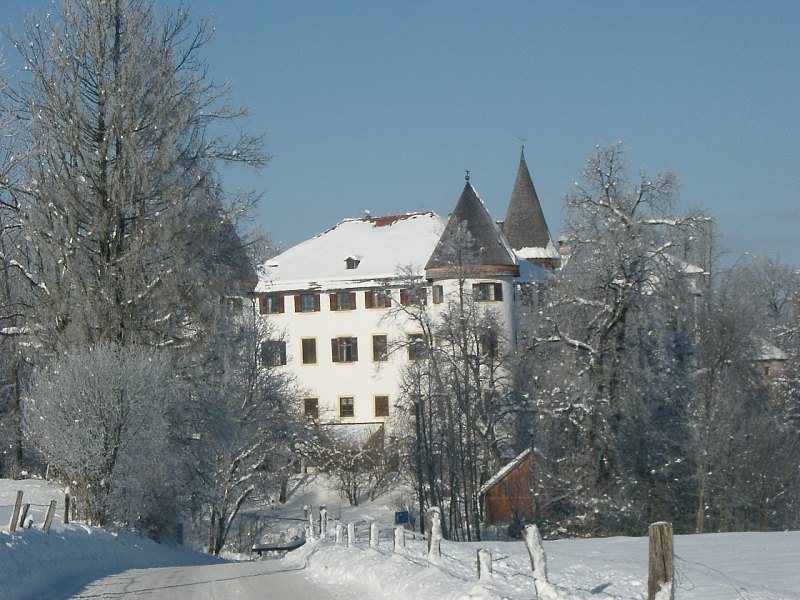
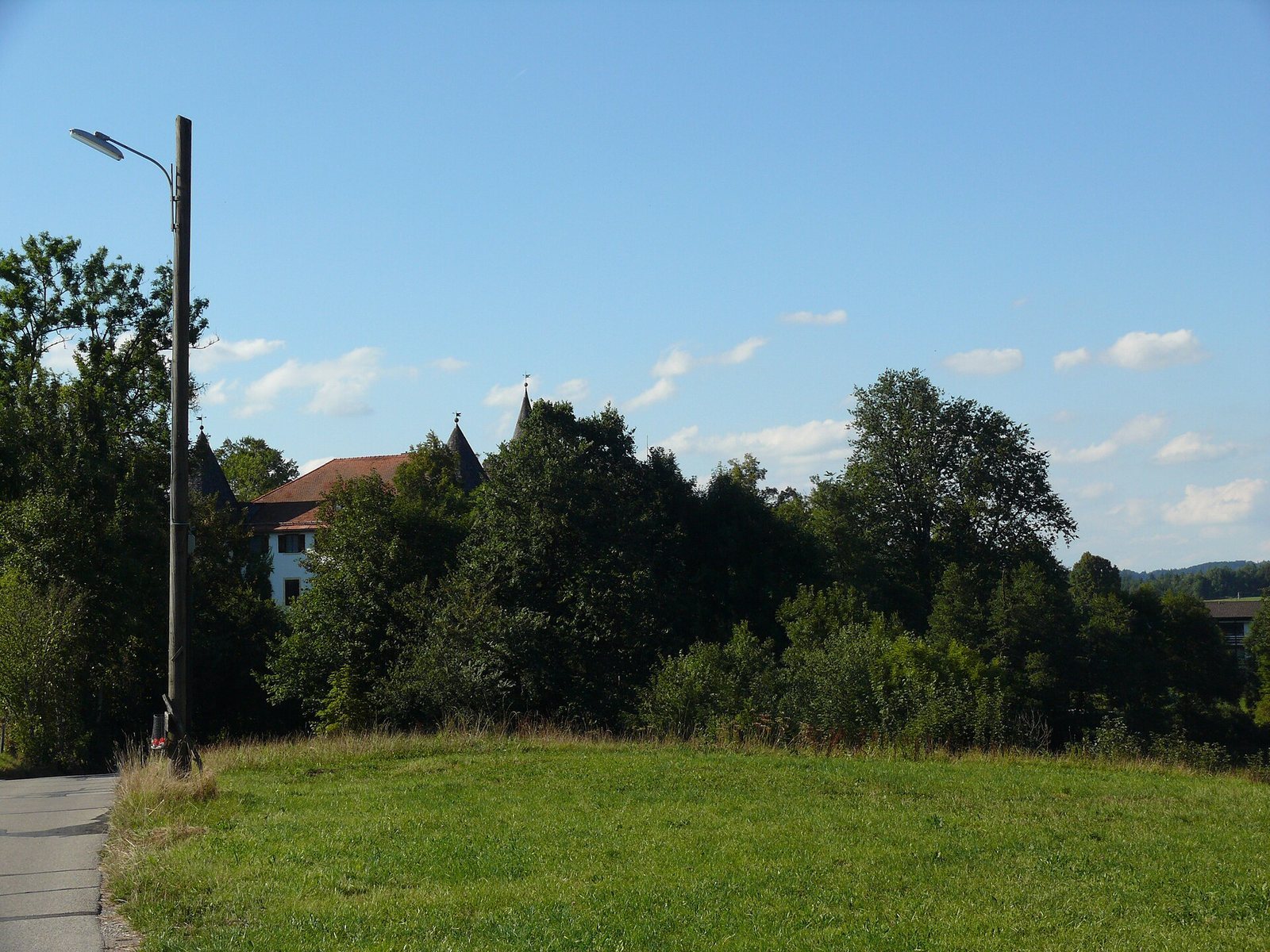
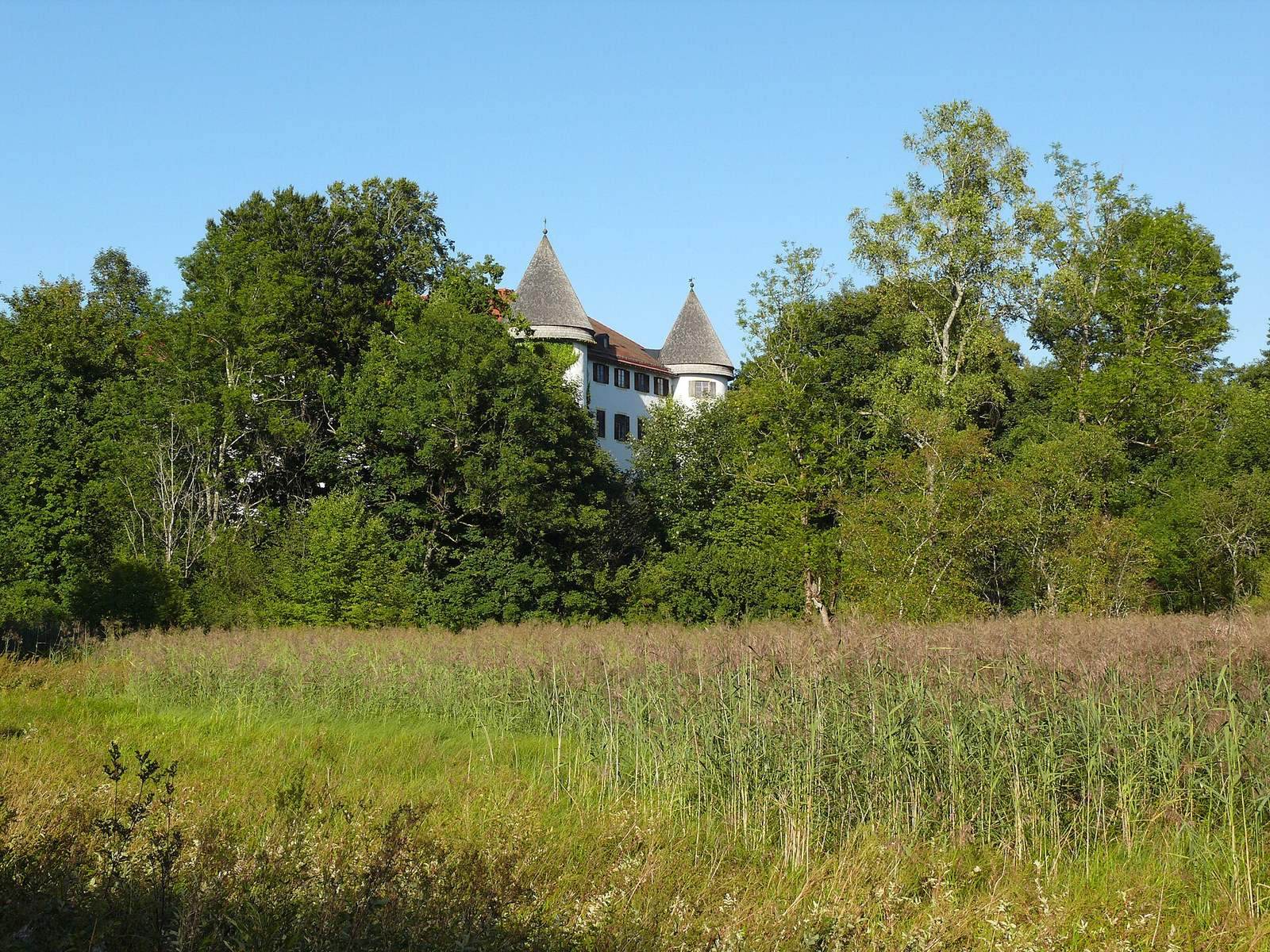
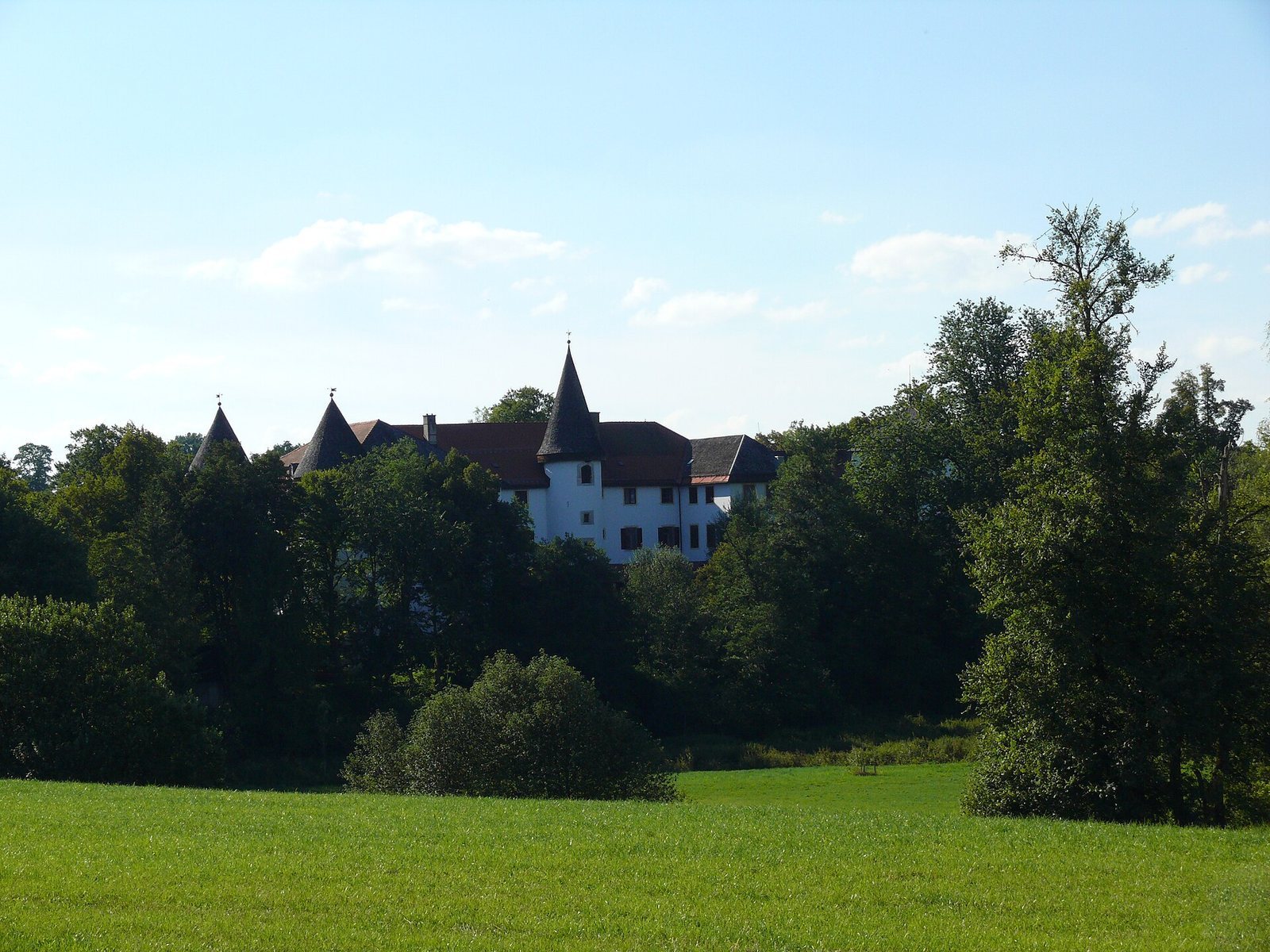
The castle stands about 710 metres above sea level at the foot of the Bavarian Alpine foothills, roughly six kilometres east of Bad Tölz. It occupies raised ground shaped like a tongue of land. Four ponds surround it on three sides; the village stream was diverted into them to strengthen the defenses. The surviving complex combines early Renaissance features with a Baroque-reworked northern section.
Renaissance features and furnishings
Chapel and interiors
The early Renaissance castle includes a chapel built for the Tänzl family. A religious grant was made for it in 1516. Renaissance features also include ceilings divided into recessed panels. Wooden sculptures and other works among the castle’s Renaissance furnishings are attributed to the Bavarian sculptor Erasmus Grasser and G. Bockschütz.
Towers and staircase
Two corner towers form part of the early Renaissance fabric. The central spiral staircase is among the oldest surviving parts of the castle. The original entrance was reached by way of this staircase, while the present main entrance was added later.
Gatehouse and silver plates
The gatehouse contains a chimney room with a tiled stove. During the 1930s, a chimney sweep found more than 100 silver plates concealed in the stove’s domed upper section. The owner’s grandfather had hidden them there during the First World War, and the hiding place was later forgotten.
Later alterations and buried remains
Northern section
The northern section was remodeled in Baroque style around 1700, adding a later phase to the castle’s Renaissance appearance.
Archaeological remains
Beneath the castle grounds are medieval and early-modern remains associated with Schloss Sigriz and the buildings that preceded it.