Behram Pasha Mosque: A Sixteenth-Century Ottoman Mosque in Diyarbakır


Site at a Glance
- Rating
- 4.8
- Popularity
- Low
- Country
- Turkey
- Primary era
- Early Modern
- Eras represented
- Early Modern
- Civilizations
- Ottoman
- Site type
- Religious
- Remains
- Mosque
On this page10 sections
History
Behram Pasha Mosque is a sixteenth-century Ottoman mosque in Diyarbakır, Türkiye, commissioned by Behram Pasha, a senior provincial governor who administered the region for the Ottoman central government. Construction began around 1564–65 and ended in 1572–73, a date preserved in an Arabic inscription above the entrance. The building belongs to the Ottoman architectural tradition and became known for combining an imperial design with local materials and workmanship.
Foundation under Behram Pasha
Behram Pasha was the son of Kara Şahin Mustafa Pasha, who had served as governor-general of Yemen and Egypt. Behram Pasha’s period as governor-general of Diyarbakır is uncertain, although it probably fell between 1564–65 and 1567–68. He died in 1585 and was buried in Aleppo. The mosque’s construction began during his connection with Diyarbakır and continued until its completion in 1572–73.
Sinan and the Building’s Design
The Ottoman architect Sinan is credited with the mosque in one of his two major autobiographies, Tuḥfetü’l-mi’mārīn, but not in Tezkiretü’l-ebniye. This difference may mean that Sinan’s involvement was limited to approving plans in Istanbul, while another architect directed the work. The person who supervised construction remains unknown. He may have been an imperial architect sent from Istanbul or a local master, and the combination of Ottoman planning with regional architectural details points to the participation of Diyarbakır masons and craftsmen.
Architectural historians have praised the mosque’s proportions and decoration. In 1971, Godfrey Goodwin characterized it as an exceptionally distinguished provincial mosque, especially within the restrained local style he associated with the building.
Remains
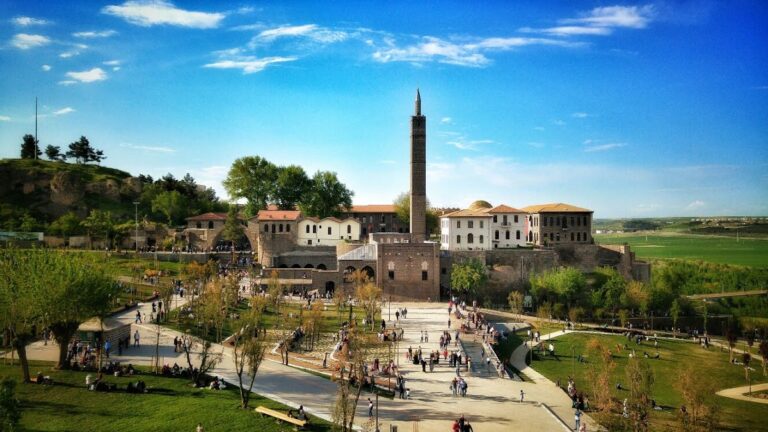
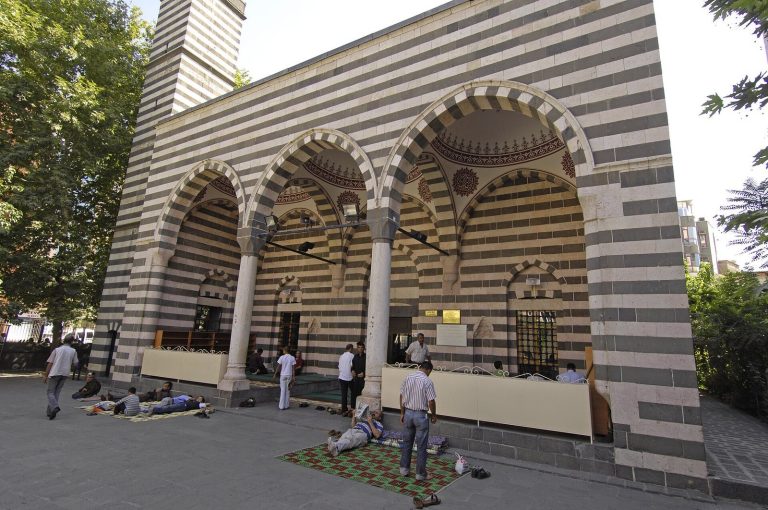
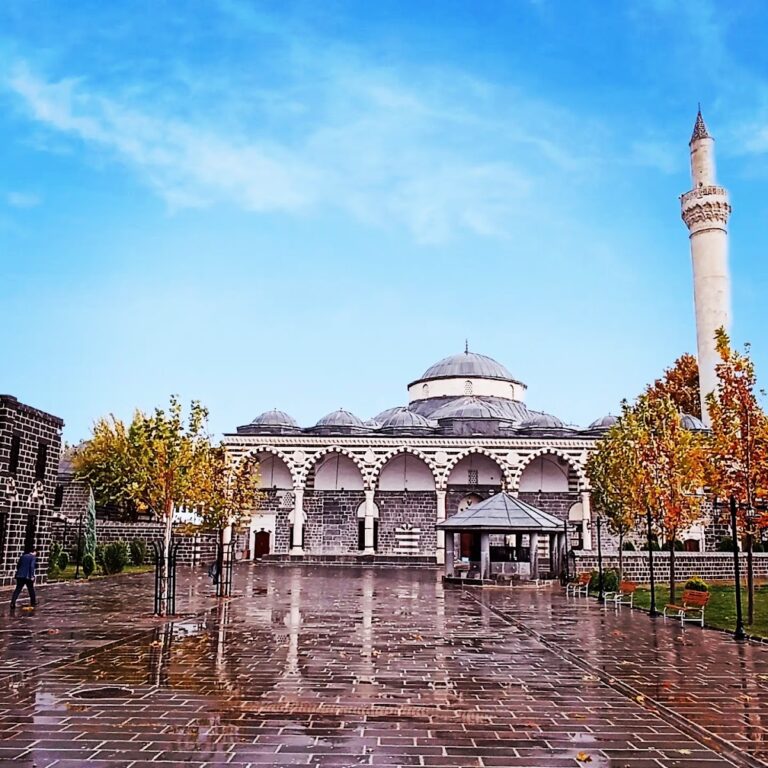
The mosque is organized around a domed prayer hall, a double front portico, a north entrance, and a forecourt fountain. Black basalt and white limestone form the principal materials, with contrasting stone layers used especially on the north façade. Ottoman planning is expressed through the centralized domed structure, while the alternating masonry and carved details give the complex a distinct Diyarbakır character.
Forecourt and Entrance
Ablutions Fountain
An octagonal ablutions fountain, or shadirvan, stands before the mosque on the central axis of the north portal. Used for washing before Islamic prayer, it has a pyramidal roof carried by composite black-and-white columns. Braided sections run through the centers of the columns, creating a pattern that is repeated in the mosque’s portico.
Portico and Minaret
The double front portico has five domes. Its two central columns use braided stone sections set between alternating black and white layers, echoing the fountain in front of them. The remaining columns are made of white marble. A single minaret rises at the northwest corner of the portico.
The north entrance portal has a stone-carved muqarnas hood. Muqarnas is a stepped, cellular form often used beneath domes, cornices, and entrance hoods. Inside, the mosque includes a mihrab, which marks the direction of prayer, and a stone minbar, the raised pulpit used for sermons.
Domed Prayer Hall
Dome and Structural Form
The main building takes the form of a simple domed cube. Its dome rests on a sixteen-sided drum, with one window on each side. Eight pointed arches support the dome, which measures 15.9 metres in diameter.
Tilework and Interior Finish
The lower wall zone, known as the dado, is covered with large square polychrome tiles made with an underglaze technique. Two types of rectangular tiles border these panels. The tiles are believed to have been produced locally in Diyarbakır, although their appearance closely resembles work associated with İznik. Together with the carved portal, mihrab detailing, and stone minbar, this interior treatment contributes to the mosque’s carefully balanced decorative scheme.