Basilique Sainte-Marie-Madeleine de Saint-Maximin-la-Sainte-Baume: A Gothic Pilgrimage Church in France


Site at a Glance
- Rating
- 4.7
- Popularity
- Medium
- Country
- France
- Primary era
- Medieval
- External website
- Open
- Eras represented
- Classical, Medieval, Early Modern
- Civilizations
- County of Provence, French, Holy Roman Empire, Ostrogothic, Roman
- Site type
- Religious
- Remains
- Basilica
On this page15 sections
History
Basilique Sainte-Marie-Madeleine de Saint-Maximin-la-Sainte-Baume is a Roman Catholic church in France, built under medieval Angevin patronage between 1295 and 1532 in the Gothic style. Dedicated to Mary Magdalene, it serves the parish of the same name in the Diocese of Fréjus-Toulon and is regarded as the most important Gothic religious building in Provence.
The tradition of Mary Magdalene
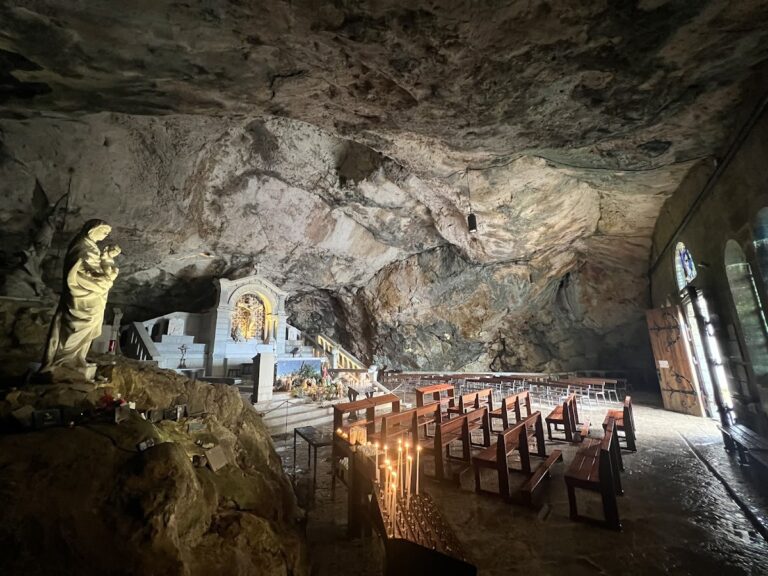
Christian tradition identifies Mary Magdalene with Mary of Bethany and says that she fled the persecution of Herod to Provence with Martha and Lazarus. After preaching in the region, she supposedly spent thirty years in a grotto of the Sainte-Baume massif. Saint Maximin, traditionally regarded as the first bishop of Aix, was said to have buried her at Saint-Maximin.
The supposed tomb was traditionally entrusted to Cassianite monks from Marseille’s Abbey of Saint-Victor. During the eighth century, the monks are said to have concealed the relics, possibly by filling the crypt with rubble, to protect them from Saracen raids. Devotion to Mary Magdalene continued, and pilgrims were recorded at Saint-Maximin in the twelfth and thirteenth centuries.
A competing claim came from Vézelay, whose monks publicized their possession of Mary Magdalene’s relics from about 1040. Accounts connected the relics’ arrival there with several different dates, including 745, 781, 789, and 880. The rivalry between the two sanctuaries became especially important after the discovery at Saint-Maximin in 1279.
Charles II and the foundation of the basilica
In 1279, Charles II of Anjou, then Prince of Salerno and son of Charles I, ordered a search for Mary Magdalene’s tomb. The investigation uncovered an early Christian tomb, now incorporated into the crypt, containing bones believed to belong to the saint. Charles II declared that divine inspiration had prompted his action.
By April 1295, Charles II was Count of Provence and King of Naples. He presented the Provençal bishops’ records concerning the discovery to Pope Boniface VIII. The pope confirmed the relics’ authenticity, granted indulgences to pilgrims, and transferred custody of Saint-Maximin and Sainte-Baume from the Benedictine monks of Saint-Victor to the Dominicans, or Order of Preachers. This Catholic order, founded by Saint Dominic and associated with preaching and theological study, thereafter became responsible for the sanctuary. Religious authorities came to describe the tomb as the “third tomb of Christendom.”
Charles II began the basilica and an adjoining Dominican convent in 1295 on the site of the discovery. He commissioned plans from the court protomagister identified as Magister Petrus Gallicus, a figure associated with Pierre d’Angicourt, although his direct role in the first construction remains uncertain.
Medieval construction
After an interruption, building resumed on a large scale from 1300 to 1316 under Jean Baudici, architect of the palace of the Counts of Provence. Jean Gobi, prior of Saint-Maximin from 1304 to 1328, supported the renewed work. By 1320, the apse and the first bay of the three naves were complete. Four more bays were constructed between 1330 and 1345.
In 1404, the apse and the five final bays of the nave had been completed. Jean II Le Meingre, known as Boucicaut and Marshal of France, then decided to build the northern part of the fourth bay. This work allowed the crypt to be covered and incorporated into the church. The crypt was levelled to the floor of the new basilica as construction proceeded.
Work resumed under Louis XII in 1508 after Jean Damiani became prior. Hugues Caillat completed the sixth bay in 1513, while Pierre Garcin and his father, Jean Garcin, completed the first three bays in 1532. Plague disrupted some of the building phases. The western façade remained unfinished from about 1530, and a sixteenth-century Gothic inscription on its interior preserves stages in the work.
Decoration, Revolution, and Dominican restoration
The interior was substantially altered during the seventeenth century. Window tracery in the side chapels was blocked to create space for altarpieces, and the terraces above the side aisles were covered with lean-to tile roofs. These changes helped give the medieval structure its later Baroque interior character.
During the French Revolution, the Dominicans were expelled and the convent and basilica were converted into a food depot under the responsibility of Lucien Bonaparte. Revolutionary authorities stripped the reliquaries of their precious metals and jewels. The sacristan and several local inhabitants concealed the saints’ relics for several years, allowing public worship to resume later.
In 1793, the organist Fourcade saved the great organ from destruction by playing “La Marseillaise” before Paul Barras and other revolutionary officials. The Dominicans returned to the convent in 1859 after Father Henri Lacordaire purchased it and restored their presence at the basilica.
Modern conservation and archaeological discoveries
Restoration began at the apse in 1839, and the church was placed on France’s list of historic monuments in 1840. Under Lacordaire in 1875, buildings along the cloister gallery and the northern chapels were demolished. Nineteenth-century conservation directed by Charles-Auguste Questel and Henri Révoil included clearing masonry and restoring profiles and facing with cement mortar and reconstructed stone.
Jules Formigé excavated the crypt and worked on its presentation during the first half of the twentieth century. His son, Jean-Camille Formigé, removed the seventeenth-century lean-to roofs above the northern side aisle and replaced them with a reinforced-concrete terrace. After the Second World War, Paul Colas worked on the tracery of the northern side aisle and northern apsidiole, a small apse-like chapel, although that work was interrupted.
Serious deterioration became apparent in 1975 and 1976, when stones fell from the ribbed vaults and transverse arches. Water entering through the roofs, drainage systems, and wall joints weakened the internal masonry and disturbed the equilibrium of the vaults. Emergency clearance and temporary strengthening were followed by waterproofing and structural consolidation. The programme included renewed roofing, improved drainage, repointing of walls and buttresses, and repairs to the supports. The unfinished western façade was strengthened in 1986 and 1987, while a wider programme from 1986 to 1993 addressed damage caused by decades of inadequate maintenance.
Excavations south of the basilica in 1993 revealed a religious complex dating from the beginning of the sixth century. It included a church with an attached baptistery about 11 metres square. A mausoleum corresponding to the present crypt had stood on the edge of the settlement roughly a century earlier. These discoveries overturned the earlier interpretation of the crypt as a private tomb built by a wealthy rural family.
Around the year 1000, the earlier church was rebuilt and enlarged at the expense of the baptistery. It was restored around 1200 and probably remained in use when the purported relics of Mary Magdalene were discovered in 1279. Geophysical investigations in 2021 identified several unfilled galleries extending beneath the basilica toward the crypt, possible burials, and anomalies suggesting an otherwise unknown church. They also indicated that the crypt had originally been larger.
In 2014, the basilica’s priest, Florian Racine, announced the discovery of a skull that might be a relic of Saint Sidonius. That year, relics attributed to Saint Lawrence, Saint Dominic, and Saint Maximin were found in the sacristy. Religious officials had hidden those relics and reliquaries in 1905. In 2017, a scientific team commissioned by the diocese produced a three-dimensional reconstruction of Mary Magdalene’s face from the skull preserved in the basilica. A recent examination described the skull as belonging to a small Mediterranean-type woman who was approximately sixty years old.
The request for the title of minor basilica was accepted in 2017, and Pope Francis formally elevated the church on 23 March 2018. A minor basilica is an honorary papal designation for a church of particular religious or historical importance. The church had long been called a basilica locally, although it had not previously held the official Vatican title.
The Dominican convent served the church until the Revolution. It closed in 1791, was restored in 1859, closed again in 1966, and was subsequently sold to a mixed-economy company dependent on the Var department and the municipality of Saint-Maximin-la-Sainte-Baume. For many years, it received Dominican postulants for extended stays and students of theology.
Remains
The basilica is a large Gothic church approximately 70 metres long and 46 metres wide. Its nine-bay nave is flanked by eight-bay side aisles, with chapels placed between the buttresses. The repeated structural units called bays organize the length of the interior. Vaults rise to 28.7 metres over the nave, 17.5 metres over the side aisles, and 10.25 metres over the side chapels. A polygonal apse is flanked by two polygonal chapels, and the building has three levels of vaulting. Its large scale and arrangement have been compared with Bourges Cathedral.
Exterior and chapels
The apse is flanked by two stair turrets, and the northern turret is topped by a relatively recent bell tower. Flying buttresses support the nave. Their pinnacles are plain rectangular masses capped with two-sloped stone roofs. The unfinished western façade retains the physical evidence of the interrupted construction programme.
Early chapels and Saint Louis
The former baptistery chapel, now the Chapel of Saint Peter, contains a painting of the Coronation of the Virgin from about 1575. It was made as an ex voto after the Christian victory at Lepanto in 1571. The Chapel of Saint Blaise contains marble baptismal fonts from about 1700, a seventeenth-century altarpiece from the Provençal school, a painting of bishops receiving their mission from Saint Peter, and a statue of Saint John the Baptist dated 1526 by the Aix sculptor Jean Guiraman.
The Chapel of Saint Louis of Anjou contains a listed historic altarpiece with three paintings. Saint Louis appears as a bishop and preacher in the centre, Mary Magdalene is shown on the right, and Martha with the Tarasque appears on the left. The chapel also holds a 1640 Crucifixion copied from a work by Anthony van Dyck and a painting of Saint Vincent Ferrer.
Mary Magdalene and Saint Éloi
The Chapel of Mary Magdalene retains traces of seventeenth-century frescoes and a wooden altarpiece by the Dominican brother Louis Gudet. Two large seventeenth-century reliquary cupboards formerly held numerous reliquaries. An inventory made in 1780 estimated the combined weight of the chasses and reliquaries at about 800 kilograms. Most disappeared during the Revolution when their precious metals were recovered.
The Chapel of Saint Éloi contains a gilded wooden altarpiece, part of a fifteenth-century altarpiece predella, and four associated panel paintings. A predella is the lower section of an altarpiece, often divided into narrative scenes. The oak predella was cut to fit an altar and is now 2.5 metres long. Its six scenes show a female donor and her daughter, Saint Thomas Aquinas contemplating the crucified Christ, Martha overcoming the dragon at Tarascon, the beheading of John the Baptist, Mary Magdalene recognizing Christ after the Resurrection, and a damaged final section retaining two portions of a Dominican habit.
The associated panels depict Saints Lawrence, Anthony, Sebastian, and Thomas Aquinas. The paintings of Lawrence and Thomas Aquinas are attributed to the Dominican André Abellon, who was a native of Saint-Maximin; the other two were heavily repainted. Lawrence carries the Gospels and a martyr’s palm beside a gridiron. Anthony holds a Gospel book and bell, with a small pig at his feet. Sebastian is pierced by arrows, while Thomas Aquinas wears the Dominican habit and holds the Gospels, a chalice, and a Host, with a radiant sun on his chest.
Later chapels and transferred furnishings
The Assumption Chapel contains a 1751 altarpiece, an eighteenth-century painting of the Assumption, and a painting of Saint Agnes of Montepulciano. It was originally intended to form a side entrance beneath a bell-tower porch, but that project was abandoned with the planned façade in 1532. The Chapel of Notre-Dame of Lourdes, also called the Epiphany Chapel, contains a copy of a 1624 painting by Rubens showing the Adoration of the Shepherds. The legal scholar Scipion Dupérier donated the copy.
The Chapel of Saint Anthony of Padua contains a Carrara-marble statue of the Virgin by the Genoese sculptor Tomaso Orsolino. It was transferred from a Capuchin convent destroyed during the Revolution. The Chapel of Saint Dominic has seventeenth-century frescoes and a painting of Saint Dominic in ecstasy. The Chapel of Saint Francis contains an altar and altarpiece transferred from the same Capuchin convent, together with a modern Nativity scene.
The Sacred Heart Chapel contains a seventeenth-century painting of Catherine of Siena and Rose of Lima kneeling before Christ. The Chapel of Saint Joseph has a richly carved altarpiece transferred from the Blue Penitents’ chapel in the town centre. Its paintings include Saints Anne and Joachim visiting the Holy Family, Mary Magdalene at Sainte-Baume, and probably Saint Maximin as a bishop. The Chapel of Saint Michael contains a painting of Michael weighing souls in the presence of Saints Raymond and Hyacinth. Other chapels are dedicated to Saints Peter, Blaise, Louis of Anjou, Mary Magdalene, Crépin, Éloi, Maximin, Anthony of Padua, Dominic, Francis of Assisi, Joseph, and Michael, as well as to Reconciliation, the Assumption, Notre-Dame of Lourdes, the Sacred Heart, Saint Thomas Aquinas, Notre-Dame of Consolation, the Holy Name of Jesus, and Saint Anne. The Chapel of Saint Crépin has a passage to the Dominican convent, while the Chapel of Reconciliation is used for confession.
Choir and apse
The choir enclosure dates from 1692 and has gates made by François Peironi of Aix-en-Provence. Ninety-four carved walnut choir stalls stand on either side of the choir. Twenty-two medallions, carved under the direction of the Dominican Vincent Funel, depict miracles or martyrdoms associated with Dominican religious figures.
The seven-sided apse has two rows of openings on five sides, separated by horizontal mullions. Its rear wall carries richly carved Corinthian architectural facing in marble, topped by a balustrade with allegorical statues. Three paintings by André Boisson show episodes from Mary Magdalene’s life: Mary Magdalene at Sainte-Baume in the central octagonal painting, her encounter with the risen Christ on the left, and her renunciation of worldly riches on the right.
A gilded-stucco Glory, approximately 6 by 6 metres, rises above the apse portico. A dove representing the Holy Spirit occupies its centre. The polychrome stucco panels on the sides of the apse were made by Jean Antoine Lombard of Carpentras in 1684. They contain a terracotta relief by Joseph Lieutaud showing Mary Magdalene receiving Communion from Saint Maximin and a marble relief by an unknown artist showing Mary Magdalene carried away by angels.
The Baroque high altar is made of local veined marble. Its gilded bronze medallions by Joseph Lieutaud represent the Supper at Emmaus and the Death of Joseph. Above it stands a red-porphyry urn by the Roman sculptor Silvio Calce, flanked by two gilded bronze dogs by Alessandro Algardi and topped by Algardi’s statuette of Mary Magdalene. The urn arrived from Rome in 1635 to receive the saint’s bones, and the solemn transfer took place in 1660 in the presence of Louis XIV and the court.
Altarpieces and pulpit
The northern apsidiole contains the Crucifixion altarpiece, completed on 29 May 1520 by Antoine Ronzen with essential assistance from Antoine of the Brea dynasty. The central panel shows the Crucifixion, with angels collecting Christ’s blood in chalices. Mary, Mary Magdalene, and John stand at the foot of the Cross, while Jerusalem appears behind them.
Eighteen smaller panels present scenes from the Passion, including the Last Supper, Christ before Annas, the arrest, the kiss of Judas, the Agony in the Garden, Christ before Caiaphas and Herod, the Flagellation, the Crowning with Thorns, Ecce Homo, Pilate washing his hands, the Way to Calvary, the Fall beneath the Cross, the Nailing to the Cross, and the Descent from the Cross. Several scenes place biblical events in recognizable or imagined settings, including the Colosseum, the Venetian Piazzetta, and the Palace of the Popes at Avignon. The Avignon palace appears in what is described as its earliest known representation in the altarpiece and is rendered with notable accuracy.
The lower front of the altarpiece contains a Deposition made largely with the collaboration of Brea. The Dominican shown at lower right is the donor Jacques de Beaune, lord of Semblançay, rather than the formerly identified prior Jean Damiani. Joseph of Arimathea and Nicodemus place Christ in the tomb, while Mary Magdalene tends his wounds and John supports the Virgin.
The southern apsidiole contains the Rosary altar and an altarpiece made between 1667 and 1671 by Balthasar Maunier. It includes a statue of Our Lady of the Rosary, paintings of the Virgin giving the rosary to Saint Dominic and Saint Joseph assisting a dying man, and a painting of the Virgin between a pope, a Dominican, and probably Margaret of Savoy. Its front incorporates a sixteenth-century wooden relief from the former high altar, made by Jean Beguin in 1536, with four episodes from Mary Magdalene’s life, including her departure for Provence.
The pulpit, completed in 1756, is made of carved walnut by Louis Gudet. Seven panels depict episodes from Mary Magdalene’s life, including her hearing Christ preach, anointing his feet, witnessing Lazarus’s resurrection, receiving Christ at Bethany, standing at the Cross, hearing the angel at the tomb, and meeting the risen Christ in the garden. Above the sounding board, Mary Magdalene is shown carried by angels. Beneath it hangs a gilded wooden dove representing the Holy Spirit.
Crypt and relics
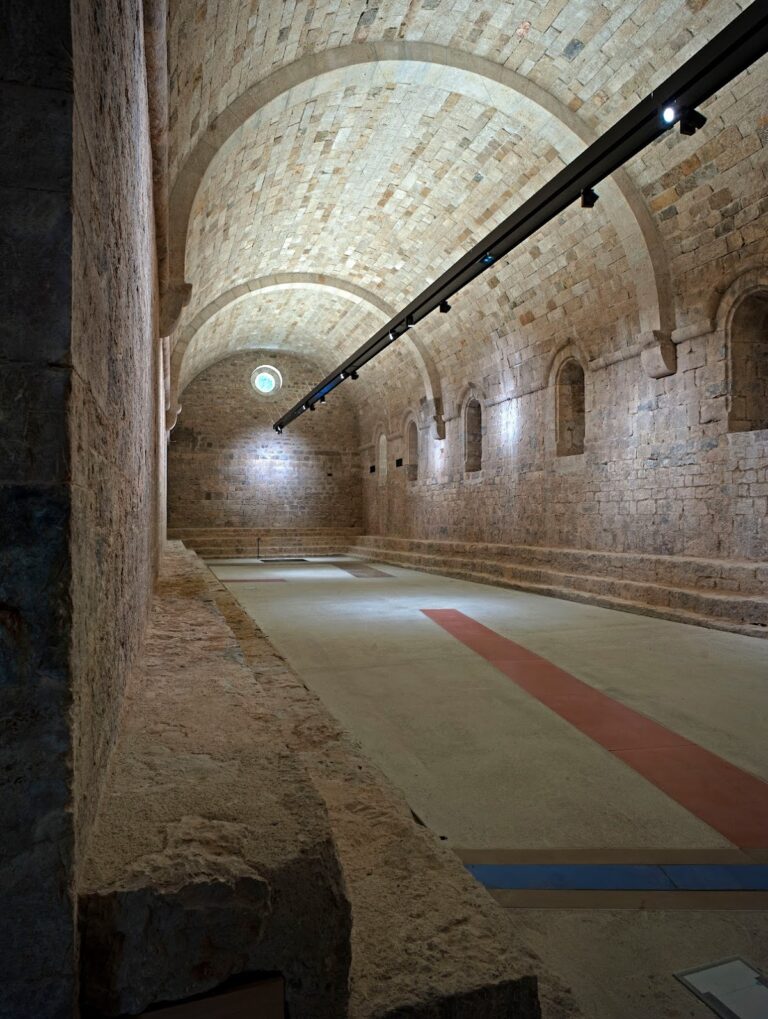
The crypt is a rectangular vaulted chamber oriented from north to south, perpendicular to the basilica’s axis. It measures approximately 4.25 metres from north to south and 4.48 metres from east to west, covering about 19 square metres. It is probably a fourth-century early Christian tomb, originally decorated entirely in marble or in marble combined with painted plaster.
The present vault was rebuilt when the fourth bay was constructed in the fifteenth century, after the crypt had been levelled. A double staircase from the sixteenth century replaced an earlier stair. A recess in the southern wall contains Mary Magdalene’s reliquary. Geophysical evidence indicates that the crypt was originally larger, although its first plan is unknown.
Four early Christian sarcophagi, generally dated to the late fourth century, stand in the crypt. Made from imported marble, several may have been carved at Arles. Their positions have changed repeatedly. The sarcophagus of Saint Marcella against the east wall shows a youthful, beardless Christ with long curly hair placing his hand on a companion who may represent the deceased. Saints Peter and Paul flank the central scene, while the lid has a frieze of tritons and dolphins.
Another sarcophagus against the east wall is traditionally called the Sarcophagus of the Massacre of the Innocents. It was formerly and incorrectly called the sarcophagus of Saint Maximin. Its front shows Christ with Saints Peter and Paul, the four rivers of Paradise, Peter receiving the keys and denying Christ, and scenes involving Moses, the Burning Bush, and Abraham’s sacrifice of Isaac. The lid depicts the Massacre of the Innocents and the Adoration of the Shepherds.
The mutilated sarcophagus of Mary Magdalene stands against the south wall and serves as an altar. Its front displays a gemmed cross, Christ before Pontius Pilate, and the martyrdom of Saint Paul. The side faces show Christ preaching and the betrayal of Judas. Against the west wall is the sarcophagus of Saint Sidonius, probably intended originally for two bodies. Its front has five niches with spiral-fluted Corinthian columns, vegetal and animal decoration, a partly preserved gemmed cross, and scenes from Christ’s life, including the healing of a blind man and Peter’s denial. Other miracles cannot be identified with certainty. The lid includes a central cartouche, Peter receiving the keys, probably the resurrection of Jairus’s daughter, the multiplication of the loaves, and Abraham’s sacrifice of Isaac.
The large reliquary of Mary Magdalene contains a skull traditionally attributed to her and a fragment of flesh or bone tissue attached to the frontal bone. Tradition identifies the fragment as the “Noli me tangere,” the place where Christ supposedly placed his fingers after the Resurrection. The original gold-and-silver reliquary, with a gold crown and jewels, disappeared during the Revolution. The present gilded-bronze and enamel reliquary was made by Didron in 1860 after a design by Henri Révoil.
The “Noli me tangere” fragment separated from the frontal bone during a recognition of the relics in February 1789. A lock of hair attributed to Mary Magdalene is preserved in another reliquary. Other relics associated with her have been linked with the Sainte-Baume grotto, Vézelay, Rome, and the monastery of Simonopetra on Mount Athos.
A former relic known as the Holy Ampoule was stolen during the night of 6 to 7 October 1904. It was a glass flask traditionally said to contain stones and earth from Golgotha marked by Christ’s blood. The stones were believed to turn red and liquefy the blood on Good Friday until Easter morning. Its display formerly required a one-way pilgrim route through the basilica.
Bells and great organ
The basilica has four bells that can be rung either in full swing or by striking, according to the type of service. Its great organ was built by Jean-Esprit Isnard with the assistance of his nephew Joseph between 1772 and 1774. The instrument has a double case, four manuals, 43 stops, mechanical action, and approximately 2,960 original pipes. It is one of the last major examples of the French classical organ and was the first in France to have horizontal trumpets.
Fourcade’s performance of “La Marseillaise” saved the organ in 1793. François Mader rebuilt its mechanical transmission and bellows around 1880. Later interventions between 1924 and 1927 were unsatisfactory but did not alter the vulnerable pipework. A proposed modernization in 1954 was abandoned after specialists and prominent organists opposed removing stops and changing the instrument’s pitch. Concerts by André Marchal that year demonstrated that no such modification was required.
The first Academy of French Classical Organ was founded in 1962 under the influence of Pierre Cochereau and Pierre Rochas. Yves Cabourdin carried out a meticulous restoration from 1986 to 1991. The organ case was designated a historic monument in 1908 and the instrumental portion in 1979. In 2007, Jiri Zurek and his team digitally recorded the sound of every pipe for the European “Sonus Paradisi” project. A renewed organ academy established in 2008 led to the creation of the association “Les orgues de Saint-Maximin Jean-Esprit Isnard” in 2010.
Nearby sites