Château Miraval: A Provençal Château-Bastide and Wine Estate


Site at a Glance
- Rating
- 3.9
- Popularity
- Low
- Country
- France
- Primary era
- Early Modern
- External website
- Open
- Eras represented
- Early Modern, Modern
- Civilizations
- French
- Site type
- Domestic
- Remains
- Manor House
On this page10 sections
History
Château Miraval is a seventeenth-century château-bastide and wine estate in Correns, France. A château-bastide is a Provençal country residence combining château and bastide forms. The estate developed through several historical phases, from traditions of pre-Roman habitation and Roman routes to its later role as a residence, agricultural property, recording studio, and wine producer.
Early traditions and the seventeenth-century estate
Miraval is traditionally associated with a site inhabited before the Roman period and with one of the major Roman roads through Gaul. Local tradition holds that Thomas Aquinas, the Dominican theologian and philosopher, stayed there briefly in 1252. Another tradition states that the Prince of Naples made the estate his principal residence in the sixteenth century while seeking an alliance with the king of France.
The château-bastide and a substantial dovecote were built during the seventeenth century. The estate’s large wine cellar followed in 1850, when it was constructed by Joseph-Louis Lambot, a family owner of the property and a French inventor associated with the early development of reinforced concrete. Lambot settled at Miraval in 1841.
From agricultural estate to recording studio
French jazz pianist Jacques Loussier bought Miraval in 1970. Known for combining jazz performance with works from the classical repertoire, Loussier founded Studio Miraval there with sound engineer Patrice Quef in 1977. The 300-square-metre studio operated until the mid-2000s and attracted performers including Pink Floyd, Sting, Sade, The Cure, Courtney Love, The Cranberries, Téléphone, UB40, Level 42, AC/DC, Wham!, and Muse. Pink Floyd recorded part of The Wall at Miraval, while Wham! recorded Make It Big there in 1984.
Loussier sold the estate to American businessman Tom Bove in the early 1990s. Bove modernized its viticulture and added leisure facilities, including a spa, Jacuzzi, twin gyms, and an indoor pool.
The Pitt and Jolie period
Brad Pitt and Angelina Jolie leased the château for three years from 2008, with an option to buy, and moved in on 27 May 2008. In 2011, they purchased the Luxembourg-based company that owned the château and estate, acquiring the property and wine business in partnership with winemaker Marc Perrin. Pitt and Jolie became equal owners after Pitt transferred 10 percentage points of his interest to Jolie in exchange for one dollar.
After the acquisition, Pitt and Jolie renovated and adapted the château under a 2009 building permit. The works were estimated at 10 million euros, and Pitt took an active role in the design. The couple married privately in the château’s chapel in August 2014. Divorce proceedings began in late 2016, after which Jolie did not return to Miraval.
In April 2017, Château Miraval was ordered to pay 565,000 euros in damages to visual artist Odile Soudant. Her company, Lumières Studio, had been abruptly excluded from a three-and-a-half-year renovation project without payment of the agreed sums or an opportunity to complete its work. In October 2021, Jolie sold her company Nouvel, which held her interest in the Luxembourg-based owner of the estate and its associated wine business, to Tenute del Mondo for 67 million dollars. Tenute del Mondo is a subsidiary of the SPI Group, owned by Russian businessman Yuri Schefler. Pitt retained the other half through his company Mondo Bongo, and litigation followed in American and Luxembourg courts.
Wine and studio revival
The partnership with Marc Perrin led to the creation of Miraval Provence SAS, jointly owned by the Perrin family and Château Miraval. The partners expanded production by purchasing grapes from outside the estate and marketing them under the Miraval name. The first Miraval Côtes de Provence rosé vintage, from 2012, was ranked among the world’s 100 best wines by Wine Spectator in 2013 and was consequently acclaimed as the world’s best rosé that year. Annual production later reached several million bottles.
The Miraval, Studio by Miraval, and Miraval Côtes de Provence appellations and trademarks were registered by Marc Perrin and consolidated in Miraval Provence in 2017. An AOC, or controlled designation of origin, is a regulated geographical appellation specifying where a product is made and the conditions of its production. Miraval also released an organic extra-virgin olive oil in 2017, while Fleur de Miraval rosé Champagne was announced for release with Champagne producer Rodolphe Péters in 2020.
In summer 2022, Brad Pitt and producer Damien Quintard reopened the recording studios after their complete restoration and refitting, under the name Miraval Studios.
Remains
Estate landscape
The estate covers several hundred hectares and includes gardens, woodland, garrigue, a pine forest, an olive grove, and a 30-hectare vineyard. Garrigue is low, dense Mediterranean scrubland that grows on dry, often rocky ground. Evergreen and white oak woodland extends among stands of stone pine, Aleppo pine, and maritime pine. Winding stone terraces follow the profiles of the slopes and are planted with thirteen varieties of olive trees.
Château and historic structures
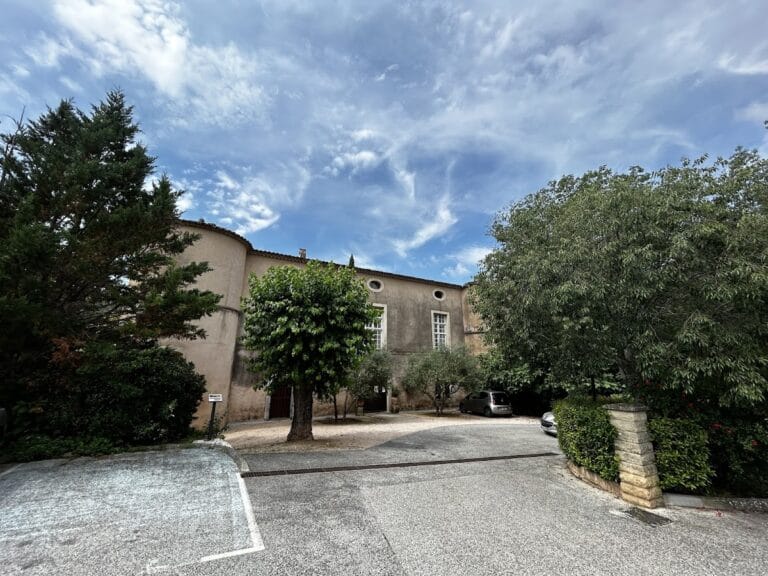
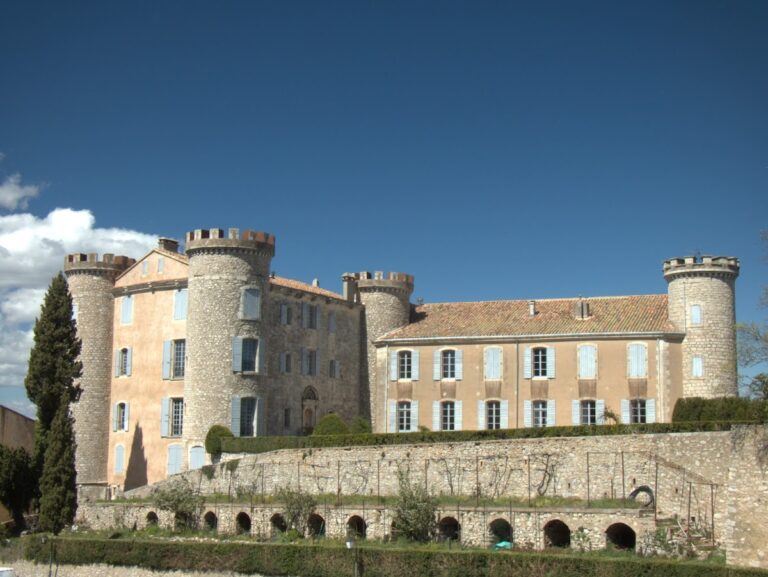
The modest vernacular château is a seventeenth-century Provençal château-bastide with thirty-five rooms. It is surrounded by a moat, fountains, ancient aqueducts, a pond, and a chapel. The substantial dovecote, also built in the seventeenth century, is an associated estate structure. The immense wine cellar was constructed in 1850 by Joseph-Louis Lambot and remains part of the property’s historic agricultural fabric.
Vineyards and olive production
Approximately 30 hectares are planted with organically cultivated vines, principally on the valley floor. The vineyards extend across Correns and Châteauvert, with 24 hectares under the Côtes de Provence appellation and 5 hectares under the Coteaux Varois en Provence appellation. Grenache, Cinsault, Rolle, Grenache Blanc, Syrah, and Cabernet Sauvignon produce rosé, two white wines, and a red wine. The Côtes de Provence appellation covers red, white, and rosé wines, while the Coteaux Varois appellation covers white wines.
The estate’s olive oil is packaged in black stoneware bottles. It combines extra-virgin olive oil from Miraval olives with locally sourced organic olives of the Verdale, Pichouline, Tanche, Lucques, Aglandau, Cayon, and Arboussane varieties.
Recording studios
The recording-studio complex includes the former Studio Miraval, a 300-square-metre international-standard facility established in 1977. Following its complete restoration and refitting, the complex reopened as Miraval Studios in summer 2022.
Nearby sites