Grotte de la Sainte-Baume: A Catholic Sanctuary and Pilgrimage Cave in France


Site at a Glance
- Rating
- 4.8
- Popularity
- Low
- Country
- France
- Primary era
- Medieval
- External website
- Open
- Eras represented
- Medieval, Early Modern, Modern
- Civilizations
- French
- Site type
- Religious
- Remains
- Sanctuary
On this page13 sections
History
The Grotte de la Sainte-Baume is a Catholic sanctuary and pilgrimage cave in France, near Plan-d’Aups-Sainte-Baume, adapted for Christian worship since late antiquity. Christian tradition associates the cave with Mary Magdalene, who was believed to have arrived from the Holy Land in AD 47 and lived there for thirty years, or possibly less according to differing traditions. The sanctuary later became one of the major pilgrimage destinations of Western Christianity.
Early traditions and Christian foundations
The cave’s very large opening and position beneath the Sainte-Baume cliffs probably made it known to people for millennia. It may have served as a prehistoric dwelling or a pre-Christian sanctuary, although repeated alterations, especially from the thirteenth century onward, are said to have removed evidence of those early phases.
Several traditions connect the mountain and its forest with earlier religious practices. Antiquarian accounts associate the cave with Marthe la Salyenne, who may have lived there during the Battle of Aix in 102 BC, when Caius Marius defeated the Teutons. The Greeks of Marseille regarded the surrounding forest as a sacred wood. The mountain may also have been linked with fertility cults, including the worship of Artemis of Ephesus, an Ephesian form of the Greek goddess associated with fertility. Lucan, writing around AD 60, mentioned a sacred wood near Marseille, although its identification with Sainte-Baume remains uncertain.
Another tradition, recorded in 1370, describes the cave as the refuge of a dragon defeated by the Archangel Michael and later overcome by Saint Martha at Tarascon. A separate tradition says that angels carried Mary Magdalene to the summit of the cliffs seven times each day so that she could pray. The Chapel of Saint-Pilon was later built at the place associated with this practice.
Around 415, Saint John Cassian founded the Christian Abbey of Saint-Victor at Marseille and established a priory at the cave. Monks from Saint-Victor served the sanctuary until the eleventh century and received pilgrims. Pope Stephen IV visited in 816, followed by Pope John VIII in 878. In 1070, a Benedictine monastery was founded at the cave entrance to accommodate growing numbers of pilgrims and provide religious services.
Medieval pilgrimage and Dominican administration
The pilgrimage grew during the Middle Ages. The cave was more accessible, and many Christians regarded it as a safer destination than the Holy Land during its conquest and occupation by Muslim powers and throughout the period of the Crusades. Saint Louis, king of France, visited on 22 July 1254 while returning from a crusade.
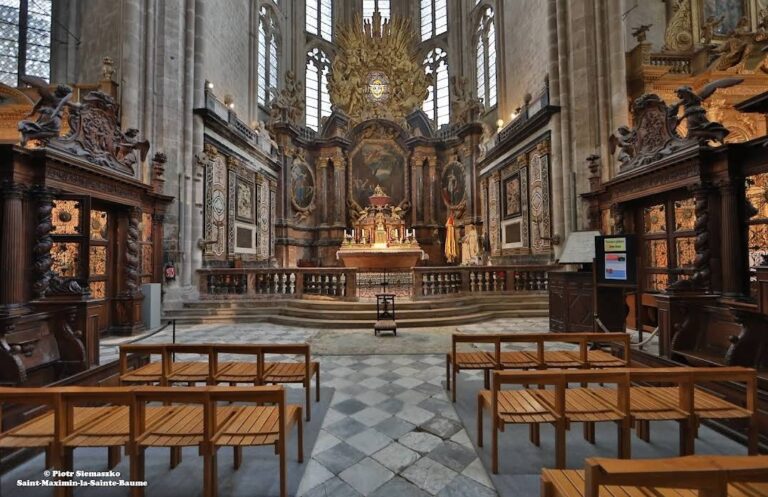
In 1279, Charles II of Anjou ordered excavations at the church of Saint-Maximin, where the relics of Mary Magdalene were found. A relic is a bodily remain or object associated with a saint. On 21 June 1295, Pope Boniface VIII issued a papal bull placing the holy sites at Saint-Maximin and Sainte-Baume under Dominican care. The Benedictines withdrew, and the Dominicans, members of the Order of Preachers founded in the thirteenth century, took their place.
During the fourteenth and fifteenth centuries, Sainte-Baume became one of the most important pilgrimage destinations in Western Christianity. Humbert II of Viennois and the poet Petrarch made the pilgrimage in 1337, and visitors came from across Europe between the fourteenth and seventeenth centuries. In 1440, a fire damaged the cave and destroyed adjacent buildings. Louis XI richly endowed the sanctuary in 1456 and designed a cupola for the altar. On 21 January 1516, Francis I visited with his mother, Louise of Savoy, and his wife, Claude of France, and contributed to restoration work.
Royal visits, destruction, and restoration
In 1516, Jean Ferrier, archbishop of Arles, established seven oratories along the Chemin des Rois. Charles IX visited the cave during his royal tour of France in 1564, but the sanctuary was pillaged during the Wars of Religion in 1586 and 1592. The civil authorities of Auriol had already vowed in 1580 to make an annual pilgrimage to Sainte-Baume on Whit Monday.
Louis XIV visited the sanctuary on 5 February 1660 with his mother, Anne of Austria, and Cardinal Mazarin. He was the last king of France to make a pilgrimage to the cave. Books about Mary Magdalene and Sainte-Baume began to appear in large numbers from the early seventeenth century onward. The cave also gave its name to the Sainte-Baume massif, the surrounding forest, the commune of Plan-d’Aups-Sainte-Baume, and the nearby town of Saint-Maximin-la-Sainte-Baume.
The French Revolution brought another severe rupture. After the liquidation of religious houses was ordered in 1789, the cave and sanctuary were pillaged. Statues of kings were decapitated, and in 1793 the interior of the cave and the adjoining large hostelry were destroyed. Barras and Fréron then ordered the complete destruction of Sainte-Baume, leaving the site in ruins. In 1814, Marshal Brune destroyed the cave and structures that had begun to be rebuilt.
After the Restoration, civil authorities organized subscriptions to rehabilitate the religious buildings. In February 1821, Louis XVIII designated the cave as a vicariate chapel. Father Henri Lacordaire visited in 1848 and began a new restoration campaign. In 1859, he re-established the Dominican community at the cave and built a hostelry in the Sainte-Baume plain so that pilgrims could again be accommodated.
Modern religious life
The sanctuary continued to attract pilgrims and maintain traditional practices. Since the Middle Ages, the cave has been connected with the Tour de France of the Compagnons du Devoir, an itinerant system of craft training in which apprentices travelled between workshops for professional formation. The pilgrimage traditionally completed this training at the supposed tomb of Maître Jacques, the legendary founder of the compagnonnage. A passage book held by the Dominicans contains the signatures of 2,961 companions from 29 trades between 1840 and 1921.
In 1914, Father Vayssière restored the access stairway and inaugurated the Calvary during centenary celebrations marking the reopening of worship at Sainte-Baume. A Calvary is a Christian devotional monument commemorating Christ’s crucifixion. The Nazareth retirement home opened opposite the hostelry in 1928, and Marthe Spitzer created the Pietà on the forecourt in 1932. A Pietà depicts the Virgin Mary mourning over the body of Christ.
Major works took place from 1997 to 2002, when the cave was closed while the sanctuary was repaired. Four Dominican friars then took up residence in the entrance convent to provide worship and public reception, and since the 2000s eight Dominican brothers have lived permanently at the sanctuary.
In June 2020, access was prohibited because of the danger of rockfall from the cliffs. Rock removal and cliff-consolidation work enabled the cave to reopen in April 2021. In late 2023, the retaining wall of the Calvary was restored to improve its stability while limiting visual impact, conserving potentially surviving archaeological remains, and protecting biodiversity. The work ended on 22 December 2023. Restoration of the stained-glass windows began in September 2023 and was expected to finish by the end of 2024.
Remains
The cave lies in the Sainte-Baume massif at the foot of an east-west rock barrier beneath a cliff about 100 metres high. Its entrance is 894 metres above sea level on the massif’s northern face, and the opening can be seen from a considerable distance. The cavity formed in Urgonian limestone within an anticline, a geological fold whose strata have locally been overturned. The folding created the karstic void occupied by the cave, which opens above a steep slope covered by the preserved primary forest of Sainte-Baume.
Cave structure and chapel
The cave is modest in size. It is broadly described as about 20 by 30 metres, while a 2008 survey recorded a generally rectangular plan measuring about 25 by 20 metres and a known development of approximately 30 metres. The entrance once extended across the full width of the cavity but is now closed by a wall. The rock barrier and entrance generally run east to west. The lowest point is four metres below the entrance, at the foot of the stairs on the right when entering, while the highest point is about four metres above entrance level behind the altar.
Most of the cavity is arranged as a chapel, with a level paved floor and benches facing the central altar. The adapted space can accommodate approximately 1,000 people. Water enters through several points, especially during wet periods. A permanent seepage was captured when the convent was developed and used to supply nearby residences with running water. The system is no longer used, but its installations remain, including a receiving basin for runoff.
The altar and Rock of Mary Magdalene
Behind the central altar is the Rock of Mary Magdalene, traditionally identified as the place where she prayed. A statue of the saint in prayer stands there. Jean-Antoine Houdon originally made the sculpture as a portrait of Mademoiselle Clairon, one of Count Joseph-Alphonse-Omer de Valbelle’s mistresses, for his tomb at the Montrieux Charterhouse. After the Revolution and the sale of church property, it was removed from the tomb and brought to the cave to represent Mary Magdalene.
In front of the statue is a reliquary offered in 1886 by Ferdinand de Terris, bishop of Fréjus-Toulon. Made by the Lyon goldsmith Armand Caillat, it contains part of a tibia and a lock of hair attributed to the penitent saint. A reliquary is a container made to preserve or display a relic.
Statues and devotional spaces
A tabernacle to the left of the altar is surmounted by a statue of Saint Michael. To its right stands a nineteenth-century statue of Mary Magdalene offered by Félix Dupanloup, while to its left is a Virgin and Child statue dating from before the Revolution. The Virgin and Child was removed and hidden by inhabitants of Plan-d’Aups before the revolutionary destruction. Other statues were not saved and were decapitated, including representations of kings and the Holy Women associated with the tomb.
Stairs to the right of the altar lead to the Rock of Mary Magdalene. Farther right, another statue titled “The Penitent” shows Mary Magdalene being carried by two angels. A second stairway descends to the lower part of the cave, where a prayer area commemorates children who died in utero or were stillborn. Small plaques on the wall bear the names of the deceased children.
The former chamber and water tradition
Fifteenth-century descriptions mention three altars, including one dedicated to Saint Martha. Near the main altar, at the rear on the left, an enclosed space known as the Chamber or Bed of Mary Magdalene was separated by a masonry wall and an iron door. Its key was held by the prior, and entry was restricted to ordained priests.
The chamber contained a life-size or larger-than-life statue of Mary Magdalene lying on her right side, with a cloak over her body, her right hand beneath her head, and her left hand on her chest. It was regarded as a true portrait made and installed by Saint Maximin, who was believed to have been her contemporary. An adjacent sculpted angel held a scroll bearing an inscription translated as, “You who are accustomed to sin, do not despair; renew yourselves before God by my example.”
The cave’s perennial water flow was already being collected in the fifteenth century and was traditionally believed to have been used by Mary Magdalene. The Bed of Mary Magdalene also became associated with superstitious rituals directed toward pregnant women. An eighteenth-century representation shows a stuffed crocodile suspended from the ceiling, interpreted as a reminder of the monster in the local dragon tradition.
Entrance wall and surviving devotional objects
The entrance wall contains seven stained-glass windows made during the 1980s by Pierre Petit, a member of the Compagnons du Devoir. Numerous ex-votos cover the wall. An ex-voto is an object offered in fulfilment of a vow or as an expression of thanks.
The cave entrance and surrounding structures are protected by nets installed on the cliffs to prevent falling blocks and rocks. The cliffs and nets were cleared and maintained in spring 2021, alongside consolidation work that allowed the cave to reopen.
Sanctuary grounds and forest features
The forecourt contains the Dominican convent on the right, a pilgrims’ shelter on the left, and a small sanctuary shop. A Pietà faces the church, while a Calvary stands farther along at the arrival point of the access path. The path includes 150 steps, symbolizing the 150 Hail Marys of the Rosary, a Catholic devotion based on repeated prayers and meditation on episodes from the lives of Jesus and Mary. An oratory stands at the foot of the path, and an access portal marks the approach.
Associated chapels and oratories
The wider sanctuary complex includes the hostelry, the cave, the Chapel of the Parisians, the Chapel of Saint-Pilon, and three oratories in the surrounding forest. The Chapel of the Parisians, the Chapel of Saint-Pilon, and the three forest oratories survived earlier destruction. The Chapel of the Parisians and the oratories are protected as historic monuments.
The Nazareth retirement home, built opposite the hostelry in 1928, is occupied by an ecomuseum. Together with the convent, shelter, hostelry, chapels, oratories, access path, and cave, these buildings and devotional features form the surviving sanctuary complex around the mountain grotto.
Nearby sites