Badelunda Church: A Medieval Parish Church in Sweden
Site at a Glance
- Country
- Sweden
- Primary era
- Medieval
- Eras represented
- Medieval, Early Modern, Modern
- Civilizations
- Swedish
- Site type
- Religious
- Remains
- Church
On this page14 sections
History
Badelunda Church is a parish church in Västerås, Sweden, serving Badelunda Parish in the Diocese of Västerås, an administrative area of the Church of Sweden. Consecrated in the thirteenth century, it stands on the Badelunda ridge in an archaeological landscape that includes Anundshög, a prehistoric burial mound. The surrounding area is designated as being of national interest for cultural heritage conservation.
Early church and medieval parish
Remains of an eleventh-century farmstead and burial ground have been found beside the churchyard. Excavations in 1998 also uncovered a large farmstead immediately south of the churchyard, in use during the eleventh century. These remains are thought likely to relate to the church’s beginnings. A wooden church was probably erected near the farmstead in the late Viking Age or early Middle Ages.
The present church was probably built in the thirteenth century and was then much smaller than it is today. Timbers in the nave and choir roof structures have been dated to 1228–1242, placing them earlier than a previously proposed date in the latter half of the century.
Medieval changes and local institutions
The church acquired a sacristy, a room for church vessels and clergy preparation, in the fourteenth century. A porch followed in the first half of the fifteenth century, and brick vaults were added later in that century. The building was probably consecrated again after the vaulting, when crosses marking the consecration were placed inside.
Anundshög remained a place for legal assemblies until the 1450s, when the gatherings were transferred to Badelunda Church. Badelunda was initially an annex parish, subordinate to Furby. The parishes were united in the sixteenth century, and after Furby Church was abandoned, Badelunda became the principal church of the united parish. In that century, Bishop Peder Swart referred to Badelunda as a chapel of St Olaf, the Norwegian king venerated as a Christian saint, although it was a church.
Burial chapel and seventeenth-century expansion
In 1648, Henrik Horn af Marienborg, a Swedish nobleman who owned Hässlö estate in the parish, completed a burial chapel south of the choir for his family. He brought the body of his father-in-law, the military commander Arvid Wittenberg, from Riddarholmen Church in Stockholm for burial there. The chapel consequently became known as the Horn-Wittenberg Burial Chapel.
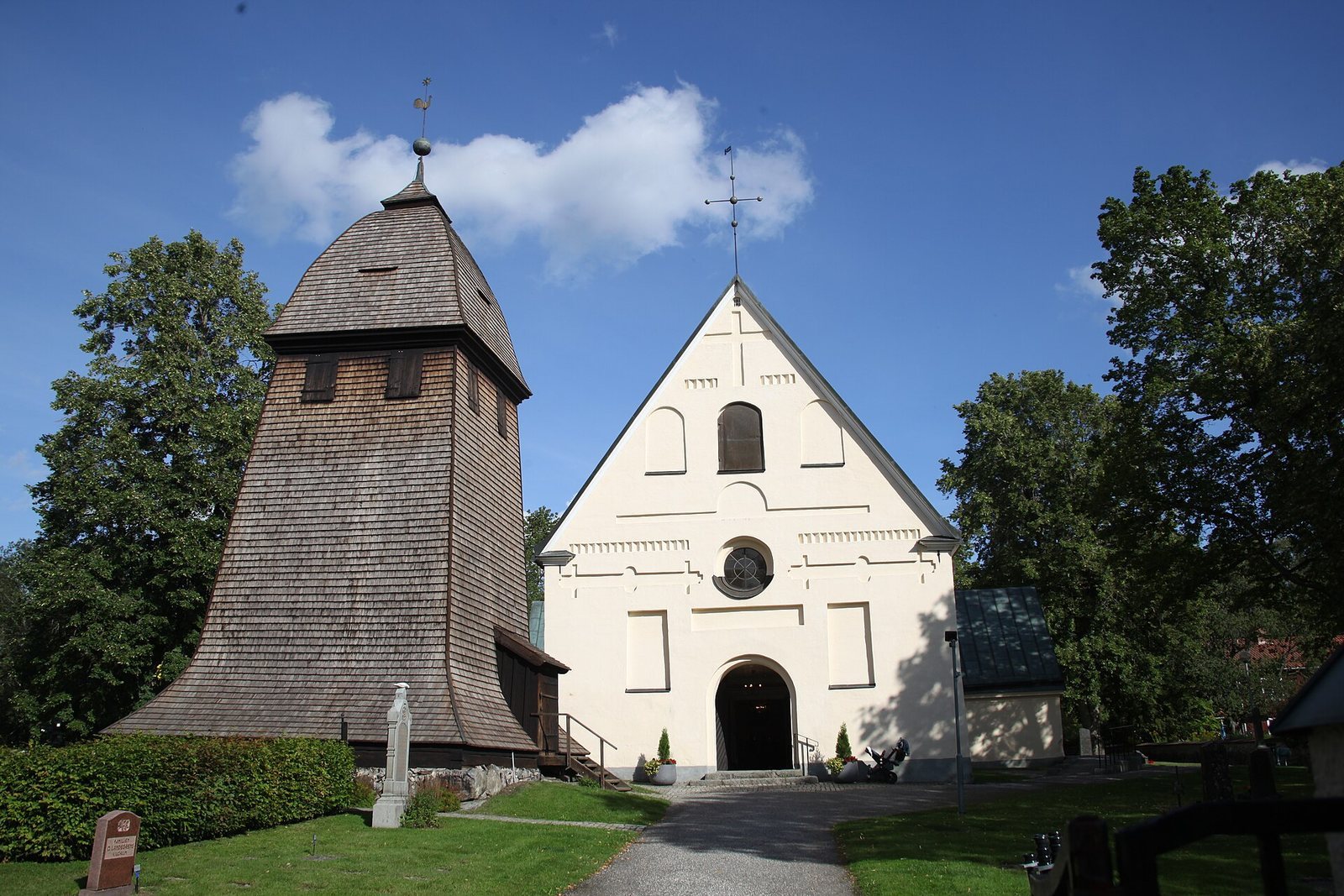
Horn also financed a major rebuilding in the late 1650s. The nave was extended ten metres to the west, and a new star vault, a ribbed ceiling with ribs forming a star pattern, was designed to match the older vaults. The west gable was decorated with elaborate blind arcading, shallow decorative arches that do not open through the wall.
From the mid-seventeenth century until 1918, apart from a few years in the 1680s and 1690s, the church served as a prebend, a benefice traditionally attached to an ecclesiastical office, for theology lecturers at Västerås Gymnasium, a secondary school. Nicolaus Johannis Rudbeckius, a clergyman and theologian, was the first lecturer responsible for the church.
Later alterations and conservation
By the mid-eighteenth century, the church’s two small windows admitted too little light. New openings were cut into the choir and opposite the pulpit, and the exterior was plastered white while the interior was whitewashed. A proposal to replace the deteriorated bell tower with a tower at the west end was abandoned, and the existing tower was repaired instead. The burial chapel’s tall spire had allowed rain to reach its roof and vault; it was removed in 1775 and replaced by a low gabled roof.
Architect C. G. Ekholm led extensive work in 1892. The choir vault, roof and chancel arch were raised and widened, and the windows enlarged. The roof’s earlier shingles were replaced with sheet metal. Inside, floors and gravestones gave way to a clinker-paved floor, open benches, a new altar and an altar rail; the vaults were smoothed and painted. Many medieval objects, including an altarpiece and wooden sculptures, were sold at auction in the mid-eighteenth century. A Madonna and Child made around 1500 is now held by Västmanland County Museum.
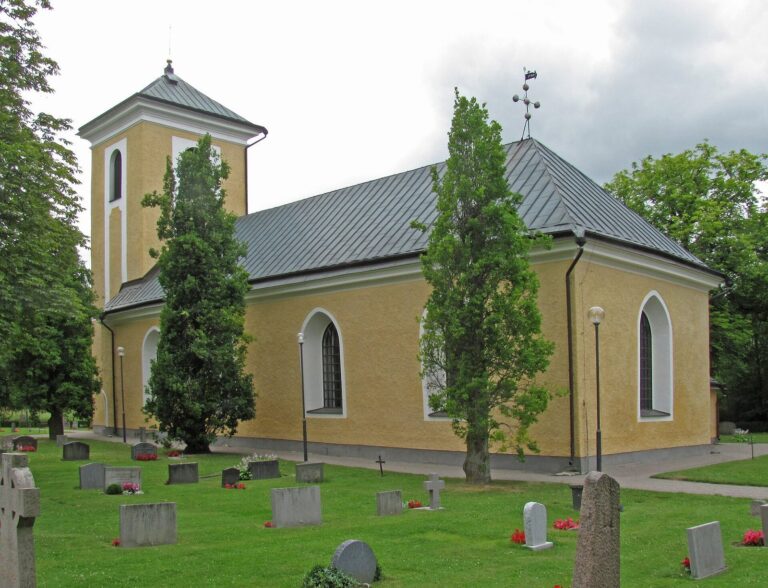
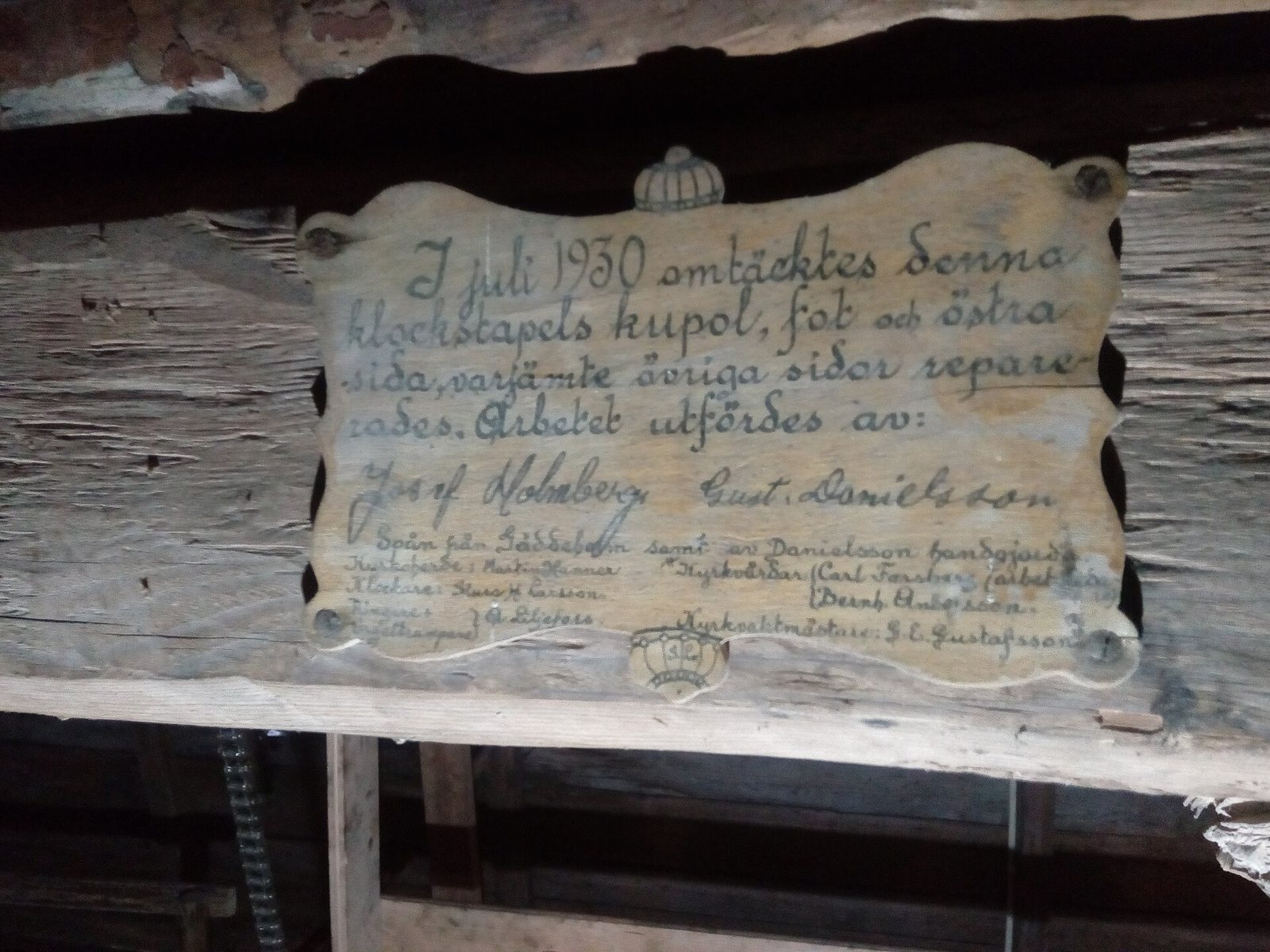
Work in the 1950s sought to restore an appearance closer to that before the nineteenth-century redesign. Coffins were moved from the burial chapel to basement space, the façade plaster was renewed and the windows reduced. Closed pews were installed, and the pulpit, altar and organ gallery took on their present appearance. The choir and central passageways received new floors, and the walls and vaults were painted white. The exterior walls were given their present yellow colour in 1998. The bell tower, described as dilapidated in 1650, may have been rebuilt afterward using parts of its predecessor. Repairs in the eighteenth century shaped much of its present appearance, and its roof was repaired in the 1930s.
Remains
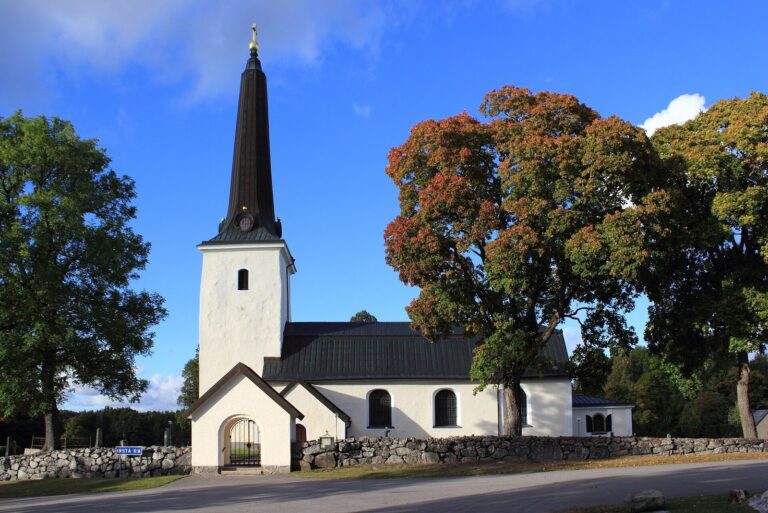
The church is a towerless building on high ground on the Badelunda ridge. Its plan brings together a nave, a smaller choir at the east end, a sacristy to the north, and a porch and burial chapel to the south. The eastern half of the nave and parts of the choir are among the oldest surviving sections. The building retains a Romanesque arrangement, a medieval plan associated with forms such as rounded arches, with a narrower and lower choir. This layout is uncommon in Svealand, a historic region of central Sweden.
Plan and exterior
Layout and materials
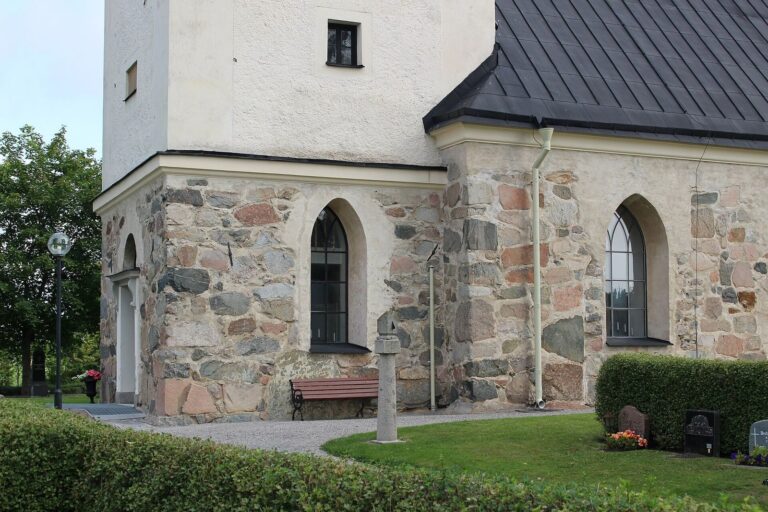
Fieldstone forms most of the church, while brick is also used in the burial chapel, the lower part of the choir and the western part of the nave. The main church and its west gable are plastered and painted yellow. The west gable’s decorative blind arcading is a prominent feature of the exterior. The nave and its extensions are covered by steep, copper-clad gabled roofs; the burial chapel has a shallower roof.
Openings and bell tower
Two round-arched windows pierce each side of the nave. A smaller opening sits in the east gable, with a round window in the west gable. The choir receives light from the south through a window in the burial chapel. The bell tower stands close to the west gable and is clad in shingles. Its construction incorporates reused medieval boards and floor planks worked with a medieval hewing technique, and its frame resembles medieval bell-tower construction.
Interior and furnishings
Vaults, altar and fittings
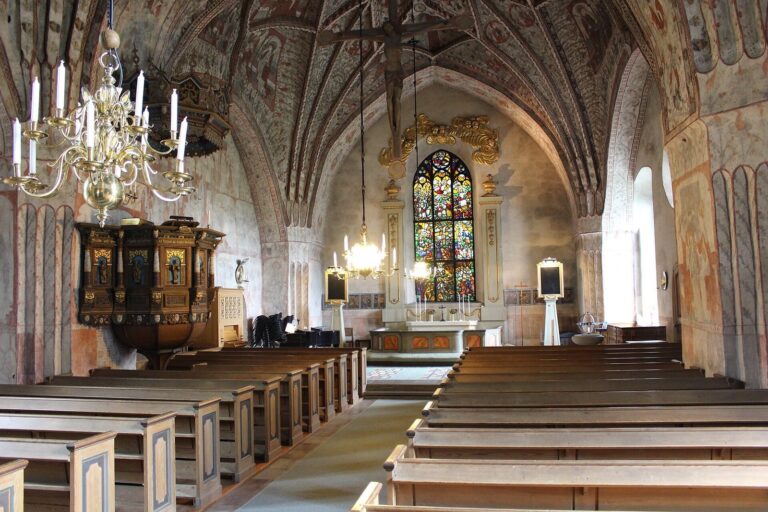
The single-nave interior has three brick star vaults, two over the nave and one over the smaller choir. The porch also has a brick vault. Medieval roof trusses survive in the nave, porch and sacristy, made from spruce and oak. An earlier roof structure over the nave and sacristy used tie beams and crossed braces. Plaster fragments in the east-gable masonry indicate that the choir once had a barrel vault, a continuous arched ceiling shaped like half a cylinder.
A brick altar stands in the choir within a small altar rail. Its window, made in 1960, was designed by Jan Brazda. A consecration cross, marking a place associated with the church’s consecration, has been uncovered on the north wall behind the pulpit. The church has closed pews and an organ gallery at the west end. Hammarbergs Orgelbyggeri AB built the organ, installed in 1979, with 13 sets of pipes selectable by controls. A soapstone and sandstone baptismal font has an eight-sided bowl. Parish priest Fredrik Arfwedsson donated it in 1892.
Porch paintings and sculpture
Paintings in the porch include fifteenth-century work attributed to Albertus Pictor, a painter associated with late-medieval Swedish church art. Their subjects include angels carrying instruments of Christ’s Passion, the hand of God with the sun and moon, Christ on the cross, and three devils. One devil holds a horn and another rides a woman. Other paintings, dated to the 1540s, are attributed to Urian Olofson. Traces were found in 1912, and Nils Källe uncovered and conserved the paintings in 1959–1960.
The church’s oldest object is a fourteenth-century triumphal crucifix made in the Mälaren region around Lake Mälaren. After spending several decades in the church attic, it returned in 1929 to its original position in the arch between the nave and choir. Israel Snickare of Västerås made the pulpit in 1655. Donated by Rudbeckius, it bears sculptures of Christ and the Evangelists; another craftsman made its sounding board fifteen years later.
Horn-Wittenberg Burial Chapel
The burial chapel is now arranged as a side chapel and has a timber barrel vault. It contains most of the church’s 21 funeral hatchments, heraldic memorials associated with funerals, connected with the Horn and Bååt families. Baroque sculptures of Matthew and John stand on either side of the altar. The church bought these sculptures in 1702; they and a sculpture of Christ with the instruments of the Passion, now also in the chapel, belonged to an earlier altarpiece. Kaspar Schröder has been proposed as their maker, as has Burchard Precht.
Bells
Two bells hang in the tower. The great bell weighs 1,060 kilograms and was recast and enlarged in 1650, 1771 and 1909, the last time by K. G. Bergholtz. The smaller bell weighs 860 kilograms and was last recast in 1879 by Johan A. Beckman & Co. Its inscription calls on people to rise and shine, names Christendom as its name, and places honour and peace of soul in belief in Christ.