Tortuna Church: A Medieval Parish Church in Sweden
Site at a Glance
- Country
- Sweden
- Primary era
- Medieval
- Eras represented
- Medieval, Early Modern, Modern
- Civilizations
- Swedish
- Site type
- Religious
- Remains
- Church
On this page21 sections
History
Tortuna Church is a medieval parish church in Tortuna, about 10 km northeast of Västerås, Sweden. It belongs to the Church of Sweden and the Diocese of Västerås. Its construction date is uncertain: the church is described as a 13th-century foundation and is generally thought to have been built around 1300, while a 19th-century inventory assigned its construction to 1468.
Origins and medieval development
The church’s earlier history may reach beyond the present building. Graves east of the churchyard may belong to an older burial ground connected with a predecessor church or chapel. In 1754, the Swedish topographer Olof Grau described the remains of a wooden church at the old churchyard. Local tradition held that it had been a chapel serving as an outlying part of Björksta Church.
A grave found beside the church wall during an archaeological investigation in 2011 was radiocarbon-dated to probably between 1205 and 1265. Its date suggests that a church may already have stood on the site, but does not establish when the present building was constructed. The competing dates proposed for the church include a likely construction around 1300 and Grau’s view that the wooden church was demolished in 1320 before work began on its successor.
Late in the 15th century, the church underwent substantial alterations. An indulgence, a grant associated in Western Christianity with remission of temporal punishment for sin, was issued for the church in 1473 by Bishop Ludechinus Abelis. The work may have been connected with this grant. A porch was added at the southern entrance, and a wooden gallery was installed above the sacristy, a room used to prepare for worship and store liturgical objects. A few decades later, an unidentified painter decorated the church with murals.
Fire and later alterations
The church may have been plundered during the Battle of Västerås in 1521, a conflict in the Swedish War of Liberation. In 1577, lightning set fire to the roof. The blaze destroyed the bell tower and its three bells and damaged the furnishings, although the murals survived. The roof was repaired the next year, while repairs to the fire-damaged walls and their repainting took place in the 1640s.
An organ, pulpit, and pews were added around the time of those repairs. Over the following decades, the east and south windows were enlarged, and a new window was opened on the north side. In 1780–1781, the deteriorated south porch was demolished and a new entrance was made at the west end. A window took the place of the former southern entrance, another window was blocked, the remaining southern portal was shifted eastward, and the windows were enlarged.
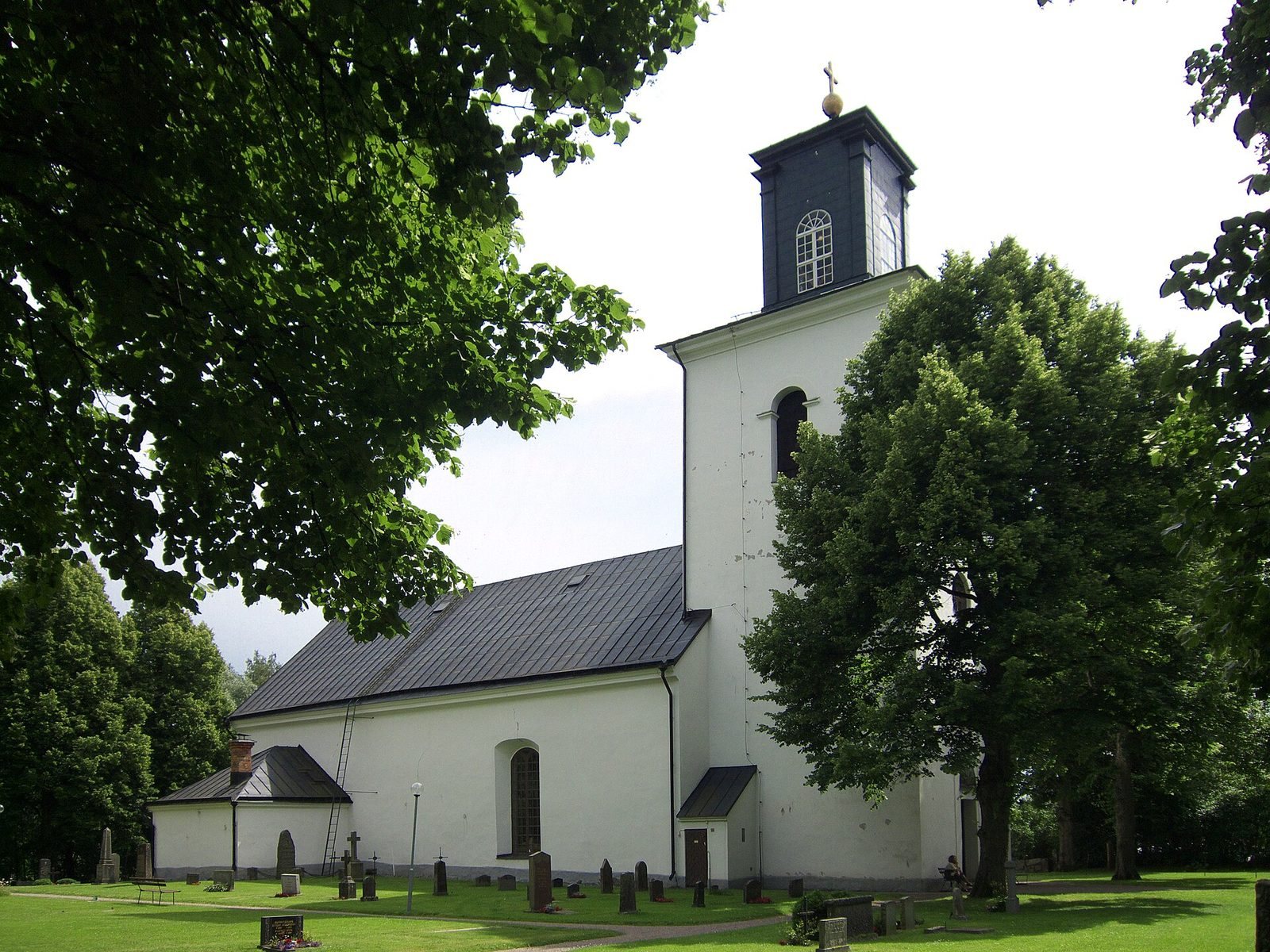
A storm several years before 1824–1825 damaged the steep roof over the nave. It was repaired with a shallower pitch, and a west tower was erected in 1824–1825. An organ gallery and a new organ followed in the decades after the tower’s construction.
Modern restoration and parish history
During a major renovation in the 1860s, work was carried out on the exterior and windows, and the floors and pews were replaced. Some of the cost was met by selling medieval church objects to the Swedish History Museum. Count Gustaf Malcolm Hamilton condemned the sale as vandalism and warned that it would harm the church; the parish later sought to recover the objects.
A major redesign in 1932 included strengthening the foundations and laying a new concrete subfloor. The medieval wall paintings were uncovered and conserved that year by John Österlund. Stained glass by Per Månsson was installed in the choir window in 1934. An archaeological investigation in 2011 found graves beside the church wall, including the grave whose radiocarbon date bears on the building’s early chronology. Since 2006, the church has belonged to Tillberga parish; before then it was part of Tortuna parish.
Remains
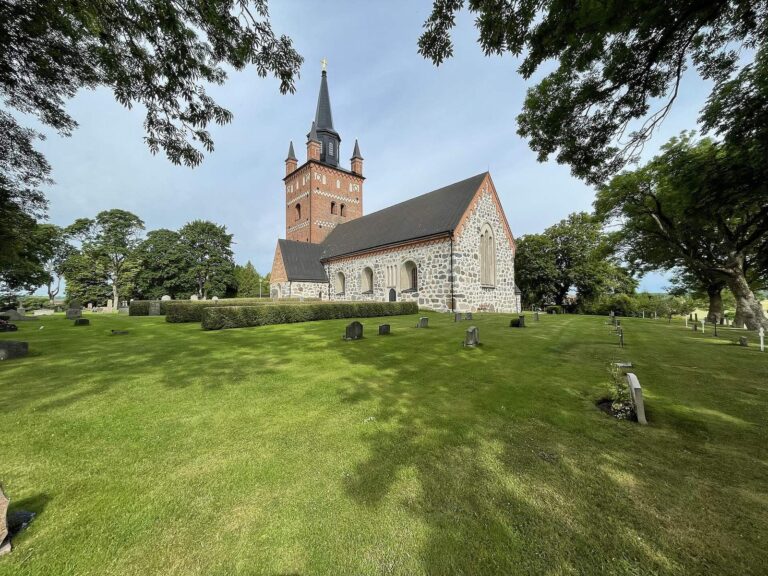
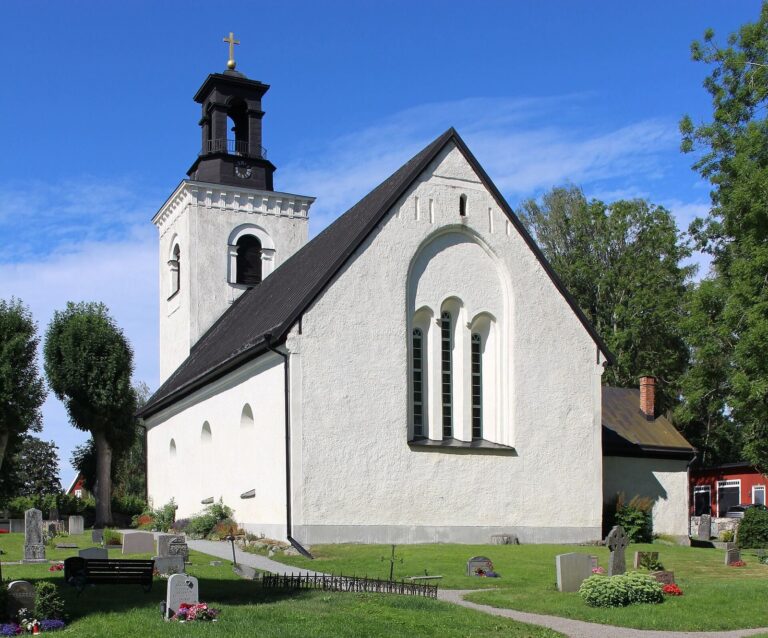
The church has a rectangular nave, meaning its main worship space has no side aisles, with a choir at the east end, a tower at the west, and a small sacristy attached north of the choir. Its interior remains a single open space. The exterior walls are smoothly plastered and whitewashed, and the surviving building combines medieval masonry with later alterations.
Plan and exterior
Early layout and interior structure
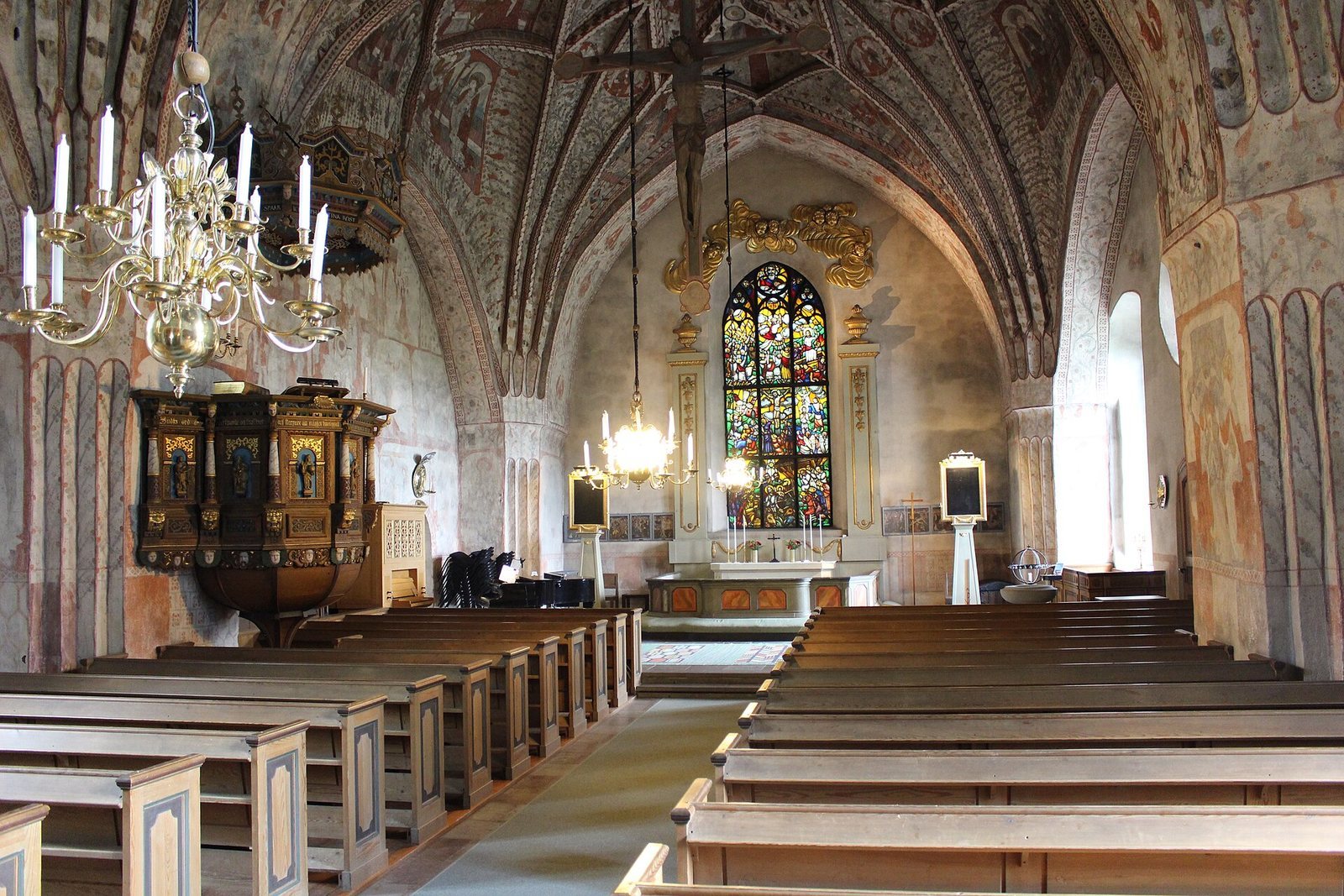
The original church had one main nave, a northern sacristy, two portals in the south wall, and a three-part window in the eastern gable. Its nave probably had a wooden barrel-shaped ceiling. Two brick star vaults, whose ribs form a star-like pattern, now cover the nave. A masonry stairway built into a pillar in the northwest corner leads to the church attic.
Openings, roofs, and runestone
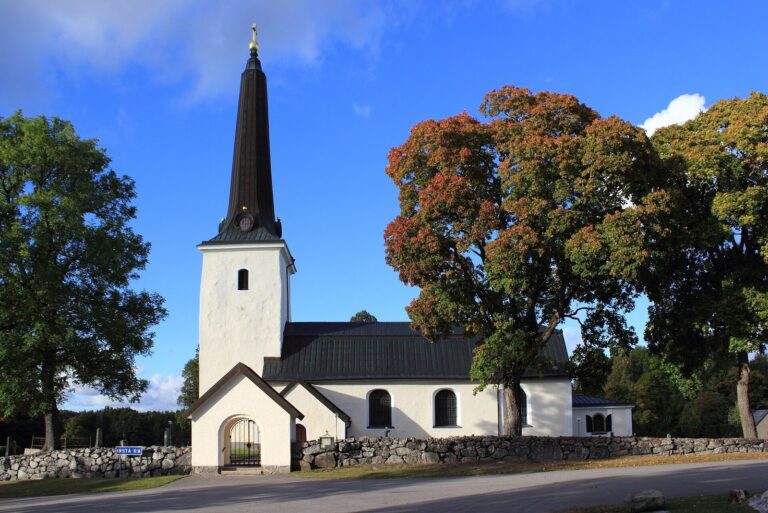
The exterior has round-arched windows on the north side and in the choir gable, with closely spaced window bars painted dark brown. Round and semicircular windows sit above the west and south portals. The south portal has a surround with flat decorative columns in the Gustavian style, a Swedish form of neoclassical design associated with the late 18th century. The nave’s gabled roof is clad in black-painted sheet metal with paired seams; the sacristy has a hipped roof. The black-clad tower rises to a four-sided lantern, a raised structure at its top, and a gilded cross on a sphere. A fragment of a runestone, a stone bearing a runic inscription, is set into the sacristy wall. Catalogued as Vs 16, it preserves an inscription beginning with the name Ärnbjörn and referring to a stone raised in memory of someone.
Medieval murals
Choir and vault paintings
The early 16th-century murals cover parts of the walls and vaults. Their subjects include saints and prophets, as well as less common religious scenes. On the north wall of the choir, a large vessel for displaying the consecrated Eucharistic host appears at the center of a depiction of the seven sacraments. The vault paintings are especially well preserved because they were never covered with whitewash.
The Last Judgment
The north side of the western vault depicts the Last Judgment. Jesus stands at the center as the dead rise from their graves beneath him. Heaven is shown to the west, while hell appears to the right in the form of seven jaws.
Saint Erasmus
A painting on the south wall shows episodes from the life of Saint Erasmus, an early Christian martyr. It includes his legendary death by boiling and the drawing out of his entrails with a windlass, a device for winding rope. The painter is unknown and is often called the Tortuna Master. The murals resemble paintings at Alnö Old Church and Svärdsjö Church; a shrine cabinet and a wooden cross at Venjan Church were probably also painted by the same artist. Earlier enlargements of the windows damaged some wall paintings, which had been whitewashed in the 18th and 19th centuries.
Interior furnishings
Altar and choir
The altar, altar rail, and decoration around the choir window were made by sculptor Jonas Holmin in 1791. The altar surfaces are painted to resemble blue marble. The closed altar rail has panels painted like brown marble, framed in gray. Around the choir window, flat columns, flaming urns, and a gilded cloud form the altar decoration. The window contains stained glass made by Per Månsson in 1934.
Pulpit and gallery
A local carpenter made the pulpit and its sounding board, a canopy above the pulpit intended to project the speaker’s voice, in 1643–1644. Anders and Karl Persson painted them. The sounding board bears a passage from Isaiah 58 calling the speaker to raise his voice like a trumpet and declare the people’s transgressions. Sculptures on the pulpit include Christ, Paul, and the four Evangelists, together with Saints Barbara and Gertrude, figures taken from a medieval altarpiece. The former back panel, with portraits of Martin Luther and Philipp Melanchthon, two leading figures of the Protestant Reformation, hangs below the gallery. The gallery front is light green with gilded carvings.
Crucifix and organs
A large crucifix associated with the chancel arch, known as a triumphal crucifix, was made in the Mälaren Valley around 1500. Its cross was added during restoration in the 1930s. The present mechanical organ was built in 1854 by Gustaf Andersson of Stockholm, who donated a Principal stop, a control for a rank of organ pipes. A five-stop organ built by Daniel Stråhle in 1739 was moved to Skerike Church in 1854, where its façade remains. Before that, Lars Ersson of Enköping had rebuilt a five-stop organ in 1642. The present instrument was reworked by A. Magnussons Orgelbyggeri AB in 1957; a separate mechanical choir organ was built by Olof Rydén in 1970.
Bells
Three bells hang in the tower. The largest weighs 1,578 kg; originally cast in 1578, it was recast by N. P. Linderberg in 1863. The middle bell weighs 950 kg and was cast by Ambjörn Andersson in 1665. Its inscription praises God’s name from sunrise to sunset. The smallest weighs 250 kg and was cast by Lars Björkman in 1767; its inscription gives glory to God alone.
Medieval objects
The Swedish History Museum holds objects from the church, including two wooden figures from an altarpiece, one representing a crowned male saint and the other a bishop. It also holds a late-15th-century altarpiece with a central scene of the crucifixion at Golgotha, the place in Christian tradition where Jesus was crucified, and a wooden Saint George and the dragon dated to around 1500. Ten surviving panels from a group originally numbering fourteen or fifteen show the final days of Jesus’s life. Used in devotions recalling events on the way to his crucifixion, they form the only surviving medieval series of this kind in Sweden. Copies of the panels are in the church choir.
Churchyard and nearby buildings
Parish buildings
The parsonage stands south of the churchyard, with the church school farther south; parts of the school date to the 19th century. To the west are a timber-framed former hearse shed and two church stables. A poorhouse dating to around 1800 stands north of the stables.
Bell-ringing stones
Three bell-ringing stones stand beside the former hearse shed. This type of monument is known only from eastern Västmanland and dates to around 1850. Groups of three stones were placed at different distances along each road to mark where church bells should begin ringing as a funeral procession approached. The fee paid determined the starting point, and the stones indicate prices of 1, 3, or 6 riksdaler, a historical Swedish currency unit.