Viby Church: A Parish Church in Mantorp, Sweden
Site at a Glance
- Country
- Sweden
- Primary era
- Early Modern
- Eras represented
- Medieval, Early Modern, Modern
- Civilizations
- Swedish
- Site type
- Religious
- Remains
- Church
On this page13 sections
History
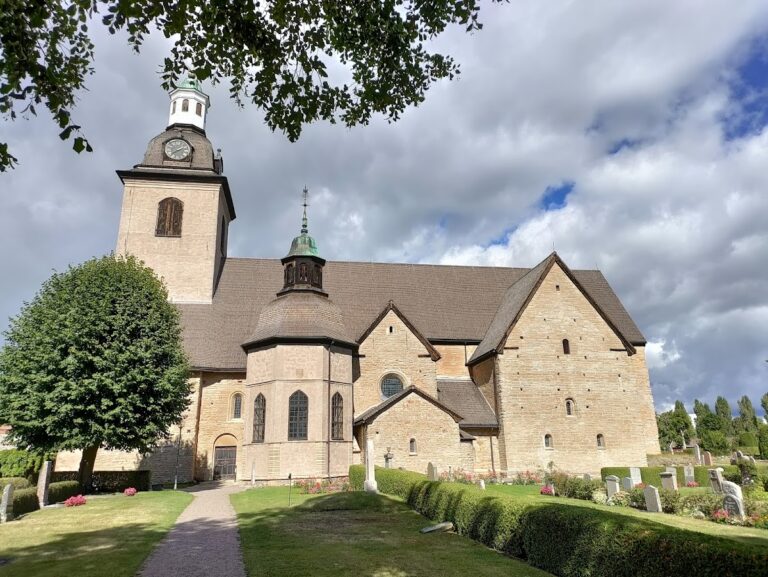
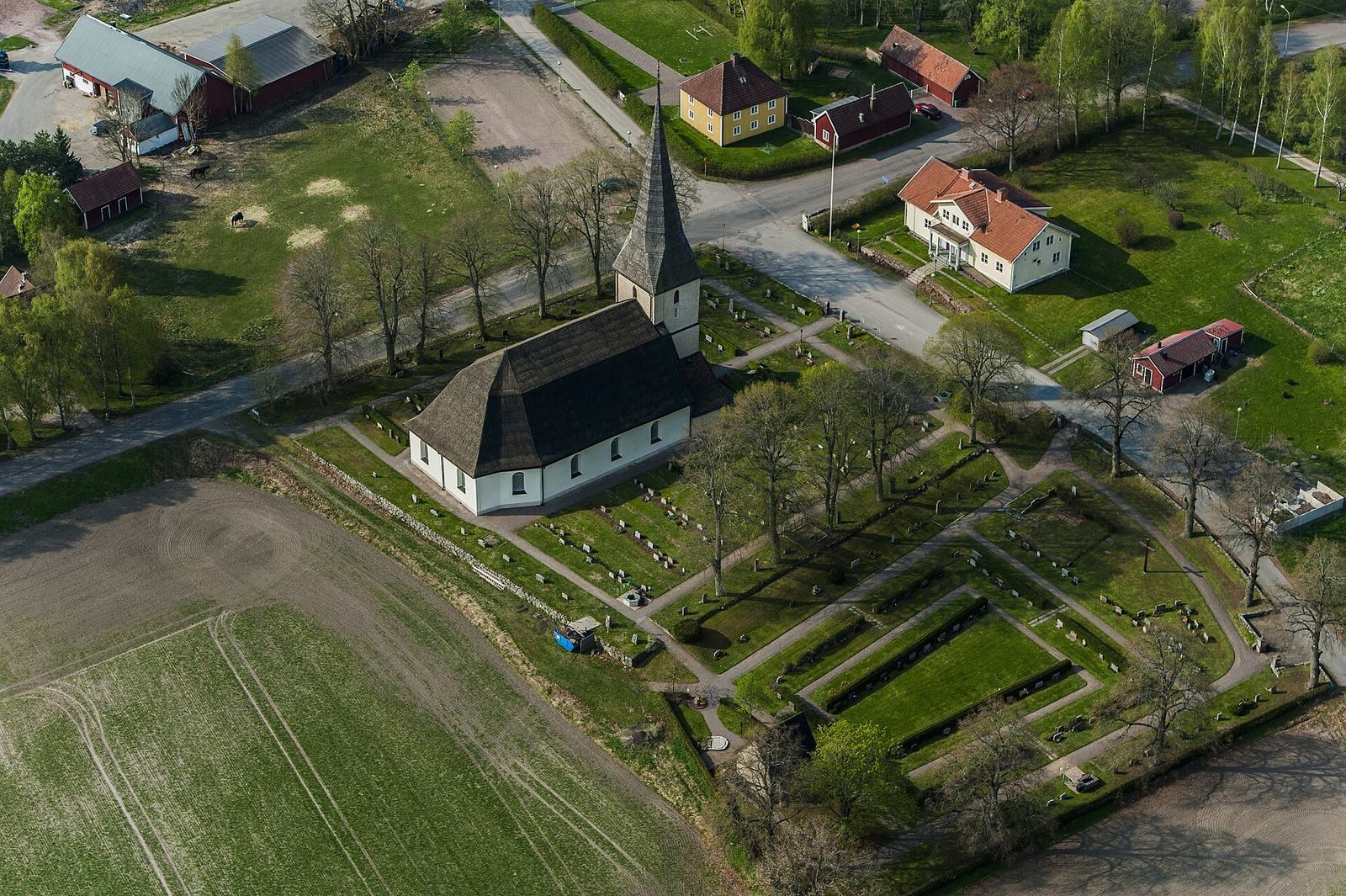
Viby Church is a parish church in Mantorp, Sweden, serving Vifolka Parish, the local congregation and its area, within the Diocese of Linköping, the regional administration of the Lutheran Church of Sweden. A fragment of a grave chest inscribed with runes points to a burial ground and a timber church on the site by the eleventh century. Such a church, called a stave church, was built around upright wooden posts. The earliest stone church was completed and consecrated around 1200.
Origins and medieval church
The stone church was given vaulted ceilings during the later Middle Ages. It remained a place of worship through the medieval period, before suffering damage in the sixteenth century.
Fire and enlargement
Danish forces reportedly burned the church in 1566. Repairs followed a few years later, and a bell tower was built in 1567.
In the late sixteenth or early seventeenth century, the existing choir was replaced by a larger one, and the church was enlarged to the east.
Rebuilding and restoration
In 1776, most of the church was demolished and rebuilt, while the tower and the western part of the north wall were retained. The work was completed that year and gave the church its current dimensions.
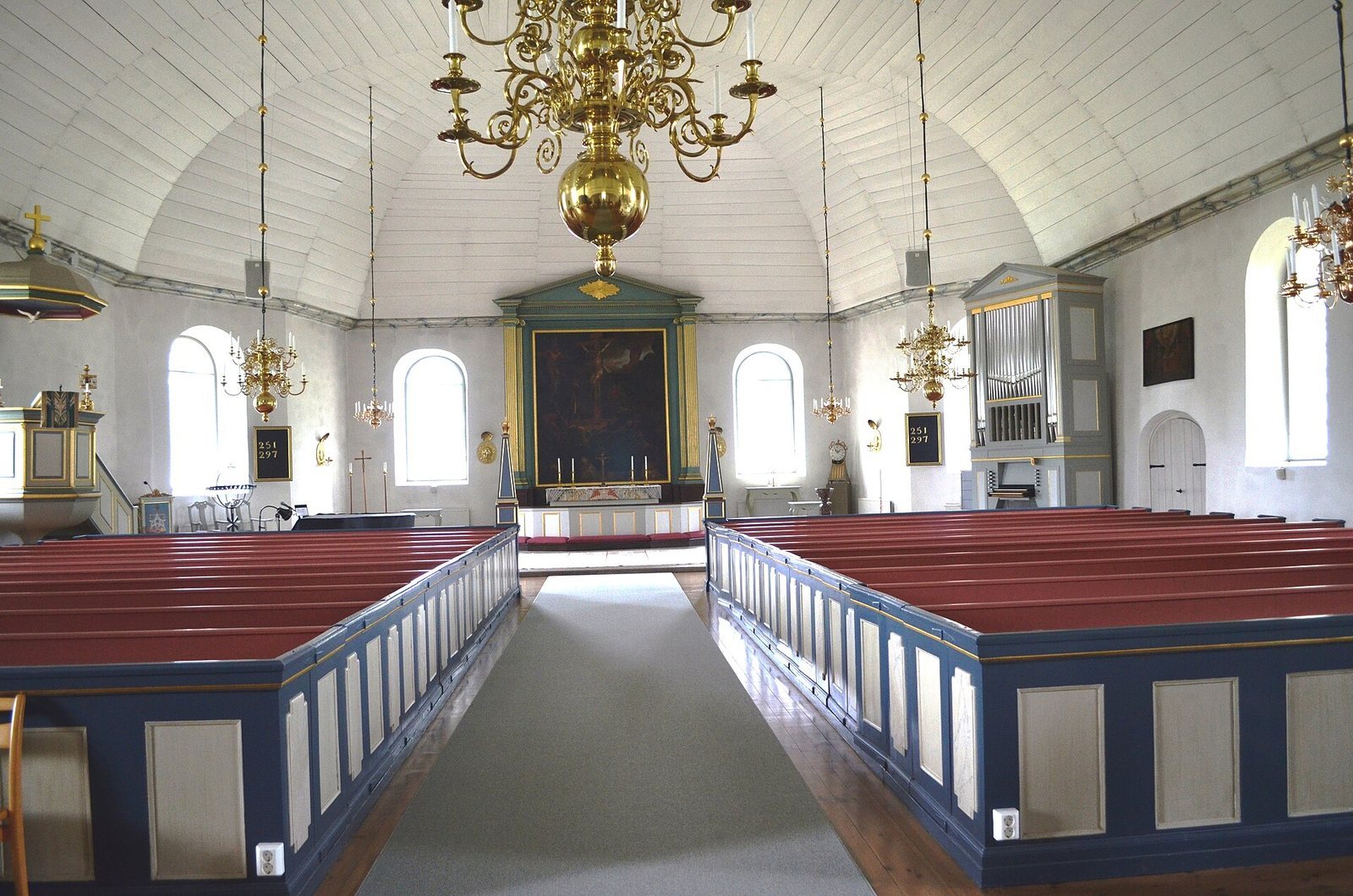
Investigations and restoration work in 1934 and 1962 brought buried foundations to light and renewed the interior in the Gustavian style, associated with Sweden in the late eighteenth century under King Gustav III.
Remains
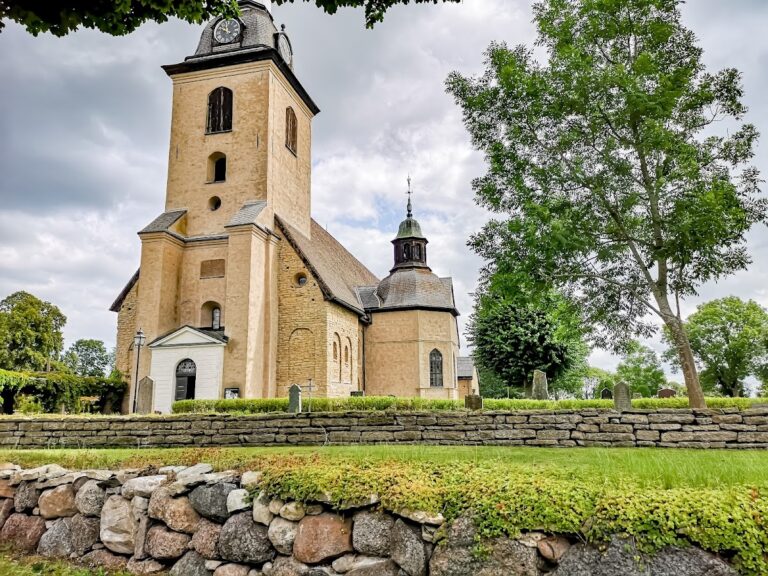
The church’s present form combines its rebuilt main structure with surviving earlier fabric. A medieval tower and a western stretch of the north wall remain above ground, while foundations beneath the floor preserve the plan of the earlier stone church.
Church fabric and plan
Early stone church
The buried foundations outline a nave, or main hall, a somewhat narrower choir around the altar, and a shallow, broad apse, a rounded end to the building. Within its walls, the church measured 14.5 metres long and 6.3 metres wide. A later triumphal arch, which separates the choir from the main body of a church, was set at the former apse wall. The eastern extension reached about six metres beyond the arch. Foundations of two further additions, one on each side of the church, were found during the 1934 investigation.
Tower, porch, and chapel
The tower is the sole surviving part of the earliest stone church. The western section of the north wall also remains. On the south side, a stone porch stands beside a funerary chapel for Commander Johan Alexander Götherhielm (1688-1764), a Swedish military officer.
Interior and furnishings
Gustavian interior and altarpiece
The interior follows the Gustavian style. Its main feature is an altarpiece painted in 1796 by the Swedish artist Pehr Hörberg.
Baptismal font
A limestone baptismal font dated to 1659 stands in the choir. It is probably the work of Michael Hacke of Skänninge.
Organs
Lars Strömblad built an organ for the church in 1782 with 17 stops, which control sets of pipes, one manual, or keyboard, and a pedal, operated by the feet. Anders Jonsson repaired it in 1836, and Svümenberg of Linköping added decoration and paintings. The instrument was rebuilt during the nineteenth century. In 1950, Nils Hammarberg made a 19-stop organ that stands behind the 1782 façade. Anders Perssons Orgelbyggeri built a mechanically operated choir organ in 1970, and Johannes Menzel Orgelbyggeri made another choir organ in 1996. The later instrument uses solid pine and oak, brass, and leather, with an oil-painted and gold-leaf finish.
Churchyard stones
Three runestones stand in the churchyard. One, found during the 1962 restoration and dated to the late tenth century, bears an inscription saying that Hök raised the stone for a capable young man and made a mound for his son Gemar, praised as an exceptionally good young man. The other two stones have partial inscriptions. The stones are identified as Östergötland runic inscriptions 204, 205, and Fv1965;54. A separate ornamentally carved stone is identified as Östergötland inscription 244.