Hitoyoshi Castle: A Sagara Clan Hill Castle in Japan


Site at a Glance
- Rating
- 4.2
- Popularity
- Low
- Country
- Japan
- Primary era
- Early Modern
- External website
- Open
- Eras represented
- Medieval, Early Modern
- Civilizations
- Kamakura shogunate, Tokugawa
- Site type
- Military
- Remains
- Castle
On this page13 sections
History
Hitoyoshi Castle is a terraced hill castle in Hitoyoshi, Japan, founded by the Sagara clan in 1205 and transformed into an early-modern Japanese castle by 1639. It stood in Fumoto, in the former Higo Province, beside the Kuma River, and served as the seat of the Sagara clan for 35 generations, from the Kamakura period until the abolition of the domain system in 1871.
Medieval foundations
In 1205, Sagara Nagayori, a local lord from Sagara Estate in Totomi Province and a retainer of Minamoto no Yoritomo, was appointed jitō, or land steward, of Hitoyoshi Estate. The estate was then controlled by Yase Sumasuke, who served Taira no Yorimori. Nagayori lured Sumasuke out on the pretext of cormorant hunting and killed him. He then enlarged Sumasuke’s castle, establishing the foundations of Hitoyoshi Castle. Tradition places this work within the period 1204 to 1206.
The castle acquired several traditional names. A crescent-patterned stone found during construction inspired the names Sengetsu Castle and Mikazuki Castle. It was also called Kuma Castle under two variant written forms. Another tradition concerns Sumasuke’s mother, Tsuga, who is said to have taken her own life from grief and resentment before becoming a vengeful spirit. A shrine intended to appease her was later built in the Third Enclosure, though it no longer survives.
The Sagara domain in war
During the Sengoku period, the Sagara clan unified the Kuma region while facing pressure from the Shimazu clan to the south and the Kitahara, Nawa, and Ōtomo clans to the north. On July 14, 1526, following an internal succession dispute, a large army led by the Kitahara clan besieged the castle, possibly with support from the Ikkō-ikki movement, a network of religious leagues that sometimes took military action. Sagara Yoshishige used a stratagem to drive the attackers away. This was the only attack on the castle by another clan after the Sagara takeover.
Sagara Yoshihi, the nineteenth head of the clan, began a major renovation during the Tenshō era, from 1573 to 1593. The work was interrupted several times and was finally completed in 1639 under Sagara Yorihiro, the twenty-second head of the clan. The project changed the site from its earlier form into an early-modern castle.
In 1581, the Sagara submitted to the Shimazu and became their vassals. In 1587, Sagara Yorifusa fought during Toyotomi Hideyoshi’s conquest of Kyushu, the campaign through which Hideyoshi brought the island under his control, and then surrendered. Negotiations conducted by his vassal Fukamizu Nagatomo secured confirmation of Hitoyoshi Castle and its territory to Yorifusa as an independent lord.
Hitoyoshi Domain and later destruction
During the Battle of Sekigahara in 1600, the Sagara initially supported Ishida Mitsunari’s Western Army and attacked Fushimi Castle and other fortifications. After the Western Army was defeated, they secretly joined Tokugawa Ieyasu’s side, achieved military success, and retained their holdings with an assessed revenue of 22,000 koku, a historical measure of agricultural production used to value a domain.
Under Sagara Yorifusa, the castle was modernized according to contemporary techniques. Its principal fortifications were made more compact, sections of the older defenses on the mountaintop were abandoned, and the riverfront defenses and port were developed. During the Edo period, the castle served as the administrative headquarters of Hitoyoshi Domain.
A fire broke out inside the castle in 1802. In February 1862, a blaze that began at a smithy in the castle town, known as the Torasuke Fire, caused extensive destruction. Together, these fires burned all of the castle buildings, after which some structures were rebuilt. The castle was abandoned in 1871 when the domains were abolished and prefectures were established.
During the Satsuma Rebellion of 1877, an uprising led by former Satsuma samurai against the new imperial government, the former castle became a base for Saigō Takamori’s forces and a scene of fighting. Buildings reconstructed in the late Edo period were then destroyed by fire. The Horiai Gate survived because it had already been moved to a private house.
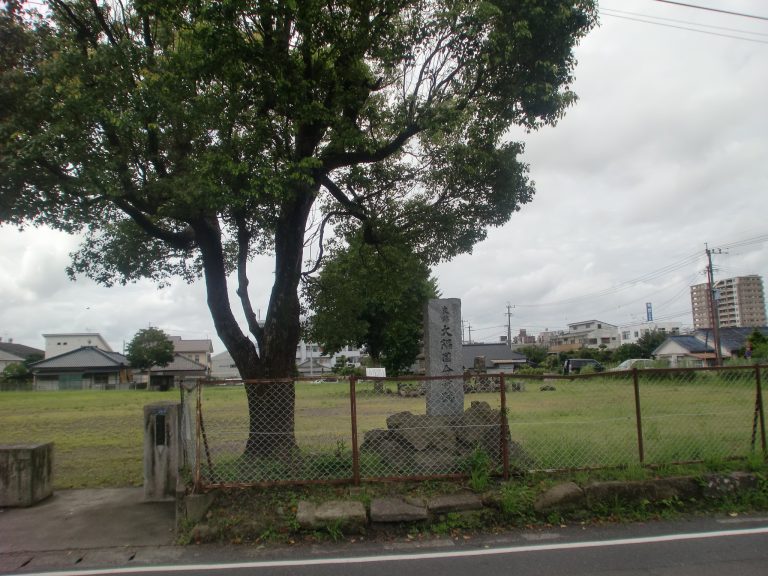
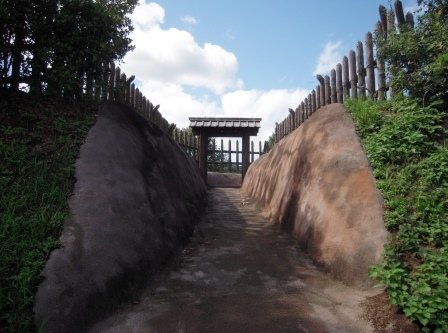
The former grounds later became Hitoyoshi Castle Park. The ruins were designated a National Historic Site on September 2, 1961. In 2006, the site was selected as number 93 in the 100 Fine Castles of Japan, and in 2015 it became a component cultural property of a Japan Heritage designation. A wooden corner turret was reconstructed in 1989, followed by the Tamon Turret beside the Main Gate and its connected wall in 1993.
The Hitoyoshi Castle History Museum opened in 2005 and preserves the remains of a stone underground chamber. A 2016 earthquake led to the removal and relocation of the city hall and civic hall that had stood within the grounds, enabling further park development. Heavy rain and flooding in July 2020 damaged the castle site and resulted in the closure of the history museum.
Remains
Terraced hill layout
Hitoyoshi Castle occupies a mountain at the confluence of the Kuma River and the Mune River, within the Hitoyoshi Basin. The basin is a valley approximately 30 by 15 kilometers, surrounded by high mountains along the southern border of Higo Province. The castle followed a terraced, ladder-like plan. The rivers formed natural moats along the north and west, while mountain slopes and cliffs provided natural defenses on the east and south.
The Third Enclosure lay beside the Kuma River, with the Second Enclosure to its south and the Main Enclosure on higher ground beyond. No tenshu, or principal castle tower, was built in the Main Enclosure. A two-story building called the Gomadō is said to have stood there instead. The Gomadō was a Buddhist ritual hall associated with goma fire ceremonies.
Defensive landscape
During the Sengoku period, subsidiary fortifications called Uehara Castle, Nakahara Castle, and Shimohara Castle occupied hills to the south, southeast, and east across the intervening valley. Their remains lie outside the present castle-park and National Historic Site area.
Riverfront and daimyō defenses
Musha-gaeshi wall
Part of the stone wall of the late Edo-period daimyō residence contains a defensive arrangement called Musha-gaeshi. Flat stones project slightly from the top of the wall, making it difficult to climb over while allowing defenders to drop stones or strike at people clinging to the face. The technique derived from European castle construction. The section facing the Kuma River is the highest and largest, and it also helped limit the spread of fire after the Torasuke Fire crossed the river and burned the castle. Comparable examples at Goryōkaku and Tatsuoka Castle are smaller.
Water Gate and port
The castle’s position beside the Kuma River supported water transport. A Water Gate served the riverfront, with rice storehouses and other facilities nearby. These features formed part of the castle’s river-oriented defenses and working areas.
Surviving and reconstructed features
Walls, earthworks, and turrets
Hitoyoshi Castle Park preserves stone walls and earthworks together with surviving or reconstructed wooden turrets and earthen walls. The wooden corner turret was rebuilt in 1989, and the Tamon Turret beside the Main Gate, with its adjoining wall, was rebuilt in 1993. The Horiai Gate remains at a private residence after its relocation before the Satsuma Rebellion.
Underground chamber and museum
The Hitoyoshi Castle History Museum contains Sagara-related materials and a preserved stone underground chamber. A well inside the chamber is 2.3 meters deep. The museum and its associated grounds occupy areas affected by the removal or relocation of the former civic facilities. The Sagara Gokoku Shrine stands west of the castle ruins.