Uto Castle: Medieval Stronghold and Early-Modern Castle in Japan
Site at a Glance
- Rating
- 3.8
- Popularity
- Very Low
- Country
- Japan
- Primary era
- Early Modern
- External website
- Open
- Eras represented
- Classical, Medieval, Early Modern
- Civilizations
- Tokugawa, Toyotomi regime
- Site type
- Military
- Remains
- Castle
On this page19 sections
History
Uto Castle is a group of two successive Japanese castle sites in Uto, Japan, comprising the medieval Uto Old Castle and the early-modern castle built nearby in the late sixteenth century. The older stronghold occupied Nishiokadai hill, while the later castle stood on Shiroyama immediately to its east. Together, they reflect Uto’s development from a regional medieval base into a fortified castle town during the transition from the Sengoku period, an era of intense warfare and political fragmentation, to the rule of the Tokugawa shogunate.
Origins and the Medieval Castle
The exact foundation date of Uto Old Castle is uncertain, although the site existed by the middle of the Heian period. Tradition attributes its construction in 1048 to Fujiwara no Yorimichi, a powerful Fujiwara regent, during a visit to Nishiokadai. The hill had an earlier defensive and elite presence. A local chieftain’s residence occupied the area during the early Kofun period, around the fourth century, and a burial mound associated with the fifth century has also been identified.
During the Nanboku-cho period, when the Southern and Northern Courts contested the imperial succession, Uto Takatoshi supported the Southern Court. He welcomed Prince Kaneyoshi at Amitsu Port and sent him onward to the regional military leader Kikuchi Takemitsu at Kumafu. Takatoshi also operated across the Uto Peninsula and took control of the neighboring Koriura Estate, which belonged to the chief priest of the Northern Court-aligned Aso family.
Uto became involved in a later struggle for control of Higo. In the late Muromachi period, Uto Tamemitsu, an adopted son of Uto Tadatoyo and a member of the Kikuchi clan, repeatedly sought the office of provincial governor. He gained the position in 1501, but Kikuchi Yoshikane defeated him at Nishiokadai in 1503. Tamemitsu was killed after the castle fell.
Kikuchi retainer Jo Tamefuyu entered the castle after the defeat, but withdrew in 1504 following Yoshikane’s sudden death. Nawa Akitada, Tamemitsu’s son-in-law, then occupied the vacant stronghold. His family, later known as the Uto Nawa clan, held Nishiokadai for approximately eighty years.
The Nawa Clan and the Move East
During Toyotomi Hideyoshi’s conquest of Kyushu in 1587, Nawa Akitaka initially supported the Shimazu but soon submitted to Hideyoshi and retained his territory. He remained neutral during the Higo uprising rather than supporting Sassa Narimasa, the newly appointed lord of Higo. After Akitaka travelled to Osaka to explain his position, his brother and castellan, Nawa Akiteru, refused a demand from Hideyoshi’s army to surrender the castle. The Nawa were defeated and dispossessed, ending their rule at Uto.
In 1588, Konishi Yukinaga received territory in Higo that included the districts of Uto, Mashiki, and Yatsushiro. The grant amounted to approximately 175,000 koku, although the precise figure is disputed. Yukinaga planned a new castle on the 13-meter-high hill east of Nishiokadai. The older site was considered too restricted for a proper castle town and poorly suited to defense against cannon. Construction probably began around 1589, after the Amakusa local-warrior uprising delayed the works.
Yukinaga also reorganized the settlement around the new castle. The town was laid out with principal north-south streets and east-west commercial lanes, while the Uto and Funaba rivers were repaired for defense and transport. These works connected the castle with a wider fortified enclosure, or sogamae, that incorporated the town, samurai residences, waterways, moats, and approaches around the hill.
The Siege of 1600
Uto Castle was besieged in 1600 after Yukinaga joined the Western Army in the conflict that culminated in the Battle of Sekigahara. Kato Kiyomasa, who later ruled northern Higo from Kumamoto, first campaigned in Bungo in support of Kuroda Josui. When the situation there favored Kuroda, Kiyomasa turned his forces against Uto.
Fighting began at the Ishinose entrance on September 19 and reached the castle town on September 20. On September 21, Kiyomasa’s army launched a general assault from five directions. Konishi’s defenders resisted strongly, using large-caliber cannon against attackers who crossed the northern moat, Hiyotanbuchi, by boat.
Kiyomasa’s forces captured the third bailey on October 2 and then attacked the main and second baileys. On October 13, the castellan Konishi Hayato agreed to surrender, and the fighting ended the following day. Hayato is variously said to have killed himself inside the castle or to have been transferred to Kumamoto and assassinated. His fate remains uncertain.
Kato Rule and Abandonment
After Yukinaga’s defeat, Kiyomasa acquired Uto and designated the castle as his retirement residence. He substantially remodeled the principal enclosure, burying parts of the Yukinaga-period remains beneath the new works. Excavated remains and surviving masonry with characteristic Keicho-period construction indicate the scale of this remodeling. Horiuchi Ujiyoshi served as castellan during Kiyomasa’s tenure.
Kiyomasa died in 1611, and the castle was abandoned in 1612. It was later dismantled under the one-castle-per-domain policy. After the Kato clan was dispossessed in 1632, Higo passed to the Hosokawa clan. In 1637, the Tokugawa government ordered further destruction of abandoned castles in western Japan, partly to prevent their use as strongholds like Hara Castle during the Shimabara Rebellion.
In 1646, Hosokawa Yukitaka received 30,000 koku and founded the Uto branch domain. As a cadet domain, it did not receive a full castle. Its administrative center was the Uto jinya, an administrative residence for a domain without a castle, in present-day Shinkoji-machi. The former castle grounds were largely left unused, although construction of the Gosen Waterway altered the northern part of the site. Stone was removed and soil was extracted from the abandoned castle area.
Later Changes and Preservation
During the Meiji period, the former second bailey became a samurai cemetery after an earlier warrior cemetery became too small. In the Taisho period, the former third bailey was developed for Uto Middle School, now Kumamoto Prefectural Uto Junior and Senior High School. Housing and other development later altered much of the third bailey and adjoining castle land.
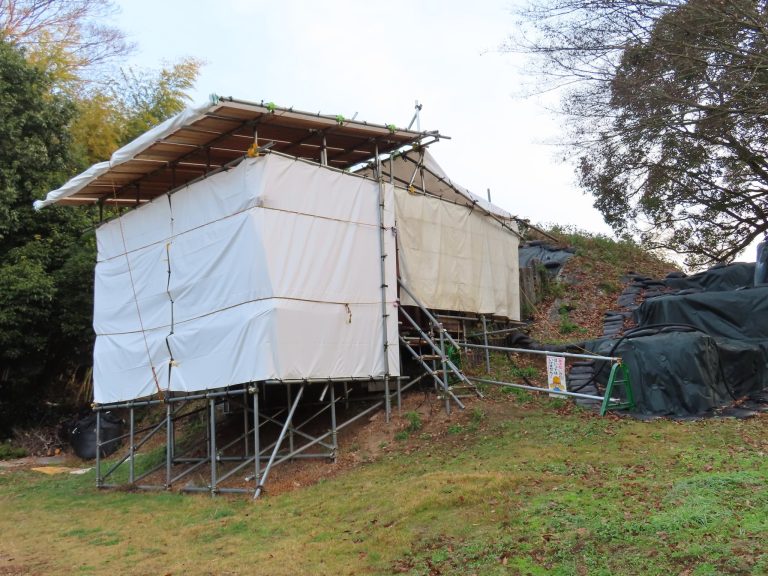
The early-modern ruins were designated a Uto City historic site in 1958, helping prevent their complete disappearance. The former main bailey became a park in the 1970s. Uto Old Castle is a National Historic Site and has been developed as the Historic Site of Uto Castle Ruins. Torrential rain in 2025 caused part of the slope on the Uto Castle hill to collapse.
A long-standing tradition holds that Kiyomasa dismantled the early-modern castle’s three-story keep and moved it to Kumamoto Castle, where it became the Uto Yagura. However, physical evidence from a major investigation of that turret in 1927 does not support the story. The tradition may instead have referred to a smaller keep rather than the surviving Uto Yagura.
Remains
Uto Old Castle on Nishiokadai
Hilltop Layout
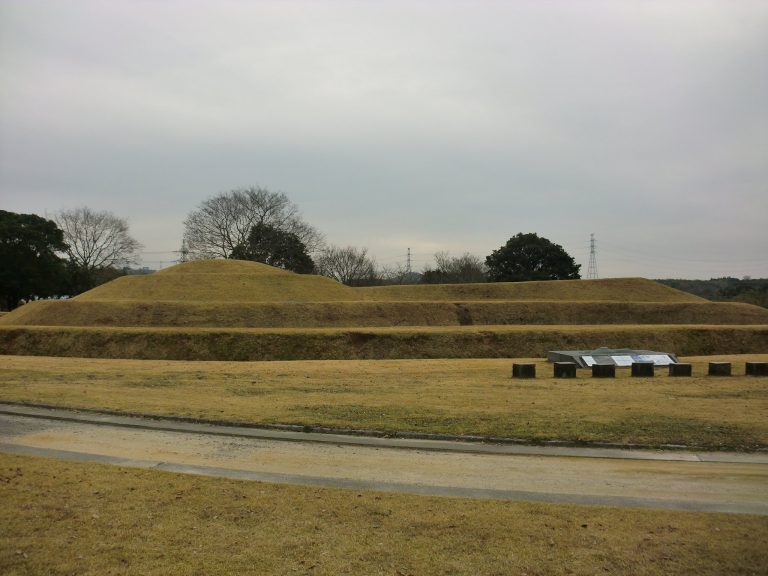
The medieval castle occupied the independent Nishiokadai hill, which extends about 700 meters from east to west, reaches approximately 350 meters at its widest point, and rises to roughly 39 meters above sea level. The castle grounds appear to have covered almost the entire hill. A central hollow divided the linked-bailey layout into Senjojiki, the principal enclosure on the east, and San no Jo on the west.
Senjojiki
Senjojiki was the largest level area. A lateral ditch, running along the enclosure boundary, surrounded it except on the north, while several vertical ditches cut down the slopes from the north toward the east. Excavation has identified numerous post-built structures, including overlapping pillar traces that indicate repeated rebuilding.
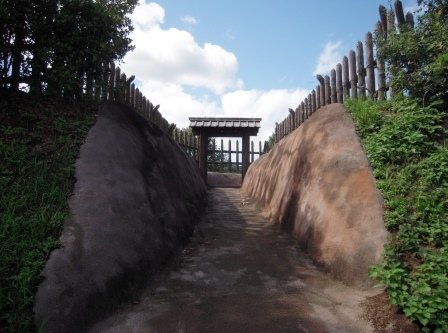
An entrance passage and gate remains were found on the eastern side of Senjojiki. The entrance, gate, and parts of the buildings have been reconstructed or restored within the historical park. Excavation north of the enclosure in 1998 uncovered an unfinished lateral ditch. Finds place its construction at the end of the sixteenth century and preserve evidence of the earthmoving methods used at the time.
More than 100 stone-pagoda components were recovered from a ditch near the gate. Their placement indicates that the ditch was deliberately filled during a carefully conducted castle-dismantling ritual. The unfinished ditch may represent hurried strengthening before Hideyoshi’s conquest of Kyushu, while the filled ditch may relate to the ritual abandonment of the old castle when the principal castle moved east.
San no Jo
San no Jo covered more ground than Senjojiki. It has fewer surviving building traces, but its larger postholes suggest that comparatively large structures stood there for a long period. A water-filled depression west of the buildings is interpreted as the remains of a garden pond, and stone pieces thought to be Go stones were excavated there in 2012.
Excavation on the northern slope in 2011 identified part of a kirigishi, a deliberately cut and steepened defensive slope, laid out at approximately 55 to 60 degrees. A dry ditch at the southwestern foot is about 10 meters wide and 300 meters long. Partial excavation suggests that it may have been cut during the middle or late Sengoku period.
Earlier Kofun Remains and Quarrying
Exposed rock surfaces and boulders across both medieval enclosures contain quarrying holes made for splitting stone. The stones appear to have been prepared as possible material for the early-modern castle’s walls but left unused. A large boulder on the northern side of San no Jo may instead have served as a garden stone.
The hill also contains remains of an early Kofun-period chiefly residence. Medieval castle construction removed most of it, but the lower part of its surrounding ditch was detected. Its distinctive shape incorporates a toad-like design associated with objects regarded as sacred on the Asian mainland at the time. It is described as the only example discovered in Kumamoto Prefecture. Several Kofun-period stone-coffin burials have also been identified in and around the historical park.
Early-Modern Castle on Shiroyama
Castle Arrangement and Defenses
The early-modern castle occupied the eastern part of the hill complex, on the rise known as Shiroyama. The central summit probably held the main bailey, the principal fortified enclosure, with the second bailey to the west and the third bailey to the east and south. A large outer moat called Hiyotanbuchi lay to the north, while a district of samurai residences occupied the area north of the third bailey. Water-filled moats linked these areas.
The castle, town, samurai residences, waterways, and moats formed an integrated sogamae, an outer defensive system enclosing the castle and its associated settlement. The broader defenses incorporated the old town to the northeast, the Funaba River, a former small hill at Ishinose to the east, and defensive ground extending south from Dambara-machi to Iriji-machi. A river port connected the castle area with the Ariake Sea.
Stone Walls, Moats, and Keep
Uto was a hirayamajiro, a Japanese castle built on a low hill or elevated natural rise. Its central area was approximately 16.3 meters high and was enclosed by stone walls about 13 meters high, a dry ditch, and five gates. The three main baileys were surrounded by inner and outer moats. The castle had a three-story, five-floor watchtower-style keep, but the keep no longer survives.
The principal surviving remains are stone walls and moats. Some stonework installed during later park construction differs from the original castle fabric and cannot be treated as archaeological masonry. The former main bailey is now Shiroyama Park, where portions of the walls and moats remain. The former second bailey is occupied by a municipal cemetery, while housing and a school substantially cover the former third bailey.
Waterways and the Castle Town
Yukinaga repaired the Uto and Funaba rivers as part of the castle’s defensive and transport system. The Funaba River served as the first defensive line of the outer moat, while the Uto River functioned as a principal waterway for the castle town. Both waterways later disappeared from the castle landscape. The visible water-related features now mainly reflect modifications associated with the Hosokawa domain’s Gosen Waterway.
Memorials and Recovered Materials
Konishi Yukinaga Statue
A bronze statue of Konishi Yukinaga stands in Shiroyama Park. It is an imaginary portrait rather than a historically authentic likeness. The figure faces toward the sea with his back to the city, recalling Yukinaga’s reputation as a naval commander under the Toyotomi government.
Decorated Tomb Materials
Stone materials from a decorated Kofun-period tomb were found during construction in the former third-bailey area. Some pieces bear linear engravings and were initially mistaken for large stones from the old castle walls. They were later identified as parts of the decorated tomb and moved for display in the rear garden of the Uto City Library.