Annountsiata Bell Tower: A Surviving Monument of Corfu’s Catholic Monastery
Site at a Glance
- Rating
- 4.4
- Popularity
- Low
- Country
- Greece
- Primary era
- Early Modern
- Eras represented
- Early Modern
- Civilizations
- Venetian
- Site type
- Religious
On this page7 sections
History
Annountsiata bell tower is a surviving monument of the former Catholic Monastery of the Annunciation in Corfu, Greece, founded during the Angevin period and consecrated on 7 January 1394. The Angevin period was the era when Corfu was ruled by the French-origin Anjou dynasty, which controlled territories in southern Italy and the eastern Mediterranean. The monastery stood between the hills of Saint Athanasius and the Holy Fathers.
Foundation under Angevin rule
The Neapolitan nobleman and sailor Pietro Capezze provided the monastery’s principal financial support and donated its land. At the consecration, the ceremony brought together the local bailli, a senior governor or administrative official, Niccolò Zen; the Catholic bishop Albano Michiel; Catholic clergy; the Orthodox protopapa, a senior Orthodox priest, and 32 Orthodox priests from Corfu. Venetian officials, Corfiot nobles and merchants, and a large crowd also attended. The monastery was entrusted to the Order of Saint Augustine, a Catholic religious order following the rule and spiritual tradition associated with Saint Augustine of Hippo.
Venetian supervision and rebuilding
From 1406, the substantial monastery and its extensive landed property came under the supervision and protection of the local Venetian bailli. The complex suffered major damage in 1537 and was completely rebuilt in 1542. Corfiots killed in the Battle of Lepanto in 1571, the major naval clash between the Holy League and the Ottoman fleet in the Gulf of Patras, were buried within the complex alongside several local Venetian officials. Repairs to the monastery roof were also carried out in 1571.
Further work took place between 1668 and 1670, when the bell tower probably acquired its final form. During this phase, the monastery church ceiling received 28 paintings by Riggoni, with additional work by the iconographer Theodore Poulakis and his brother. An iconographer is an artist who creates religious images according to Christian artistic conventions.
Seminary, destruction, and survival
In 1713, the local archbishop Augusto Antonio Zacco decided that the complex should cease functioning as a monastery and become a seminary. It was badly damaged during the French invasion of Corfu in 1797. German bombing on 14 September 1943 caused the complex to burn completely, although the ruins remained standing.
In 1953, during the mayoral administration of Stamátios Dessýlas, the local municipal authority demolished the entire complex except for the bell tower and the northeastern end of the former monastery church. Between 2020 and 2022, the Corfu Ephorate of Antiquities restored the bell tower. An Ephorate of Antiquities is a regional archaeological service responsible for protecting, studying, and conserving historic monuments.
Remains
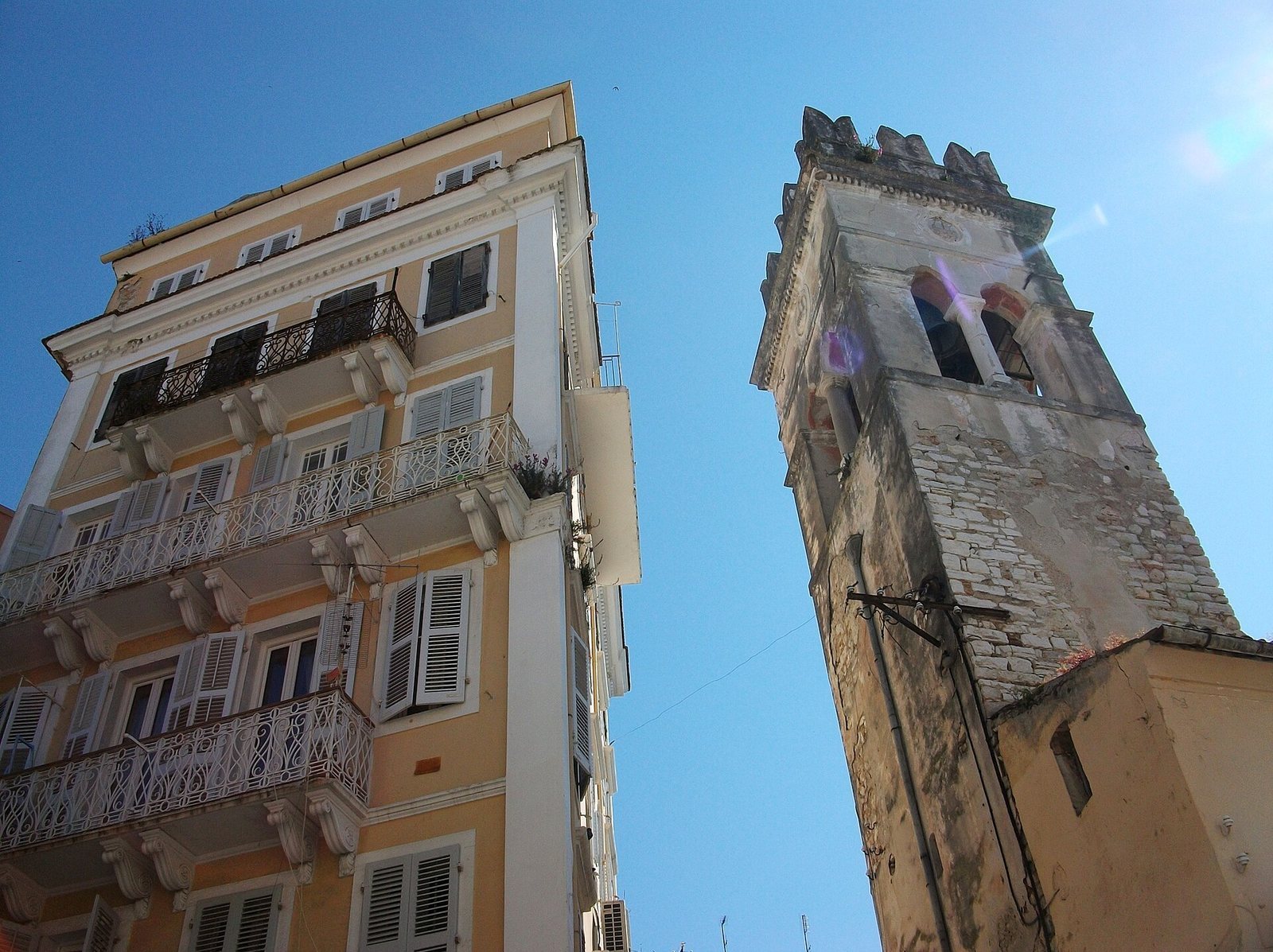
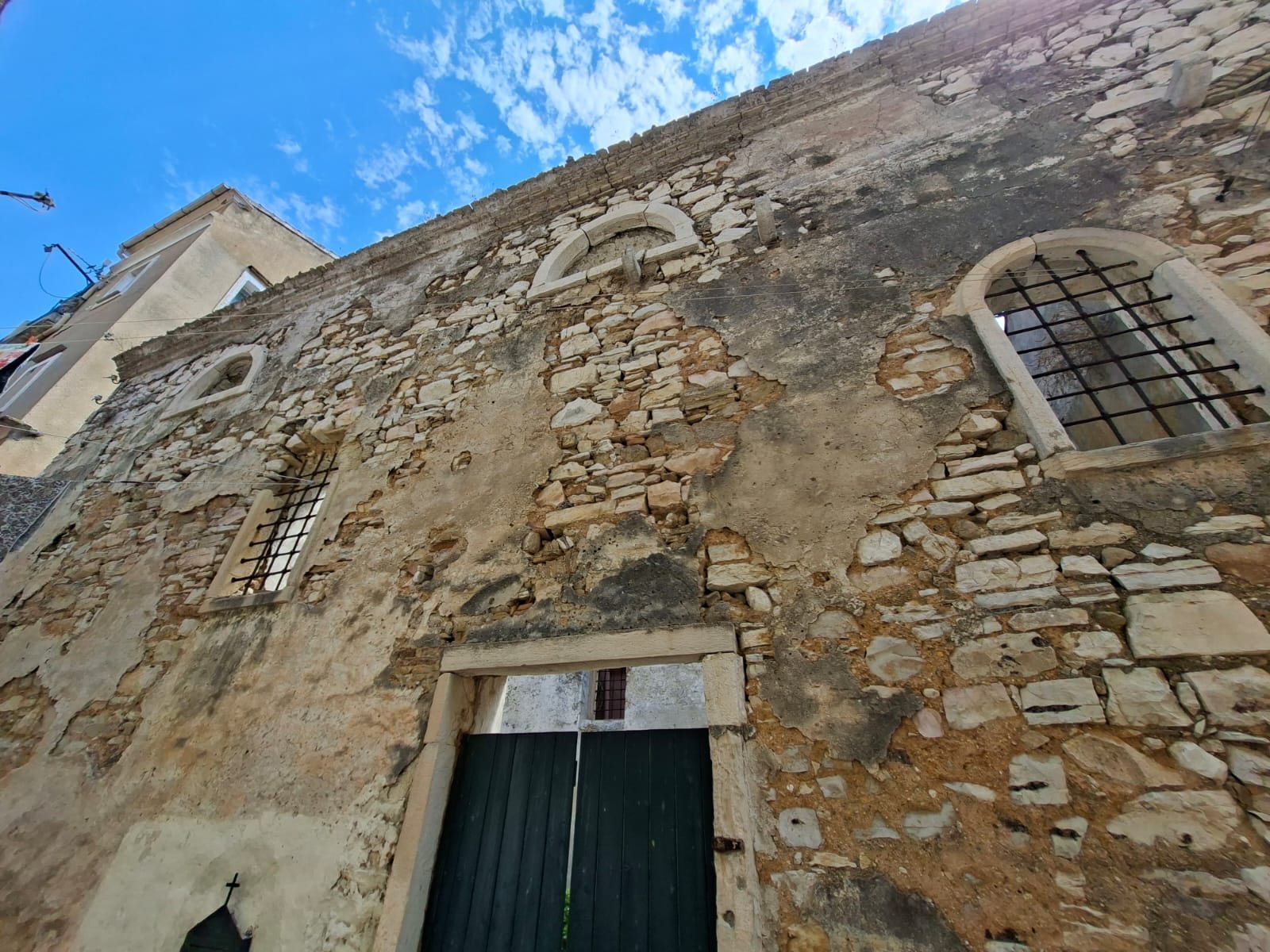
The surviving remains stand in the city of Corfu at the junction of Evgeníou Voulgáreos-Motsenígou and Vrachlióti streets. They consist chiefly of the bell tower and the northeastern end of the former monastery church. The church was a three-aisled basilica, meaning that its interior was divided lengthwise into a central nave and two side aisles. The surviving structures preserve elements of the former complex’s religious, commemorative, and decorative character.
Bell tower
The bell tower retains allegorical representations of Corfu on its upper parts, accompanied by the island’s local emblem. Wall paintings were uncovered in the tower during the restoration of 2020 to 2022. Part of this painted decoration is now exhibited within the Old Fortress of Corfu.
Former monastery church
The northeastern end of the monastery church survives beside the bell tower. The church facade had three circular windows and was reached by a small staircase elaborately worked in red marble. Its walls carried funerary inscriptions and stelae, together with Baroque architectural decoration. Baroque architecture is characterized by theatrical forms, rich ornament, and dynamic sculptural treatment.