Corcyra: An Ancient Greek City-State on Corfu
Site at a Glance
- Popularity
- High
- Country
- Greece
- Primary era
- Classical
- Eras represented
- Iron Age, Classical
- Civilizations
- Ancient Greek, Byzantine, Roman
- Site type
- City
On this page19 sections
History
Corcyra was an ancient Greek city-state on the island of Corfu in Greece, founded as a Corinthian colony around 734 BC. Its authority extended across the island, and its position made it a major port for ships sailing west. Corcyra’s naval power gave it influence over routes connecting mainland Greece and the Ionian Sea with the Adriatic and southern Italy.
Foundation and early rivalries
Human habitation on the island predates the Greek city. People lived there by at least the Mesolithic or Neolithic period, while the island’s Bronze Age culture appears to have shared characteristics with that of southern Italy. An Eretrian trading and maritime outpost apparently preceded the Corinthian settlement. Corcyra and Corinth later joined in founding Epidamnus and Apollonia in the region of present-day Albania.
In 664 BC, Corcyra defeated Corinth in the earliest naval battle between Greek city-states known from historical records. The conflict contributed to the fall of Corinth’s Bacchiad ruling family and the rise of Cypselus, although Corcyra remained under Corinthian authority. Herodotus also related a story that connected the cities’ hostility to Corinthian ruler Periander: after Corcyraeans killed his son Lycophron, Periander supposedly seized 300 Corcyraean youths to castrate them. The tale is likely a myth explaining the rivalry rather than a record of events.
In 480 BC, Corcyra promised and equipped 60 ships for the Greek effort against Persia, but they arrived too late for the Battle of Salamis. Herodotus attributed the delay to Corcyra’s desire to maintain neutrality, while unfavorable winds served as the stated excuse. Greek traditions also linked the city’s name to Korkyra, a naiad, or water nymph, and offered a separate mythic connection to Medusa. Thucydides identified Corcyra with Scheria, the homeland of the Phaeacians in the Odyssey.
Conflict and alliance in the fifth century BC
A dispute with Corinth over Epidamnus became one of the causes of the Peloponnesian War. Corcyra sought Athenian support against Corinth, and Athens agreed to a defensive alliance, sending 30 ships in two groups. They were instructed to act only if Corcyra came under attack. Corinth defeated Corcyra at Sybota, but withdrew when the second Athenian group arrived. The Epidamnus dispute helped bring Athens and Corinth’s ally Sparta into a wider conflict, alongside disputes involving Megara and Potidaea.
In 427 BC, a civil conflict divided Corcyra between democrats, who favored continued alliance with Athens, and oligarchs, supporters of government by a small group who sought ties with Corinth and Sparta. With Athenian naval assistance, the democrats prevailed. They killed people they suspected of hostility, while other opponents escaped to the Greek mainland. In 425 BC, a Spartan fleet of 60 ships besieged Corcyra. Part of the fleet stayed at the siege as the rest moved to trap Athenians sheltering at Pylos after a storm. The episode led to the Battle of Sphacteria.
Corcyra remained allied with Athens until 410 BC, when it came under Spartan dominance and joined the Peloponnesian League, an alliance led by Sparta. Around 375 BC, a Peloponnesian fleet commanded by Mnasippus attacked and besieged the city. Hunger drove some inhabitants to desert; Mnasippus sold them into slavery or later had them executed. In 373 BC, Corcyra joined the Second Athenian Confederacy, a later alliance led by Athens.
Hellenistic and Roman rule
Corcyra changed hands repeatedly during the Hellenistic period, the era that followed Alexander the Great’s conquests. In 303 BC, after Cassander of Macedon failed to capture the city, the Spartan commander Cleonymus occupied it briefly. Corcyra then regained its independence. Three years later, Cassander besieged it again, but Agathocles, ruler of Syracuse, intervened and destroyed his fleet. Agathocles took control of the island and, in 295 BC, gave it as a dowry when his daughter Lanassa married Pyrrhus, king of Epirus.
Lanassa left Pyrrhus in 291 BC and sought to transfer Corcyra to her next husband, Demetrius Poliorcetes of Macedon. In 274 BC, Pyrrhus’s son Ptolemy recovered the island for his father. Corcyra remained part of the Epirote League, a political federation in Epirus, until 255 BC, when it regained independence after the death of Alexander II, the last king of Epirus.
In 229 BC, following a Greek defeat at the Battle of Paxos, Illyrians under Demetrius of Pharos briefly occupied Corcyra. Rome intervened during the First Illyrian War. Demetrius surrendered, and Corcyra became a Roman protectorate, a territory under Roman protection and influence, while retaining the status of a free city. Under Roman rule it served as a naval base and kept some independence. Around 189 BC it was governed by a Roman prefect, an appointed official, and in 148 BC it became part of the province of Macedonia.
Christianity, destruction, and archaeological work
Christianity reached Corcyra in the first century AD. Tradition credits its introduction to Jason of Thessalonica and Sosipater of Iconium, described as disciples of Paul. Goths destroyed the city in the sixth century AD, after which it was abandoned.
The first archaeological finds in the area came during the nineteenth century, when the island was under British rule. Investigations began late in that century, with Heinrich Schliemann and Wilhelm Dörpfeld among those involved. Greek archaeologists and Dörpfeld conducted systematic excavations from 1910 to 1914; work continued in 1919–1920, in 1939, and from 1954 onward. The Roman bath was restored in 1994–1995.
Remains
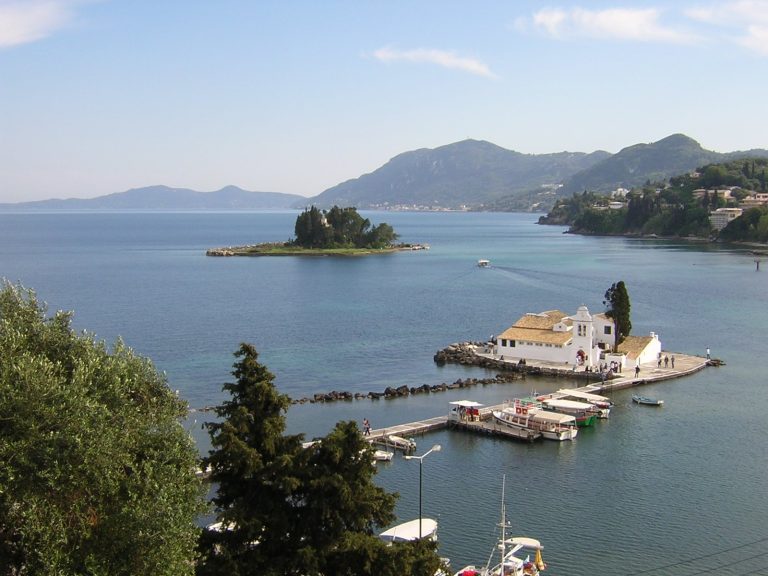
The archaeological area, known as Palaiópoli, or Old Town, occupies a hook-shaped promontory on Corfu’s central east coast, about two kilometres south of modern Corfu town. Parts lie within the grounds of Mon Repos Palace. The ancient city extended between two harbors, with its elevated or fortified upper area, the acropolis, in the south and the lower city spread across the space between them. The ruins generally lie close to the modern ground surface, and many ancient building stones were reused in medieval and later buildings and fortifications in Corfu town.
Harbors and city center
Hyllaia Harbor lay to the west of the city and could be closed by a chain in antiquity. Its site is now a lagoon-like bay. Alcinous’s Harbor, named for a mythological king, occupied the eastern shore. Between the two harbors, the city’s central public space, the agora, served as its commercial center. It was paved throughout, and remains of several buildings survive around it.
Temples
Temple of Artemis
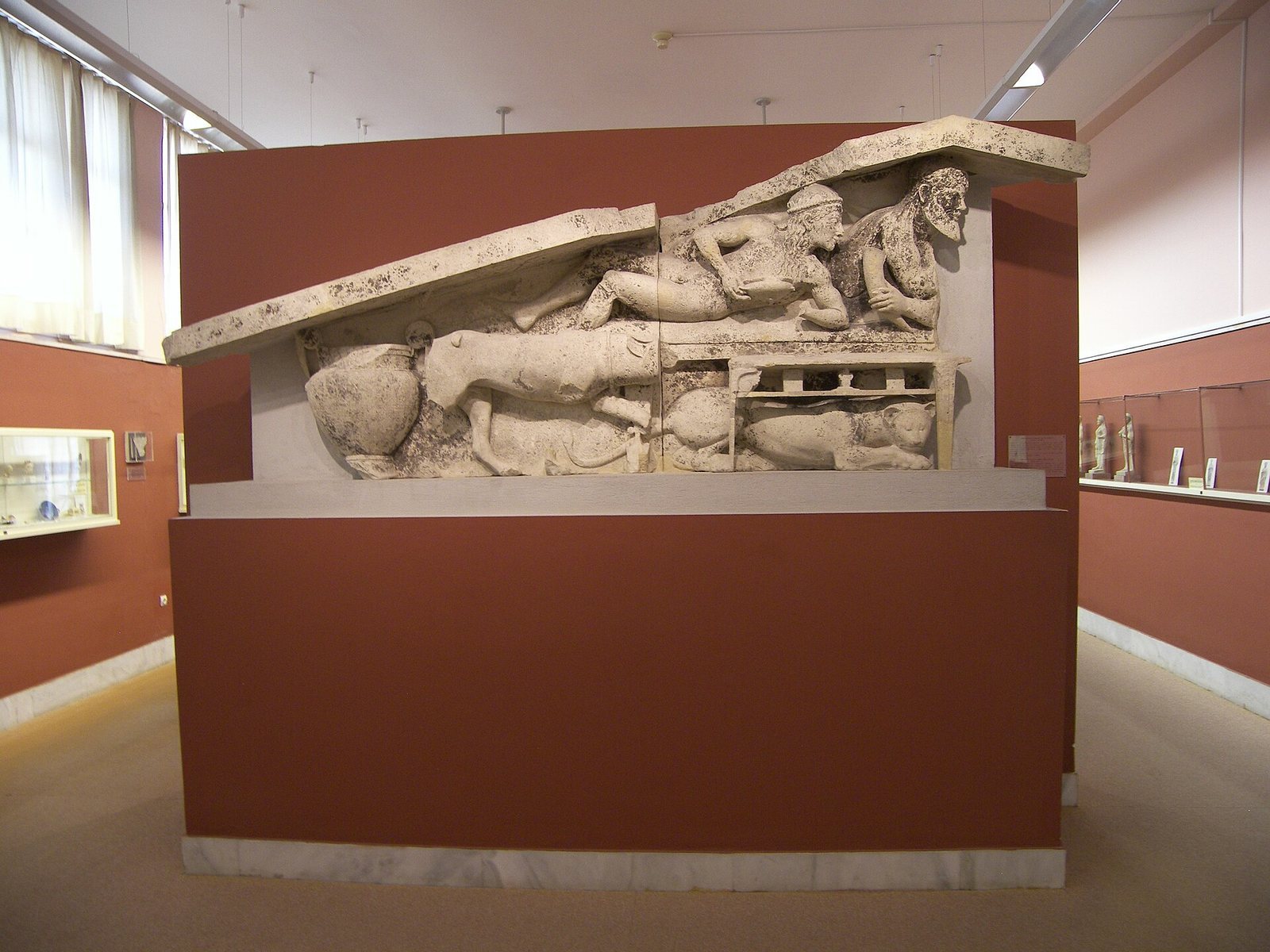
Built around 580 BC on the northern slope of the acropolis, southwest of the city center, the Temple of Artemis was an early example of the Doric order, a Greek architectural style with relatively plain columns and capitals. It measured about 22.4 by 47.9 metres, with eight columns across the front and 17 along each side. Its triangular front feature, or pediment, depicted a Gorgon, a creature from Greek mythology. Fragments of its sculpted pediment are held at the Archaeological Museum in Corfu town.
Temple of Hera
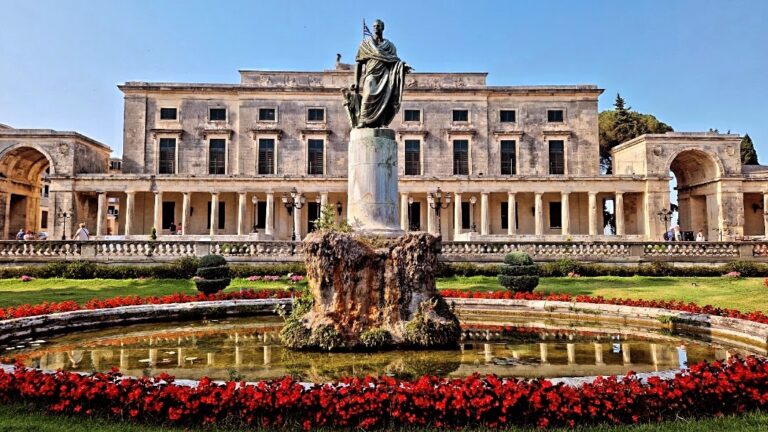
Ruins of a Doric temple to Hera stand within the Mon Repos grounds. Built in the fourth century BC, it may have been the largest temple on the island.
Temple of Kardáki
The Doric Temple of Kardáki stood near the shore at the eastern edge of the city, also within the Mon Repos grounds. Built in the late sixth century BC, it may have been dedicated to Poseidon, Apollo, or Asclepius. It had six columns across the front and 11 along the sides. Its remains are the best preserved among Corcyra’s temples.
Civic, religious, and performance buildings
Early Christian basilica
East of the agora are the remains of a five-aisled early Christian basilica dating to the fifth century AD. It is among the best-preserved buildings in the archaeological area.
Roman bath
The ruins of a Roman bath built around AD 200 lie southeast of the agora, within Mon Repos park. The complex used a hypocaust, an underfloor system that heated rooms, and is among the area’s best-preserved structures.
Odeion
A Roman-period odeion, a building associated with musical performances, is another surviving feature of the ancient city.
Fortifications and tomb
Nerantzícha Wall
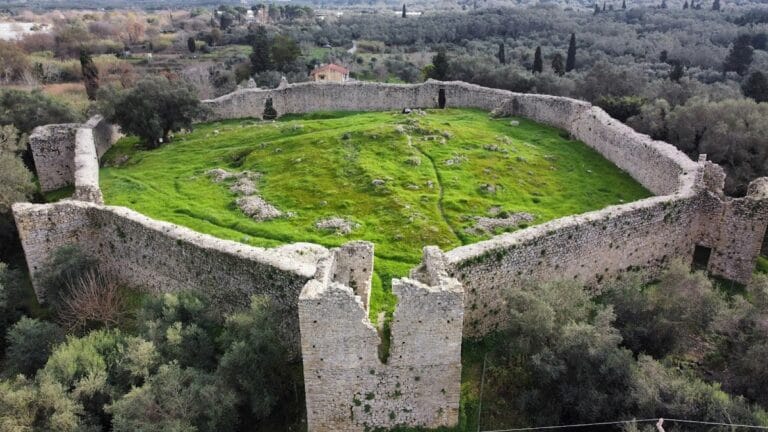
Near the western edge of the ancient city, close to Corfu airport, a surviving section of the city’s fortification wall is known as the Nerantzícha Wall.
Tomb of Menekrates
Farther north, in the area of present-day Corfu town, stands a round tomb known as the Tomb of Menekrates.
Museum collections
Architectural fragments and other finds from Corcyra are held at the Archaeological Museum in Corfu town and the Palaiópoli Archaeological Museum within the archaeological area. The latter includes column fragments and floor mosaics.