Corfu New Fortress: A Venetian Defense of Corfu’s Port


Site at a Glance
- Rating
- 4.4
- Popularity
- Medium
- Country
- Greece
- Primary era
- Early Modern
- External website
- Open
- Eras represented
- Early Modern, Modern
- Civilizations
- British, Venetian
- Site type
- Military
- Remains
- Fort
On this page10 sections
History
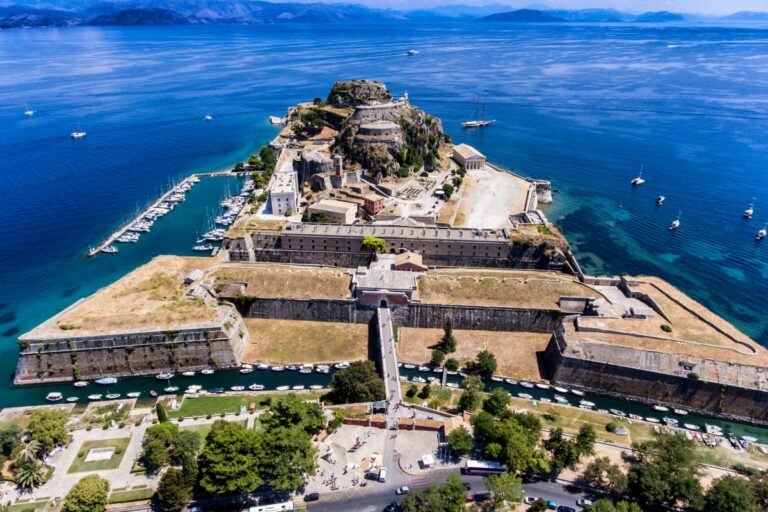
Corfu New Fortress, also known as the Fortress of Saint Mark or the Sea Fortress, is a Venetian fortification in Corfu, Greece. Built on Saint Mark’s Hill beside the old port, it formed part of the city’s expanded defenses from the late sixteenth into the seventeenth century. Its purpose was to protect the harbor and the settlements outside the medieval citadel, now called the Old Fortress.
Venetian foundation
The first major Ottoman siege of Corfu in 1537 demonstrated that the existing citadel, although strongly defended, could not shelter the wider population. Another Ottoman attack in 1571 brought heavy civilian losses and the capture of people from the suburbs. In response, Corfu’s city council sent representatives to the Republic of Venice to request stronger defenses beyond the old fortress.
During the 1570s, Venetian authorities demolished about 2,000 houses in the suburb of San Rocco. The clearance created space for new walls and fortifications and supplied building materials. The New Fortress was then begun as the central work in this enlarged defensive perimeter. Construction started in 1577, although its stages are not fully certain, and completion is placed in 1645. The original design is attributed to Ferrante Vitelli, a military engineer and architect who had served the Duke of Savoy and supervised fortresses in northern Italy.
The fortress was designed with two defensive levels. The lower works guarded the harbor, while the upper works covered the city. Venetian governors of the Old and New Fortresses were appointed by the Venetian Senate, the governing institution of the Republic of Venice, for two-year terms. Their oaths prohibited communication with one another during their tenure, a precaution intended to prevent collusion or treason. Nikola Alačević served as captain of the New Fortress from 1744 until his death on Corfu in 1746.
Sieges and changing rule
During the Second Siege of Corfu in 1716, the New Fortress resisted Ottoman attacks for several weeks. On 18 August, Ottoman forces captured its counterscarp, the outer defensive slope across the ditch from the main rampart. Field Marshal von der Schulenburg then arrived with troops from the Old Fortress and attacked the Ottoman forces from the rear and flank, compelling them to withdraw. A storm later dispersed the Ottoman camp and dislodged part of its fleet, while the arrival of a Spanish relief squadron also contributed to the retreat.
Venetian rule was followed by French control, the Septinsular Republic, the First French Empire, the United States of the Ionian Islands, and British rule. French and British authorities expanded and strengthened the fortress. The British protectorate over the Ionian Islands lasted from 1815 to 1863, and most of the buildings now standing inside the fortress date from that period.
In 1799, while French forces controlled Corfu, a Russian-Ottoman squadron commanded by Admiral Fyodor Ushakov fought the French near the New Fortress. After Corfu passed to the united Greek state in 1864, the British dismantled the seaward defenses, removed the artillery, and destroyed the gun platforms. The demilitarized fortress was later used for the city police school.
Damage, restoration, and later use
During the Corfu Incident of 1923, an episode of tension between Italy and Greece, the Italian Air Force bombarded the New and Old Fortresses on 31 August. Greek refugees from Asia Minor were sheltering in the New Fortress, but no casualties were reported. Luftwaffe air raids also damaged the site near the end of the Second World War. The fortress was restored after the war, although a Greek naval base occupied the site for many years.
Most of the fortress has been open to visitors since 2010, while British-period brick buildings on the upper level remain under the ownership of defense authorities. The fortress is owned by Greece’s Ministry of Culture and continues to serve cultural purposes through exhibitions, museum displays, concerts, theatrical festivals, and other events. It was also used as a filming location for For Your Eyes Only in 1981.
Remains
Layout and defensive levels
Corfu New Fortress occupies Saint Mark’s Hill near the old port and is smaller than the Old Fortress. Its compound is arranged on two levels as a bastioned fortification, with three principal sections. The faces of the bastions point both toward the island and toward the city, while the fortress wall continued along the shore toward the defenses of the Old Fortress.
Lower level
The lower level contains Punta Perpetua, a three-storey structure, and a pentagonal bastion. These works formed the harbor-facing part of the defensive system. A dry, stone-lined moat extends along the western side from the vegetable market to the new harbor.
Upper level
The upper level contains the principal elevated defenses, including the twin bastions Skarponas and Epta Anemoi, or Seven Winds. The Seven Winds Bastion rises approximately 55 metres above sea level and has views toward the sea and the mountains of mainland Greece.
Walls and internal defenses
Two rows of walls enclose the fortress and are linked by a complex network of passages and corridors. One wall has crenellations, while the other incorporates spherical niches. The bastions contain numerous arched chambers, galleries, ventilation shafts, stairways, and ramps. Underground cisterns, powder magazines, artillery positions, and halls formed additional parts of the defensive system.
The fortress was built primarily of hewn stone masonry, also called ashlar, in which carefully cut stones are laid as a finished wall surface. It originally held approximately 700 artillery pieces, with an estimated range reaching the Albanian coast. The seaward artillery positions and gun platforms were removed or destroyed after Corfu joined Greece in 1864.
Buildings and inscriptions
A building beneath the Seven Winds Bastion was constructed during the British period as military barracks. It now contains art exhibitions, museum collections, and areas for cultural or social events. At the summit stands a stone defensive building alongside a British-period brick building that serves as the headquarters of the Corfu Naval Station and contains naval-station offices. Residential buildings were generally limited to quarters for the commander, senior officers, and some noble families.
Lions accompanied by Venetian inscriptions appear on the walls and bastions. Above the city-side entrance gate is a relief of the winged Lion of Saint Mark, the emblem of the Venetian Republic and an association with Saint Mark, Venice’s patron saint. Further lion images occur elsewhere on the fortifications.
At least two inscribed monuments remain attached to the rampart walls. The best-preserved dates from 1728 and records work ordered by Doge Alvise III Mocenigo, planned by Marco Antonio Diedo, and completed by fleet commander Giorgio Grimani. The monument displays the Lion of Saint Mark and the arms of the Diedo family above its Latin inscription.