Corfu Old Fortress: A Byzantine and Venetian Citadel in Greece


Site at a Glance
- Rating
- 4.6
- Popularity
- High
- Country
- Greece
- Primary era
- Early Modern
- External website
- Open
- Eras represented
- Medieval, Early Modern, Modern
- Civilizations
- British, Byzantine, Venetian
- Site type
- Military
- Remains
- Citadel
On this page15 sections
History
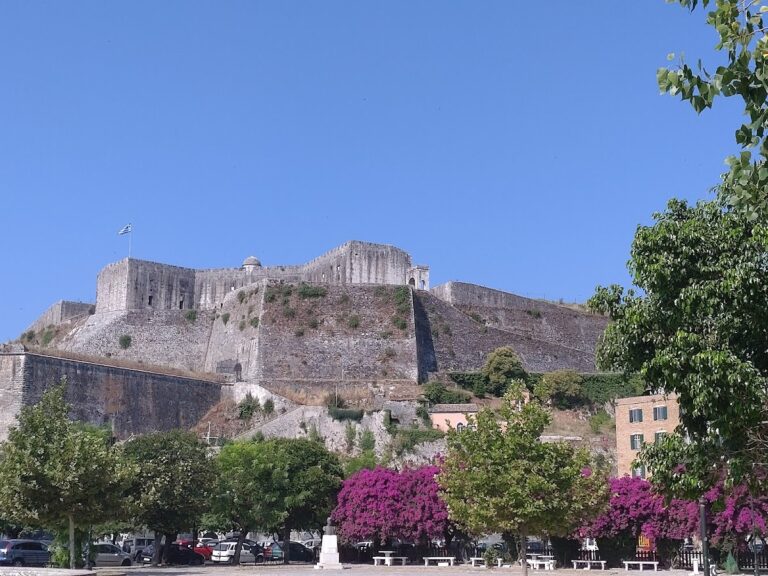
Corfu Old Fortress is a Byzantine and Venetian citadel in Corfu, Greece, occupying the rocky peninsula at the eastern end of the city. Its first fortifications date from around the sixth century, when inhabitants sought refuge there after the Ostrogoths destroyed the ancient city of Corcyra. The fortress later became a major Venetian military stronghold and resisted Ottoman attacks in 1537, 1571, and 1716.
Byzantine origins and medieval development
The peninsula contained Corfu’s medieval town during the Byzantine period, the era of the medieval Roman state centered on Constantinople. The earliest defensive works were established around the sixth century, while the western, higher peak was fortified by the Byzantines around the twelfth century. The medieval settlement remained within the peninsula until the thirteenth century.
There are no recorded political or military developments at the site from the seventh to the tenth centuries. In the early eleventh century, however, the Byzantine princess and historian Anna Komnene described Corfu as a very strongly fortified city in her Alexiad. The citadel subsequently developed through three principal phases over approximately fifteen centuries: Byzantine fortification of the western peak, early Venetian transformation of the peninsula and defense of the eastern peak, and later Venetian modernization for cannon warfare.
Venetian transformation
From the early fifteenth century, Venice, the maritime republic that controlled Corfu for much of the early-modern period, began replacing most Byzantine defenses with its own system. During the sixteenth century, Corfu acquired approximately its present urban form, while the Old Fortress became primarily a military site. The Venetians created the Contrafossa, a sea-filled moat linking the Gulf of Kerkyra with Garitsa Bay, separating the citadel from the city and turning it into an artificial island. They added further ditches and smoothed sections of the surrounding rock to make attack more difficult.
The first Ottoman siege came in 1537. Sultan Suleiman the Magnificent sent approximately 25,000 men under the Ottoman admiral Hayreddin Barbarossa. The army landed at Govino Bay, destroyed Potamos while advancing toward Corfu, and took control of the island except for the Old Fortress and Angelokastro. Approximately 20,000 people who could not find shelter in either fortress were killed or enslaved. Venetian authorities also expelled women, children, and elderly people from the fortress, a decision that angered the Corfiot population.
After the siege, the Venetian governor ordered new defensive zones, including bastions and towers. The military engineers Savorgnan and Martinengo designed major fortifications between 1545 and 1555. These works formed part of the later Venetian defensive system, which included high walls, additional ditches, and projecting bastions, a type of fortification that allowed defenders to fire along adjoining walls.
Ottoman forces attacked again in August 1571, after operations on the mainland and the Paxoi Islands. They destroyed Potamos and devastated undefended parts of Corfu, burning houses, churches, and public buildings, while the city fortress remained in Venetian hands. The fortress’s twin peaks also shaped Corfu’s Western name, traditionally understood as “city of the peaks,” from a Greek term for a summit or peak.
The siege of 1716 and reconstruction
The final major Ottoman assault occurred during the Ottoman–Venetian War, one of the conflicts between the Ottoman Empire and Venice over territory and maritime routes in the eastern Mediterranean. In 1716, Venice placed Count Johann Matthias von der Schulenburg in charge of Corfu’s defense, and he strengthened the Old Fortress. On 6 July, Ottoman forces under Kara Mustafa Pasha began their siege after positioning artillery on the nearby hills of Avrami and Sarocco.
After seven weeks of fierce fighting, the Ottoman army abandoned the assault and left Corfu on 19 August 1716. The Venetians and Schulenburg then planned additional defenses on Avrami and Sarocco to prevent artillery attacks on the fortress. They also built an arsenal at Gouvia for maintaining and repairing the Venetian fleet. Schulenburg rebuilt the Old Fortress and completed two new forts on the hills by 1721. Those forts were later demolished after Corfu was united with Greece under the Treaty of London in 1864.
A major disaster struck in 1718, when lightning hit the powder magazine in the eastern fortress. The resulting chain reaction destroyed three secondary ammunition facilities and most buildings inside the fortress, including the palace of the Captain General, the senior military commander under Venetian administration. Many buildings in the city were also damaged, and hundreds of people died, among them the Venetian commander Andrea Pisani, brother of Doge Alvise Giovanni Mocenigo.
Changing sovereignty and twentieth-century history
The governors of the Old and New Fortresses were selected by the Venetian Senate for two-year terms. Each governor swore not to communicate with the other during the term, a security measure intended to prevent a joint conspiracy against the Venetian Republic. Control of the fortress passed from Venice to France in 1797, to the Septinsular Republic in 1800, back to France in 1807, to the United Kingdom in 1814, and finally to Greece in 1864. The Septinsular Republic was a short-lived Ionian state established in 1800 under Ottoman and Russian protection after French rule.
After the 1923 Asia Minor catastrophe and the Greek–Turkish population exchange, refugees from Asia Minor and Eastern Thrace were temporarily housed in the fortress from January 1923. On 31 August 1923, during the Corfu Incident, a military and diplomatic crisis between Italy and Greece, the Italian air force bombarded the Old and New Fortresses. Fifteen civilians died, including thirteen refugees from Asia Minor.
In June 1944, during the Nazi occupation, the fortress was used to imprison Corfu’s Jewish population before deportation. After being ordered on 8 June to report the next morning, most of Corfu’s Jews assembled at the Old Fortress on 9 June. They were forced to surrender jewelry and property keys and were held in harsh conditions. They were transferred through Lefkada, Patras, Piraeus, and Haidari before 1,800 were deported by rail to the Birkenau extermination camp. Only 120 eventually returned to Corfu.
Today the fortress functions as an open monument and cultural complex. It houses the Historical Archive of Corfu, the Public Library of Corfu, the Byzantine Collection of Corfu, services of the Ministry of Culture, and the Hellenic Music Research Lab of the Ionian University. Its buildings and open areas also accommodate exhibitions, research, and cultural events.
Remains
The fortress occupies a rocky peninsula between the Gulf of Kerkyra to the north and Garitsa Bay to the south. Its two elevated peaks, defensive walls, bastions, towers, ditches, and surrounding water obstacles form a citadel whose visible fabric largely reflects Venetian rebuilding and later alteration. The eastern peak lies nearer the sea, while the higher western peak stands closer to the city.
Peaks, moat, and approach
The twin peaks
The eastern peak, known as the Old Castle or Castle by the Sea in Venetian terminology, served for a period as a powder magazine, a secure building for gunpowder and other ammunition. The western peak, called the New Castle or Castle near the Land, was fortified by the Byzantines around the twelfth century and later incorporated into the Venetian defense system. Towers historically strengthened both peaks.
The Contrafossa
The Contrafossa is a sea channel and moat linking the Gulf of Kerkyra with Garitsa Bay. It remains identifiable by its Italian name and forms the principal defensive separation between the fortress and the city. A second ditch east of the Contrafossa created another obstacle. Together with the surrounding water and the smoothed rock surfaces, these features supported the fortress’s defensive design.
The entrance and internal passage
Access to the citadel originally crossed a drawbridge, which was replaced in modern times by a permanent bridge. The present entrance is reached through the Spianada, the large open square created when buildings in front of the Old Castle were demolished during the later Venetian period. An arched entrance leads into a gallery toward the center of the citadel. A passage on the left reaches the northern rampart, while a narrow lane at the end of the tunnel leads toward the former military camp.
Religious and military buildings
Church of Saint George
On the southern part of the hill stands the Doric Church of Saint George, built in 1840 by the British for the British community. After the British departure, it became a Catholic church. Icons transferred from the Church of Saint Spyridon in Corfu’s old town later decorated the building.
Prison and military chapel
A Venetian prison dating from 1786 remains within the fortress and was later enlarged by the British. The citadel also contains a military chapel, linking the surviving religious and administrative buildings with its long military use.
British barracks and hospital
Two British barracks built in 1850 form part of the later military fabric. One of these buildings is now used by the Public Library of Corfu. A former military hospital within the fortress functions as a music school, while a British nineteenth-century cookhouse survives with its ovens.
Lighthouse and cultural spaces
A lighthouse stands on the western summit. Other buildings and open areas accommodate archives, collections, exhibitions, research, and cultural events, preserving the fortress as an institutional complex as well as a defensive monument.