Palace of St. Michael and St. George: British High Commissioner’s Residence in Corfu


Site at a Glance
- Rating
- 4.7
- Popularity
- Medium
- Country
- Greece
- Primary era
- Modern
- External website
- Open
- Eras represented
- Modern
- Civilizations
- British
- Site type
- Civic
- Remains
- Palace
On this page8 sections
History
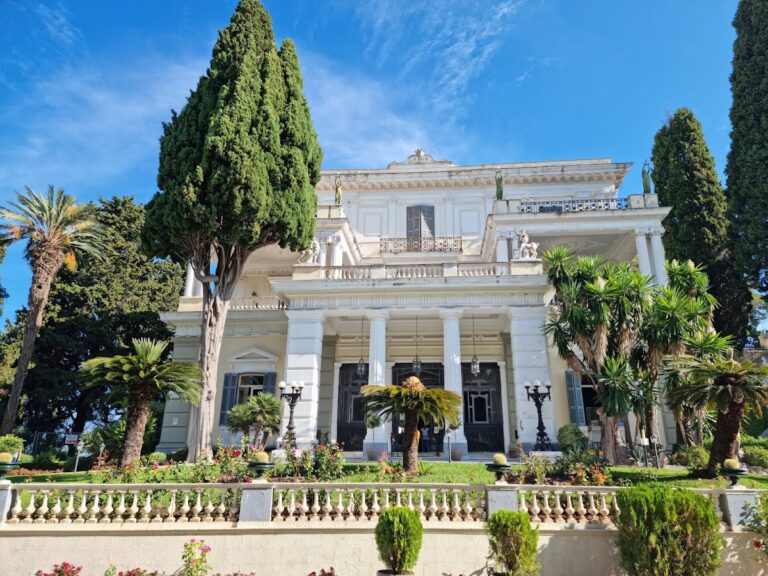
The Palace of St. Michael and St. George is a three-storey neoclassical building in Corfu, Greece, constructed in the Greek Revival style between 1819 and 1824 under British administration of the Ionian Islands. Commissioned by Sir Thomas Maitland, the British Lord High Commissioner, it served as the High Commissioner’s residence and housed the Ionian Senate, the islands’ representative legislative institution, as well as the Order of St Michael and St George, a British order of chivalry associated with distinguished service in the Mediterranean and overseas territories.
British administration
The foundation stone was laid on St. George’s Day in 1819, and the palace was completed in 1824. It occupies a position between Corfu’s old town and the Venetian-era Old Fortress. The building was designed by George Whitmore, a British Royal Engineers colonel who later became a major-general. The Royal Engineers were responsible for military engineering, construction, and related technical work.
Royal residence and wartime damage
After Corfu joined the Kingdom of Greece in 1864, the palace became a royal residence. Until 1967, the Greek king used it occasionally for state business while living at the nearby Mon Repos villa, a Corfu residence associated with the Greek royal family. The palace survived the Italian bombardment of Corfu during the Corfu Incident of 1923, a diplomatic and military crisis involving Italy and Greece. It suffered greater damage when it provided temporary accommodation for refugees from Epirus during the Greek Civil War, the armed conflict between government forces and communist-led insurgents from 1946 to 1949.
The interior was restored in 1954 with assistance from a private trust organized by Sir Charles Peake, then the British ambassador to Greece. Further renovation took place for the 1994 European Union Summit. The palace is protected as a heritage building under Greek law.
The Museum of Asian Art
The Museum of Asian Art of Corfu was established in 1927 as the Museum of Chinese-Japanese Art and is now housed in the palace. Its collection began with 10,500 objects donated by the Greek collector Gregorios Manos, who became the museum’s first curator. In 1973, Nikolaos Hadjivasiliou added 400 works from India, Pakistan, Tibet, Siam, and Southeast Asia, broadening the museum’s focus and leading to its present name. In 1980, Charilaos Hiotakis donated 360 porcelain, bronze, and ivory objects, mainly dating from the seventeenth to nineteenth centuries. The collection now contains approximately 15,000 works representing Chinese, Korean, Indian, and Japanese cultures, including paintings, sculptures, and porcelain.
Remains
Neoclassical exterior
The palace is built primarily from limestone imported from Malta, with Maltese workers involved in its construction. Neoclassicism and the Greek Revival draw on the forms of ancient Greece and Rome through monumental symmetry, columns, and formal arches. The main facade has columns and two triumphal arches, one dedicated to St. Michael and the other to St. George. The two gateways beside the palace are the Gate of St. Michael and the Gate of St. George. Smaller buildings arranged symmetrically behind the arches stand on either side of the main structure. Sculptural decoration was created by the Maltese sculptors Vincenzo and Ferdinando Dimech and the Corfiot sculptor Pavlos Prosalentis. Sculptures along the main roof cornice represent the seven Ionian Islands, while the central figure includes a horn regarded as an English symbol.
State rooms and interior decoration
The state rooms are organized around a monumental staircase and a central rotunda, a circular space arranged around a central axis. The rotunda leads to the Throne Room and the state dining room. The former Ionian Parliament chamber occupies the first floor, while the upper level contains the Commissioner’s Throne Room, dining rooms, and ballrooms. Sculptures and frescoes enrich the interior, where bronze and marble predominate. A central glass dome brings substantial daylight into the building.
Garden of the People
Gardens extend beside and behind the palace, overlooking the sea and the bay through old Venetian fortifications and turrets. They contain old Venetian stone aquariums, exotic trees, and flowers. A wrought-iron spiral staircase descends toward the sea. The staircase was formerly used by the Greek royal family as a shortcut to the sea baths at the foot of the surrounding fortifications and is closed to garden visitors. The former Royal Gardens are now called the Garden of the People.
Nearby sites