Achilleion: A Neoclassical Palace on Corfu


Site at a Glance
- Rating
- 4.2
- Popularity
- Very High
- Country
- Greece
- Primary era
- Modern
- External website
- Open
- Eras represented
- Modern
- Civilizations
- Greek
- Site type
- Domestic
- Remains
- Palace
On this page12 sections
History
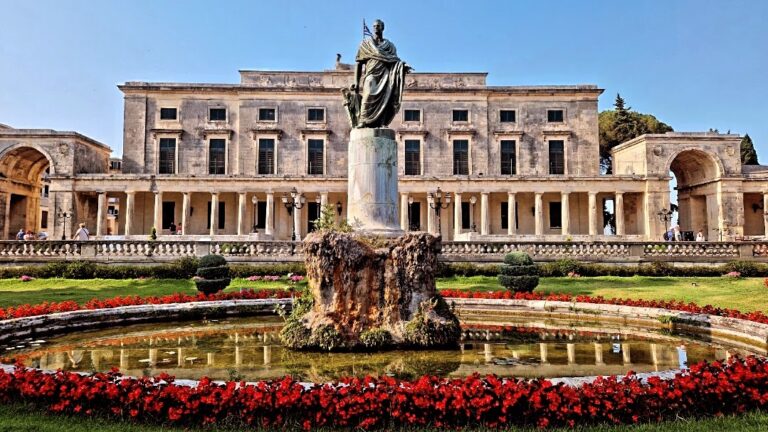
Achilleion is a Neoclassical and Pompeian-style palace at Gastouri on Corfu, Greece, built for Empress Elisabeth of Austria-Hungary and completed in 1891. Pompeian style draws on the decorative forms of ancient Roman houses at Pompeii. Elisabeth dedicated the palace to Achilles, the principal Greek hero of Homer’s Iliad, whose tragic story and connection with ancient Greece deeply interested her.
Elisabeth’s Corfiote retreat
Elisabeth first visited Corfu in 1861 and returned repeatedly. Her interest in Achilles grew after she visited the ruins of Troy and the hero’s tomb in 1885. She later developed plans for a private retreat on the island. In 1889, she acquired Villa Vraila from the Corfiote philosopher and diplomat Petros Vrailas-Armenis and decided to replace it with a palace devoted to Achilles.
Construction began in 1889 and ended in October 1891. The Italian architect Raffaele Caritto created the principal design, while the Austrian consul Alexander von Warsberg helped develop the project and initially supervised the works. After Warsberg’s death, the naval officer Baron von Bukovicz took over that responsibility. Elisabeth financed the building and directed its decoration.
The palace was intended as a private refuge after the death of Elisabeth’s only son, Crown Prince Rudolf, at Mayerling in 1889. Rudolf’s death profoundly affected her. She used Achilleion during only part of each year, but continued to visit almost every spring until her assassination in Geneva in 1898. She eventually considered selling the property, and much of the interior was later moved to Vienna.
Wilhelm II and the imperial residence
After Elisabeth’s death, the palace passed to a daughter who did not use it regularly, and it remained largely abandoned for several years. Some collections, including a statue of Crown Prince Rudolf, were sent to Austria-Hungary, while other furnishings stayed at Achilleion.
Kaiser Wilhelm II of Germany first visited Achilleion in 1890, before construction was complete. After two years of negotiations, he purchased the property in 1907. Wilhelm, German emperor and king of Prussia from 1888 to 1918, used it as a Mediterranean and summer residence. He generally stayed for several weeks each spring between 1908 and 1914, and his presence made the palace a centre of European diplomatic activity.
Wilhelm restored the building, added accommodation for his retinue, and reorganized the garden statuary. His interpretation of Achilles emphasized the hero’s military strength rather than Elisabeth’s interest in Achilles as a tragic and idealized figure. He replaced Ernst Herter’s statue of the wounded Achilles with Johannes Götz’s colossal Victorious Achilles. He also removed Heinrich Heine’s statue and replaced it with a statue of the deceased Elisabeth.
During his stays on Corfu, Wilhelm joined the archaeologist Wilhelm Dörpfeld in excavations around Garitsa. Objects found during this work were later exhibited at Corfu’s archaeological museum in 1996.
War, state ownership, and changing uses
During the First World War, French and Serbian forces used Achilleion as a military hospital. The occupation damaged the property and caused some collections to be removed or lost. French forces also erased Wilhelm’s German dedication from the base of Victorious Achilles.
Following the Treaty of Versailles and the war reparations imposed in 1919, the Greek state nationalized Achilleion. From about 1921 to 1924, the palace housed an orphanage for Armenian children from Constantinople. During the interwar period it also accommodated government services, and some valuables were auctioned. In 1937, part of the building was adapted for collections belonging to the Corfu museum.
During the Second World War, Italian and German Axis forces used the palace successively as a headquarters and a hospital. The Axis powers were the coalition led principally by Germany, Italy, and Japan. These wartime uses caused further deterioration. After the war, the Greek state used Achilleion for schools and a kindergarten before returning it to the management of the Greek tourism authorities.
Museum and diplomatic setting
In 1962, the state leased Achilleion for twenty years to a private company. The upper floor became a casino, while the ground floor became a museum focused chiefly on Elisabeth and Wilhelm. The company also attempted to recover objects that had been sold or lost from the palace. The lease ended in 1983, and the casino was progressively moved elsewhere from 1988 before its definitive relocation in 1992.
Since the late twentieth century, Achilleion has operated principally as a museum under the management of the Greek tourism authorities and their development company. The palace is protected as a building under Greek law. Its diplomatic role has also been revived on a limited basis. The Treaty of Corfu, associated with the European Union’s fourth enlargement, was signed there in 1994, and European Union agriculture ministers held an informal meeting at the palace in 2003. In 1979, an international conference on Wilhelm II’s character and political role took place in his former bedchamber.
Remains
Achilleion occupies about 200,000 square metres on a hill above Corfu’s eastern coast, approximately 145 metres above sea level. The grounds overlook the Ionian Sea, Pontikonissi, Corfu city, and the southern part of the island. The white-marble palace has three storeys, with 128 rooms distributed across a ground floor and two upper floors. Its design combines Neoclassical forms with Pompeian decoration and was intended to evoke an ancient palace of mythical Phaeacia, the island kingdom in Homer’s Odyssey where Odysseus receives aid before returning to Ithaca.
Palace entrance and interior
The monumental entrance gate has an iron grille bearing the name Achilleion in gilded lettering. Winged horses flank the name, while meanders and other geometric forms enrich the grille. A path leads from the gate to the principal building, where a life-size statue of Empress Elisabeth stands near the entrance.
Doric columns support the terrace of the principal facade, which is framed by marble centaurs. A higher terrace carries four bronze Muses holding torches. On the left side of the facade, a winged Hermes holds a document. The entrance vestibule contains Vincenzo Galloppi’s ceiling fresco The Four Seasons and the Hours, populated by putti and allegorical figures. It also holds a copy of Franz Xaver Winterhalter’s portrait of Elisabeth at the age of twenty-one and a grey-marble fireplace decorated with small statues.
Opposite the entrance, a monumental staircase of marble and bronze rises toward Franz Matsch’s large fresco The Triumph of Achilles. Statues of Zeus and Hera stand on either side. The fresco shows Achilles carrying the body of the defeated Hector in his chariot, presenting the mythological subject that governs much of the palace’s imagery.
Rooms and collections
The chapel associated with Elisabeth’s Catholic practice contains a representation of Christ’s judgment by Pontius Pilate, a painting of the Virgin and Child by Franz Matsch, and other religious statues and paintings. Its decoration also includes painted wall treatment and an icon of the Virgin Mary.
Two salons preserve memorabilia associated with Elisabeth and Wilhelm. Elisabeth’s room contains small personal objects, while Wilhelm’s room includes a model of the yacht Hohenzollern and paintings connected with his interest in the sea and navigation. Elisabeth’s blue dining room and smoking room has stucco putti and now contains museum offices. Two adjoining rooms hold furniture associated with the imperial occupants, including Elisabeth’s wheeled iron bed and desk. One room also contains Ludwig Thiersch’s painting of Odysseus meeting the Phaeacian princess Nausicaa.
Peristyles and garden terraces
Staircase of the Gods and Peristyle of the Muses
The facade-side Staircase of the Gods descends toward the terraced gardens and is decorated with statues of Apollo, Aphrodite, Artemis, Hermes, and other deities. At the rear of the palace, the Peristyle of the Muses adjoins the building at first-floor level. A peristyle is a colonnade bordering an open court or garden. Its Ionic columns have brightly painted lower sections, and the space contains statues of the nine Muses, daughters of Zeus and Mnemosyne, together with the ancient Three Graces.
The peristyle leads to the palm-planted Garden of the Muses. Along its wall stands the Gallery of Philosophers, a group of thirteen busts representing ancient philosophers, poets, and orators. From the peristyle, the upper part of the main staircase and Matsch’s Triumph of Achilles are visible.
Garden features and statues
The central fountain in the Garden of the Muses contains a statue of a large fish carrying the bound body of a man. Beside it stands the figure known as the Musician with Cymbals, described as a copy of an ancient work. Across the terrace, the semicircular marble Bench of Tears faces the sea. It is associated with Elisabeth’s practice of sitting there to mourn Rudolf or to await the ship carrying mail to Corfu.
A pair of fighting figures called the Assailants marks the end of the Garden of the Muses. A small staircase between them connects the first terrace with a second, wooded terrace. The gardens contain myrtles, lemon trees, olive trees, oleanders, palms, cypresses, and bougainvillea, and extend down toward the sea.
Achilles statues and the former temple
Ernst Herter created Wounded Achilles, also called Dying Achilles, in Berlin in 1884. Elisabeth placed it at the centre of her garden, where it became the principal emblem of her conception of Achilleion. Wilhelm later moved the statue and replaced it with Johannes Götz’s Victorious Achilles, although Herter’s work remains central to the museum collections.
More than 11 metres high, Götz’s colossal bronze dominates the lowest terrace. Achilles wears hoplite armour, the equipment of a heavily armed Greek infantryman, and carries a shield with an intricate relief of a Gorgon’s head, a mythological protective image. The statue faces north toward Corfu city. Wilhelm commissioned it as a guardian of the gardens and placed on its base a dedication to Achilles and himself. The inscription was later removed.
Under Elisabeth, a small round temple in the gardens housed Louis Hasselriis’s statue of Heinrich Heine. Wilhelm sold the statue in 1908 and replaced it with Ernst Herter’s life-size statue of Elisabeth. The temple was later demolished, and Elisabeth’s statue was moved to the palace entrance. Other surviving features include a statue of Hermes near the path around the facade, the Future Sailor, showing a boy seated on the stern of a wrecked ship while studying an atlas, and a bathtub associated with Elisabeth.
The palace and grounds retain furnishings, personal objects, paintings, religious works, and the model of the Hohenzollern. A functioning lift serves the building. Around the palace, a tiled path contains stones bearing dates connected with Achilleion’s history, including the date of its construction.