Ancient Athens: Greek City-State and Archaeological Centre



Site at a Glance
- Rating
- 4.8
- Popularity
- Very High
- Country
- Greece
- Primary era
- Classical
- External website
- Open
- Eras represented
- Bronze Age, Iron Age, Classical
- Civilizations
- Ancient Greek, Mycenaean, Roman, Seleucid
- Site type
- City
On this page23 sections
History
Ancient Athens was a Greek city-state in Greece, centred on the Acropolis and extending across the Attic peninsula. Human occupation of the Acropolis area began in the Neolithic period, approximately 4000/3500–3000 BC, while the city’s main monumental development unfolded from the Archaic period through the Classical age. Athens eventually included an urban centre, surrounding hills and plain, suburbs, and the ports of Piraeus and Phaleron.
Prehistoric and Archaic Athens
Early and Middle Bronze Age settlement existed near the Erechtheion, and during the Mycenaean period the Acropolis became a fortified centre with a palace. In the thirteenth century BC, a fortification conventionally known as the Cyclopean or Pelasgian Wall enclosed the hill, which also served as the seat of a local ruler. Settlement continued into the Archaic period, after which the Acropolis functioned primarily as a sanctuary.
Athenian tradition attributed the unification of the separate communities of Attica to the mythical king Theseus. This process, known as synoikism, or the political union of communities into one city-state, was probably gradual and extended over several centuries from the early first millennium BC. The city was also associated with the mythical founder Cecrops and was sometimes called Cecropia.
By the eighth century BC, the Acropolis had acquired a sacred character through the cult of Athena Polias, Athena in her role as protectress of the city. Under the tyrant Peisistratus in the mid-sixth century BC, the sanctuary gained prominence, the Panathenaia became Athens’ principal festival of Athena, and the first monumental temples and buildings were established. The Great Panathenaia, held every four years, included a major procession and athletic competitions. Other important observances included the Dionysia, Lenaia, Eleusinian Mysteries, Thesmophoria, and Synoikia.
From Aristocracy to Democracy
Athens developed from monarchy into aristocratic government and then toward oligarchy and democracy. Draco’s laws were recorded around 624 BC and were noted for their severity. Solon’s reforms of 594 BC cancelled certain agricultural debts, released people enslaved for debt, divided citizens into four property classes, and created the Council of Four Hundred. His measures also strengthened participation through the citizen assembly and courts, although political rights still depended partly on wealth.
Peisistratus established a tyranny around 561–560 BC, with interruptions caused by exile. In Archaic Greece, a tyrant was a ruler who seized power outside the normal constitutional process. Peisistratus formally retained Solon’s laws while promoting trade, agriculture, architecture, religious buildings, and public works. After his death in 527 BC, his sons Hippias and Hipparchus ruled. Hipparchus was assassinated in 514 BC, and Hippias was expelled with Spartan assistance in 510 BC.
After the tyranny, Cleisthenes reorganized the citizen body by replacing the four traditional tribes with ten territorially organized tribes, divided into local communities called demes. He established the Council of Five Hundred and a board of ten elected generals. These reforms created the institutional basis of Athenian democracy. The assembly became the central body for political decisions, while the Areopagus, an ancient council named after the Hill of Ares, retained authority especially in homicide and religious cases.
Persian Wars and Fifth-Century Prosperity
Athens supported the Ionian revolt against Persia in 499 BC. Under Miltiades, it defeated the Persian invasion at Marathon in 490 BC, and under Themistocles it played the decisive naval role in the Greek victory at Salamis in 480 BC. During that invasion, the city was evacuated, occupied, looted, and burned. The Persians were finally defeated at Plataea in 479 BC.
After the Persian Wars, Athens rebuilt its urban and religious monuments and became the leading power of the Aegean. The Delian League, an alliance of Greek states formed against Persia, was founded in 478 or 477 BC. Its treasury and meeting place were transferred from Delos to Athens in 454 BC, and the alliance gradually became an Athenian imperial system financed partly by tribute from its members.
Themistocles directed the rapid reconstruction of Athens’ city walls and strengthened Piraeus as the centre of naval power. Cimon continued work on the Acropolis, Agora, and fortifications. Athens, Piraeus, and Phaleron were connected by the Long Walls, creating a defensive system that allowed the city to remain linked with its ports.
Under Pericles, an Athenian general, politician, and speaker, the city entered its principal period of political, economic, artistic, and architectural prosperity, conventionally called the Golden Age or the Age of Pericles. A major building programme on the Acropolis began around 448 BC and continued through the second half of the fifth century BC. Tribute from the Delian League and income from the Laurion silver mines contributed substantially to this prosperity.
War, Defeat, and Macedonian Rule
The Peloponnesian War between Athens and the Spartan-led alliance began in 431 BC and interrupted the building programme. Athens suffered a severe plague, which killed Pericles in 429 BC, and eventually lost the war in 404 BC. Sparta destroyed the city walls, and Athens lost its maritime supremacy.
Democracy was briefly replaced by the oligarchic regime of the Four Hundred in 411 BC and, after the war, by the Spartan-backed Thirty Tyrants in 404–403 BC. Thrasybulus helped overthrow the regime and restore democracy in 403 BC, after which an amnesty was proclaimed.
During the Corinthian War, Conon restored Athens’ fortifications in 393 BC. Athens founded the Second Athenian League in 378 BC, but its influence declined after the Macedonian victory over Athens and its allies at Chaeronea in 338 BC. Athens then became subject to Macedonian hegemony and joined the League of Corinth. The Lamian War ended in an Athenian defeat in 322 BC. Macedon imposed a garrison, curtailed Athenian independence, and destroyed the city’s naval power, although Athens remained prosperous and culturally influential during the Hellenistic period.
Hellenistic rulers and benefactors continued to build in the city. Demetrius Poliorcetes captured Athens during the wars of the Successors. Ptolemy III Euergetes and Attalus II supported buildings including the Ptolemaic Gymnasium and the Stoa of Attalus, while Antiochus IV unsuccessfully attempted to complete the Temple of Olympian Zeus in 174 BC.
Roman Athens and Late Antiquity
Athens became part of the Roman world in the second century BC and was incorporated into the Roman Empire in 145 BC. After supporting Mithridates VI against Rome, the city was besieged and captured by Sulla in 86 BC. It suffered extensive destruction, its walls, including the Long Walls, were demolished, and its commercial importance declined.
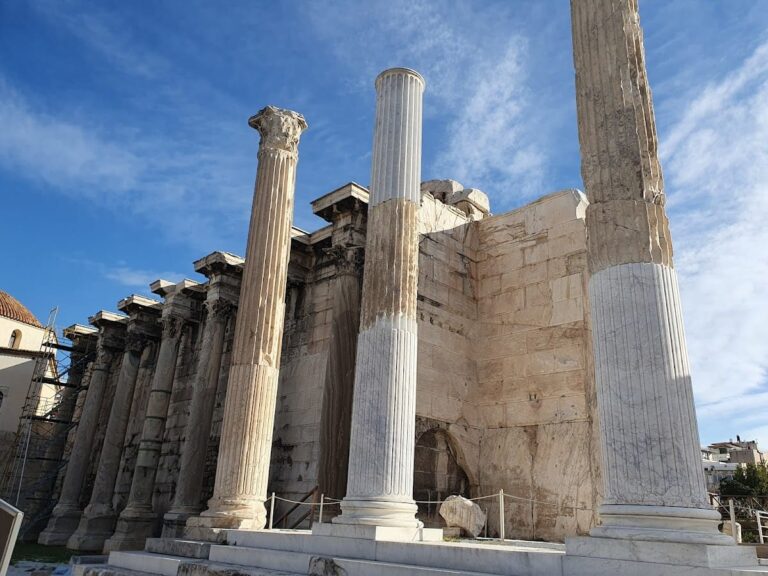
During the Roman imperial period, renewed patronage reflected Athens’ intellectual and cultural reputation. Julius Caesar and Augustus supported the Roman Agora. Agrippa built an odeion, a building for musical performances and competitions. Hadrian sponsored the completion of the Temple of Olympian Zeus and constructed a library, aqueduct, gymnasium, and new district. Herodes Atticus built the odeion that bears his name.
The Heruli destroyed much of Athens in AD 267. The city was subsequently reduced in size and enclosed by a smaller circuit of walls. Its philosophical schools continued until Emperor Justinian closed them in 529, after which Athens lost its ancient intellectual role. From the sixth century AD, the spread of Christianity led to the conversion of ancient sanctuaries. The Parthenon became a church dedicated to the Virgin Mary and later the metropolitan church of Athens, the Erechtheion became a church of the Saviour or the Virgin, the Temple of Athena Nike became a chapel, and the Propylaea became an episcopal residence.
Medieval, Ottoman, and Modern Transformation
During Frankish rule from 1204 to 1456, the Propylaea were converted into a palace for the Frankish rulers. Under Ottoman rule from 1456 to 1833, the Acropolis again served as a fortress and housed a Turkish garrison.
On 26 September 1687, during the Second Venetian–Ottoman War, a Venetian bomb struck the Parthenon, which the Ottomans were using as a powder magazine, and caused its explosion. In 1801–1802, Lord Elgin, a British ambassador and collector, removed substantial parts of the Parthenon’s sculptural decoration and sculptures from the Temple of Athena Nike and the Erechtheion.
The Acropolis came under Greek control in 1822, when Odysseas Androutsos, a military leader of the Greek War of Independence, became its first commander. After Greek independence, the monuments were placed under the care of the Greek state. Excavations began in 1835–1837, systematic excavation was carried out by Panagiotis Kavvadias in 1885–1890, and extensive restoration began under Nikolaos Balanos in the early twentieth century.
The Acropolis Preservation Committee was established in 1975 to organize large-scale study, consolidation, conservation, and restoration. Work has continued in cooperation with the Acropolis Restoration Service and the Ephorate of Antiquities of the City of Athens. Archaeological investigation has progressively cleared parts of the ancient centre, removed medieval structures from the Acropolis, and combined excavation with ancient descriptions, especially that of Pausanias, to identify former buildings. Much of the ancient lower city remains beneath modern Athens.
Remains
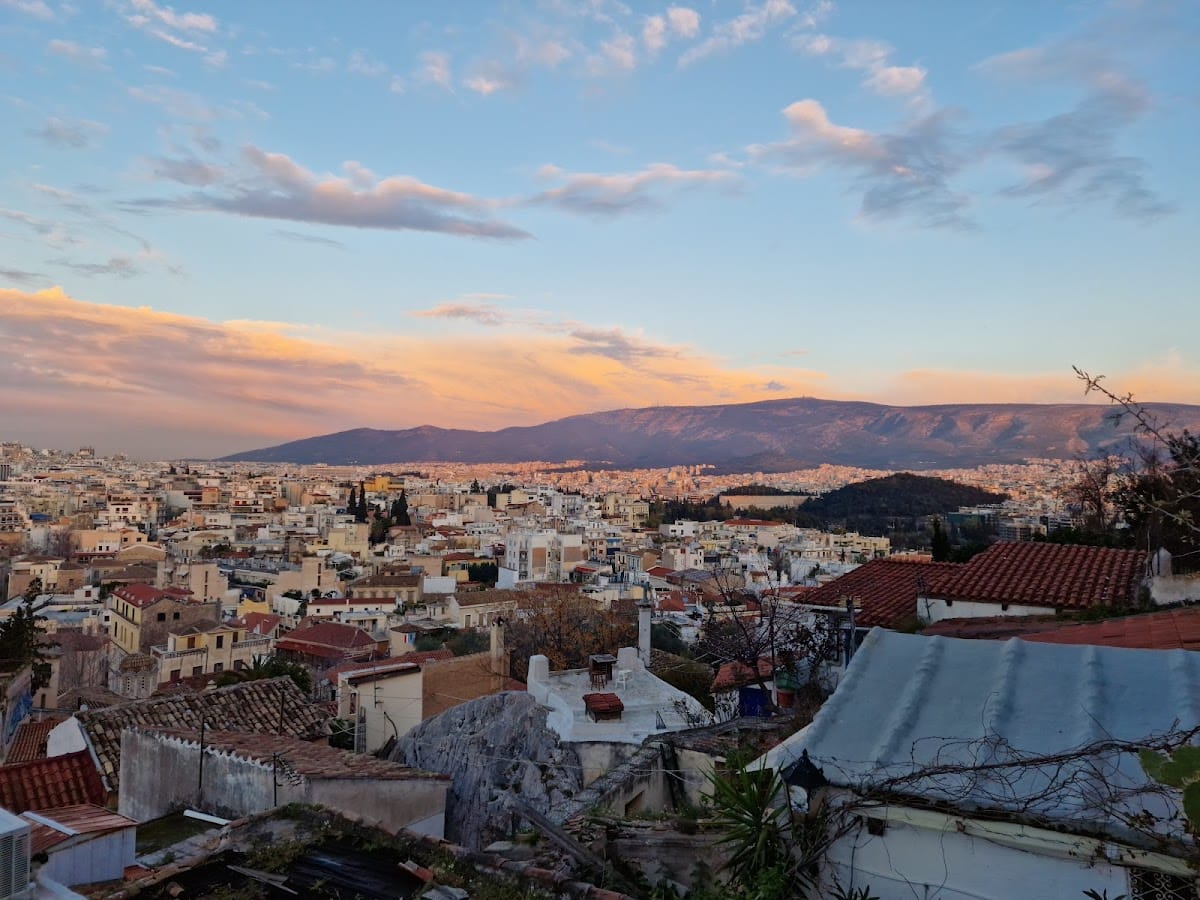
Ancient Athens occupied the Attic plain approximately five kilometres from the Saronic Gulf. The Aigaleos, Parnes, Pentelikon, and Hymettus mountains bordered the plain, which was crossed by the Ilissos, Eridanos, and Cephissus rivers. Limestone and marble from Pentelikon and Hymettus were important building materials. The walled city was approximately 1.5 kilometres in diameter, while the fortified area of Athens, Piraeus, and the connecting Long Walls covered about 600 hectares. The built-up area within the fortifications has been estimated at approximately 250 hectares, with suburbs extending beyond them.
The Acropolis and Its Sanctuaries
Fortifications and Early Sanctuaries
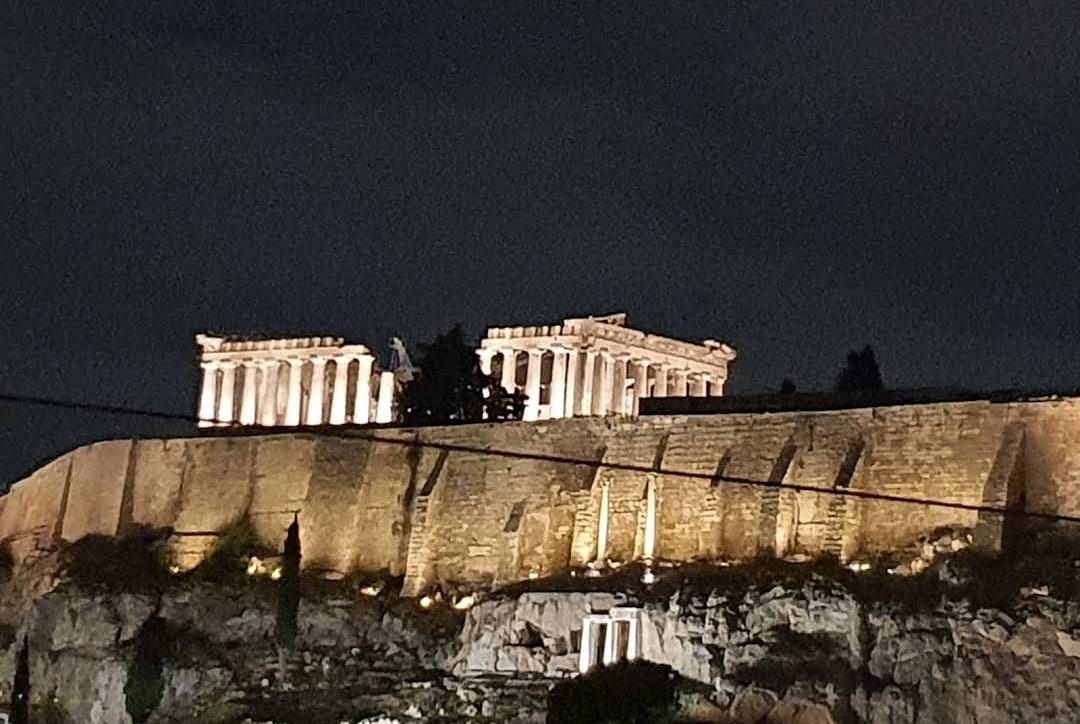
The Acropolis is a steep, flat-topped natural rock approximately 50 metres high, 350 metres long from east to west, and 145–150 metres wide from north to south. Its sides are naturally precipitous except on the west, where access was possible. The hill successively served as a fortified settlement, political centre, and religious centre. Sections of the Mycenaean or Cyclopean Wall, also called the Pelasgian Wall, survive within later structures and remain visible in parts of the northern fortification. The southern section was rebuilt by Cimon and became known as the Cimonian Wall.
The summit contained temples, bronze and marble statues, and other works of art. Early sanctuaries date from the eighth century BC, including an early temple of Athena traditionally dated to approximately 700 BC. The Hekatompedon, or Hundred-Foot Temple, was one of the principal Archaic temples and dates to approximately 570–566 BC. A Temple of Athena Polias was built around 529–520 BC. The sanctuary also included the Temple of Artemis Brauronia and early attempts at monumental entrance construction.
Parthenon and Propylaea
The Parthenon was built for Athena between 447 and 438 BC on or near the site of the unfinished Hekatompedon and the earlier temple destroyed by the Persians. It is a monumental Doric temple, an architectural form defined by its column proportions and decorative conventions. Its sculpture covered both the interior and exterior, and the programme was directed by Phidias. The building served as a treasury and was connected with the Panathenaic festival.
The Propylaea, the monumental western entrance to the Acropolis, was constructed between 437 and 432 BC under Pericles. A marble stairway rose up the western slope to a portico with six Doric columns. The small Temple of Athena Nike stood beside the entrance. The Acropolis was later enclosed by a western fortification with two gates, one of which survives as the Beule Gate.
Erechtheion and Acropolis Monuments
The Erechtheion was built approximately 421–406 BC north of the Parthenon. This Ionic complex contained three distinct sanctuaries, one for Athena Polias, one for Erechtheus, and the Pandroseion for Pandrosos, daughter of Cecrops.
A colossal statue of Athena Promachos, meaning Athena who fights at the front, stood between the Parthenon and the Erechtheion. Its helmet and spear were visible from the sea. Votive offerings included marble korai, or sculpted female figures, statues of horsemen, bronze and terracotta figurines, vessels, and inscribed dedications. A small Temple of Rome and Augustus was built east of the Parthenon in 27 BC. No larger building was added to the Acropolis during the Hellenistic or Roman periods.
Walls, Agora, and Civic Hills
City Walls and Long Walls
After the Persian destruction, architectural members from earlier temples were incorporated into the northern fortification wall. The classical city wall, usually called the Themistoclean Wall, enclosed the enlarged urban area. It was approximately 6.5 kilometres long, about eight metres high, three metres thick, and included fifteen gates. Its surviving remains are especially substantial in the Kerameikos. Important gates included the Dipylon, Sacred Gate, Piraean Gate, Melitian Gate, Knight’s Gate, Itonian Gate, Gate of the Dead, Gate of Diochares, Diomean Gate, and Acharnian Gate.
The Long Walls consisted of two parallel walls approximately seven kilometres long leading to Piraeus, with a narrow passage between them, and a third wall approximately 6.5 kilometres long leading to Phaleron. The complete interconnected fortification system had a stated total length of approximately 35 kilometres. Piraeus contained the commercial harbour of Kantharos and the naval harbours of Zea and Munichia, while Piraeus and Phaleron were linked to Athens by the walls and associated roads.
Classical and Roman Agora
The Agora lay north-west of the Acropolis and north of the Areopagus. It began as an open area approximately 200 by 250 metres, crossed diagonally by the Panathenaic Way. From the sixth to the first centuries BC, it became surrounded by administrative buildings, sanctuaries, stoae, and other public structures. A stoa was a covered colonnade or portico used for shelter, circulation, and social activity.
The western side contained the Bouleuterion, the council building, and the circular Tholos, where the prytaneis, officials responsible for daily administration, met, ate, and made sacrifices. Other buildings included the Temple of Hephaestus, the Temple of Zeus Phratrios and Athena Phratria, the Temple of Apollo Patroos, the Metroon, and the monument of the Eponymous Heroes. The area also included the Altar of the Twelve Gods, the Leokoreion, the Aiakeion, and an early colonnaded court.
Stoae included the Stoa Basileios, the Stoa of Zeus Eleutherios, the South Stoas, the Stoa Poikile, the Middle Stoa, and the Stoa of Attalus. The Stoa Poikile was decorated with paintings, including a representation of the Battle of Marathon. The present building on the site of the Stoa of Attalus is a 1956 reconstruction.
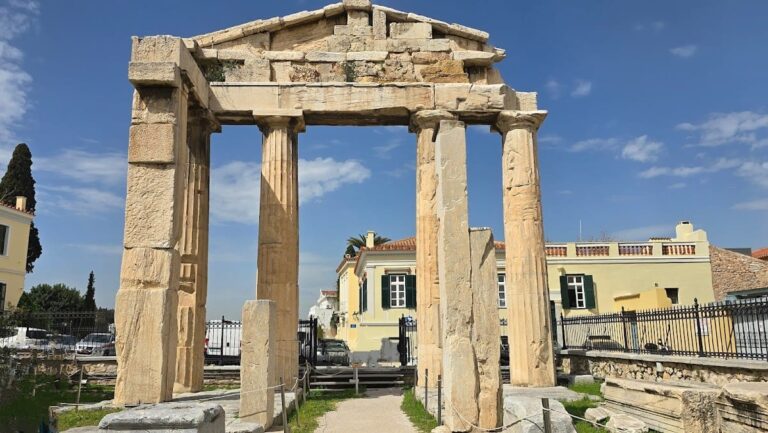
During the Roman period, the Agora acquired the Temple of Ares, smaller temples, Agrippa’s Odeion, a basilica, a nymphaeum, the Library of Pantainos, and the South-East Stoa. The Roman Agora was established east of the older Agora as a new commercial centre. Its principal surviving remains include the Gate of Athena Archegetis and the Tower of the Winds.
Areopagus and Pnyx
The Areopagus is a rocky hill north-west of the Acropolis, between the Acropolis and Agora. The Areopagus Council met there, and a flight of steps was cut into its southern side. Mycenaean and Geometric graves, together with remains from the Classical through Roman periods, were found around the hill.
The Pnyx is a semicircular hill south-west of the Areopagus and contained the principal meeting place of the Athenian assembly. Its meeting area was built in at least three phases, beginning in the early fourth century BC, with later phases dated approximately 404–403 and 345–335 BC. The rock-cut bema, or raised speaker’s platform, survives with remains of two stoae and the Heliotropion associated with the astronomer Meton.
Religious, Dramatic, and Educational Areas
Acropolis South Slope
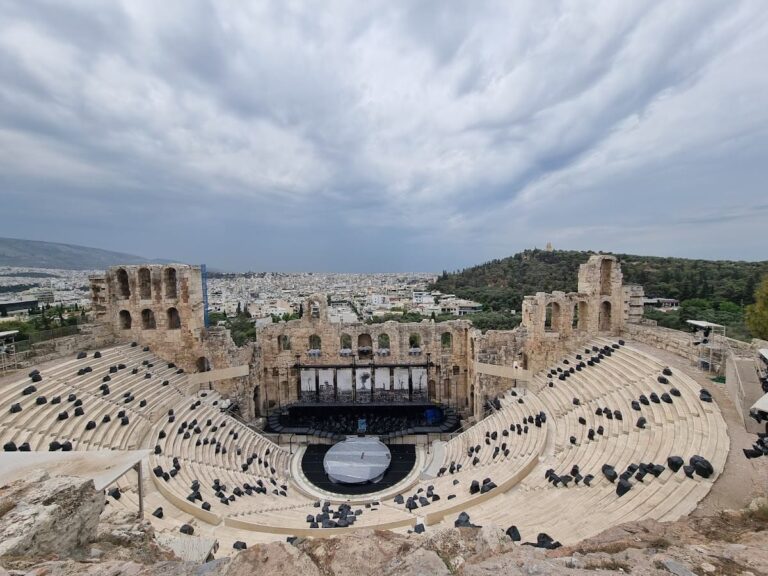
The south slope of the Acropolis contained the sanctuary of Dionysus Eleuthereus, the Theatre of Dionysus, two temples, the Asclepieion, the Eumenes Stoa, and the Odeion of Herodes Atticus. The Theatre of Dionysus developed from earlier wooden structures, began around 500 BC, and reached monumental form during the period of Lycurgus, approximately 338–326 BC. It hosted dramatic competitions during the Dionysia and was also used for assembly meetings during the Hellenistic period.
The Odeion of Pericles stood beside the theatre. The Odeion of Herodes Atticus was built during the Roman period, while the monuments of Nikias and Thrasyllus commemorated dramatic victories.
Earlier Agora and Olympieion
The original Agora, sometimes called the Thesean Agora, lay east or north-east of the Acropolis and was distinct from the Classical Agora. It was associated with the Prytaneion, the Theseion, and the Street of the Tripods, where wealthy citizens who financed dramatic productions erected victory tripods. The surviving Lysicrates Monument is one such commemorative monument.
The Temple of Olympian Zeus, or Olympieion, stood south-east of the Acropolis near the Ilissos and the spring of Callirrhoe. Peisistratus initiated its construction in the sixth century BC, work resumed under Antiochus IV in 174 BC, and Hadrian completed the temple in AD 131–132 after approximately seven centuries of interruption. A large enclosure wall connected the precinct with the city fortifications, and Hadrian’s Arch marked the boundary between the old and new city.
Other sanctuaries in the Olympieion area and its surroundings included those of Apollo Delphinius, Kronos and Rhea, the Panhellenion, Pythion, Palladion, Dionysus in the Marshes, and Artemis Agrotera. Caves and sanctuaries around the Acropolis included the Cave of Apollo Hypoakraios, the Cave of Olympian Zeus, the Cave of Pan, the sanctuary of Aphrodite and Eros, and the sanctuary of Aglaurus.
Stadium and Gymnasia
The Panathenaic Stadium stood south of the Ilissos in the district of Agrai. It was first built in 329 BC under Lycurgus, renovated by Herodes Atticus in AD 143–144, and rebuilt in the nineteenth century. The 1896 Olympic Games were held there.
The Academy lay approximately 1.5 kilometres north-west of the Dipylon. This sacred grove contained a gymnasium, sanctuaries, and altars. The gymnasium was founded under Peisistratus and enclosed by a wall under Hipparchus. Surviving remains include a fourth-century BC peristyle building and later gymnasium structures.
The Lyceum was a gymnasium dedicated to Apollo Lyceus east of the city, where Aristotle taught. Cynosarges, across the Ilissos near the Diomean Gate, was a gymnasium dedicated to Heracles and associated with the teaching of the Cynic philosopher Antisthenes. Later remains include a gymnasium built under Hadrian in AD 134.
Kerameikos, Roads, and Archaeological Collections
Kerameikos and the City Gates
Kerameikos, the Potter’s Quarter, occupied an area partly within and partly outside the Themistoclean Wall. The Inner Kerameikos extended to the Dipylon, while the Outer Kerameikos served as the principal cemetery. Graves range from the Sub-Mycenaean and Geometric periods to later burials of prominent Athenians and war dead. The area also contains large funerary monuments, roadside tombs, and sanctuaries including the Tritopatreion and the sanctuary of Artemis Aristoboule and Kalliste.
The Dipylon and Sacred Gates stood in the Kerameikos. The Panathenaic Way began at the Dipylon, crossed the Agora, and led to the Acropolis, while another road led toward the Academy. The Sacred Way began at the Sacred Gate and led toward Eleusis. The Eridanos River crossed the Kerameikos and was almost completely covered by the Roman period, when it functioned partly as a drain. Sections of the city wall, the two gates, and the Pompeion also survive. The Pompeion passed through several construction phases and served the Panathenaic festival.
Routes, Finds, and Collections
The principal internal routes included the Panathenaic Way, the Piraean Road, the Sacred Way toward Eleusis, and the Street of the Tripods. The Panathenaic procession followed the route from the Dipylon through the Agora to the Acropolis, while Eleusinian processions used the Sacred Way.
Important remains and finds from the Acropolis, Agora, Kerameikos, Piraeus, and other parts of ancient Athens are distributed among the Acropolis Museum, the National Archaeological Museum, the Ancient Agora Museum, the Kerameikos Archaeological Museum, the Piraeus Archaeological Museum, the Epigraphic Museum, the Numismatic Museum, and other collections. Much of the Parthenon’s sculptural decoration is outside Greece, including a substantial group in the British Museum.