Acropolis of Athens: Ancient Sanctuary and Fortified Hilltop
Site at a Glance
- Country
- Greece
- Primary era
- Classical
- Eras represented
- Stone Age, Bronze Age, Classical, Early Modern, Modern
- Civilizations
- Ancient Greek, Greek, Mycenaean, Ottoman, Roman
- Site type
- Religious
- Remains
- Sanctuary
On this page25 sections
History
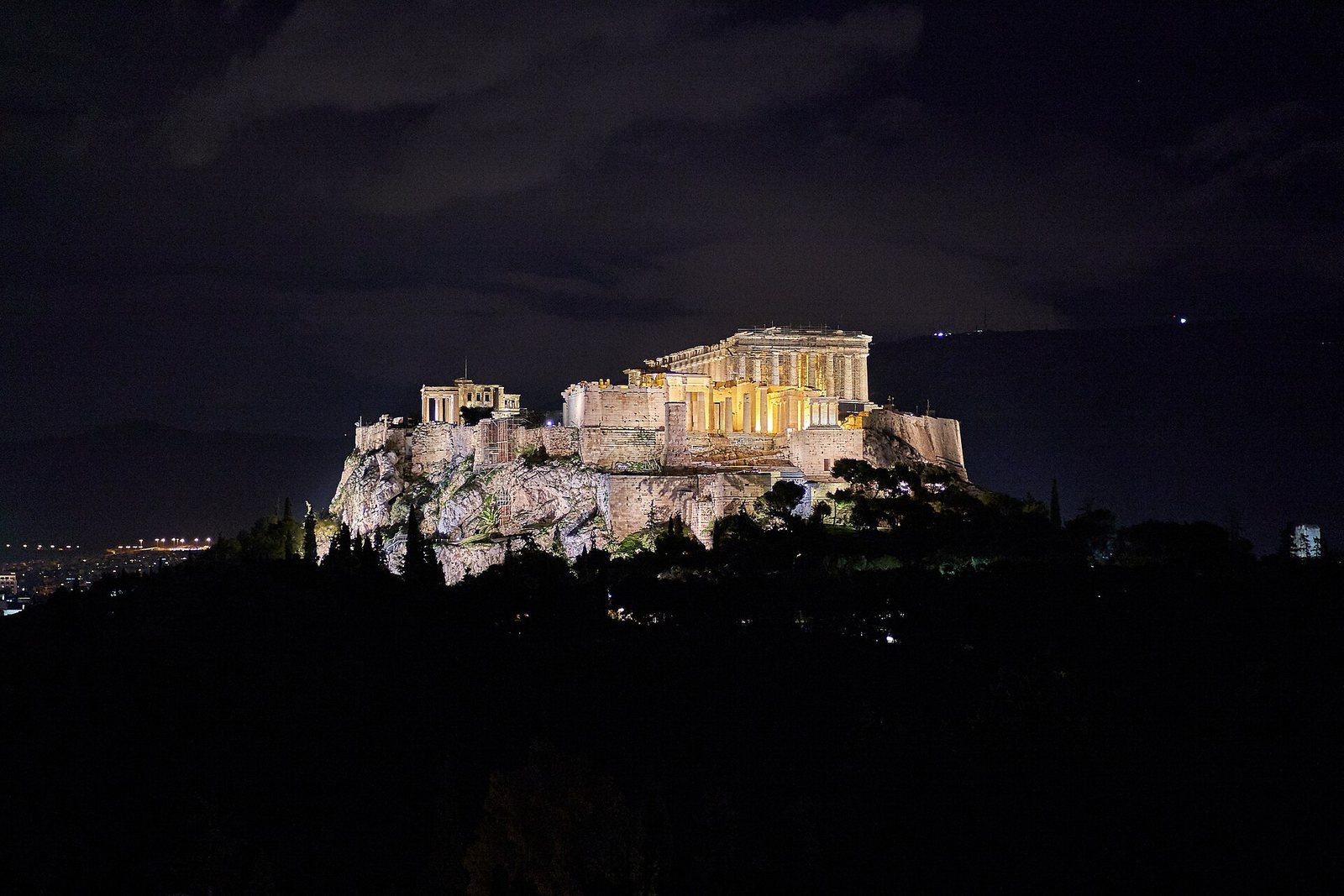
The Acropolis of Athens is a rocky hilltop sanctuary in Athens, Greece, occupied from the Neolithic period onward and developed by ancient Greeks into a centre of worship and civic life. Its history includes a Mycenaean fortification, a major building programme in the fifth century BC, and successive changes of use under Byzantine, Latin, and Ottoman rule.
Early occupation and sacred traditions
Archaeological evidence points to activity on and around the hill across the Neolithic and Bronze Ages. Finds include pottery from the Early and Middle Helladic periods, child burials on the summit, and six graves covered by burial mounds on the southern slope. By the Late Bronze Age, a Mycenaean palace may have stood on the hill, though its form and even its existence remain uncertain. A massive circuit wall was built around the thirteenth century BC, but the evidence does not show whether it was connected with a palace.
Stories about the Acropolis linked it to the beginnings of Athens. One tradition places the contest between Athena and Poseidon for the patronage of Attica in the reign of Cecrops. Poseidon struck the ground with his trident and produced a saltwater spring; Athena offered an olive tree and won the contest. Another story says that Athena cared for Erichthonius, born from Gaia, in her sanctuary. Cecrops’s daughters opened the basket containing the child and, terrified, leapt from the hill; Cecrops later entrusted Erichthonius with kingship. A further myth places Apollo’s assault on Creusa in a cave on the Acropolis. She abandoned their son Ion, whom Hermes carried to Delphi.
From about 1200 to 800 BC, the hill may gradually have shifted from settlement and stronghold toward sanctuary, although evidence for this transition is limited. Worship of Athena is associated with the Acropolis from the second millennium BC, and bronze offerings dating to about 770–700 BC show that at least part of the summit was already sacred. Athena Polias, Athena as protector of the city, was the sanctuary’s principal deity. Her ancient wooden cult image was washed and dressed each year in a new robe, while its jewellery and gold ornaments were cleaned.
Archaic Athens and Persian destruction
The Acropolis retained defensive and political importance as its religious role grew. The abolition of the Athenian monarchy in 752 BC accompanied a decline in its political function. In the second half of the seventh century BC, Cylon and his supporters occupied the stronghold in an attempt to establish a tyranny. Besieged there, they sought protection at the altar of Athena Polias. After the cord connecting them to the goddess’s statue broke, they were killed. Later attempts to seize power also focused on the hill.
Peisistratus took the Acropolis during his first bid for power in 561 BC, but his family did not use it as a residence. His son Hippias and his supporters were later besieged below the summit. Around 508 BC, Isagoras occupied the hill with support from the Spartan king Cleomenes I in another attempt to seize power. The Acropolis may have become wholly a sanctuary after that episode. The development of a civic centre around the future Agora, a public gathering and administrative space, further reduced the hill’s political role during the sixth century BC.
Major construction is associated with the Panathenaea, Athens’s festival in honour of Athena, instituted by Peisistratus in 566 BC. Offerings became more numerous and elaborate during the sixth century, reflecting the city’s prosperity and a widening range of dedicants, including artisans as well as aristocrats and officials. The annual festival included the presentation of a new woollen robe to Athena Polias; at the Great Panathenaea, held every four years, a robe was presented to Athena Parthenos.
Persian forces captured and sacked Athens in 480 BC, burning or destroying buildings and damaging or destroying many statues and offerings on the Acropolis. Most residents had evacuated the city, taking the statue of Athena Polias with them. Those who remained on the summit were killed. Xerxes ordered a final sacrifice to Athena after the capture, and Mardonios’s forces further demolished surviving buildings the following year. Worship continued, but the sanctuary remained largely unreconstructed for about twenty years. A building was repaired to shelter the statue of Athena Polias.
Fifth-century rebuilding
A large temple known as the Pre-Parthenon was begun on a platform made by cutting back the hill to the north and adding fill to the south. Its design changed from limestone to Pentelic marble after the Athenian victory at Marathon in 490 BC. Work probably stopped around 483 BC, when Themistocles persuaded the Athenians to give priority to building a fleet. The temple was unfinished when the Persians invaded in 480 BC.
After the Persian Wars, a portion of the Old Temple of Athena was taken apart and its material used to repair the rest. The restored building housed the statue of Athena Polias and included rooms for heroic cults and the treasury. It continued as a treasury after the Erechtheion took over the statue’s role. The Old Temple burned in 406 BC and may have suffered another fire around 377–376 BC; the date of its final destruction is uncertain.
Cimon oversaw clearance work and the erection of the bronze Athena Promachos in the decades after the wars. A broader rebuilding followed under Pericles, including the Parthenon and the Propylaea. The Erechtheion and Temple of Athena Nike were completed later, during the period associated with Nicias. Athens began using the Delian League’s shared funds for the works after the alliance’s treasury was transferred to the city in 454 BC. A decree in 449 BC assigned funds from the League to the treasury of Athena Polias. The building programme was interrupted by the outbreak of the Peloponnesian War, which halted construction in 431 BC.
Phidias directed the artistic programme and was associated with the statue of Athena Parthenos. Ictinus and Callicrates designed the Parthenon, while Mnesicles began the Propylaea in 437 BC. The Temple of Athena Nike was completed during the Peace of Nicias, between 421 and 409 BC, and the Erechtheion was built between 421 and 406 BC.
Hellenistic and Roman use
During the Hellenistic period, which followed the conquests of Alexander the Great, and under Roman rule, existing buildings were repaired and monuments to foreign rulers were added. The Attalid kings Attalos II and Eumenes II were commemorated on the summit. Their monuments were later rededicated to Augustus or Claudius and to Agrippa, respectively. Eumenes II also commissioned a covered colonnade on the southern slope.
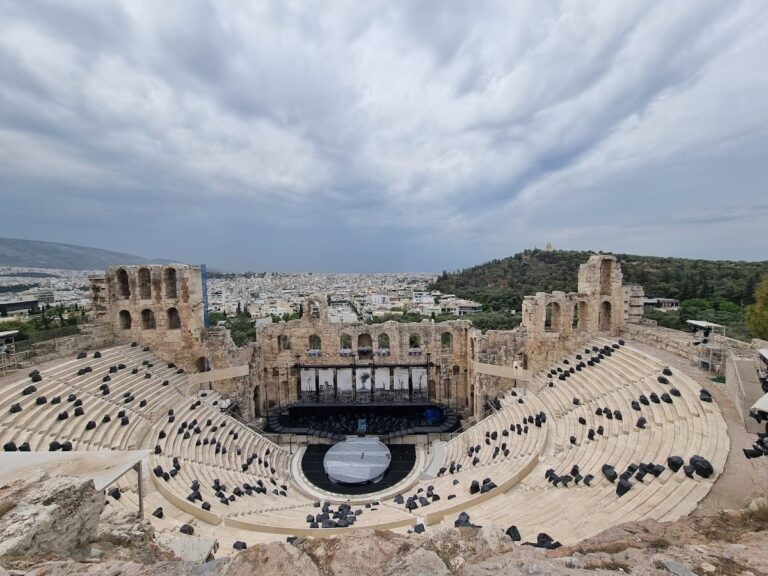
In the Roman period, a sanctuary of Apollo was established in a cave on the northern slope, and Herodes Atticus built a performance hall on the southern slope in AD 161. After an invasion in the third century, the walls were repaired and the Beule Gate was built to limit access, restoring the Acropolis’s use as a fortress.
Medieval and Ottoman transformations
During the Byzantine period, the Parthenon became a church dedicated to the Virgin Mary. Under the Latin Duchy of Athens, a medieval Western European regime, the Acropolis served as the city’s administrative centre. The Parthenon became its cathedral, and the Propylaea formed part of the ducal palace. After the Ottoman conquest, the Propylaea housed the Turkish army’s garrison headquarters, while the Erechtheion served as the governor’s private quarters.
In 1687, during the Morean War, a Venetian-Ottoman conflict, Venetian bombardment hit the Parthenon, then used to store gunpowder. The resulting explosion severely damaged the building. The Temple of Athena Nike had been dismantled shortly before the siege to strengthen the defences. A defensive wall called Serpentzé was built between the Odeon of Herodes Atticus and the Stoa of Eumenes. Before withdrawing, the Venetian commander Francesco Morosini removed some sculptures.
Independence, excavation, and conservation
Greek forces besieged the Acropolis in 1821–1822 during the Greek War of Independence. Ottoman forces under Kioutachis besieged it again in 1826–1827. Greek defenders built a bulwark named for Odysseas Androutsos to protect the rediscovered Klepsydra spring, then the fortress’s only fresh-water supply. Bombardment during the later siege brought down part of the Erechtheion and killed several people. The garrison capitulated on 5 June 1827, and the Acropolis remained under Ottoman control until March 1833.
After Greek independence, restoration and excavation began alongside the removal of many later structures. Excavations started in the 1830s, and houses within the Acropolis were removed in 1837. Charles Ernest Beulé discovered the gate now bearing his name in 1852. Further major excavations followed between 1882 and 1890. Nikolaos Balanos proposed rebuilding the Parthenon’s columns in 1921, and that work continued until 1933. A broader programme begun in 1975 gathered and identified architectural fragments from the hill and its slopes, and reassembled original material where possible.
During the German occupation in 1941, German soldiers raised their flag over the Acropolis. Resistance figures Manolis Glezos and Apostolos Santas took it down. In 1944, Prime Minister Georgios Papandreou visited the site to mark liberation from the occupation. The Acropolis monuments were added to UNESCO’s World Heritage List in 1987, a register of cultural and natural properties recognized for their outstanding universal value. Reinforced-concrete paths installed in 2021 to improve accessibility altered circulation on the site and prompted controversy among archaeologists.
Remains
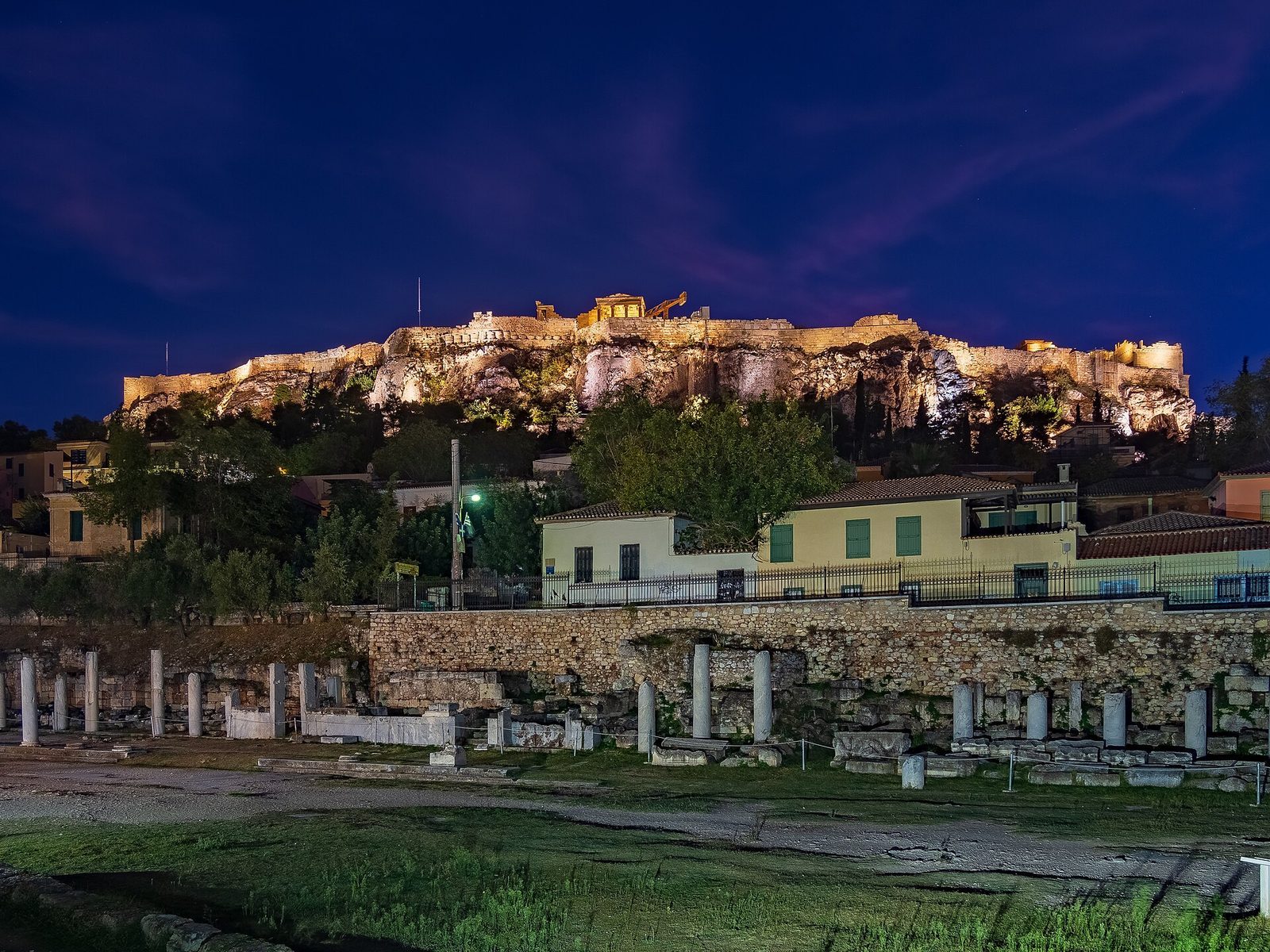
The Acropolis is a limestone-topped hill about 156 metres above sea level. In its natural state, the summit measured roughly 270 metres from east to west and 85 metres from north to south. Fifth-century BC work enlarged it to nearly 150 metres across and formed a plateau of about 23,000 square metres. The main approach is from the west, and erosion created two clefts on the northern side.
Landscape and early remains
Geology and stability
Soft reddish Athens schist lies beneath the Acropolis limestone. Tectonic forces pushed the limestone over the schist, and erosion later separated the summit from the larger limestone formation. Springs and caves formed where the two rock types meet. Tectonic movement and erosion also make the limestone unstable and contribute to rockfalls. Retaining walls, drainage systems, and rock bolts have been used to protect the archaeological remains.
Prehistoric traces
Neolithic finds include pottery east of the Erechtheion, stone and obsidian objects, and animal bones on the northwestern slope. Foundations of a Late Neolithic house lie in a cave above the Sanctuary of Asclepius. Later prehistoric finds include pottery near the Erechtheion and southeast of the summit. Middle Helladic pottery and child burials were found on the plateau, while six graves beneath burial mounds occupy the southern slope.
Mycenaean defenses and water
The Mycenaean circuit wall, built of local limestone, measured about 760 metres long, 3.5 to 6 metres thick, and as much as 10 metres high. Its remains lie beneath the Temple of Athena Nike and the Propylaea and on the eastern side of the summit; excavation has also traced its course elsewhere around the plateau. A projecting defensive structure protected the western entrance. A lower enclosure, known as the Pelargikon or Enneapylon, is associated with the fortification.
A fissure on the northeastern edge leads down about 35 metres to soft marl, where a well was cut during the Mycenaean period. Sixty-five steps provided access to this protected water supply. The site’s archaeological remains also include a Mycenaean spring or fountain.
Buildings and sacred spaces on the summit
The Parthenon
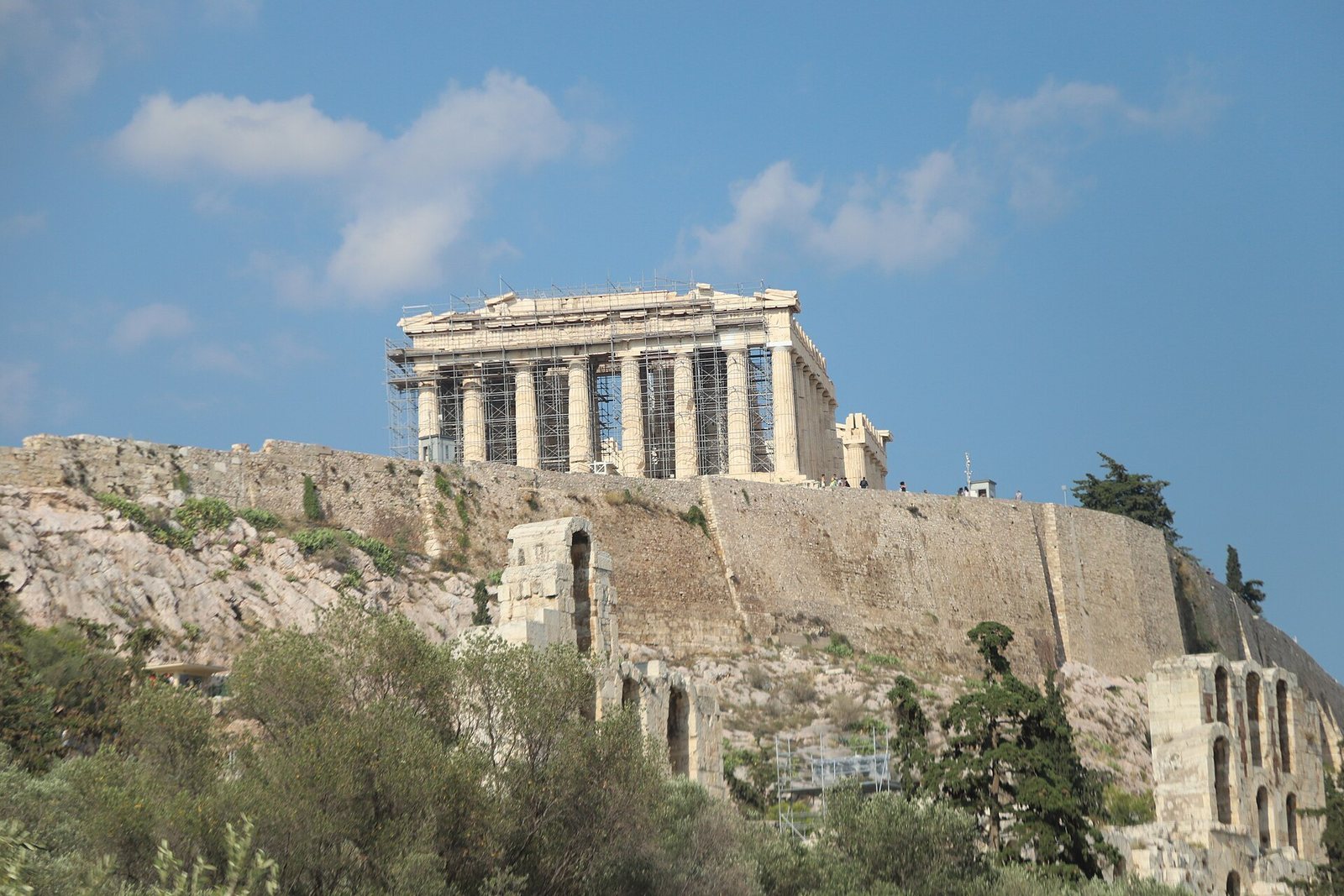
The Parthenon stands near the centre of the summit. Its upper base measures about 69.5 by 30.9 metres, and its lower base about 72.3 by 33.7 metres. The marble came from Mount Pentelicus, roughly 17 kilometres away. Eight columns stand at each end and seventeen along each side; the columns are about 10.43 metres high.
An outer colonnade surrounds an interior divided into two rooms. The eastern room, about 29.9 metres long and 19 metres wide, housed the statue of Athena Parthenos. The western room, about 19 by 13.2 metres and without windows, held offerings and the Delian League treasury. Above the outer columns, a band of alternating sculpted panels and plain blocks ran around the building. A second sculpted band, about 160 metres long, depicted the Panathenaic procession with 378 human and 245 animal figures. Of the original 92 sculpted panels, 19 survive, some on the building and others in the British Museum. Their subjects include the Trojan War, battles between gods and giants, Greeks and Centaurs, and Greeks and Amazons.
The building’s design includes slight curves in the platform, base, and upper horizontal structure. Its columns swell gently and lean inward, and those at the corners are thicker than the others. The marble roof used about 8,480 tiles; surviving examples are made from Pentelic or Parian marble. Decorative lion heads on the cornice were not used to drain rainwater.
Phidias and his workshop made the statue of Athena Parthenos from gold and ivory. It showed the goddess wearing a helmet, protective garment, and robe, with a shield and spear and a small figure of Nike, the personification of victory, in her right hand. The shield, about 4.8 to 5 metres across, carried a battle between Greeks and Amazons on its exterior and a battle between gods and giants on its interior. Copies show a column that may have supported the statue, though its presence in the original is uncertain.
The Propylaea
The Propylaea is the monumental western gateway to the summit. Begun in 437 BC and built partly over an earlier entrance, it had marble colonnades that were nearly complete by 432 BC. The northern wing was decorated with paintings by Polygnotus. Its roof and floor have been partly restored.
Temple of Athena Nike
South of the Propylaea stands the small Temple of Athena Nike, built of Pentelic marble. Its four-column porches and Ionic design date to the late fifth century BC. Sculptural decoration includes a band concerning the Persian Wars and reliefs of winged figures representing victory on the defensive platform’s parapet.
The Erechtheion
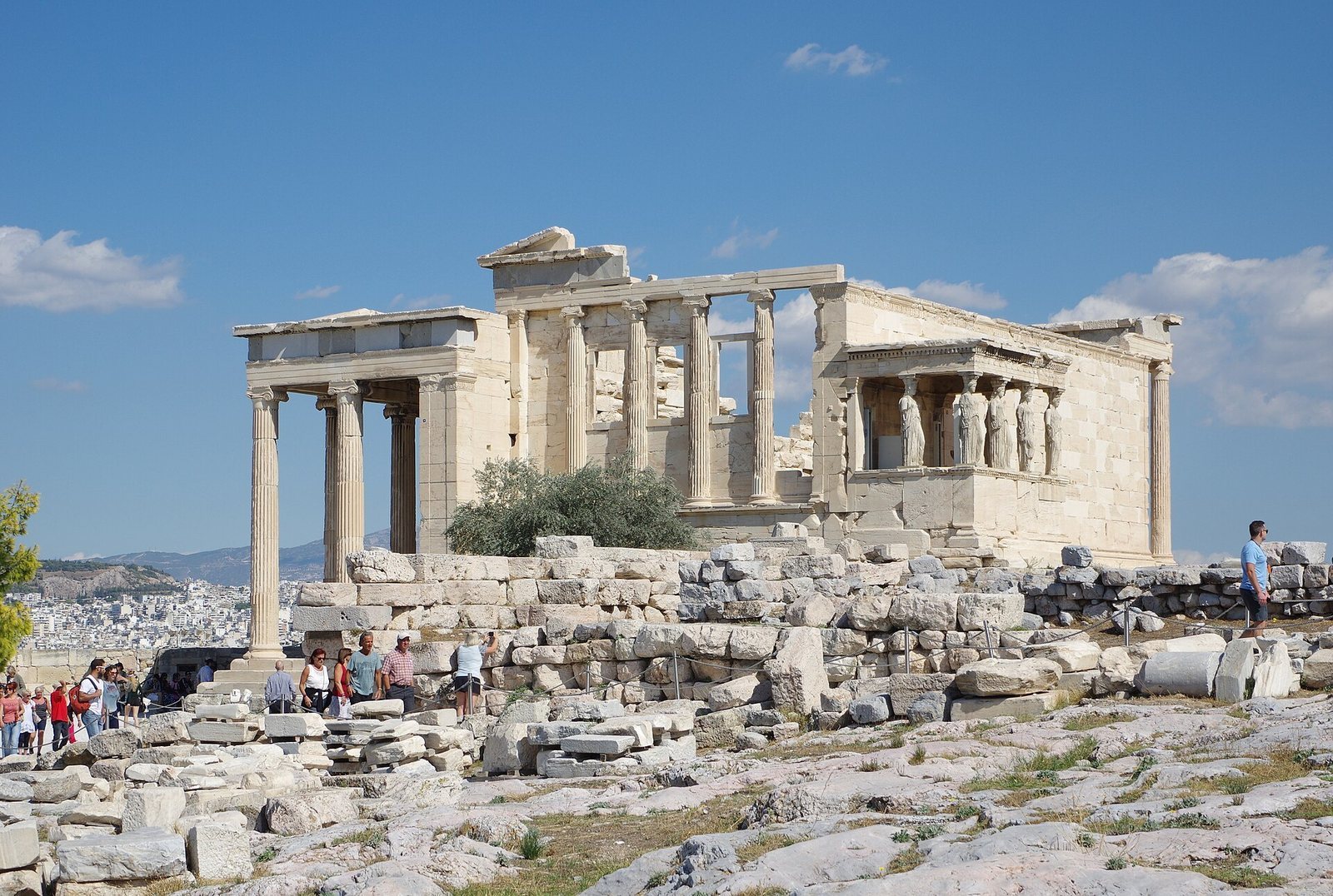
The Erechtheion occupies uneven ground and brings several sacred spaces together. Its eastern entrance has six Ionic columns; Ionic columns also support the northern porch. The southern porch is carried by six sculpted female figures, called caryatids, which serve as architectural supports. The building’s eastern part was dedicated to Athena Polias. Its western part housed the cult of Poseidon-Erechtheus and altars of Hephaestus and Boutes. Marble figures mounted on dark Eleusinian limestone plaques formed its exterior sculpted band. Fire damaged the original interior in the first century BC, after which the building was rebuilt several times. The figures now on the porch are copies; the originals are in the Acropolis Museum and the British Museum.
Other summit sanctuaries
The Sanctuary of Artemis Brauronia lay between the Temple of Athena Nike and the Parthenon. It had a trapezoidal plan with two side wings and a covered colonnade about 38 metres long and 7 metres wide. On the north side, the Arrephorion housed the young women who wove Athena’s robe. A nighttime ritual route connected it to a sanctuary of Aphrodite and Eros on the northern slope.
Other identified sacred and civic remains include the Pandroseion, a sanctuary associated with Pandrosos; the Chalkotheke, a storehouse for bronze objects; the Eleusinion, connected with the Eleusinian Mysteries, initiation rites associated with Demeter and Persephone; the Altar of Athena; and sanctuaries of Zeus Polieus and Pandion. Excavation revealed foundations and the plan of the Eleusinion. The remains also include a sanctuary of Dionysus Eleuthereus and the Mycenaean fountain.
Structures on the southern slope
Theatre of Dionysus
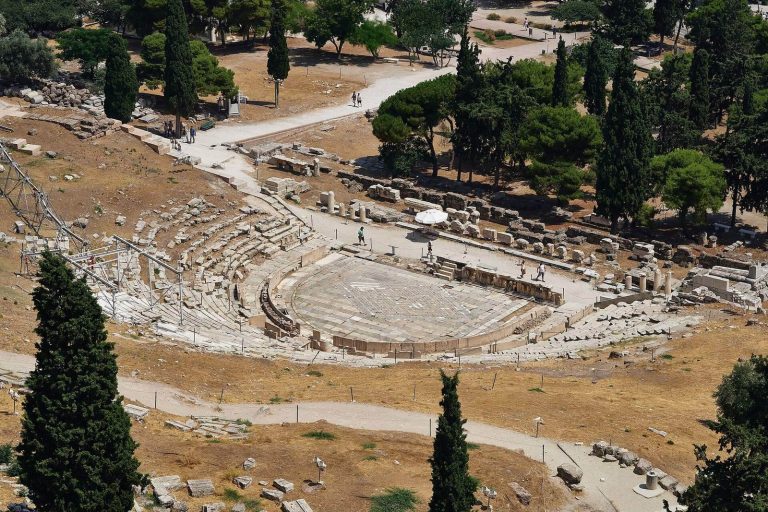
The Theatre of Dionysus lies outside the summit enclosure on the southern slope. Its early marble seating was replaced by stone tiers late in the fifth century BC. Sixty-seven later marble seats in the central front rows were reserved for priests and kings.
Performance buildings and covered colonnade
Near the theatre, the Odeon of Pericles was a rectangular, roofed venue for music, with two rows of columns and a formal entrance. Musical performances began there in 446 BC. The Odeon of Herodes Atticus, a large Roman-period performance building, was also built on the southern slope. It was destroyed about a century after its construction and reconstructed during the 1950s.
The Stoa of Eumenes, a covered colonnade about 163 metres long, sheltered spectators at the Theatre of Dionysus. Above the theatre and the colonnade stands the Sanctuary of Asclepius, founded about 420 BC. The southern slope also contains the Temenos of Dionysus Eleuthereus, a sacred enclosure associated with Dionysus, and remains of a sanctuary of Pandion.
Other structures, finds, and conservation
Roman and later remains
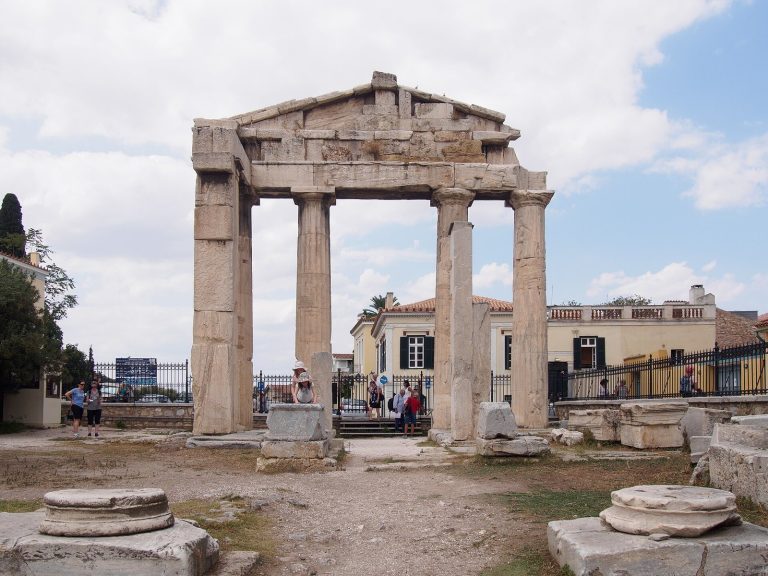
Near the Parthenon stood the small circular Temple of Roma and Augustus, about 23 metres away and surrounded by nine marble columns. In front of the Propylaea, the Roman-period Beule Gate has two flanking towers, each about nine metres high. The Frankish Tower, added during the Latin period, was demolished in the nineteenth century. The Parthenon mosque, formed during the Ottoman period, was demolished in 1843.
Statues and archaeological finds
Athena Promachos, a bronze statue by Phidias made around 450–448 BC, stood behind the Propylaea. It was about nine metres high on a base 1.5 metres tall, and showed Athena with a spear and a large shield decorated with a battle between Greeks and Centaurs by Mys. The Acropolis Museum on the southern slope, about 280 metres from the Parthenon, houses many finds from the site. These include Archaic statues of young women and young men, among them the Moschophoros and the Rampin Rider, as well as sculptures and offerings recovered from deposits associated with the Persian destruction. Some objects, including sculptures from the Parthenon, are held in museums elsewhere.
Restoration work
Conservation has reassembled original architectural fragments where possible, used new Pentelic marble sparingly, and employed titanium supports in repairs designed to be reversible. The work restored 2,675 tonnes of architectural members: 686 stones were assembled from original fragments, 905 were patched with new marble, and 186 were made entirely from new marble. The programme used 530 cubic metres of new Pentelic marble. The original Caryatids were replaced on the Erechtheion by copies to protect them.