Beulé Gate: The Roman Fortified Entrance to the Acropolis
Site at a Glance
- Popularity
- Medium
- Country
- Greece
- Primary era
- Classical
- Eras represented
- Classical, Medieval
- Civilizations
- Byzantine, Crusader, Ottoman, Roman
- Site type
- Military
- Remains
- Gate
On this page11 sections
History
Roman builders erected the Beulé Gate as a fortified entrance on the Acropolis in Athens, Greece, probably in the late third or early fourth century CE. Its construction is generally associated with the aftermath of the Heruli, a Germanic people who sacked Athens in 267 or early 268 CE, when the Acropolis was developed as a defensive position as well as a religious sanctuary.
Roman construction and the monument of Nikias
The gate’s exact date remains uncertain. Some proposals place it during Emperor Valerian’s reign, from 253 to 260, before the sack; others date it to shortly after the attack or roughly a decade later. Most modern interpretations favor construction in the sack’s aftermath. The gate formed part of the Post-Herulian Wall, a defensive circuit built around the Acropolis after the attack. The wall is placed about two decades after the sack, and its construction, the gate’s erection, and the dismantling of the Choragic Monument of Nikias are generally considered to belong to roughly the same period.
The gate may have replaced an earlier, less heavily defended entrance, an interpretation proposed by Walter Miller in 1893. It is also thought to have guarded the approach to the Klepsydra spring, an important source of water during a siege. Together, these functions reflect the Acropolis’s growing military role.
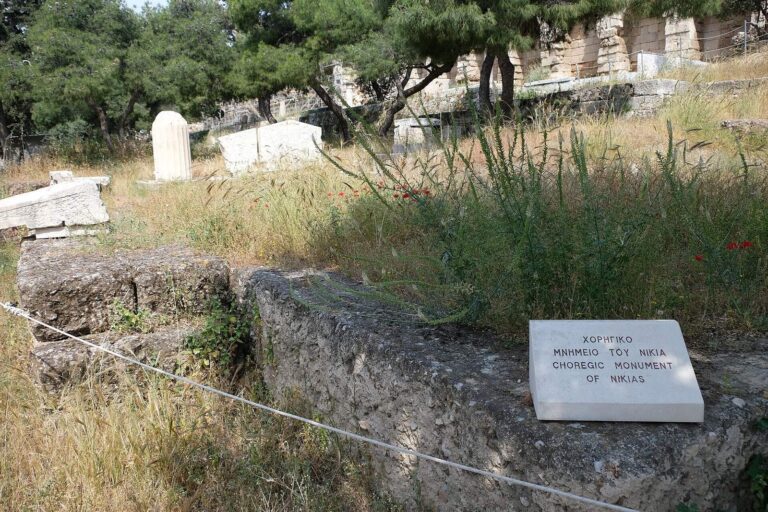
The earlier monument whose stone was used in the gate had been built shortly after 320 BCE. It commemorated the Athenian choregos Nikias, a citizen who paid for and organized a chorus for public performances, and his victory in that year’s competitions. Its demolition date is disputed, although a date in the late third or early fourth century CE is widely accepted. Wilhelm Dörpfeld proposed that it was taken down in 161 CE, linking it to a foundation beneath the Odeon of Herodes Atticus. In 1910, William Bell Dinsmoor rejected that location, placing the monument at the eastern end of the Stoa of Eumenes and arguing for a later demolition.
The dedication to Nikias survives as one of the latest inscriptions of its kind from Hellenistic Athens. During Demetrios of Phaleron’s rule, from 317 to 307 BCE, laws intended to restrain aristocratic extravagance brought the construction of choragic monuments to an end. Public art thereafter increasingly took the form of ruler portraits and large buildings commissioned by rulers.
A different inscription, on a stone reused in the Acropolis’s Ottoman defenses, commemorates Flavius Septimius Marcellinus for paying for an Acropolis gateway. Dated to after 325 CE, around the middle of the fourth century, it is usually associated with the Beulé Gate, though the identification is disputed. The inscription calls Marcellinus lamprotatos, equivalent to the Latin clarissimus, a rank indicating senatorial standing, and identifies him as a former agonothetes, an official who funded and organized festivals and games.
Medieval and Ottoman use
The Beulé Gate remained the Acropolis’s main entrance during the Middle Byzantine period, the medieval phase of the eastern Roman Empire from about 843 to 1261. Under descendants of Othon de la Roche, the first holder of the medieval Duchy of Athens, the gate was closed and its north tower strengthened. The Propylaia, the Acropolis’s monumental gateway, was also shut during the medieval period and later reinforced with the Frankish Tower. The entrance route shifted to another gateway at the western foot of the defensive platform supporting the Temple of Athena Nike. In 1395, the notary Niccolò da Martoni described the Beulé Gate as visible but no longer in use.
During Ottoman rule, from 1458 to 1827, the Acropolis’s defenses were altered again. The gate’s towers were raised and a defensive platform was built above them. Beulé later reported signs that gunpowder had damaged the gate before those works. By the nineteenth century, knowledge of the entrance had been lost.
Rediscovery and modern use
Clearance and repair work following the Greek War of Independence revealed a lower route to the Propylaia in 1829. Auguste Titeux began uncovering its staircase in 1846 but died before completing the work. Kyriakos Pittakis, Greece’s senior official responsible for antiquities, finished clearing the steps in 1850 and partly reconstructed them.
In 1852, Pittakis asked Charles Ernest Beulé, a member of the French School at Athens, to help remove later structures around the Propylaia. Founded in 1846, the school supported excavation and classical study while also advancing France’s standing in archaeology. Beulé believed that Mnesikles, the architect of the Propylaia, had built a second gateway there. Excavators uncovered more steps on 16 May and identified the wall and gate by 29 May. Beulé left Athens in early June, returned in December, and directed further work on the entrance.
On 5 January 1853, Greece’s Minister of War halted the excavation out of concern that it would weaken the Acropolis’s defenses. With help from the French embassy, Beulé secured permission to continue, arguing that the site had little military value and could not withstand an assault for 24 hours. To cut through a hard mortar layer, the excavators used 68 kilograms of gunpowder obtained from sailors serving with the French Navy’s Levant patrol fleet. The blasting drew criticism from archaeologists and Greek commentators. Pittakis was nearly hit by falling debris, and a false report circulated that he had been killed.
The towers were fully exposed by 12 April 1853 and the gate by the following day. Excavation ended that month, and the monument formally opened on 11 May. Beulé’s discovery attracted enthusiastic attention in France, but Thomas Henry Dyer disputed his claim that Mnesikles had built the gate. Dyer and Ludwig Ross also criticized an inscription Beulé had placed at the monument.
In the 1960s, the Acropolis’s main entrance moved to the southeast, and the Beulé Gate came to serve primarily as an exit. It forms part of the Acropolis of Athens UNESCO World Heritage Site, inscribed in 1987.
Remains
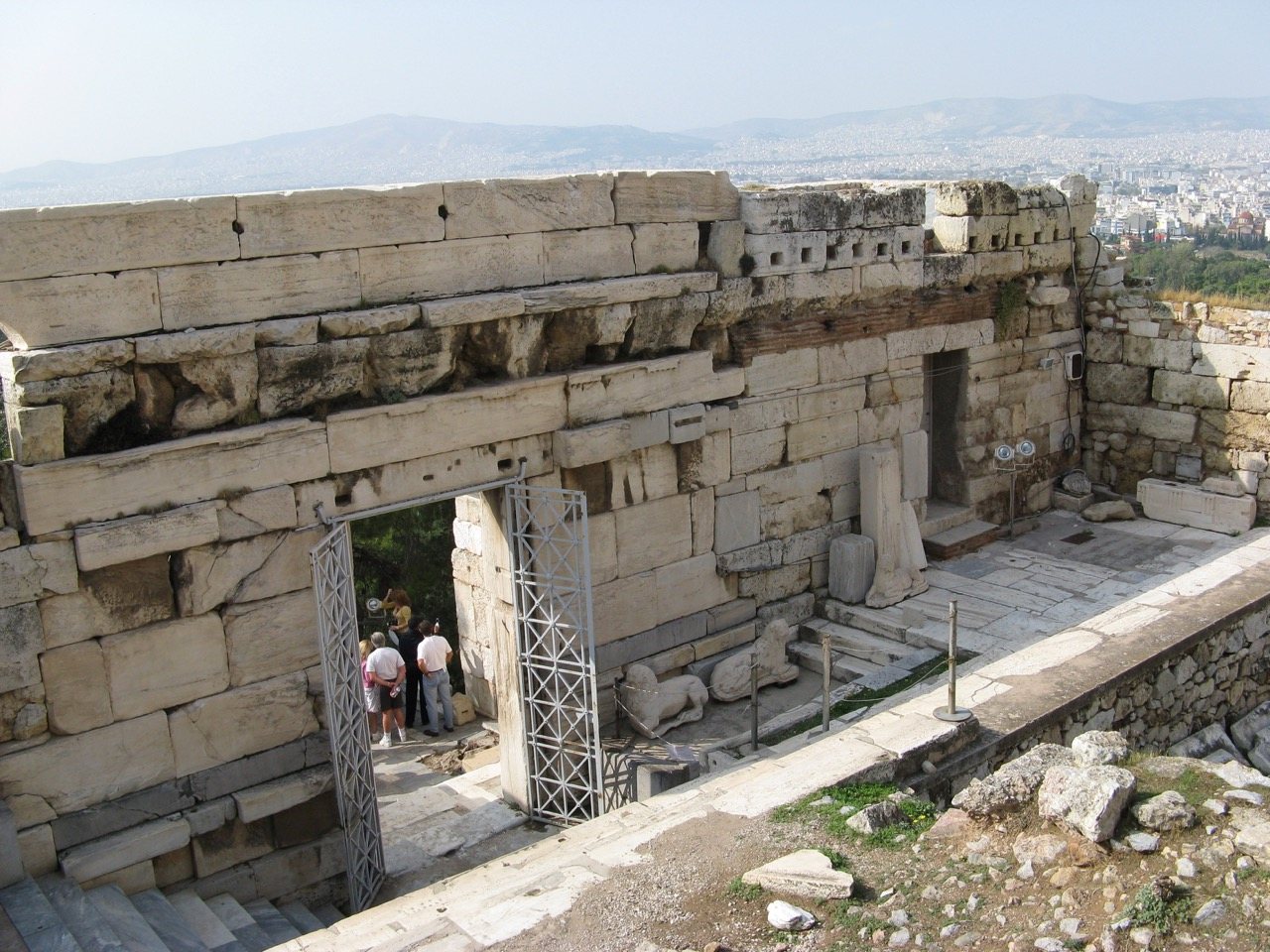
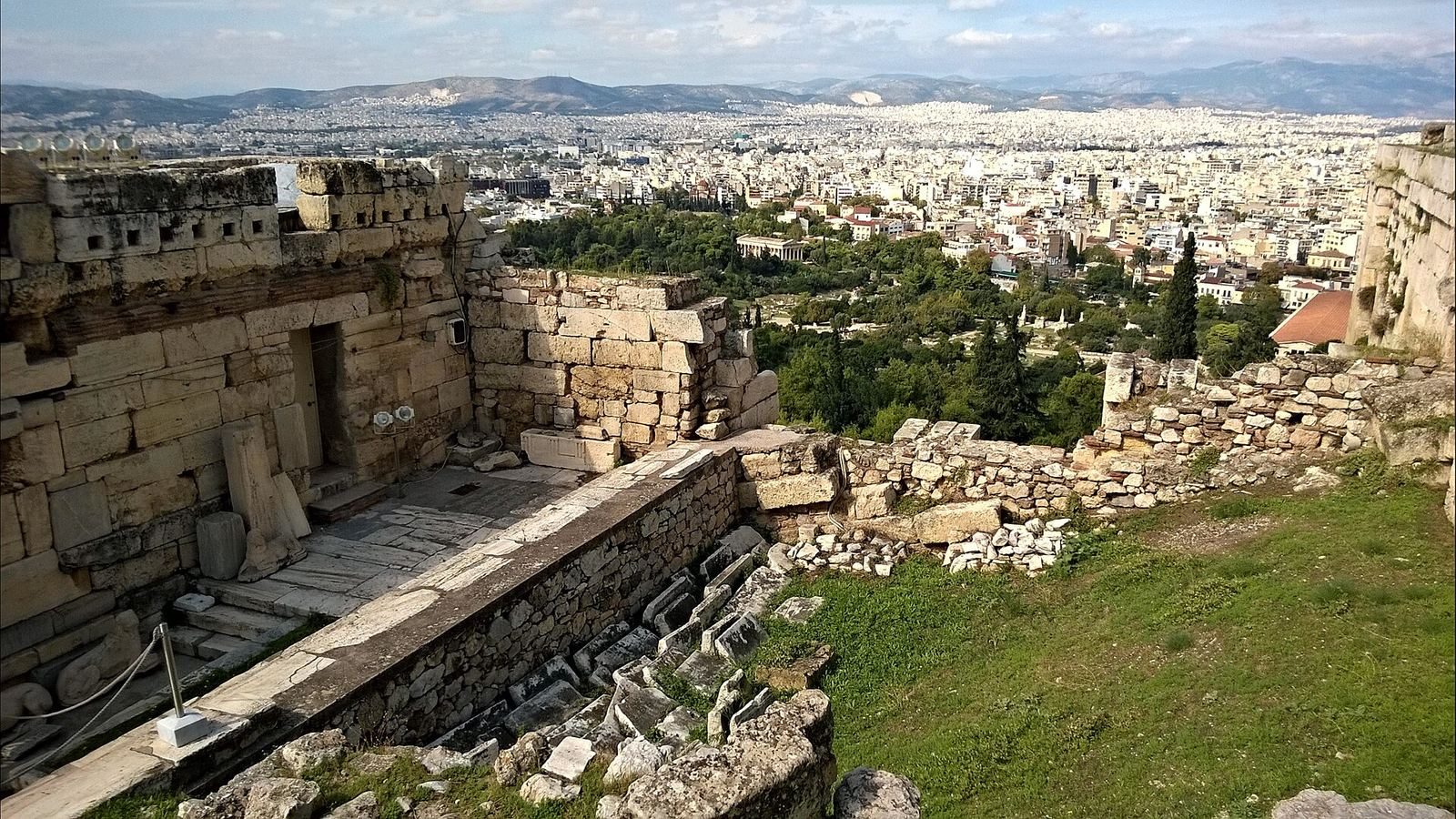
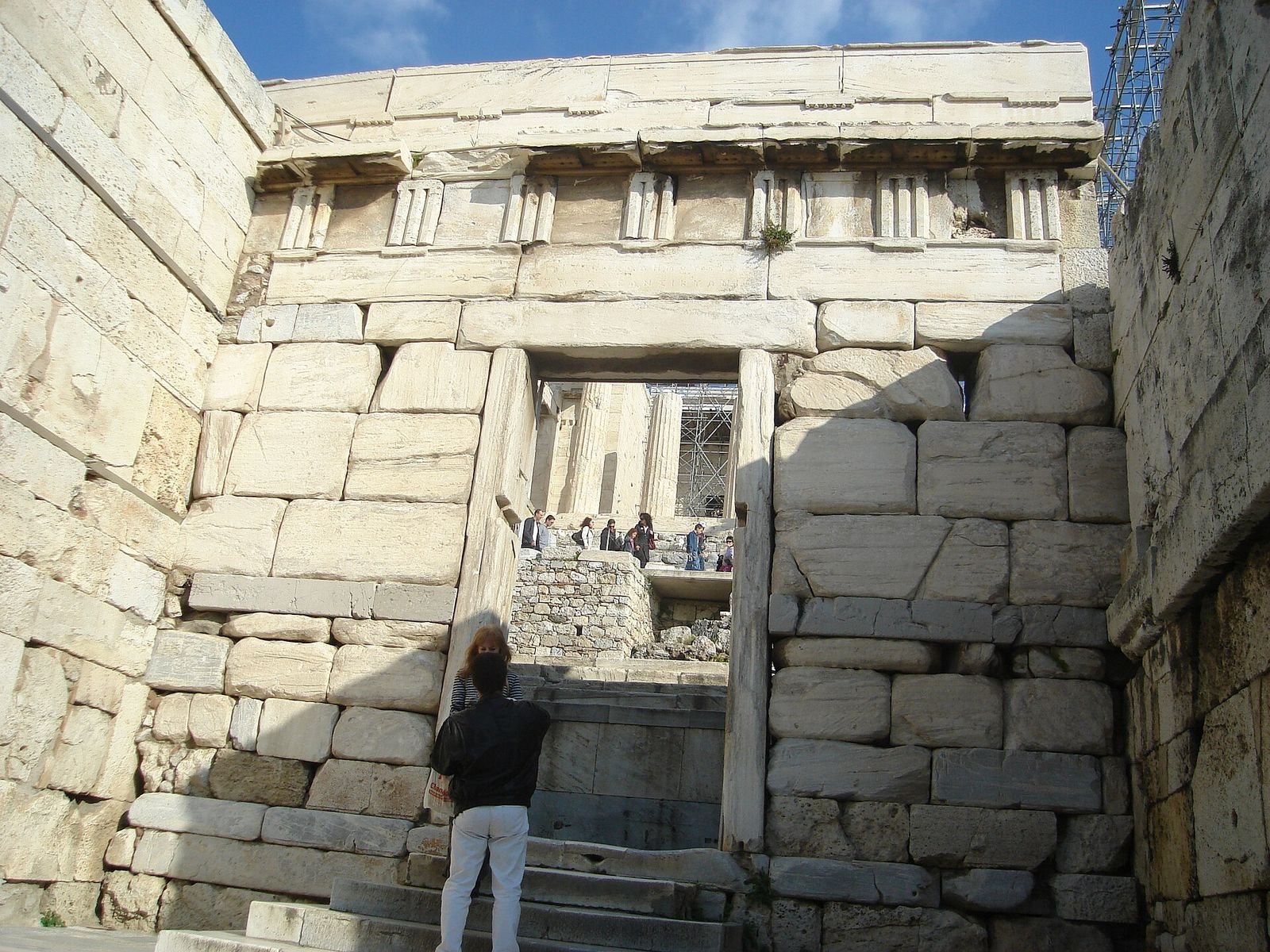
The gate stands at the foot of a monumental staircase leading to the Propylaia, about 37 metres to the east. The staircase was built in the later first century CE, possibly at the instigation of Emperor Claudius. The gate is nearly 23 metres wide; its central section is about 7 metres high and 7 metres wide. Two projecting towers and connecting walls link the structure with the upper terraces, including the terrace of the Temple of Athena Nike.
Architecture and reused stone
Doorway and facade
The doorway is set in a marble wall and aligned with the main route through the Propylaia. It measures 3.87 metres high, 1.89 metres wide at the base, and 1.73 metres at the top. Above it, a Doric composition, using one of the principal styles of ancient Greek architecture, combines a Pentelic-marble architrave, or horizontal beam, with a frieze, a horizontal architectural band. Marble metopes, or frieze panels, alternate with poros, a type of limestone, formed into vertically grooved blocks. A projecting cornice with blocks beneath it and an upper wall complete the composition.
Towers and connecting walls
The two massive towers flank the entrance and project about 5 metres from the gate. Walls join them to the higher terraces, including that of the Temple of Athena Nike. The gate and the Post-Herulian Wall share courses of differently coloured marble laid in alternating bands.
Stone from the monument of Nikias
Most of the gate was assembled from marble taken from the monument of Nikias. During its dismantling, some projecting cornice stones were numbered in place to guide their later assembly. The monument’s limestone-and-marble Doric frieze was reconstructed along the gate’s top. Its original single-beam architrave was divided into two pieces and set both above and below that frieze. The dedication to Nikias remains visible in the gate’s upper horizontal structure. The original monument had a square main chamber and a front porch with a pediment and six columns. Its dedication had run across the beam above those columns. The arrangement at the gate has been interpreted as creating architectural harmony with the Propylaia, which had served as a model for Nikias’s monument.
Later additions
A wooden roof was added along the gate’s inner face in the third or fourth century CE. In the sixth century, under Emperor Justinian, a further lintel reduced the doorway’s height. During the Middle Byzantine period, another storey with a wooden roof was built above the gate, and a north–south barrel vault, or continuous arched ceiling, was constructed against the inner eastern sides of the towers and gate wall. During the Frankish period, a vaulted structure was built inside the north tower to reinforce it. In the Ottoman period, the towers were heightened and a defensive platform was added above the gate.
Commemorative stone
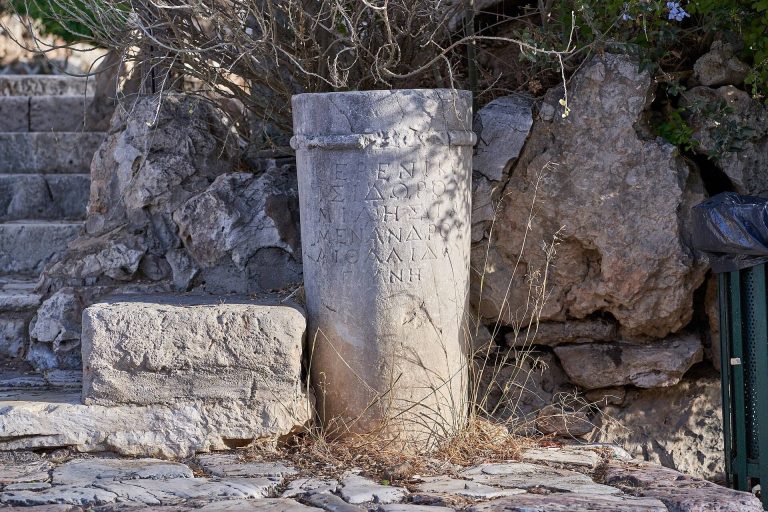
Beulé placed a stone recovered during the excavation to the right of the entrance. It carries an inscription in Ancient Greek, with a French translation beneath it.