Alhambra: The Nasrid Palace and Fortress in Granada, Spain
Visitor Information
Google Rating: 4.8
Popularity: Very High
Official Website: www.alhambra-patronato.es
Country: Spain
Civilization: Early Modern, Medieval Islamic
Site type: Military
Remains: Citadel
History
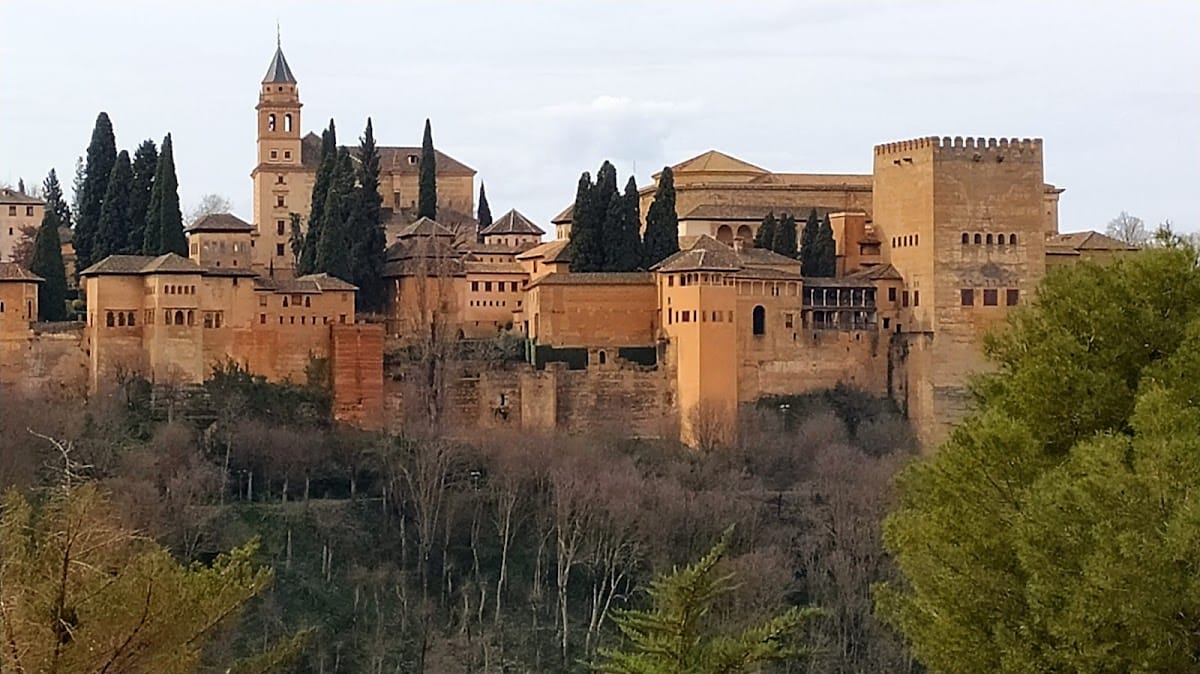
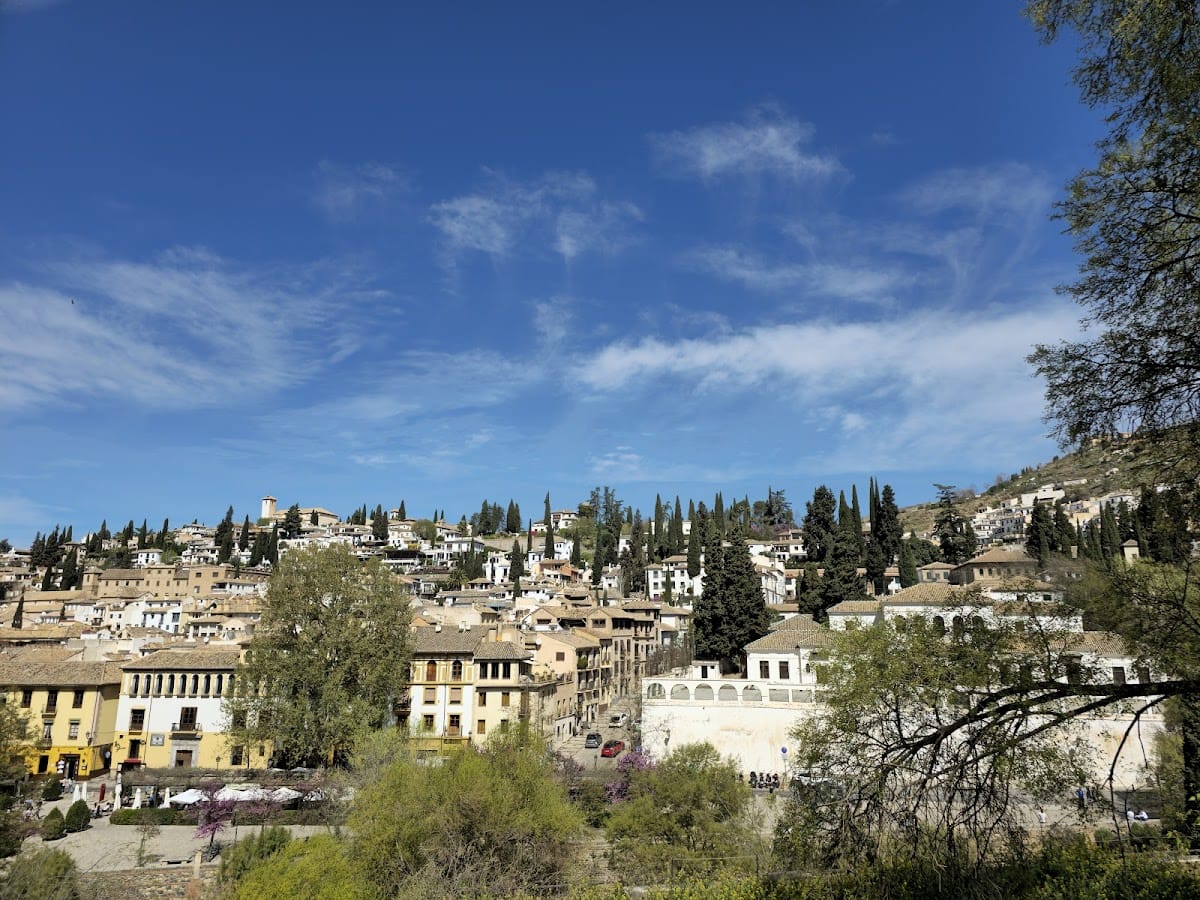
The Alhambra is located in Granada, a city in the province of Granada, southern Spain. It was constructed by the Nasrid dynasty, the last Muslim rulers in the Iberian Peninsula, beginning in 1238 under Muhammad I Ibn al-Ahmar. The site occupies Sabika hill, which had earlier fortifications and the 11th-century palace of Samuel ibn Naghrillah. The Alhambra served as the royal residence and fortress of the Emirate of Granada, the final Muslim state in Al-Andalus.
Throughout the 14th century, the Alhambra underwent significant expansions and renovations under Nasrid rulers Yusuf I and Muhammad V. These rulers shaped much of the palace complex’s definitive character, enhancing its role as a self-contained royal city with administrative, religious, and residential functions. The complex included a mosque, baths, artisan workshops, and an advanced water system, reflecting its importance as a political and cultural center.
In 1492, the Christian Reconquista culminated with the surrender of Granada by the last Nasrid sultan, Muhammad XII, who handed over the Alhambra without a battle. Following the conquest, the Alhambra became the royal court of Ferdinand and Isabella. Christopher Columbus received support for his voyages there. The Christian rulers modified parts of the complex, adapting fortifications for artillery and adding Renaissance elements, including the Palace of Charles V, commissioned in 1526 but left unfinished by the early 17th century.
The Alhambra declined in importance after the 18th century, especially following the end of the Tendilla family’s governorship in 1717–1718. It suffered damage during the Napoleonic occupation between 1810 and 1812, including the destruction of eight towers. Rediscovered by European Romantic travelers, notably Washington Irving, whose 1832 “Tales of the Alhambra” brought renewed international interest, the site began to attract preservation efforts.
Restoration started in 1828 under architect José Contreras and continued through the 19th and 20th centuries. A more scientific approach to conservation was introduced by Leopoldo Torres Balbás between 1923 and 1936. The Alhambra was declared a Spanish National Monument in 1870 and later recognized as a UNESCO World Heritage Site in 1984, securing its status as a cultural treasure.
Remains
The Alhambra covers about 142,000 square meters (35 acres) on a narrow promontory overlooking the Vega of Granada. Its fortress walls are mainly built from rammed earth, a technique using compacted red clay reinforced with brick and stone, giving the complex its distinctive reddish color and its name, meaning “the red fortress.”
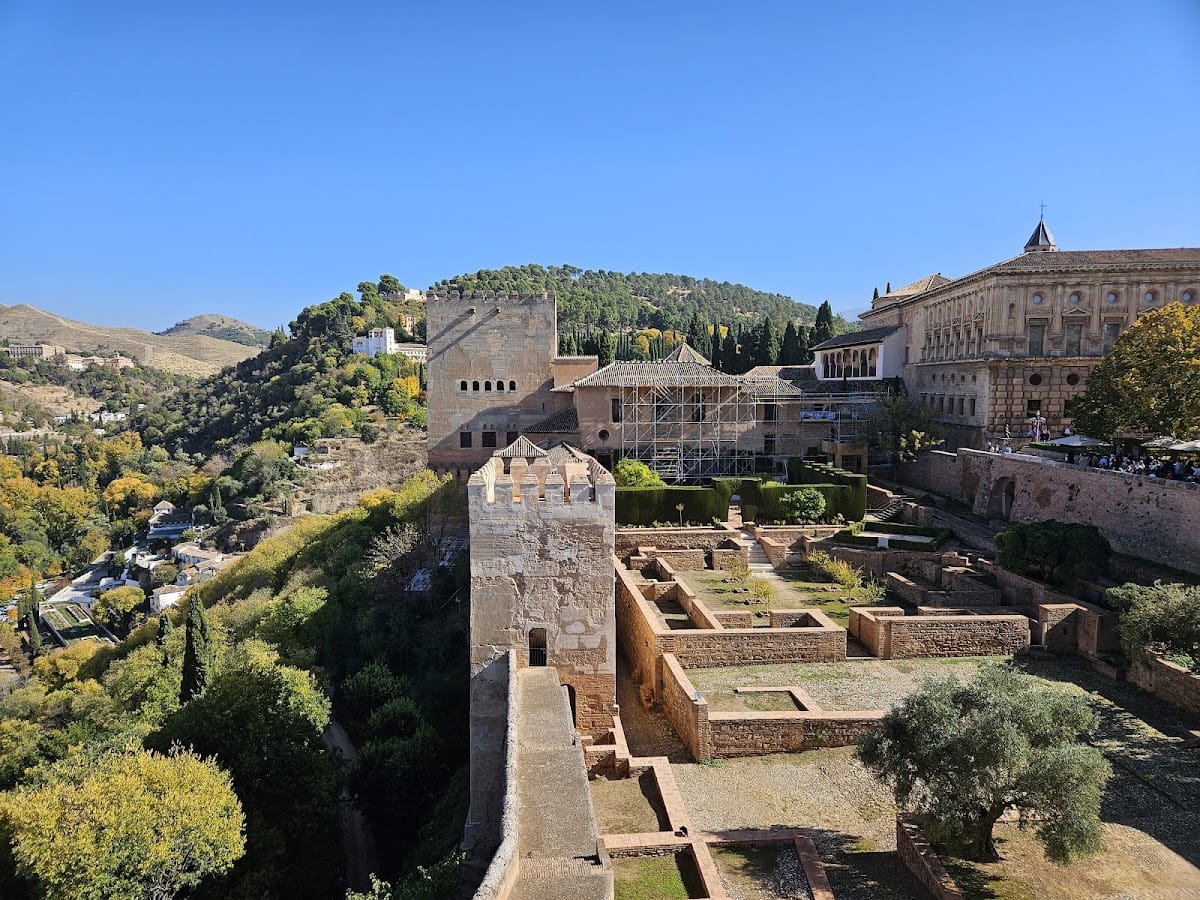
The westernmost section is the Alcazaba, the oldest part of the complex. This large fortress includes thirteen defensive towers, such as the 26-meter Torre del Homenaje (keep) and the 25-meter Torre de la Vela (watchtower). The Alcazaba housed elite guards, a communal kitchen, baths (hammam), and water cisterns. Though partially ruined, its defensive structures remain prominent.
The royal palace complex, known as the Casa Real Vieja or “Old Royal Palace,” consists of three main parts arranged west to east: the Mexuar, the Comares Palace, and the Palace of the Lions. The Mexuar served administrative and public functions, including the chancery and treasury. It features two courtyards and a main hall that acted as the throne room. Although altered after the Reconquista, much of the Mexuar has been restored.
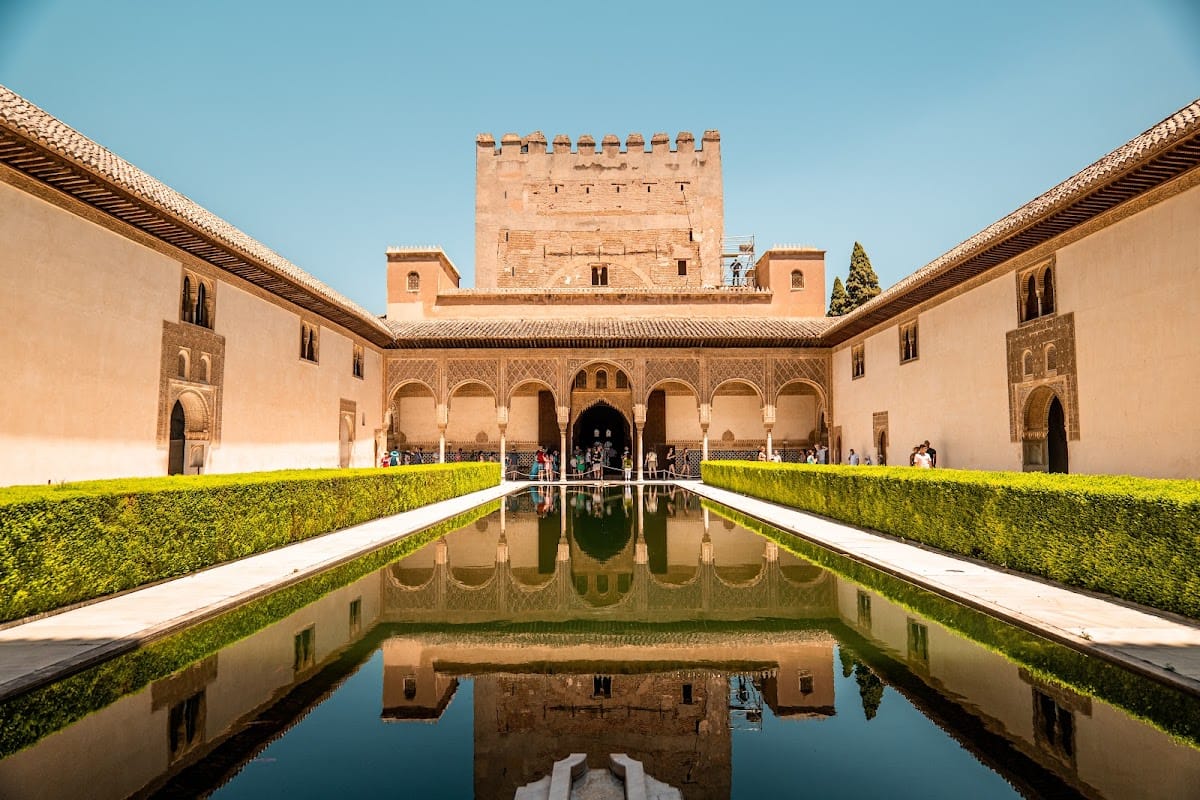
The Comares Palace was the official residence of the sultan and the seat of government. It centers on the Patio de los Arrayanes, a long courtyard with a reflective pool bordered by myrtle hedges. Attached to the palace are the well-preserved Comares Baths. The Salón de los Embajadores, or Hall of the Ambassadors, is the largest room in the Alhambra, notable for its 18.2-meter-high wooden dome made of over 8,000 interlinked pieces symbolizing the seven heavens, along with rich tile and stucco decoration.
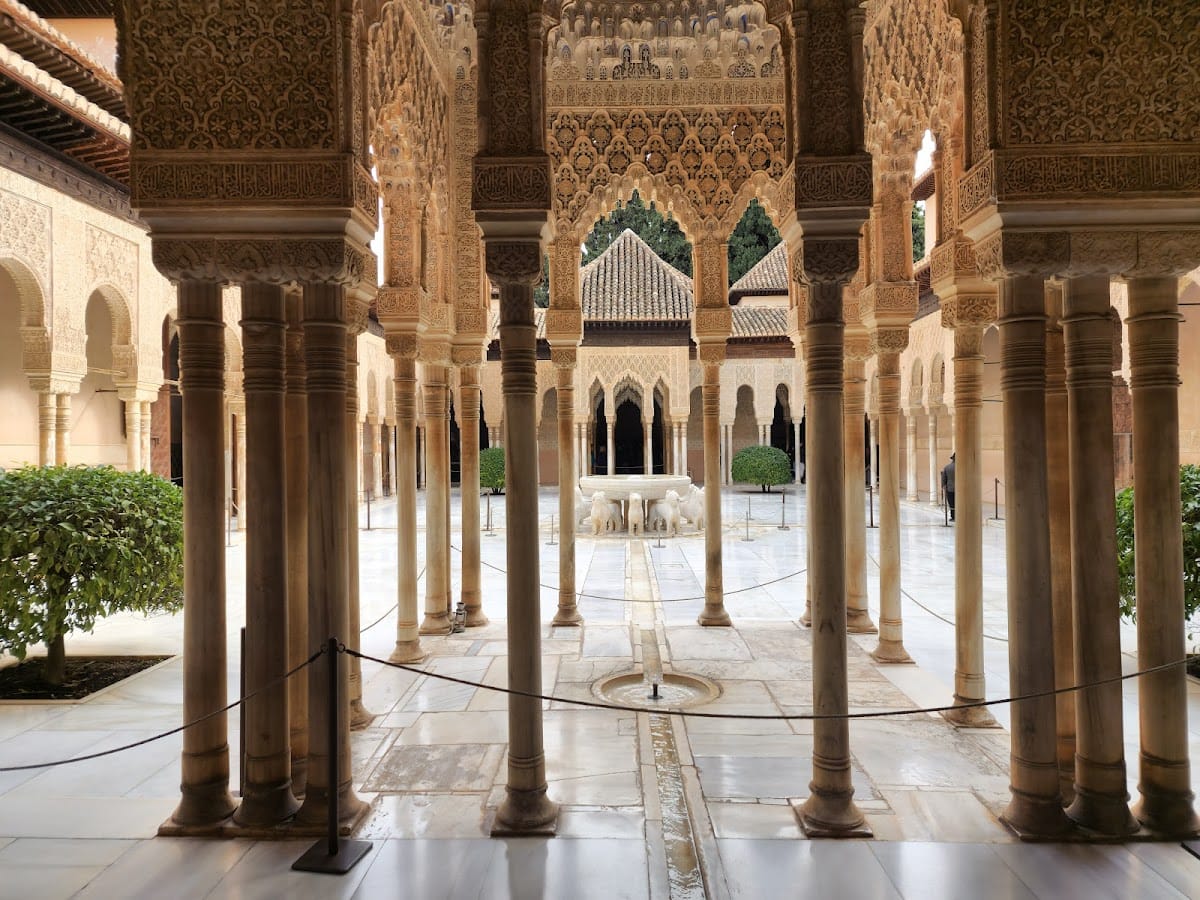
The Palace of the Lions, built under Muhammad V, represents the peak of Nasrid architecture. Its central courtyard measures approximately 28.7 by 15.6 meters and is surrounded by a portico with a distinctive pattern of columns. The courtyard features the famous Fountain of the Lions, a marble basin encircled by twelve lion sculptures. An inscribed poem by Ibn Zamrak praises the fountain and explains its hydraulic system. Four halls surround this courtyard, each with unique muqarnas (stalactite-like) vaults and decorative elements, including the Sala de Dos Hermanas, which has one of the most remarkable muqarnas domes in Islamic art.
The Mirador de Lindaraja is a small projecting room with double-arched windows on three sides overlooking gardens. It contains finely carved stucco, original mosaic tiles with Arabic inscriptions, and a wooden lattice ceiling with colored glass pieces.
The Partal Palace, the oldest surviving Nasrid palace built by Muhammad III, is located on the northern edge of the walls. It features a pavilion with a portico facing a large reflective pool and a richly decorated oratory with a mihrab, a niche indicating the direction of prayer.
Several towers along the northern wall, such as the Torre de los Picos, Torre de la Cautiva, and Torre de las Infantas, were converted into small palatial residences during the Nasrid period, blending defensive and residential functions.
The Palace of Charles V, a Renaissance building commissioned in 1527 by the Christian emperor Charles V, stands within the Alhambra complex. It is a massive square stone structure enclosing a circular courtyard. Its exterior displays rustication, pilasters, and allegorical reliefs symbolizing imperial power. Construction halted in 1637 and was only completed after restorations in the 20th century.
The Church of Santa María de la Alhambra, built between 1581 and 1618, occupies the site of the former Alhambra Mosque. The mosque, completed in 1305 under Muhammad III, had a hypostyle hall with three naves separated by arches on marble columns, a wooden roof, and a slender minaret. After the Christian conquest, the mosque was converted into a church and later demolished in 1576. The preserved hammam annex of the mosque remains accessible, showing a sequence of rooms typical of Islamic baths, with fragments of original decoration and marble flooring.
The Rawda, the Nasrid royal mausoleum built by Isma’il I in the early 14th century, no longer stands but its foundations and layout are visible. It consisted of a rectangular enclosure with a small horseshoe-arch gate, a square mausoleum chamber with a central lantern roof supported by four pillars, and adjoining rooms. It was decorated with carved stucco and tilework. Important Nasrid rulers were buried here before their remains were moved.
The Generalife, a Nasrid country estate and summer palace east of the Alhambra, includes several rectangular garden courtyards with decorated pavilions. It was originally connected to the Alhambra by a walled corridor.
The water supply system, known as the Acequia del Sultan, still exists largely intact. It channels water from the Darro River about 6.1 kilometers east of the Alhambra. The system includes branches supplying both the Generalife and the Alhambra, with an arched aqueduct delivering water to the Torre del Agua. This network distributes water through conduits and reservoirs, creating the interplay of light, sound, and water surfaces that characterize the palaces.
Original furnishings have not survived, but the palaces were once decorated with carpets, floor cushions, tapestries, and large Hispano-Moresque vases about 125 centimeters tall. These vases, decorated with Arabic inscriptions and cobalt blue, white, and gold motifs, are known as “Alhambra vases.” Ten examples survive, including the 14th-century Vase of the Gazelles.
A notable surviving object is a bronze lamp from 1305 that hung in the main mosque. It is decorated with Arabic inscriptions and vegetal motifs. The original is displayed in the National Archaeological Museum in Madrid, while a replica is kept in the Alhambra Museum.
Nearby sites