Aleksej Fort rotunda: A Forward Fortification of the Warsaw Citadel


Site at a Glance
- Rating
- 4.4
- Popularity
- Very Low
- Country
- Poland
- Primary era
- Modern
- External website
- Open
- Eras represented
- Modern
- Civilizations
- Russian
- Site type
- Military
- Remains
- Fort
On this page7 sections
History
Aleksej Fort rotunda, also known as Fort Traugutta, is a 19th-century forward fortification in Warsaw, Poland. Built between 1847 and 1849, it formed part of the defensive system surrounding the Warsaw Citadel. The fort was originally called Fort Alekseja and later Fort Berga.
Construction outside the Citadel
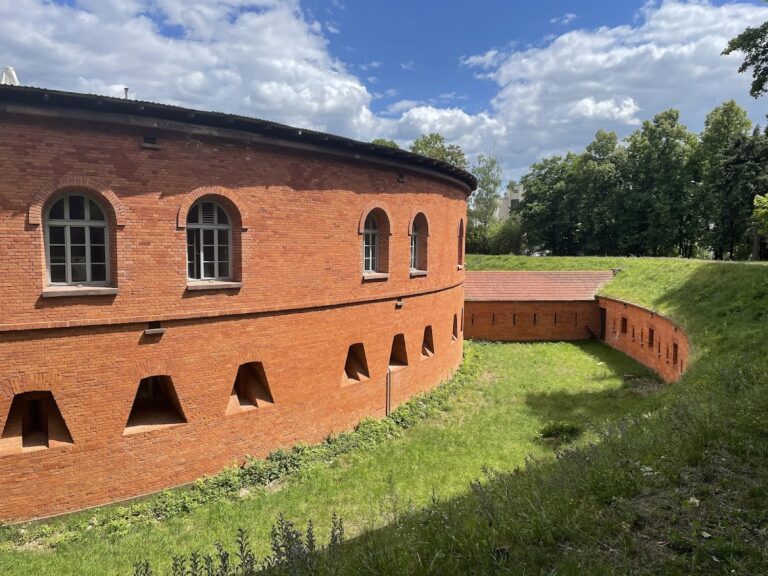
The Warsaw Citadel was built in the 1830s, but it served mainly as a prison and had limited capacity for the direct defense of Warsaw. Additional forward fortifications were therefore constructed outside the Citadel, including the work that became Aleksej Fort. Its initial form consisted of a large brick artillery battery, a fortified position for one or more guns.
Modernization and later history
Between 1864 and 1874, the fort was modernized with the addition of a brick-and-earth lunette, a detached fortification with two forward faces and an open rear side. The new work was surrounded by a dry moat, which was defended by caponiers, fortified structures projecting into the moat so defenders could fire along the ditch.
In September 1939, during the German invasion of Poland at the beginning of the Second World War, an anti-aircraft defense platoon was stationed at the fort. The site entered Poland’s register of historic monuments in 1965. It now lies within Janusz Kusociński Park, an area separated from Romuald Traugutt Park, and remains the only fortification around the Citadel to preserve parts of its earthwork layout.
Remains
Fortification layout
Central artillery battery
The central part of the fort contains a visible artillery tower, or battery, representing the fort’s principal gun position. The surviving structure forms part of the physical remains of the original brick artillery work.
Brick-and-earth lunette
The later lunette consisted of two forward faces and an open gorge, or rear side. A dry moat enclosed it, with caponiers positioned to defend the ditch. Parts of the fort’s earthwork arrangement have survived, while the surrounding street grid emphasizes the outline of the former fort.
Nearby sites