Church of the Visitation of the Blessed Virgin Mary: A Gothic Parish Church in Warsaw


Site at a Glance
- Rating
- 4.7
- Popularity
- Low
- Country
- Poland
- Primary era
- Medieval
- External website
- Open
- Eras represented
- Medieval, Early Modern, Modern
- Civilizations
- Polish–Lithuanian Commonwealth
- Site type
- Religious
- Remains
- Church
On this page14 sections
History
The Church of the Visitation of the Blessed Virgin Mary is a Roman Catholic parish church in Warsaw, Poland, founded in 1409 by Janusz I the Old, Duke of Masovia, and his wife, Danuta Anna of Lithuania. Built in the Gothic period, it was completed and consecrated in 1411 by Bishop Wojciech Jastrzębiec. The church stands on the Vistula escarpment in Warsaw’s New Town and, according to tradition, occupies the site of an ancient pagan place of worship.
Medieval foundation and expansion
A cemetery was established beside the new church, which soon served the fishermen and artisans of the surrounding community. The church also became known for sermons delivered in German. Its original form had one nave, a ceiling, and an arched presbytery. During the second half of the fifteenth century, it was expanded into a three-nave basilica, a church with a central nave flanked by side aisles, chiefly through the support of Bolesław IV, Duke of Warsaw and Zakroczym. A bell tower was added on the southern side in 1518.
Parish administration and early modern life
On 14 January 1562, Sigismund Augustus, King of Poland and Grand Duke of Lithuania, granted the chapter of St. John’s Church the right to administer the church, use its revenues, and appoint vicars. On 30 April 1608, Bishop Jędrzej Opaliński established a permanent parish priest, or praepositus, an office responsible for administering the church.
The church’s religious community expanded during the sixteenth and seventeenth centuries. In 1523, Stanisław de Strzelcze, a canon of Wrocław, Płock, and Poznań, established the mansyonaries, priests assigned to perform regular services and prayers connected with a foundation. A visitation in 1641 listed the parish priest, six mansyonaries, an organist, and eleven side altars in addition to the high altar. The parish priest, Mateusz Jagodowicz, had recently restored the church and installed a stone floor.
In 1641, services in the Chapel of Saint Benon were held in German for German Catholics living in Warsaw. Hungarians staying in the city also held services there in their own language. Nine houses belonging to the church, probably built of wood, accommodated the parish priest, mansyonaries, organist, and other servants. In 1640, the parish priest began legal proceedings against residents who refused to pay rent to the church and rejected his authority over them.
War, reconstruction, and modern history
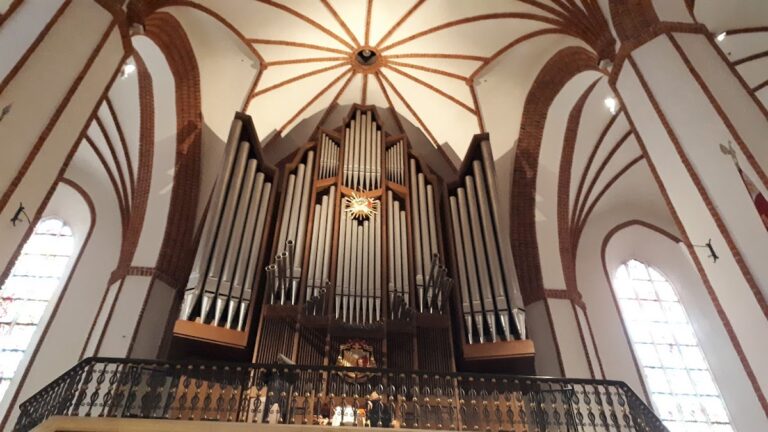
The church was burned during the Swedish war in 1656 and rebuilt by approximately 1690. It was altered repeatedly during the nineteenth and twentieth centuries. The central tower was remodeled and a new roof was installed in the nineteenth century, while the old organ was dismantled and modernized in 1829.
Between 1906 and 1915, Józef P. Dziekoński and Stefan Szyller directed a Gothic Revival reconstruction, a nineteenth-century movement that reinterpreted medieval Gothic architecture. The building was damaged during the defense of Warsaw in September 1939 and burned by German forces during the Warsaw Uprising in August 1944. The nave roof collapsed, and the upper part of the tower was destroyed.
Reconstruction continued from 1947 to 1966. During the first phase, from 1947 to 1952, the church’s earlier appearance was restored with the help of historical panoramas of Warsaw. Beata Trylińska designed the postwar reconstruction. During the period of martial law, the church hosted the Pastoral Care of Creative Communities, where prominent writers and actors prepared patriotic programs that attracted large crowds.
In 1965, the church, bell tower, rectory, and organist’s house were entered in Warsaw’s register of historic monuments. The church became a Historic Monument of Poland in 1994 and forms part of Warsaw’s protected historic center. It belongs to the Roman Catholic Archdiocese of Warsaw and remains a parish church dedicated to the Visitation, the Christian episode in which the Virgin Mary visits her relative Elizabeth.
Remains
Gothic church and bell tower
Church structure
The surviving church is a squat brick Gothic building organized as a three-nave basilica. Its stepped gable, slender blind niches, pointed-arch portal, and low, broad aisles are supported by buttresses. The building preserves the principal arrangement created when the original single-nave church was transformed during the late fifteenth century.
Southern bell tower
The southern bell tower dates from 1518 and has stepped gables. Its form is often compared to a bunch of grapes. Tall stepped buttresses rise beside brick walls decorated with geometric friezes, panels, and narrow openings. The tower became a recognizable element in Warsaw’s skyline and appears in historic city panoramas, which helped guide its reconstruction after the Second World War.
Chapels and interior
Baroque chapels
Two white, square Baroque chapels were added at the rear of the Gothic church during the seventeenth and eighteenth centuries. Their green, cupola-like roofs have small lanterns at the back, creating a marked contrast with the brick medieval structure.
Interior furnishings
The dark interior contains a Neo-Gothic high altar with a painting of the Visitation, depicting the meeting of the Virgin Mary and Saint Elizabeth. A metal sculpture of Jesus stands in the Chapel of Divine Mercy, which closes the right-hand nave.
Church grounds and riverside setting
Former cemetery square
A stone wall encloses the church grounds. The square, formerly the church cemetery, is planted with tall chestnut trees and contains a wooden cross inscribed “Save your soul” and a statue of the Virgin Mary dated 1870.
Monument and park
A small monument to Walerian Łukasiński stands within the grounds. Łukasiński was a Polish military officer and political activist imprisoned for many years by the Russian authorities. Behind the church, a small park has steps descending toward the Vistula and the Kościuszko river embankment.